Fidelity Assesses the Limits of AI's Influence on the Crypto Market

cryptonews.ruDipublikasikan tanggal 2026-08-20Terakhir diperbarui pada 2026-08-20

Abstrak

Fidelity Analysts Assess the Limits of AI's Impact on the Crypto Market Fidelity Digital Assets senior analyst Max Waddington notes that AI agents could become a new source of activity in the digital asset sector, from payments to trading and lending. However, the benefits will likely be distributed unevenly. Fidelity's study of over 100,000 GitHub developers shows AI coding assistants increased commit counts by up to 180% and releases by 30%. These tools enable smaller teams to build blockchain applications faster, though critical financial software still requires manual code review. In the crypto industry itself, developer counts fell in 2026 amid lower prices, but commits per developer continued to rise. Waddington cautions that more applications don't guarantee success; user adoption, liquidity, compliance, and trust remain key. Autonomous AI agents, capable of payments, trading, liquidity provision, and lending, are emerging as another driver. Blockchains are suitable due to 24/7 operation and programmable settlements. According to Keyrock, AI agents had already conducted over 176 million transactions worth more than $73 million by May, predominantly using USDC. Infrastructure is developing, with Coinbase launching tools like the x402 protocol and 'Coinbase for Agents'. However, Fidelity expects agents to use multiple platforms (both public blockchains and traditional finance systems) based on cost and convenience. A surge in AI-driven transactions may not proportion...

AI agents could become a new source of activity for the digital asset sector—from payments to trading and lending. The benefits from this will be distributed unevenly among market participants, believes Max Waddington, Senior Analyst at Fidelity Digital Assets.

Developers Are Using AI More Frequently

Fidelity studied data from over 100,000 GitHub developers. The use of digital programming assistants increased the number of commits by up to 180% and the number of releases by 30%.
Source: Fidelity.

Waddington noted that such tools will allow small teams to build and launch blockchain applications faster. However, in financial and other critical software, code still requires manual review.

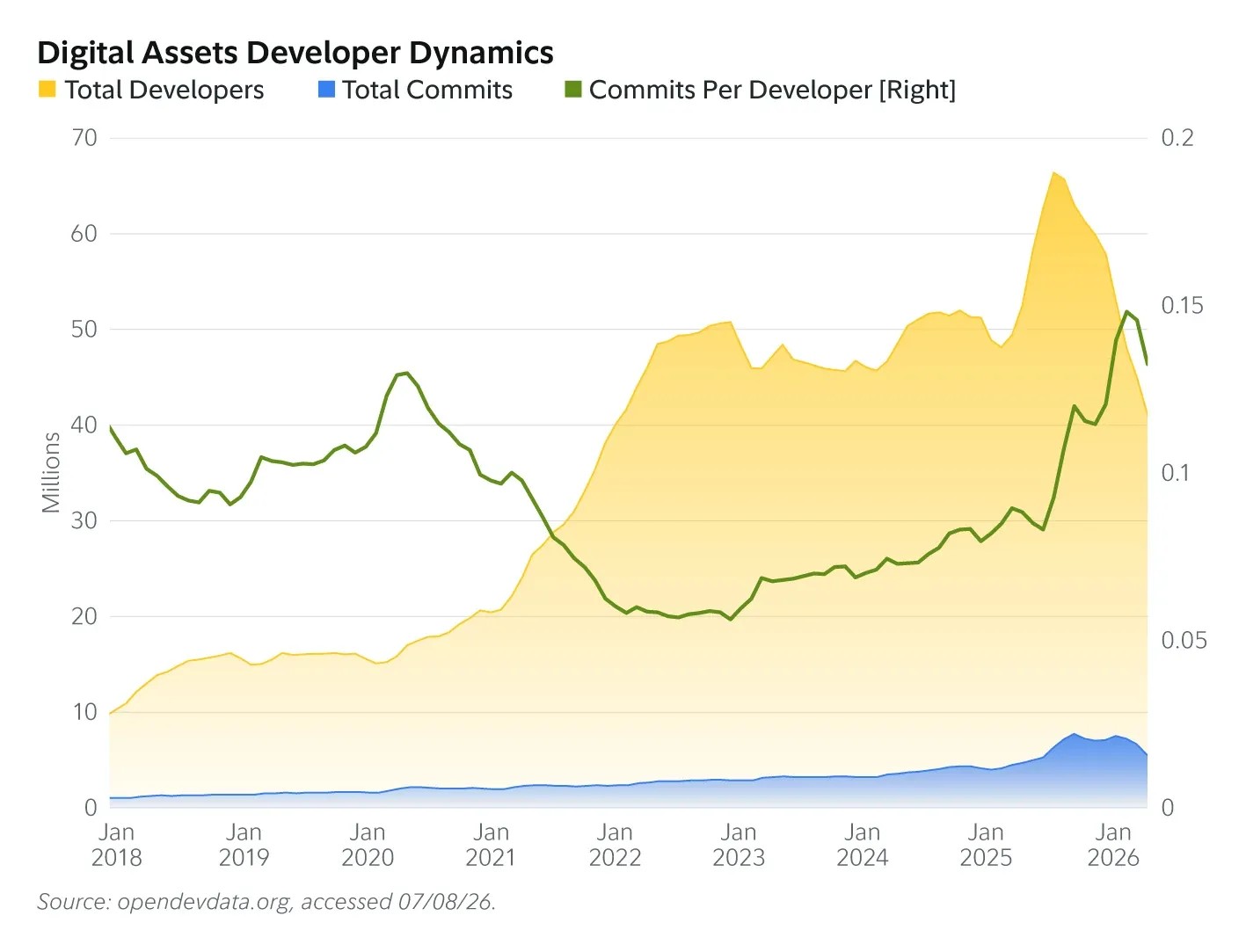
A similar trend was observed within the crypto industry itself. In 2026, against the backdrop of declining digital asset prices, both the number of developers and the volume of commits decreased, with the latter indicator falling more slowly. As a result, the average number of changes per developer continued to grow.

At the same time, an increase in the number of applications alone does not guarantee their success. Projects still need users, liquidity, regulatory compliance, and trust. According to Waddington, as development becomes cheaper, these factors will come to the forefront.

AI Agents Will Go On-Chain

Autonomous AI agents could become an additional driver of activity in the sector. They are capable of independently making payments, trading assets, providing liquidity, as well as issuing and taking loans.

Blockchains are suitable for such operations due to 24/7 operation, programmable settlements, and the ability to conduct microtransactions without human involvement.

This market is already taking shape. According to Keyrock, by May, AI agents had conducted over 176 million transactions worth more than $73 million. About 98.6% of the operations involved the USDC stablecoin.

Infrastructure for such scenarios is also developing. One of the most active players here is the exchange Coinbase, which previously launched the x402 protocol for automatic internet payments and later introduced Coinbase for Agents—a set of tools for trading and settlements using AI.

Nevertheless, Fidelity does not expect all agent operations to migrate to public blockchains. Banks, fintech companies, and traditional players are developing their own solutions, possessing an established customer base, infrastructure, and access to credit products.

In the view of analysts, AI agents will most likely work with multiple platforms simultaneously, choosing between them based on cost and convenience.

What are AI agent payments (agentic payments)?

Transaction Growth Does Not Guarantee Revenue Growth

Even if AI attracts millions of new operations to blockchains, this will not necessarily lead to a proportional increase in revenue for the networks themselves.

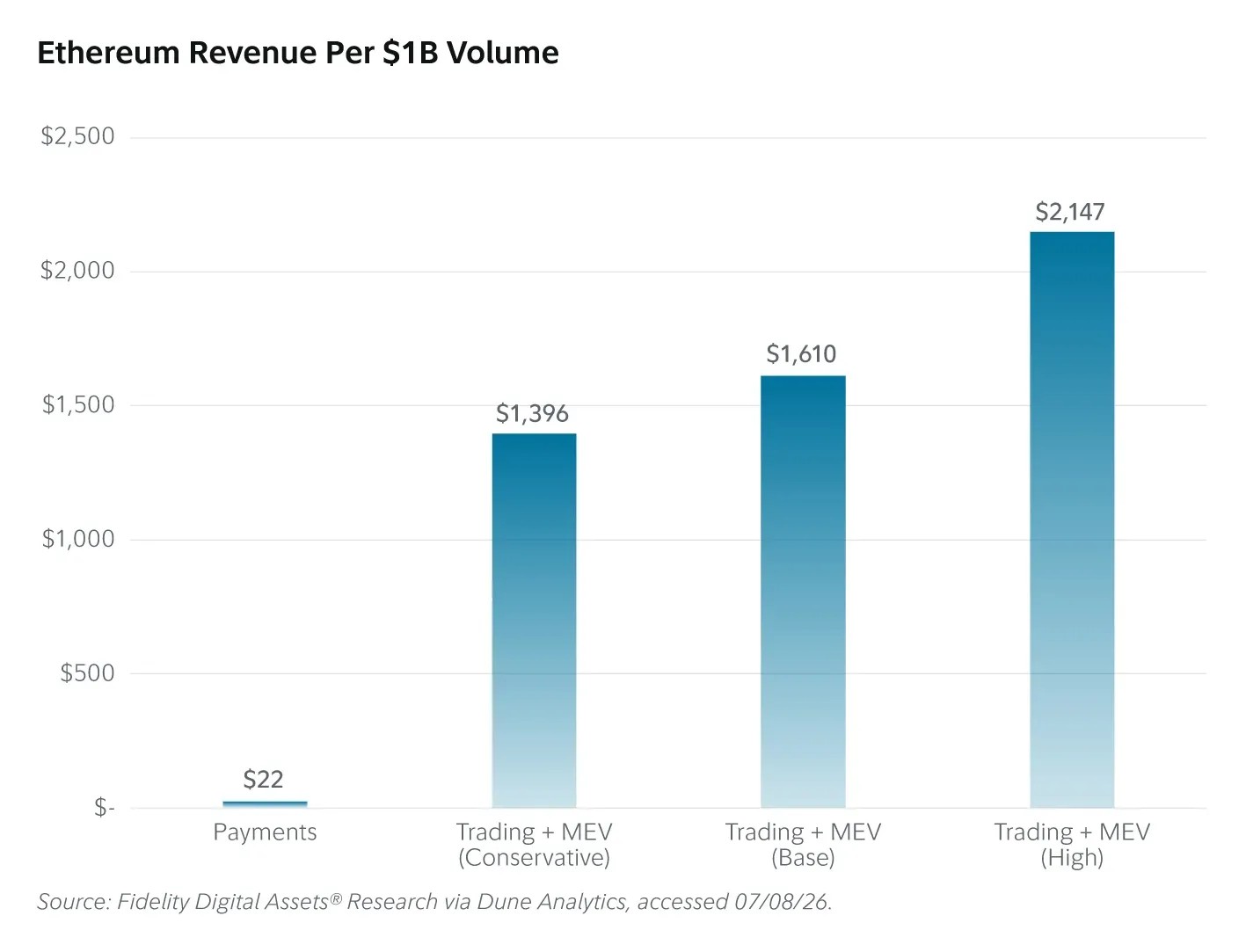
As an example, experts cited payments: their number can grow rapidly, but the fee per transaction remains low. Such transactions can also be batched, conducted off the main network, or moved to cheaper L2 solutions.

Operations with capital generate much more significant revenue. According to Fidelity's calculations, over the last 180 days, trading brought the base layer of Ethereum 49 times more revenue per dollar of volume than payments. Additional revenue is also created through MEV.
Source: Fidelity.

This is why analysts see greater potential in AI agents that will trade, lend, borrow, and provide liquidity. In the case of mass adoption of automatic payments, the main beneficiaries may be stablecoin issuers and infrastructure providers, rather than the native tokens of blockchains.

Recall that in March, specialists at Bernstein named digital assistants as the future of stablecoins. Later, Franklin Templeton noted that AI agents could become a driver of crypto payments.

end-content

Pertanyaan Terkait

QAccording to the Fidelity analysis mentioned in the article, what are the two main areas of crypto market activity that AI agents could significantly impact?

AAccording to the Fidelity analysis, AI agents could significantly impact two main areas: 1) Development of blockchain applications by increasing developer productivity, and 2) On-chain activity through autonomous operations like payments, trading, lending, and providing liquidity.

QWhat key finding about developer productivity using AI assistants did Fidelity's study of GitHub data reveal?

AThe study of over 100,000 GitHub developers revealed that the use of AI coding assistants increased the number of code commits by up to 180% and boosted the number of software releases by 30%.

QWhy does the article suggest that a surge in AI-driven transactions might not proportionally increase blockchain networks' revenue?

AThe article suggests this because many AI-driven activities, like payments, generate low fees per transaction. Furthermore, these transactions can be batched, processed off-chain, or moved to cheaper Layer-2 solutions, limiting revenue for the base layer. Revenue from capital-based activities like trading is much more significant.

QWhat is the primary type of cryptocurrency used by AI agents for their on-chain transactions, according to data from Keyrock cited in the article?

AAccording to data from Keyrock cited in the article, approximately 98.6% of transactions conducted by AI agents used the stablecoin USDC.

QWhat does the article identify as a major challenge for new blockchain projects, which will become even more critical as AI lowers development costs?

AThe article identifies that attracting users, ensuring liquidity, complying with regulatory requirements, and building trust are the major challenges for new projects. As AI makes development cheaper, these factors will become the primary focus for success, rather than just the ability to create an application.

Bacaan Terkait

Dukungan Likuiditas AS Tiba, Inilah Keuntungan Intinya

Tanggal 19 Agustus, Departemen Keuangan AS mengumumkan akan meningkatkan batas atas pembelian kembali likuiditas untuk obligasi jangka panjang (10-30 tahun) dari USD 2 miliar menjadi minimal USD 4 miliar per operasi. Penyesuaian ini berlaku mulai 9 September hingga 4 November. Pasar bereaksi positif, dengan imbal hasil obligasi 10-tahun dan 30-tahun turun. Hal ini memberi kelegaan bagi aset berisiko seperti saham teknologi, obligasi panjang, emas, dan aset kripto karena tekanan pada tingkat diskon berkurang. Penting untuk dicatat, operasi ini **bukan quantitative easing (QE)** ala Fed. Departemen Keuangan hanya membeli obligasi lama yang kurang likuid untuk memperbaiki fungsi pasar, bukan menciptakan uang baru atau mengurangi kebutuhan pendanaan pemerintah. Pasar merespons karena tindakan ini menunjukkan kesediaan pemerintah untuk meredakan tekanan likuiditas di ujung panjang kurva imbal hasil, yang memicu pembelian kembali posisi jual. Namun, dampak jangka panjangnya terbatas. Tiga faktor membatasi dampaknya: **1) Skala** (peningkatan USD ~14 miliar relatif kecil dibandingkan kebutuhan fiskal), **2) Sumber dana** (pembelian mungkin dibiayai dengan penerbitan utang jangka pendek baru), dan **3) Konteks makro** (tekanan inflasi dan kebijakan Fed tetap dominan). Kesimpulannya, langkah ini adalah **bantalan penyangga** yang memberi dukungan marginal bagi aset jangka panjang dan dapat memicu pemulihan valuasi jangka pendek. Namun, ketebalan dan keberlanjutan rally ini akan diuji oleh **pengumuman pembiayaan kembali triwulanan pada 4 November**, yang akan mengungkap struktur penerbitan utang dan komitmen pembelian kembali yang sebenarnya. Ini bukan awal dari narasi pelonggaran yang berkelanjutan.

marsbit21m yang lalu

Dukungan Likuiditas AS Tiba, Inilah Keuntungan Intinya

marsbit21m yang lalu

Peraturan Baru SEC Dirilis, Banteng Datang

SEC telah menerbitkan rancangan aturan baru yang mengizinkan proyek aset kripto awal mengumpulkan dana hingga $5 juta dalam empat tahun tanpa registrasi penuh sebagai sekuritas, dengan proyek lebih besar diperbolehkan mengumpulkan $20 juta atau $75 juta per 12 bulan. Aturan ini memperkenalkan mekanisme "Safe Harbor Kontrak Investasi," di mana penerbit dapat mengajukan Formulir TR untuk menyatakan diri bahwa mereka telah menyelesaikan atau menghentikan "upaya manajerial kunci" yang dijanjikan, meskipun SEC tetap berwenang menantang pernyataan ini di kemudian hari. Perubahan utama adalah pergeseran dari pendekatan regulasi berbasis penegakan hukum sebelumnya menjadi kerangka yang lebih terstruktur: penerbit harus membuktikan sendiri kapan token mereka "lulus" dari status kontrak investasi ke aset independen, berdasarkan janji yang dibuat selama penawaran. Hal ini mendorong tim proyek untuk lebih berhati-hati dalam membuat komitmen publik, karena janji-janji tersebut akan menjadi dasar penilaian kelulusan. Aturan ini juga mencakup pembatasan geografis, mengharuskan sebagian besar kegiatan penerbitan dan operasional berada di dalam AS, yang bertujuan mengembalikan aktivitas penggalangan dana aset kripto ke yurisdiksi AS. Sementara itu, pembagian token melalui airdrop dan hadiah jaringan juga dapat diperhitungkan dalam batas pengumpulan dana. Dengan Kongres AS yang lambat dalam mengesahkan undang-undang kripto seperti RUU CLARITY, SEC mengambil inisiatif untuk menetapkan aturan administratif ini. Jika diadopsi, aturan tersebut dapat memberikan kejelasan prosedural bagi proyek kripto mengenai transisi dari sekuritas ke aset mandiri, meskipun detail teknis masih memerlukan umpan balik publik.

marsbit30m yang lalu

Peraturan Baru SEC Dirilis, Banteng Datang

marsbit30m yang lalu

Trading

Spot
活动图片