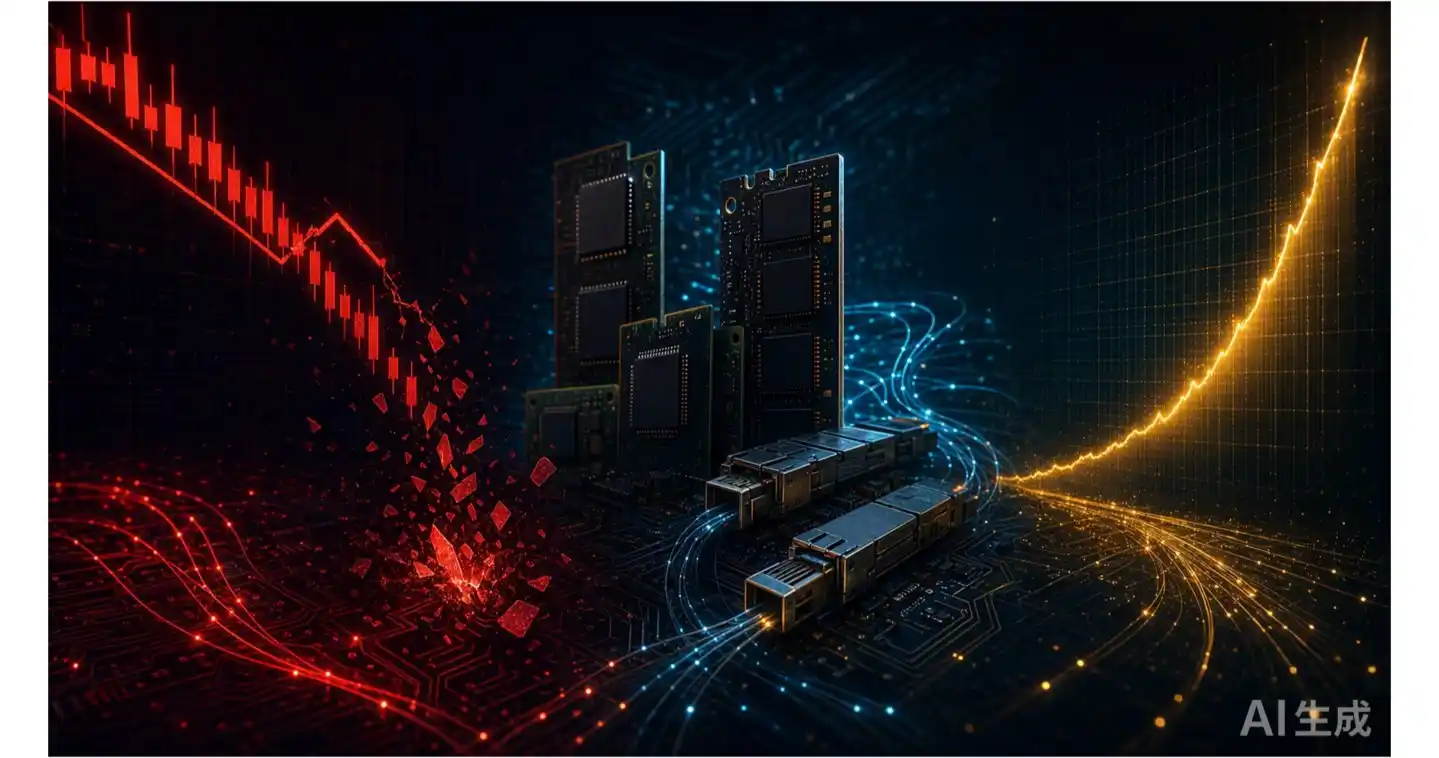
Last night (August 18th), U.S. stock market saw a rare broad sell-off in two of the sharpest spears of the AI hardware sector—optical communication and memory chips. The Philadelphia Semiconductor Index closed down 4.98%, with all 30 component stocks falling, marking its largest single-day drop since July 29th; the three major U.S. stock indices closed lower for the third consecutive session.
The market narrative is shifting focus from the "unlimited imagination of AI capital expenditures" to "how much interest must be paid on this money."
Looking at the broader picture first. The Dow Jones fell 0.22%, the S&P 500 fell 0.69%, and the Nasdaq fell 1.33%. Superficially, the declines don't seem dramatic, but zooming in on the internal dynamics of the AI hardware sector reveals a structural stampede.
The memory sector was hit hard across the board. Kioxia ADR plunged over 13%, SanDisk fell 9.01%, Seagate fell 9.16%, Western Digital fell 7.43%, Micron fell 7.02%, and SK Hynix ADR dropped over 9%. The optical communication and AI infrastructure sectors fell even deeper. Fabrinet plummeted 19.38%, Coherent fell 12.75%, CoreWeave fell 12.10%, Lumentum fell 9.87%, Marvell fell over 6%, and Corning fell over 4%.
Large-cap tech stocks couldn't escape unscathed either. Meta fell 4.45%, NVIDIA fell 2.34%; Chinese AI assets also faced pressure, with Baidu closing down 12.73% following its earnings release, and 21Vianet falling nearly 17%.
A noteworthy detail is that the steepest declines occurred precisely among the stocks that had risen the most aggressively and carried the purest AI narratives. This isn't a broad-based decline but rather a repricing within the AI narrative. The market is beginning to re-sort assets based on different risks, with the longest-duration, most crowded positions being the first to suffer.
Triple Pressures and Structural Factors
The 30-year U.S. Treasury yield touched 5.337% intraday, hitting a new high since June 2007, its highest level in 19 years. The 10-year yield also climbed to 4.75%, its highest since January 2025. This is a global rise in long-term rates; Japan's 10-year government bond yield rose to a 30-year high, Germany's 30-year hit its highest since 2011, and France's 30-year reached its highest level since 2008.
One analyst summarized it succinctly: "The required return threshold for investments is rising again. But this time, it's not because the market is revising short-term rate expectations higher, but rather due to the combined effects of oil prices, government bond supply, and the long-end term premium."
For growth stocks, this is tantamount to a simultaneous deterioration of both the numerator and denominator in the valuation formula. The essence of pricing growth stocks is discounting future cash flows; every notch higher in the discount rate inflicts greater damage on assets with profit realization further in the future. AI hardware stocks are precisely the "longest-duration" sector in the U.S. stock market, with profits priced for realization in three to five years, making them far more sensitive to interest rates than other industries. A warning from Citadel Securities is representative: the Fed's reluctance to tighten monetary policy while inflation is above target itself raises the risk of higher long-term bond yields.
The rise in long-term bond yields this round is not an isolated market event. According to Goldman Sachs data, AI-related bond supply so far this year has reached $489 billion, surpassing the $322 billion for all of 2025; additionally, over $1 trillion in annual AI capital expenditure is pouring into the bond market. The financing needs of the AI industry are now competing with traditional sovereign borrowers for funds.
A typical case study illustrates the point. Blackstone's QTS issued $3.9 billion in 5-year bonds for Microsoft data centers, with subscription demand as high as $23 billion and an issuance yield of 7.228%. This information has two readings. First, market enthusiasm for subscribing to AI assets remains strong; second, a financing cost of 7.2% means data center projects must generate returns higher than that. The bond market is doing the math for AI with real money, and the calculated interest threshold is raising the required return for every capital expenditure.
The Trump administration suspended engagement with Iran, with Trump himself stating there will be "no talks with Iran now or in the future"; the deadlock over control of the Strait of Hormuz remains unresolved; the Speaker of the Iranian parliament stated the strait "will remain closed." Brent crude rose above $91/barrel, WTI settled at $84.94/barrel, approaching the $85 mark, and the S&P 500 Energy Index rose 1.8%, hitting a new high since March.
The transmission path of rising oil prices is straightforward: oil price → inflation expectations → long-term rates. But for growth stocks, this is the worst combination, with both profit expectations and valuations under pressure. Analysts generally judge that Brent crude will continue to trade within a relatively wide range of $70 to $100, and geopolitical variables are unlikely to disappear in the short term.
Three structural reasons.
First, the biggest gains, the most crowded positions. HBM memory and 800G/1.6T optical modules are the purest narratives and most elastic plays in this round of the AI rally, having accumulated substantial momentum and leveraged funds. The unwinding of crowded trades often exhibits two characteristics: first, declines far exceeding the index, and second, longer recovery times, as both profitable positions and leveraged positions rush for the exit simultaneously, often selling off at any cost.
Second, most sensitive to the capital expenditure narrative. Demand for memory and optical communication is directly tied to the "acceleration" rather than the "absolute value" of cloud providers' capital expenditures. Any questioning of the sustainability of AI investment will first impact this segment. They are assets priced for "imagination space," not for "current profitability."
Third, amplified industry chain elasticity. The profit and valuation volatility of optical module and memory companies are inherently greater than those of platform giants. Once rising discount rates trigger valuation compression, the magnitude of a double whammy is far greater than for giants with stable profits.
However, there is an easily overlooked detail: this round of selling was not accompanied by a disproval of AI fundamentals. NVIDIA fell only 2.34%, not a crash, indicating the market is cutting valuations and crowding, not the logic itself. The real divergence lies in whether this is a sharp correction or a trend inflection point.
Three Indicators Determine Direction
The Asian session has already given the first response. South Korea's KOSPI opened down 5%, Samsung Electronics fell 6.7%, SK Hynix fell 7.4%; Japan's Nikkei 225 opened nearly 1% lower. China's A-share computing power, optical communication, and memory sectors also faced pressure. Given the extremely strong correlation between A-share optical module leaders and U.S. optical communication stocks, short-term sentiment contagion is inevitable.
For the subsequent trend, watch three indicators.
First, whether the 30-year U.S. Treasury yield can stop around 5.3%. If it continues higher and holds, the valuation compression for growth stocks is not over; if it retreats from this level, a window for an oversold rebound will open. The judgment of Peter Boockvar, Chief Investment Officer of One Point BFG Wealth Partners, represents the bearish view: "If rates continue to climb on this trend, it's not a matter of 'if' rates will have an impact on stocks, but 'when'."
Second, oil prices and the geopolitical situation. Whether Brent can stay within the $70-$100 range and how the Strait of Hormuz deadlock evolves directly determine whether the inflation narrative strengthens or weakens.
Third, pricing signals from AI bond financing. Subscription multiples and issuance yields for debt like QTS are the most direct votes by the market on the risk premium for AI assets; simultaneously, pay attention to the Fed's stance on oil price-driven inflation, which largely determines the direction of long-term rates.
For A-shares, short-term correlation is inevitable, but the medium-term logic needs separate consideration. The medium-term drivers for A-share optical modules and memory are domestic cloud provider capital expenditures and domestic computing power demand, which are not perfectly synchronized with the correlation to overseas interest rates. After a sharp decline, one must be wary of both "mis-selling" and "high-level catch-up declines." The key to distinguishing between them remains the actual realization of capital expenditures. For holders, more important than predicting the index is reviewing the profit realization schedule of their holdings. For stocks whose earnings have already materialized on the balance sheet and whose valuations remain reasonable, the pullback is more of an emotional disturbance; for high-priced stocks supported purely by narrative, they need to be measured again with the ruler of interest rates.
Last night was not the end of the AI narrative, but a shift in pricing logic, from "story" to "interest." When data center financing costs stand above 7% and the 30-year U.S. Treasury yield hits a 19-year high, every penny of capital expenditure must answer the question of return rate. The market's calculation for AI has only just begun.
(This article was first published on Titanium Media APP, Author | Silicon Valley Tech_news, Editor | Qin Conghui)