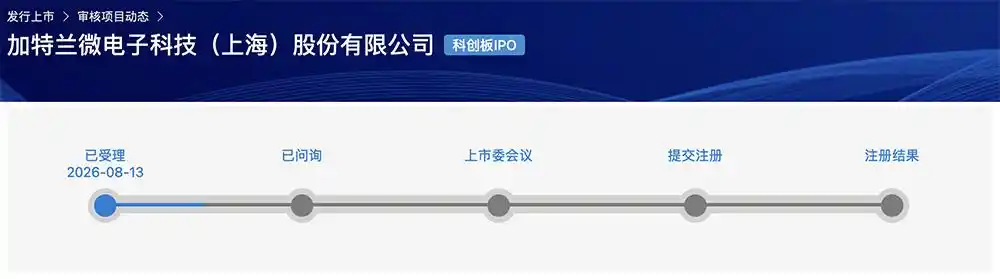
Core Things (Xindongxi) reported on August 14th. On August 13th, the IPO application of Shanghai-based automotive-grade millimeter-wave radar chip company Calterah was accepted on the Science and Technology Innovation Board (STAR Market).
Calterah was founded in February 2014 and has been awarded honors such as a National-level Specialized, Refined, Unique, and Innovative "Little Giant" Enterprise. Its products include millimeter-wave radar chips and Ultra-Wideband (UWB) chips, widely used in automotive-grade fields such as advanced driver assistance systems (ADAS), autonomous driving, vehicle interior and exterior sensing, digital keys, as well as industrial and consumer fields like robotics, smart home, and smart city applications.
The prospectus shows that the company mass-produced the world's first automotive-grade CMOS process 77GHz millimeter-wave radar RF front-end single-chip in 2017, breaking the long-standing industry technology pattern based on GaAs and SiGe semiconductor processes and multi-chip solutions.
Currently, Calterah has become the fourth largest global supplier and the second largest domestic market supplier of automotive-grade millimeter-wave radar chips. It is the domestic leader and ranks among the top two globally for the CMOS process route in achieving mass production of automotive-grade millimeter-wave radar SoC chips, holding a leading position in the domestic market for automotive-grade millimeter-wave radar chips and automotive-grade Ultra-Wideband chips.
The National Integrated Circuit Industry Investment Fund Phase II (Big Fund II) is one of its shareholders, holding 0.6266%.
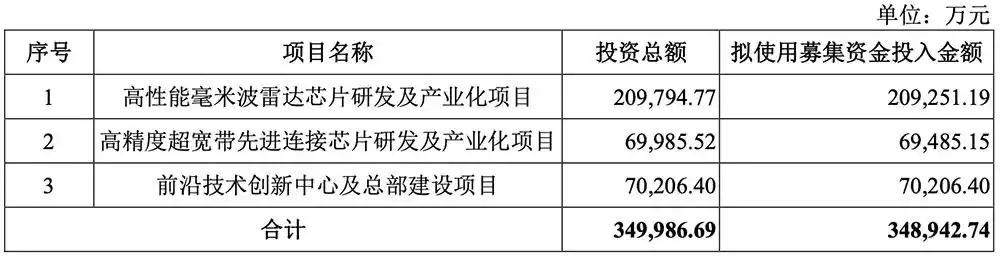
In this IPO, Calterah plans to raise 3.489 billion yuan for the following projects: High-Performance Millimeter-Wave Radar Chip R&D and Industrialization Project, High-Precision Ultra-Wideband Advanced Connectivity Chip R&D and Industrialization Project, and the Frontier Technology Innovation Center and Headquarters Construction Project.
01.
Revenue Exceeded 600 Million Yuan Last Year,
Yet to Achieve Profitability
From 2023, 2024, 2025, and Q1 2026, Calterah's revenue was 206 million yuan, 303 million yuan, 632 million yuan, and 154 million yuan, respectively. Net profit was -323 million yuan, -334 million yuan, -193 million yuan, and -60 million yuan, respectively. R&D expenses were 304 million yuan, 365 million yuan, 370 million yuan, and 98 million yuan, respectively.
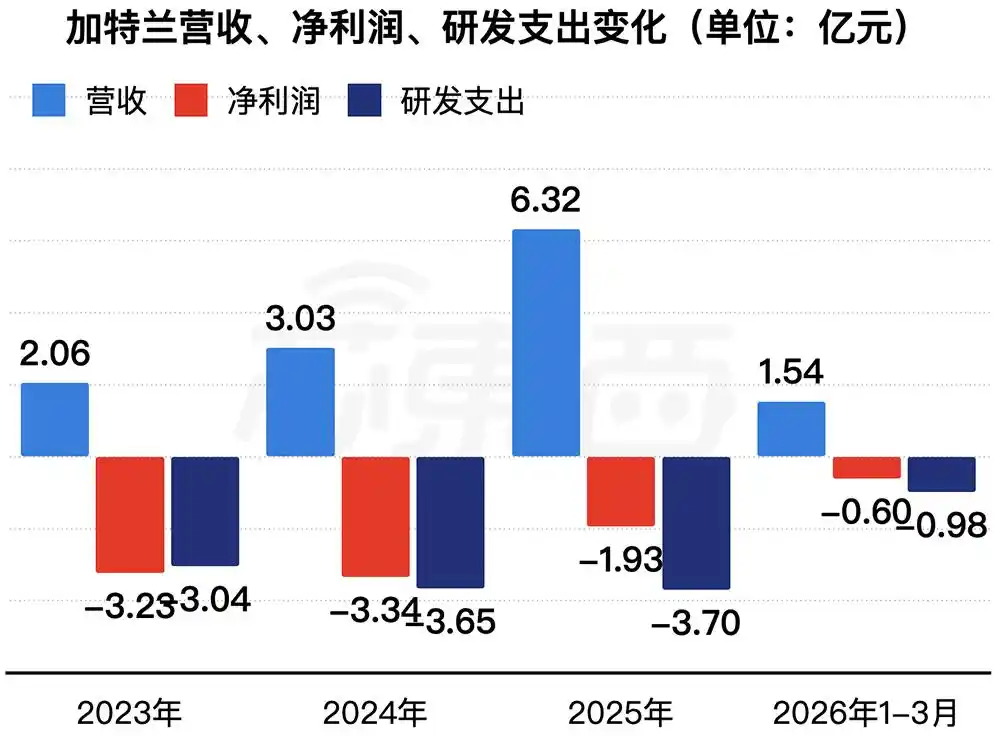
▲ Calterah's Revenue, Net Profit, and R&D Expenditure from 2023~Q1 2026 (Chart by Core Things)
As of the end of Q1 2026, the company's accumulated deficit stood at 172 million yuan.
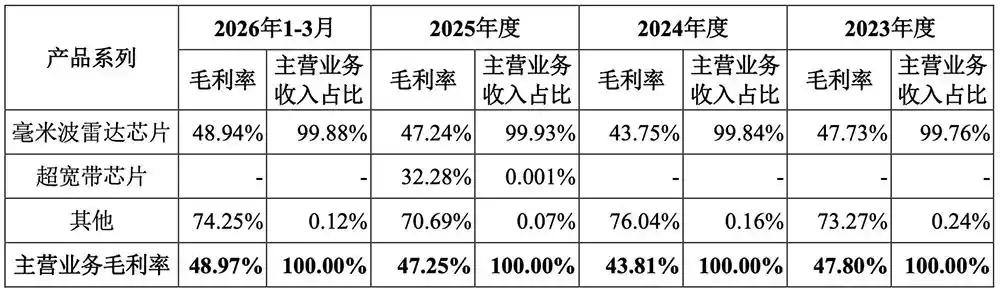
During the reporting period, its gross profit margin on main operations remained at a relatively high level and showed a stable and slightly increasing trend overall, at 47.80%, 43.81%, 47.25%, and 48.97%, respectively. The composition of gross profit margin by main product category is as follows:
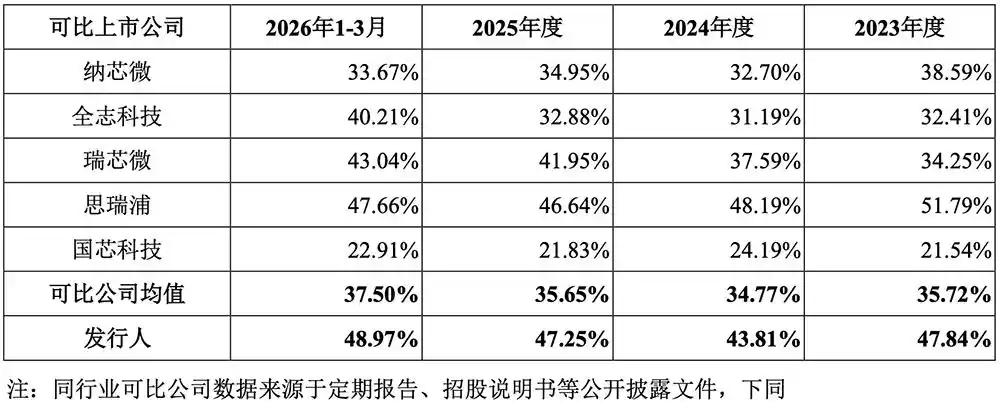
During this period, Calterah's gross profit margin was significantly higher than the average comprehensive gross profit margin of comparable listed companies in the same industry.
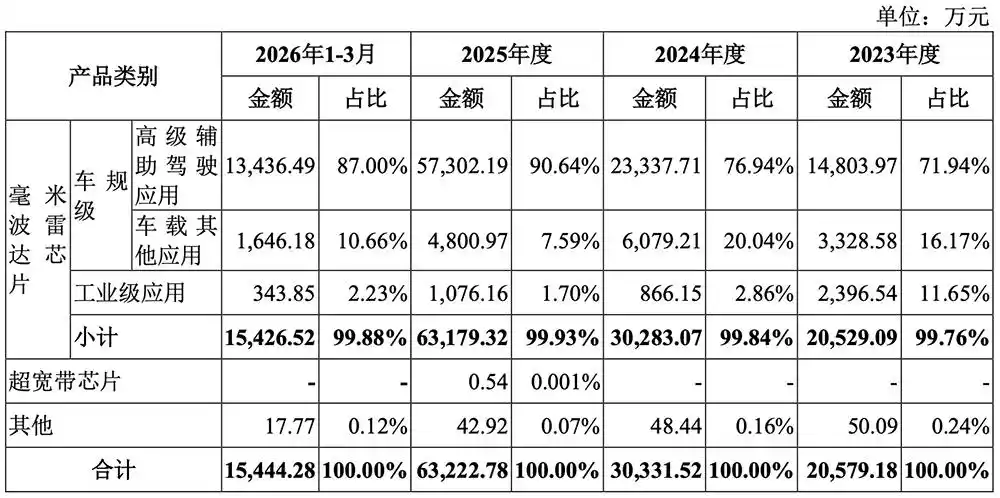
From 2025 to Q1 2026, over 97% of its revenue came from automotive-grade millimeter-wave radar chip applications.
The aforementioned automotive-grade chip products mainly include Alps platform's Alps and Alps-Pro series and Kunlun platform's Kunlun series products. Industrial-grade chip products mainly include Alps platform's Rhine series and Kunlun platform's Lancang series products. Ultra-Wideband chip products are Dubhe platform's Dubhe series products. Other sales revenue primarily comes from PCB development boards used for testing or in conjunction with its chips.
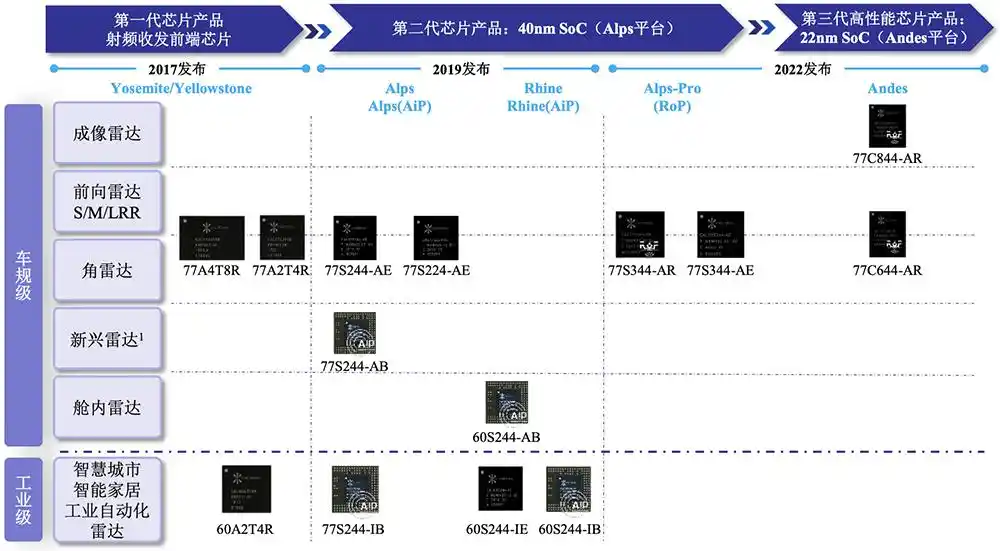
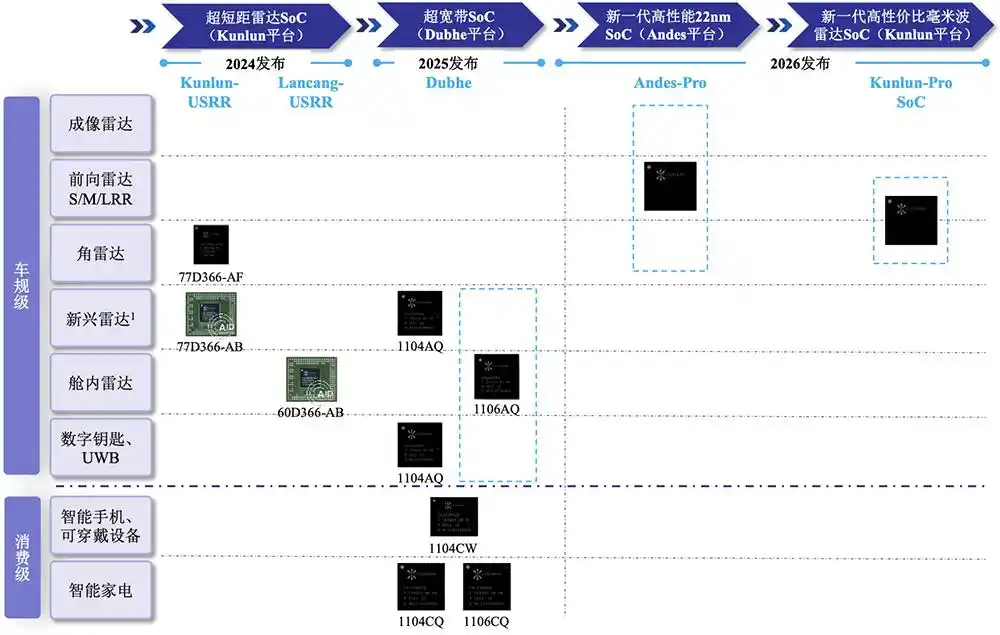
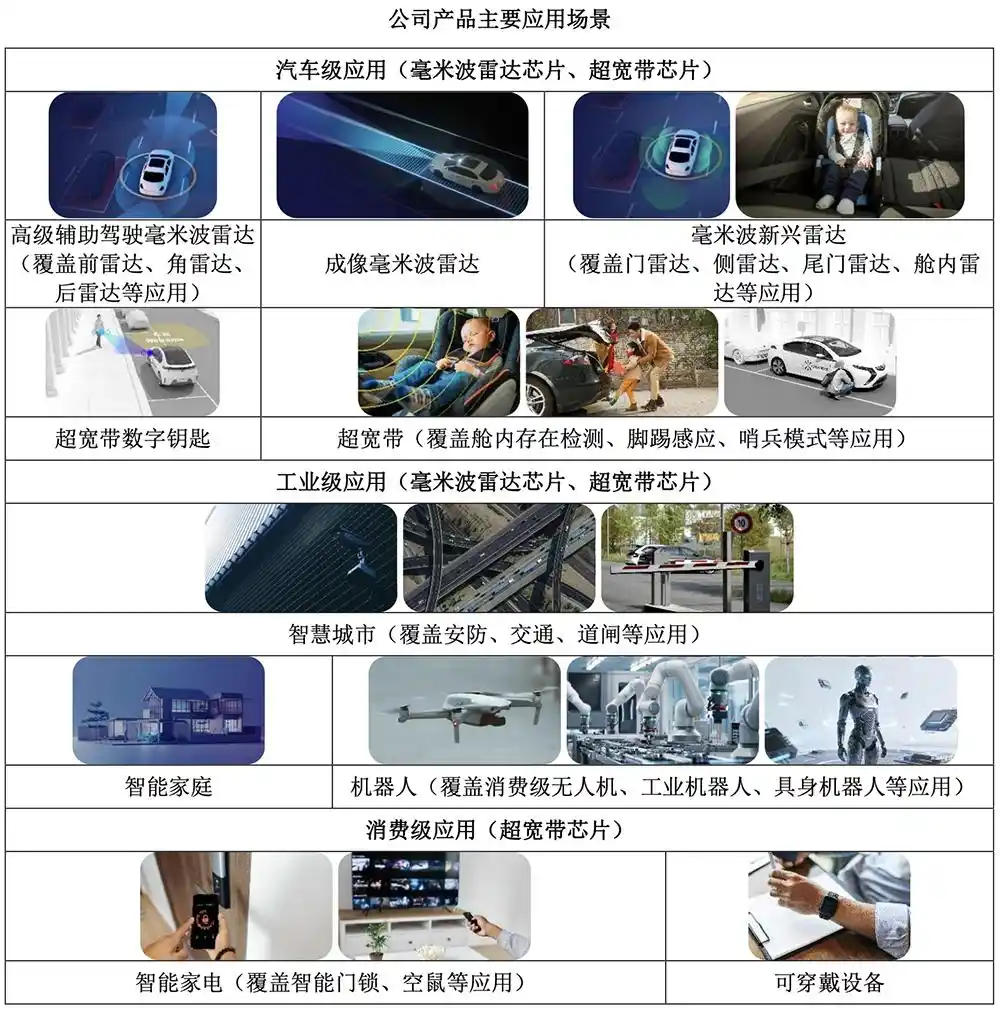
Its existing main millimeter-wave radar chip product platforms can be widely applied in automotive ADAS and autonomous driving fields including front radar, corner radar, imaging radar, etc., body interior and exterior sensing fields like cabin radar, door radar, side radar, tailgate radar, and industrial and consumer fields like robotics, smart home, and smart city.
Ultra-Wideband chip existing product platforms are mainly applied in automotive-grade fields such as digital keys, automatic parking, cabin radar, kick sensing, sentry mode, and consumer-grade fields like wearable devices and smart home appliances.
As of the end of March 2026, Calterah had 275 R&D personnel, accounting for 66% of the total employees, and had obtained 141 authorized invention patents.
02.
Revenue from Top 5 Direct Customers Exceeds 99%
Currently, Calterah's products have gained recognition from numerous domestic OEMs (Original Equipment Manufacturers) and have successfully entered the supply chain of foreign OEMs.
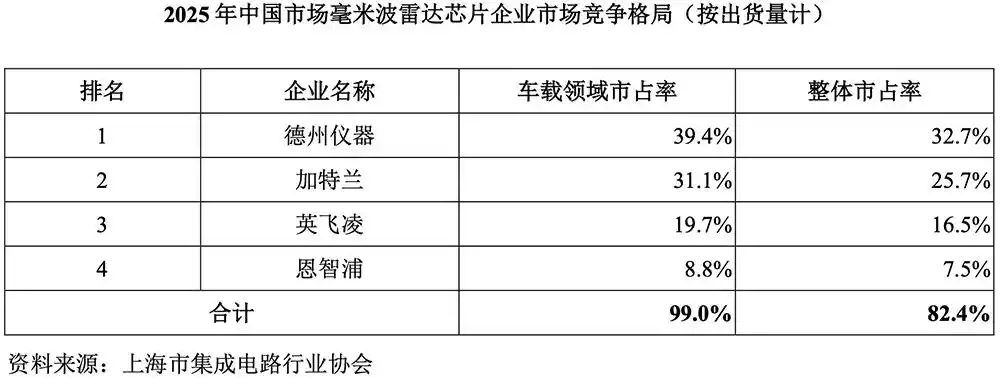
In 2025, according to Yole statistics, Calterah ranked fourth globally in the automotive millimeter-wave radar chip market (including ADAS and child presence detection applications), with a market share of approximately 4%.
According to the Shanghai Integrated Circuit Industry Association, in 2025, Calterah's market share in the domestic automotive millimeter-wave radar chip market reached 31.1%, second only to Texas Instruments, ranking second in the domestic market.
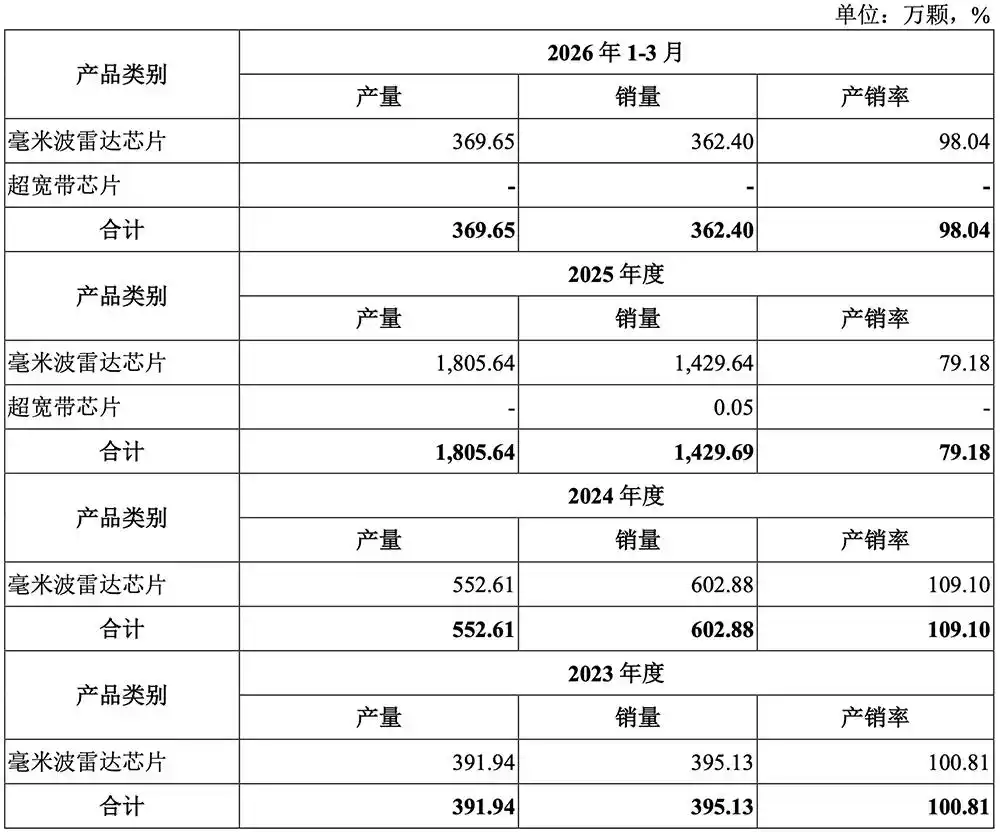
The production volume, sales volume, and production-sales ratio of Calterah's main products are shown in the following table:
As of the end of March 2026, in the automotive-grade field, its millimeter-wave radar chips have cumulatively shipped over 30 million units, covering domestic renowned OEMs including BYD, Geely, Changan, Chery, SAIC, FAW, Dongfeng, Leapmotor, Seres, NIO, and others.
Simultaneously, Calterah has also been competing with globally renowned chip companies in the international market. It has become the first domestic millimeter-wave radar chip supplier for the global platforms of two well-known European Tier 1 companies and has successfully entered the main vehicle models of overseas OEMs like Sweden's Volvo and the US's Rivian, accelerating the internationalization of Chinese millimeter-wave radar chips.
In June 2026, Calterah launched the newly upgraded Kunlun-Pro series, which can better meet L2 and higher-level ADAS requirements, and the Andes-Pro series serving 4D imaging radar.
Its direct customer concentration is high, with main end customers being millimeter-wave radar module manufacturers.
In 2023, 2024, 2025, and Q1 2026, the sales revenue from Calterah's top five direct customers accounted for 99.77%, 99.07%, 99.90%, and 99.97%, respectively, mainly consisting of well-known integrated circuit distributors in the industry.
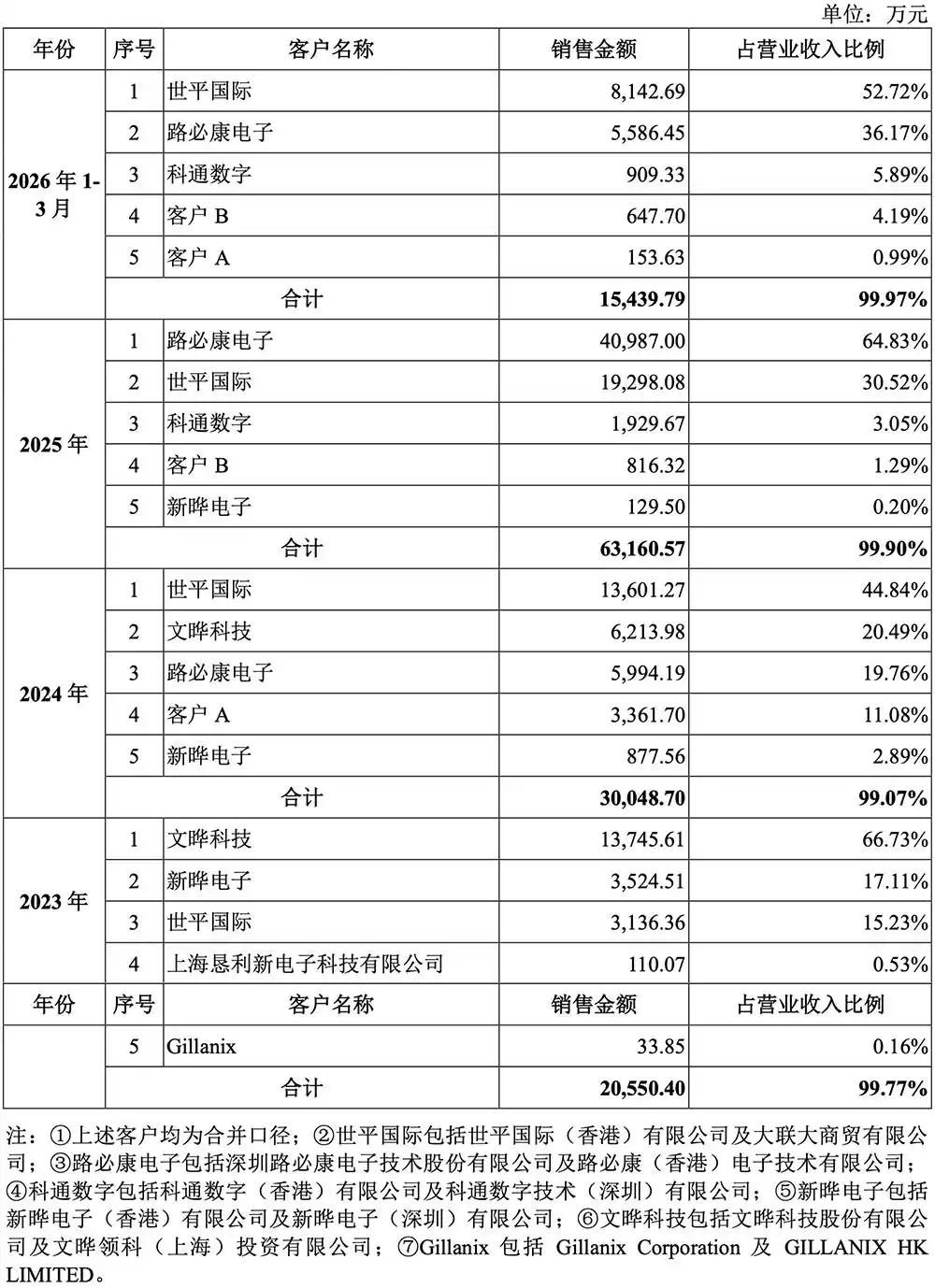
The automotive OEM market where Calterah's products are primarily applied is highly concentrated. BYD, as a major downstream end-user of Calterah, had Calterah enter its ADAS supply chain relatively early.
Benefiting from the significant increase in procurement demand due to BYD's "Mass Intelligent Driving" push in 2025, Calterah's sales to BYD's main millimeter-wave radar suppliers through authorized distributors substantially increased that year, leading to a relatively high revenue share from a single distributor for Calterah.
Since 2026, affected by factors such as downstream OEMs introducing second suppliers, the sales revenue from the largest end customer has continued to face pressure, which has been transmitted to Calterah.
In 2023, 2024, 2025, and Q1 2026, Calterah's procurement amount from its top five suppliers accounted for 54.50%, 61.55%, 70.53%, and 80.16% of the total procurement amount, respectively, indicating a high concentration of suppliers.
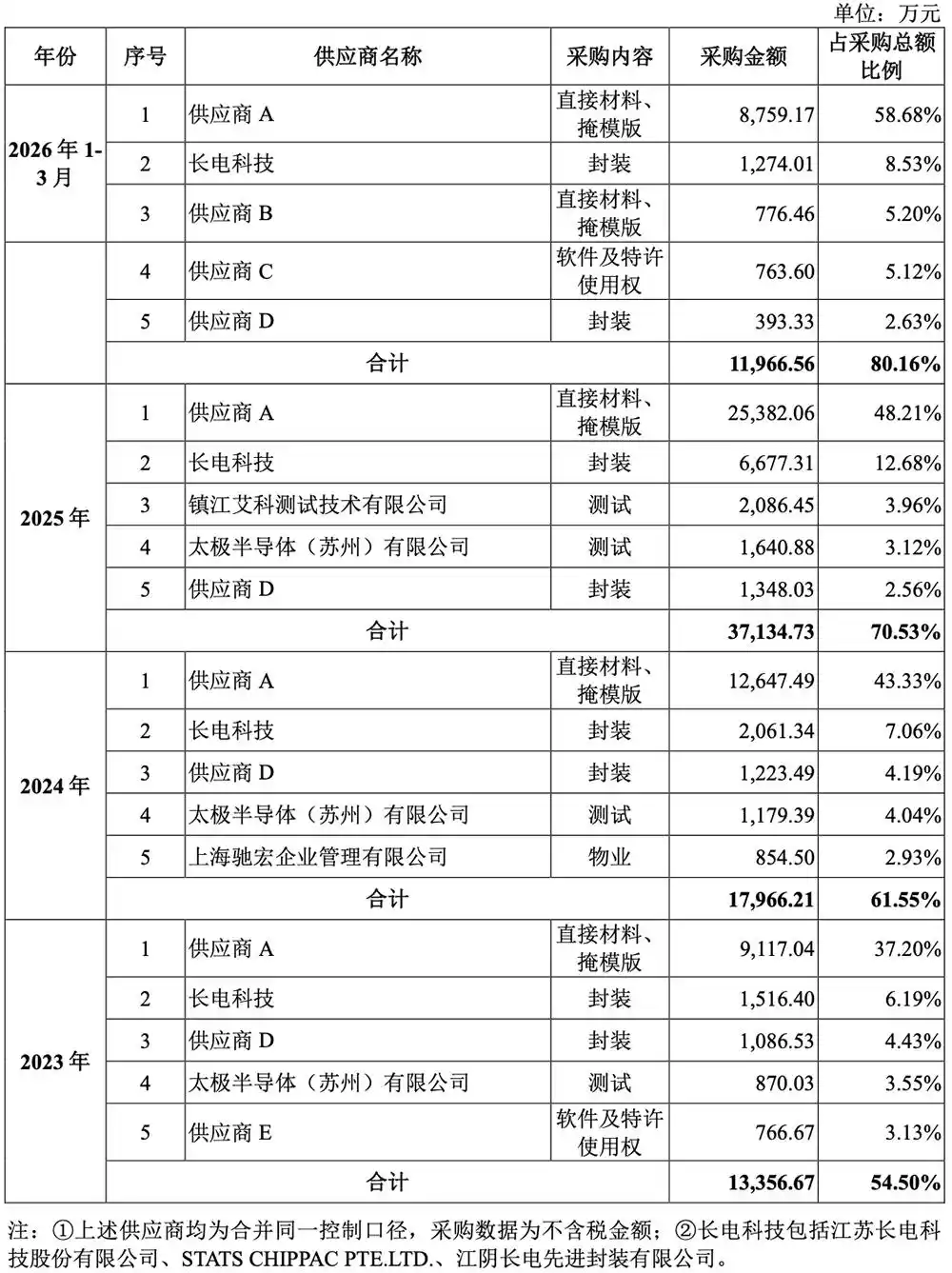
Its production-related procurement mainly includes wafer fabrication and packaging and testing services. Major suppliers include Supplier A, Supplier D, and other overseas companies. The company also purchases R&D-related resources such as EDA software and IP from overseas manufacturers like Supplier C and Supplier E.
During the reporting period, Calterah's production links such as wafer fabrication, chip packaging, and testing primarily involved cooperation with overseas suppliers. The use of EDA tools and some interface IP required for chip R&D and design also involved situations where the main terminal suppliers were from overseas. The proportion of overseas procurement in each period of the reporting period exceeded 50%.
03.
Big Fund II as Shareholder, Multiple Key Personnel with Backgrounds at Texas Instruments and OPPO's ZEKU
As of the date of signing the prospectus, Calterah has no single shareholder holding more than 30%, resulting in a relatively dispersed shareholding structure and no controlling shareholder.
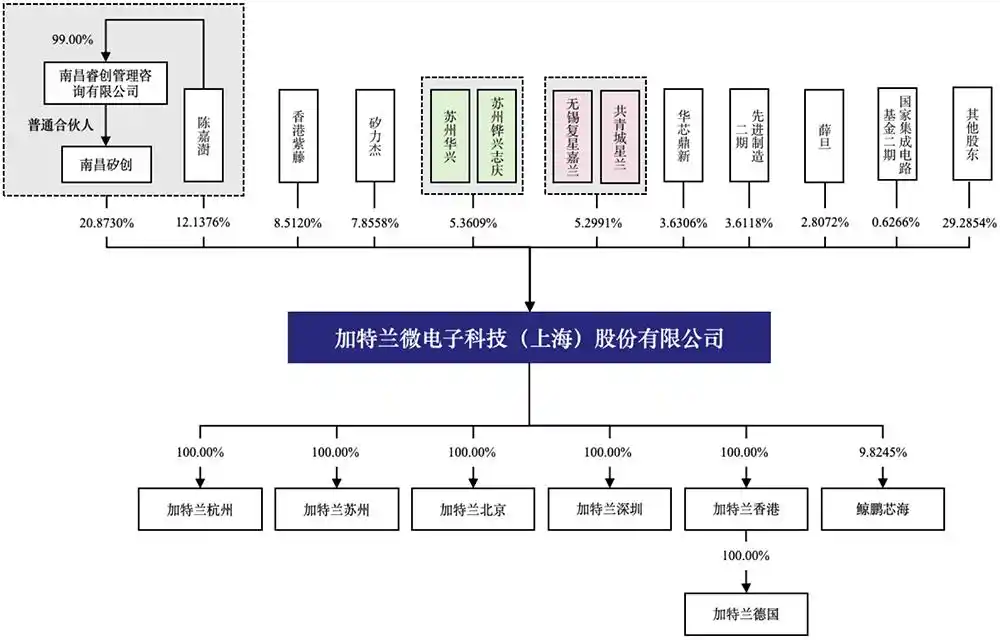
Its founder, Chairman, and General Manager Chen Jiashu, through direct shareholding and control of Nanchang Xichuang, collectively controls 33.0106% of Calterah's voting rights and is the actual controller.
Shareholders individually holding more than 5% of Calterah's shares include: Nanchang Xichuang (20.8730%), Chen Jiashu directly (12.1376%), Hong Kong Ziteng (8.5120%), Silergy (7.8558%), and Wuxi Fosun Jialan (5.1790%).
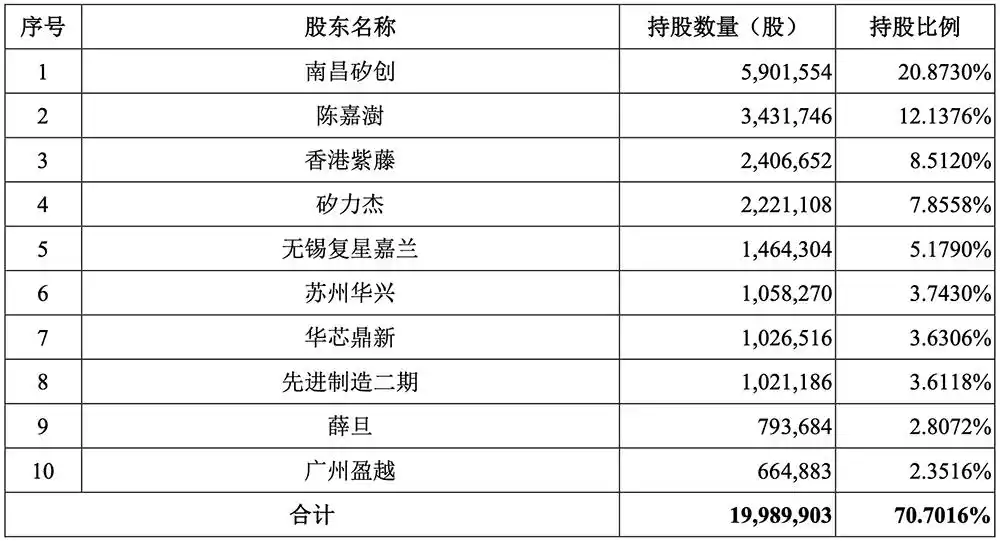
▲ Shareholding Quantity and Proportion of Calterah's Top Ten Shareholders
The National Integrated Circuit Industry Investment Fund Phase II ("Big Fund II") is also among Calterah's shareholders, holding 0.6266%.
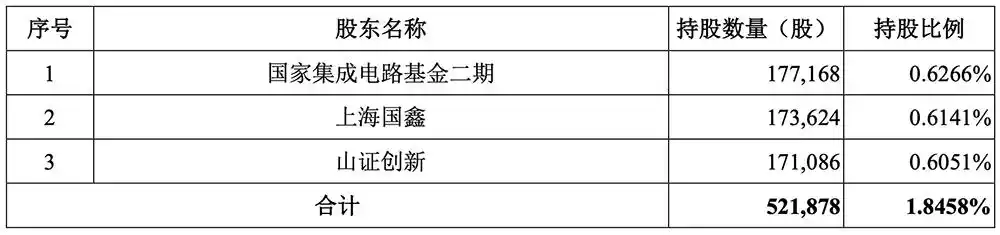
▲ Shareholding of State-Owned Shareholders in Calterah
Calterah's founder, Chairman, and General Manager Chen Jiashu was born in 1984. He holds a Bachelor's degree in Electronic Engineering from City University of Hong Kong and a Ph.D. in Electrical Engineering and Computer Science from the University of California, Berkeley. His research results were published at ISSCC four times. He worked at Tensorcom from August to December 2013 and founded Calterah by investment in February 2014.
Calterah's Director and Deputy General Manager Zhou Wenting was born in December 1981 and also holds a Ph.D. in Electrical Engineering and Computer Science from the University of California, Berkeley. She worked as a researcher at Texas Instruments Incorporated from January 2014 to September 2016.
Two other Deputy General Managers, Lü Yuzhao and Ruan Xiaoli, both previously worked at Texas Instruments (Shanghai) Co., Ltd.
Calterah has five core technical personnel. Its Senior Electromagnetic Scientist and Production Technology Director Wang Dian previously served as an engineer at DJI Technology Co., Ltd. (Shenzhen). Digital Director Shi Yiping and System Director Zhou Huiqiang both previously worked at OPPO's chip subsidiary, ZEKU Technology.
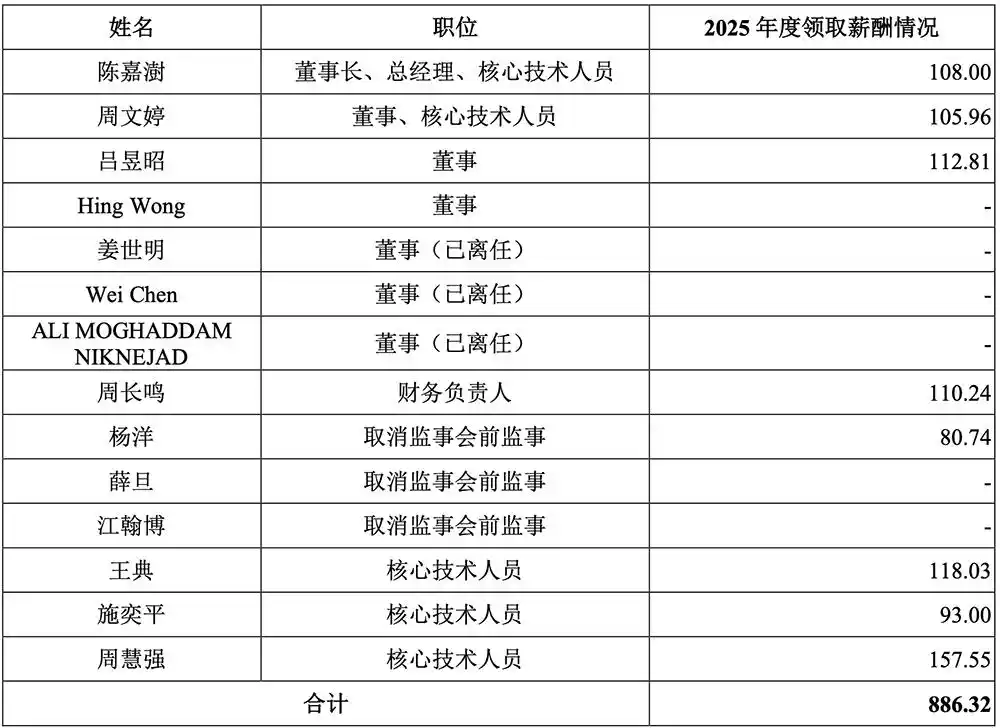
The total annual compensation (excluding share-based payments) received in 2025 by Calterah's Directors, Supervisors (before the cancellation of the Supervisory Board), Senior Management personnel, and core technical personnel from the company amounted to 8.8632 million yuan. Details of the compensation received are as follows:
04.
Conclusion: Facing Fierce Market Competition, Still a Gap in Comprehensive R&D Strength Compared to International Giants
The millimeter-wave radar chip and Ultra-Wideband chip industry is becoming increasingly competitive.
On one hand, overseas industry leaders such as Infineon, NXP, and Texas Instruments started earlier, possess strong technical capabilities, and hold significant advantages in comprehensive R&D strength, core technology reserves, and key customer coverage due to years of R&D investment, mature automotive-grade certification systems, and complete ecosystem layouts. They dominate the global high-end automotive-grade chip market.
On the other hand, benefiting from industrial policies and the trend of automotive semiconductor localization downstream, substantial capital and talent have entered the millimeter-wave radar chip and Ultra-Wideband chip fields. The number of domestic enterprises has grown rapidly, leading to intense competition among domestic manufacturers vying for market share. Calterah faces increasingly fierce market competition.
In recent years, Calterah has closely followed the development trend of automotive industry intelligence, continuously launching competitive wireless sensing and communication chips. However, compared to international giants like NXP, Infineon, and Texas Instruments, there remains a certain gap in comprehensive R&D strength, core technology accumulation, and key customer coverage.
This article is from the WeChat public account "Core Things" (Xindongxi), author: ZeR0, editor: Moying