Fidelity Withdraws $46.8 Million from FBTC Amid Bitcoin ETF Price Declines

cryptonews.ruDipublikasikan tanggal 2026-08-13Terakhir diperbarui pada 2026-08-13

Abstrak

The mid-week session saw another shift in cryptocurrency ETF flow dynamics. Bitcoin once again lost ground due to resurgent share redemptions in two of the market's largest funds, while Ethereum quietly attracted fresh capital. Smaller altcoin categories remained unchanged. Bitcoin ETFs recorded a net outflow of $61.16 million, entirely attributable to Fidelity and BlackRock. Fidelity's FBTC saw a larger outflow of $46.82 million, and BlackRock's IBIT added $14.34 million to the outflow. No other Bitcoin ETF reported a net inflow. This offset a modest inflow from the previous day, exacerbating the volatile demand pattern seen throughout the week. In contrast, Ethereum ETFs finished the session with a net inflow of $7.38 million. Fresh capital primarily went into BlackRock's ETHA fund, providing a net gain after two days of weak or negative flows earlier in the week. The modest inflow occurred during a session where Bitcoin funds faced renewed pressure from the two major issuers. Activity in other segments was muted. ETFs for Solana, XRP, and HYPE recorded zero net flows for the day. The data indicated institutional demand for cryptocurrencies remained selective and restrained, with Bitcoin experiencing the most volatility, Ethereum attracting some incremental capital, and the altcoin ETF market largely on the sidelines.

The mid-week session brought another shift in the flow dynamics of cryptocurrency ETFs. Bitcoin once again lost ground due to the resumption of share redemptions in two of the market's largest funds, while Ether quietly attracted fresh capital, and smaller altcoin categories remained unchanged.

As a result, activity throughout the day was focused almost exclusively on the two largest cryptocurrency assets.

Fidelity and BlackRock Cause Outflows from Bitcoin ETFs

Bitcoin ETFs recorded a net outflow of $61.16 million, with the entirety of this outflow attributed to Fidelity and BlackRock.

Fidelity's FBTC fund registered a more significant outflow of $46.82 million. BlackRock's IBIT fund added another $14.34 million to the outflow. No other bitcoin fund reported a net inflow during the session. The total trading volume for this category reached $1.19 billion, and the aggregate net assets at the close amounted to $77.37 billion.

This result offset the modest inflow of $4.89 million recorded the previous day and exacerbated the volatile dynamics that have characterized demand for Bitcoin ETFs throughout this week.
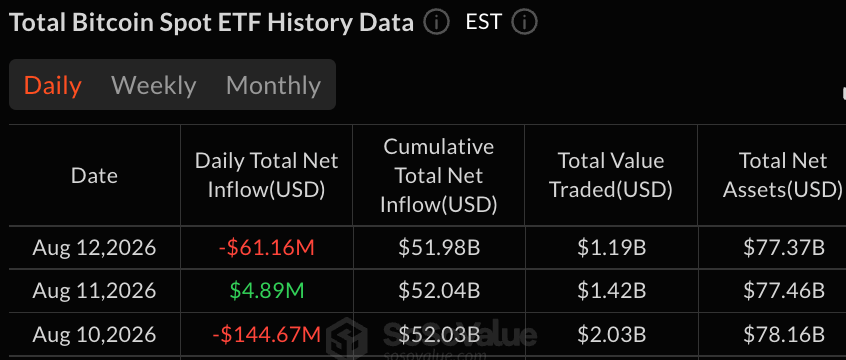
This week, Bitcoin ETF flows have become volatile again: two days of outflows and one day of inflow have been recorded so far. Source: Sosovalue

Ether Finds Buyers While Altcoin Funds Remain Dormant

Ether ETFs finished the week in the black with a net inflow of $7.38 million.

The fresh capital was directed primarily into BlackRock's ETHA ETF, providing this category with net growth after two sessions of weak or negative flows at the start of the week. The total trading volume for Ether ETFs was $358.38 million. The aggregate net asset value at the close was $10.53 billion.

The contrast with Bitcoin was notable both in volume and direction. The inflow into Ether was modest; however, it occurred during a session when Bitcoin funds faced renewed pressure from two major issuers.

Activity in other segments was subdued.

ETFs for Solana, XRP, and HYPE recorded zero net flows for the day. Existing shares could still change hands in the secondary market, but no new ETF shares were issued or redeemed on a net basis.

Wednesday's data indicated that institutional demand for cryptocurrency remained selective and restrained. Bitcoin still experienced the most significant fluctuations, Ether managed to attract additional capital, and the altcoin ETF market largely remained on the sidelines.

end-content

Kripto yang Sedang Tren

Pertanyaan Terkait

QWhich two companies' Bitcoin ETFs experienced the entire net outflow from the category, and what were the amounts?

AFidelity's FBTC and Blackrock's IBIT experienced the entire net outflow. FBTC had an outflow of $46.82 million, and IBIT contributed an additional $14.34 million to the outflow.

QWhat was the overall financial result for Bitcoin ETFs during the reported trading session?

ABitcoin ETFs recorded a net outflow of $61.16 million during the session.

QHow did Ethereum ETFs perform in terms of capital flows compared to Bitcoin ETFs during the same session?

AEthereum ETFs recorded a net inflow of $7.38 million, primarily into Blackrock's ETHA, in contrast to the net outflow experienced by Bitcoin ETFs.

QWhat was the reported activity level for Solana, XRP, and HYPE ETFs during this period?

AETFs on Solana, XRP, and HYPE recorded zero net flows for the day. There was no net creation or redemption of new ETF shares.

QWhat does the article's data for Wednesday suggest about the institutional demand for cryptocurrency via ETFs?

AThe data suggests that institutional demand remained selective and restrained. Bitcoin experienced the greatest volatility, Ethereum managed to attract additional capital, while the altcoin ETF market largely remained on the sidelines.

Bacaan Terkait

Grayscale: «Jika Proposal Diterima, Harga Dua Altcoin Ini Bisa Naik»

Kepala Penelitian Grayscale, Zack Pandl, menyatakan bahwa jika perubahan tokenomik yang sedang dibahas dalam komunitas Ethereum ($ETH) dan Solana ($SOL) diimplementasikan, laju pertumbuhan pasokan kedua aset kripto tersebut dapat melambat secara signifikan. Hal ini berpotensi berdampak positif pada harga. Menurut Pandl, perubahan yang diusulkan dalam kode ekosistem Ethereum dan Solana bertujuan untuk mengurangi laju inflasi tahunan token $ETH dan $SOL. Dengan segala kondisi lain tetap sama, melambatnya pertumbuhan pasokan dapat mengurangi jumlah token baru yang masuk ke pasar, sehingga meningkatkan kelangkaan aset yang ada. Perkiraan Grayscale menunjukkan bahwa jika aturan ini diterapkan, inflasi pasokan tahunan Ethereum bisa turun menjadi sekitar 0,4% pada akhir 2031 — mendekati laju pertumbuhan pasokan Bitcoin. Inflasi pasokan tahunan Solana diproyeksikan turun menjadi sekitar 1,1%. Sebagai perbandingan, pasokan emas tumbuh sekitar 1,8% per tahun, sedangkan inflasi indeks harga konsumen AS sekitar 3,3%. Perubahan yang diusulkan untuk Ethereum dan Solana masih dalam diskusi komunitas dan belum disetujui secara final. Pandl mencatat bahwa proposal untuk Solana tampaknya mendapat dukungan lebih luas dan karena itu memiliki kemungkinan lebih besar untuk diimplementasikan. Namun, penurunan inflasi token juga dapat mengurangi imbalan bagi investor yang melakukan staking, karena sebagian besar pendapatan staking $ETH dan $SOL berasal dari penerbitan token baru. Pandl menekankan bahwa melambatnya pertumbuhan pasokan dapat meningkatkan kelangkaan, memberikan tekanan kenaikan pada harga $ETH dan $SOL, dan investor yang memegang token tanpa staking khususnya mungkin mendapat manfaat. *Ini bukan rekomendasi investasi.

cryptonews.ru34m yang lalu

Grayscale: «Jika Proposal Diterima, Harga Dua Altcoin Ini Bisa Naik»

cryptonews.ru34m yang lalu

Trading

Spot

Artikel Populer

Cara Membeli FLOW

Selamat datang di HTX.com! Kami telah membuat pembelian Flow (FLOW) menjadi mudah dan nyaman. Ikuti panduan langkah demi langkah kami untuk memulai perjalanan kripto Anda.Langkah 1: Buat Akun HTX AndaGunakan alamat email atau nomor ponsel Anda untuk mendaftar akun gratis di HTX. Rasakan perjalanan pendaftaran yang mudah dan buka semua fitur.Dapatkan Akun SayaLangkah 2: Buka Beli Kripto, lalu Pilih Metode Pembayaran AndaKartu Kredit/Debit: Gunakan Visa atau Mastercard Anda untuk membeli Flow (FLOW) secara instan.Saldo: Gunakan dana dari saldo akun HTX Anda untuk melakukan trading dengan lancar.Pihak Ketiga: Kami telah menambahkan metode pembayaran populer seperti Google Pay dan Apple Pay untuk meningkatkan kenyamanan.P2P: Lakukan trading langsung dengan pengguna lain di HTX.Over-the-Counter (OTC): Kami menawarkan layanan yang dibuat khusus dan kurs yang kompetitif bagi para trader.Langkah 3: Simpan Flow (FLOW) AndaSetelah melakukan pembelian, simpan Flow (FLOW) di akun HTX Anda. Selain itu, Anda dapat mengirimkannya ke tempat lain melalui transfer blockchain atau menggunakannya untuk memperdagangkan mata uang kripto lainnya.Langkah 4: Lakukan trading Flow (FLOW)Lakukan trading Flow (FLOW) dengan mudah di pasar spot HTX. Cukup akses akun Anda, pilih pasangan perdagangan, jalankan trading, lalu pantau secara real-time. Kami menawarkan pengalaman yang ramah pengguna baik untuk pemula maupun trader berpengalaman.

437 Total TayanganDipublikasikan pada 2024.12.10Diperbarui pada 2026.06.02

Cara Membeli FLOW

Diskusi

Selamat datang di Komunitas HTX. Di sini, Anda bisa terus mendapatkan informasi terbaru tentang perkembangan platform terkini dan mendapatkan akses ke wawasan pasar profesional. Pendapat pengguna mengenai harga FLOW (FLOW) disajikan di bawah ini.

活动图片