Robinhood Provides the Answer: Why Ethereum Becomes the Optimal Solution After Traditional Businesses Enter

Foresight NewsDipublikasikan tanggal 2026-07-13Terakhir diperbarui pada 2026-07-13

Abstrak

The article argues that as real-world, cash-flow-focused businesses enter the blockchain space, they are increasingly choosing the Ethereum L1 + L2 architecture as the optimal infrastructure solution, in contrast to earlier crypto projects built primarily around token sales. It uses Robinhood as a prime example: after testing its stock tokenization product on Arbitrum One, Robinhood launched its own dedicated blockchain, "Robinhood Chain," which is built as an Ethereum L2 using Arbitrum's technology, relying on Ethereum for data availability (via blobs), using ETH as its native gas token, and employing a standard bridge to Ethereum. The author, Ryan Berckmans, distinguishes between two types of participants with different incentive structures: 1. **The "Old Crypto Economy":** Projects whose primary goal is to create and sell a token, with value derived from utility expectations, speculative "monetary premium," or distant cash-flow promises. Their technology stack choices are often flexible and driven by grants, copycat opportunities, or the need for a new token narrative. 2. **The Emerging "Real-World On-Chain Economy":** Traditional businesses using blockchain to improve existing services or create new cash-flow streams. Their goal is to maximize business profits, not token appreciation. For them, blockchain is infrastructure, and they prioritize low risk, security, user reach, operational control, liquidity, and interoperability. For these real-world enterprises, buildi...


Written by:@ryanberckmans, Member of the Ethereum Community

Compiled by:Saoirse, Foresight News


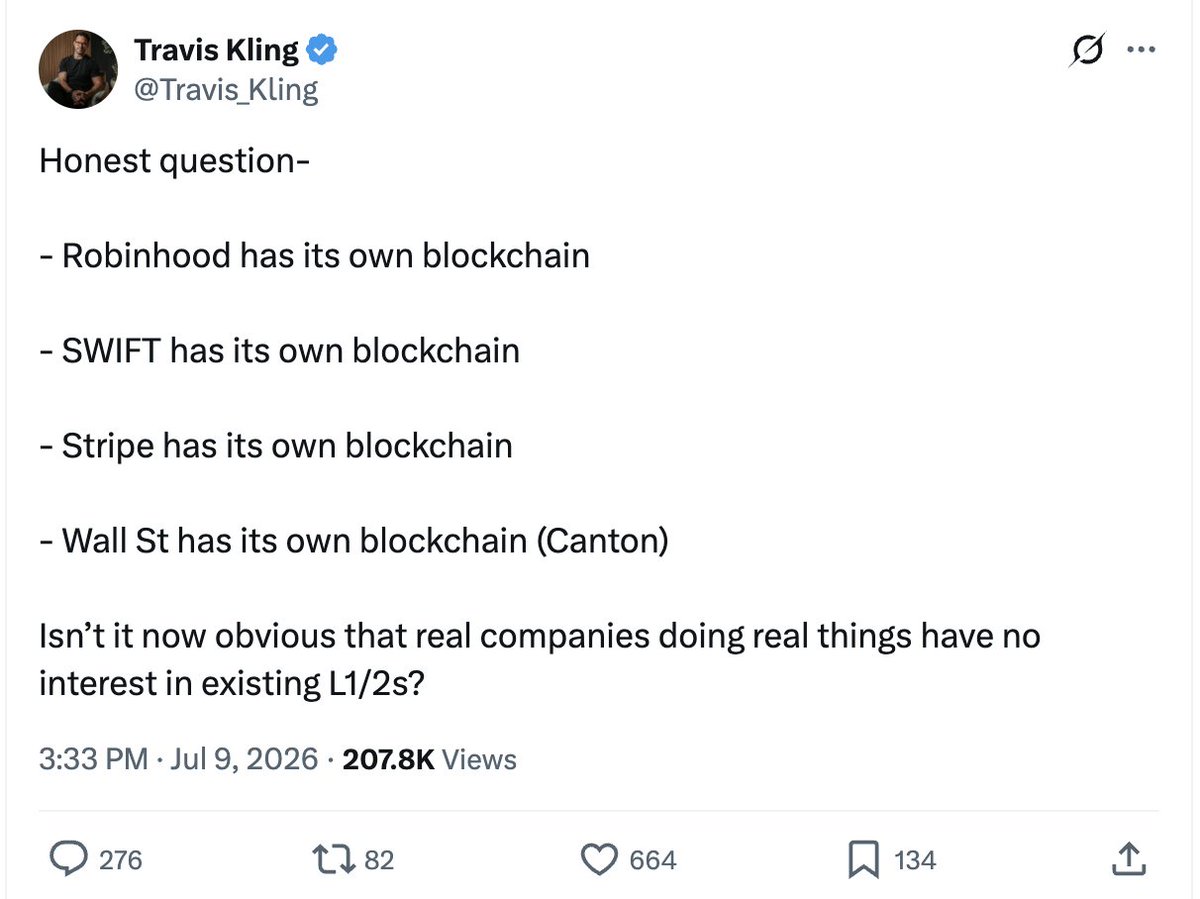
Travis Kling recently proposed a viewpoint: Is there now an obvious conclusion that businesses seriously conducting real-world operations have no interest whatsoever in the various existing L1 and L2 solutions? His first example was Robinhood. Yet, Robinhood is precisely the perfect counterexample: when real-world enterprises make decisions based on business logic, the vast majority will choose the Ethereum L1+L2 architecture.

(Note: Travis Kling is the founder and chief investment officer of the crypto asset management firm Ikigai, with years of investment experience at institutions like Point72 on Wall Street, and is a well-known crypto macro investor.)


Robinhood chose Ethereum as the underlying L1 and subsequently built its own Ethereum layer-2 network based on Arbitrum technology. Robinhood Chain relies on Ethereum Blobs for data availability, uses ETH as the native gas token, and is equipped with a standard cross-chain bridge secured by Ethereum.


This does not negate the Ethereum L1+L2 model; on the contrary, it confirms that this architecture is operating as originally designed.


The deeper core lies in the vastly different incentive mechanisms among participants. Early crypto industry players built public chains and chose technology stacks with the goal of issuing tokens. The emerging real-world on-chain economy is gradually establishing Ethereum L1+L2 as the underlying standard for cash-flow businesses.


These two types of participants have entirely different objective functions. As the market participant structure shifts, Ethereum's advantages will become increasingly evident.


Old Crypto Economy: Everything Optimized for Tokens


The "real-world enterprises serving real users" referred to in this article follow the classic corporate operation model: creating products consumers need, generating cash flow by providing services, and increasing the equity value corresponding to that cash flow.


Here, "real users" have demands stemming from normal economic activities, not merely speculative demand created by a new round of token issuance. Of course, crypto-native users also belong to real users.


This is not a judgment on whether various protocols are useful or whether builders have pure intentions; it is not a moral distinction. The core differentiating point lies in the economic objectives of the operating entities.


The value of a token can only come from three sources:


  1. Cash Flow: Possessing a reliable claim on future cash flow, akin to on-chain equity or bonds;
  2. Utility Value: Granting holders privileged access to, control over, or governance of a high-value system. Even without cash flow, a token that can control critical resources still holds value;
  3. Monetary Premium: People are willing to hold the asset long-term, convinced that others will recognize and accept it later. The asset transforms into a store-of-value carrier, becoming an ultimate unit of account, not just a voucher awaiting redemption for rights.


The monetary premium is real but extremely difficult to maintain. It requires powerful network effects in market confidence, liquidity, ecosystem adoption, scenario integration, and practical application. Gold, the US dollar, Bitcoin, and Ethereum have each established their own forms of monetary premium; hardly any other assets have achieved this.


Looking back, since the proliferation of programmable crypto assets, the vast majority of participants in the industry have not been formal enterprises pursuing stable cash flow. Their business models mostly involve selling tokens, with token value supported by utility expectations, hype-driven monetary premium, or distant, hard-to-fulfill cash flow narratives.


Some paths are very direct: developing a protocol and directly issuing a native token. Some are more roundabout: receiving grants from ecosystem projects funded by token sales, then selling the received tokens. Some projects do plan to generate revenue in the future. However, when token valuations are severely disconnected from reasonable expected cash flow, the essential business model still relies on market confidence in the token.


Almost everyone replicated similar playbooks, so this model slowly became the industry norm.


Important exceptions exist, of course: centralized exchanges are mostly pure cash-flow businesses, naturally adopting multi-chain strategies, where adding a new public chain is like adding a deposit/withdrawal channel. Some stablecoin issuers are also real-world cash-flow enterprises, initially serving the crypto circle but now expanding into the broader real economy.


But these exceptions precisely prove the core point: enterprises aiming to earn cash choose infrastructure to maximize their own business returns, not to boost token appreciation.


Incentive Mechanisms Ultimately Shape Technical Architecture


An entity's objective function determines its technical route choices. If a business's core mission is to operate a cash-flow business, the blockchain is just infrastructure. The enterprise selects a public chain to reduce risk, optimize products, reach users, and protect profits.


If the primary goal is token monetization, the choice of public chain becomes extremely flexible. Whichever public chain provides ecosystem grants, projects will develop on it. Seeing a successful protocol on Chain A, replicate a similar product on Chain B to facilitate investor valuation comparisons. As long as issuing a new token is desired, a brand new L1, L2, appchain, gas token, governance system, or niche technology stack can be packaged as marketing highlights.


The issue is not technological diversity itself. The crypto field will continue to see a Cambrian explosion of innovation with numerous applications, protocols, layer-2 solutions, and specialized execution environments emerging. The real industry-distorting trend is: for every new idea, there's a rush to independently build a sovereign ecosystem, separately set up an L1, prepare a security budget, cultivate liquidity, issue native monetary assets, completely disregarding whether the business itself necessitates it.


As the industry's focus gradually shifts towards cash-flow real-world businesses, innovation and exploration will not cease but will increasingly be built upon a unified underlying foundation. Enterprises will focus on differentiated development at the application layer and layer-2, relying on Ethereum L1 for settlement, security guarantees, liquidity hosting, and value storage. Ultimately, the industry will form a dumbbell structure: diverse applications flourish at the edges, while underlying infrastructure continues to consolidate.


The common logic of the old crypto industry: build the entire technical architecture around the token you want to sell to investors.


Market Participants Are Evolving


The future shape of the crypto industry will inevitably differ from the past, for one core reason: the players have changed.


The previous US administration persistently suppressed on-chain industry development, but now the wind has shifted. The "GENIUS Act" has been formally enacted, establishing a federal regulatory framework for payment stablecoins. The EU's MiCA regulatory framework is fully effective. Brokers, payment companies, banks, asset management institutions, and governments worldwide are beginning to deploy strategies around stablecoins, asset tokenization, and on-chain business.


This does not mean all regulatory challenges are solved, but large institutions can finally engage in long-term planning for on-chain business.


We are at the starting point of the large-scale adoption S-curve.


As the industry matures, crypto and traditional financial systems will no longer be fragmented. Assets, money, transactions, finance, identity, and trust will all be carried by a combination of on-chain and off-chain systems. Eventually, the term "Web3" will fade from public consciousness, much like "Web2" did, and everything will simply be called the internet.


By then, within the crypto market, the proportion of real-world enterprises serving ordinary users from the real economy will significantly increase. Not only will the number of such enterprises rise, but more crucially, capital volume, user scale, asset volume, and institutional influence will tilt towards these entities.


They will no longer be crypto projects struggling to find business models merely to support token narratives. Instead, they will be real companies using blockchain to improve existing businesses and create entirely new cash-flow avenues.


The market landscape will be rewritten. The infrastructure selection logic of the token economy era is entirely unsuitable for the cash-flow real economy.


Real-World Enterprises Procure Blockchain Infrastructure


Real-world enterprises have very low budgets for infrastructure trial-and-error risks. Companies do not want to bear the extra burden of consensus mechanisms, cross-chain bridges, validator systems, gas assets, governance tokens, liquidity operations, and a pile of unrelated additional modules. Any new technical module must create user value; otherwise, it is a liability.


Blockchain should serve the business, not the other way around.


Some businesses are naturally suited for multi-chain deployment: exchanges, wallets, stablecoin issuers, and various asset issuance platforms require broad user coverage. However, even when operating across multiple chains, it doesn't mean all public chains are equal; usually, a core public chain is designated to handle liquidity, asset issuance, settlement, business data storage, and deep ecosystem integration.


For the vast majority of on-chain businesses, the focus will be on deeply cultivating one main chain or a few chains within the same system.


Enterprises generally have three choices:


  1. Ethereum L1: Used when the business pursues ultimate decentralization, credible neutrality, minimal risk, and deep liquidity. L1 has higher transaction costs, exchanged for the industry's strongest shared security environment.
  2. Build a custom Ethereum L2: Used when the enterprise needs operational control, high customization, compliance capabilities, stable cost models, low latency, and high throughput. This allows operating an independent blockchain according to its own needs while remaining bound to the Ethereum foundation.
  3. Use mature shared layer-2: Used when the business scale is insufficient to support an independent L2, deploying directly on existing public L2s. Base, Arbitrum One, Robinhood Chain, and other Ethereum layer-2s become general-purpose development platforms.


Such enterprises will still engage in asset cross-chain operations, export products externally, and connect to other networks. Having a core main chain does not equate to isolation; asset interoperability and business interconnection have become standard for on-chain businesses.


But the core home chain is crucial. It determines the security foundation, standard data state, liquidity flows, operational model, and long-term development dependencies of the entire system.


Why the Ethereum L1+L2 Architecture Fits Enterprise Needs


Ethereum precisely splits the two core demands of large enterprises: L1 creates a highly decentralized, credibly neutral, and liquidity-rich global settlement hub; various L2s constitute a diverse market of execution environments, enabling high speed, low cost, vertical customization, and operator autonomy.


The foundation remains solid and neutral, while the upper layers flexibly adapt to different operating entities, jurisdictions, differentiated products, and user groups. Layer-2 solutions not only achieve Ethereum scaling at the technical level but also achieve scaling at the institutional level: institutions can operate their businesses according to their own rules without requiring the global base layer to accommodate their needs.


Independent L1s can also provide operational autonomy and high performance. In some scenarios, having full control over consensus and data availability holds value. But full sovereignty comes at a high cost.


A brand new independent L1 must build from scratch and continuously maintain a security budget, validator nodes, cross-chain trust assumptions, liquidity, development tools, ecosystem partnerships, and institutional credibility.


It creates a new security and liquidity island, significantly increasing friction costs for interaction with Ethereum L1 and the vast layer-2 ecosystem. Only when the independent consensus mechanism itself can create enormous commercial value is it worth bearing these costs for an enterprise.


For the vast majority of enterprises, the benefits of building an independent L1 cannot cover the comprehensive costs.


A customized Ethereum layer-2 can secure almost all the advantages of an independent L1: high TPS, control over execution logic, independent upgrades, custom fee structures, transaction ordering, latency control, access rules, and product-specific features.


Simultaneously, layer-2 inherently possesses advantages that are difficult for a native L1 to build quickly: settlement and data availability relying on Ethereum, native standard cross-chain bridges, seamless connection to Ethereum's existing funds and assets, and cross-chain interaction with minimized trust requirements based on the same underlying layer.


The design details of layer-2 solutions remain crucial. Admin permissions, upgrade keys, proof systems, and withdrawal guarantee mechanisms determine how much underlying security users can inherit.


Even a layer-2 with relatively high operator control still relies on Ethereum L1 to establish an unbreakable settlement foundation. For an enterprise simply conducting business, there's no need to independently operate and secure a base-layer L1.


An Ethereum layer-2 is both an independent blockchain and part of the Ethereum economic system. The operator can customize the execution environment while reusing Ethereum for settlement, Blob data storage, and cross-chain interoperability. Most will deeply integrate ETH into the ecosystem, directly using ETH as the gas token. The native standard bridge allows L1 assets to flow into the layer-2 economy with low trust thresholds.


Each new layer-2 creates a differentiated product segment, continuously amplifying Ethereum's network effects.


Robinhood's Decision is Highly Instructive


Robinhood's development path holds textbook-level reference value. The company first launched its stock token business on the mature shared layer-2 Arbitrum One. After validating the product model and clarifying its needs, it launched its own proprietary blockchain based on the Arbitrum platform.


This will likely become a common industry development path: first validate the product using shared infrastructure, then upgrade to a proprietary L2 once business scale, product requirements, and profit models are met.


Robinhood Chain is customized for financial services. Leveraging Arbitrum technology, it achieves 100-millisecond latency, predictable transaction pricing, and high throughput. The entire infrastructure meets all of Robinhood's requirements for performance, security, and regulatory compliance.


Simultaneously, Robinhood Chain is inherently an Ethereum layer-2: it relies on Ethereum Blobs for data, uses ETH for gas, and connects via a standard bridge to Ethereum that doesn't require third-party verifiers.


This is the standard template for real-world enterprises building on-chain products.


Robinhood doesn't need to create its own gas token from scratch and then justify to the market that the token possesses a long-term monetary premium. Robinhood itself is a publicly traded company with equity; all its profit growth comes from users, products, existing assets, and transaction-generated cash flow.


Blockchain is just infrastructure.


Choosing ETH to pay for gas is a purely rational business decision. The layer-2 itself needs to pay ETH to Ethereum for L1 underlying services. ETH has ample liquidity and is natively integrated across the ecosystem. Issuing a proprietary gas token would only add extra costs for promotion, liquidity maintenance, price volatility, and reputational risk without improving Robinhood's core business.


The metric for judging Robinhood's success or failure is the application-layer product and its off-chain derivative businesses, not whether it can create a new asset with monetary properties.


Therefore, many people misunderstand: some claim Robinhood developing its own blockchain means it abandoned the existing L1/L2 system. The opposite is true: Robinhood simply did not want to share a single execution environment with everyone. It did not abandon Ethereum; it chose Ethereum as the underlying parent chain for its own blockchain.


The Ethereum L1+L2 architecture is no longer just a theoretical concept.


Coinbase made the same choice when building Base. Coinbase is not an Ethereum evangelist; Brian Armstrong (Coinbase co-founder and CEO) has publicly stated he is more bullish on Bitcoin long-term. Yet, when the enterprise selected underlying infrastructure for its on-chain business, it still built Base as an Ethereum layer-2.


This choice is highly persuasive—the decision stemmed from commercial interests, unrelated to belief preferences.


When an enterprise's goal is to build a cash-flow business, not to host a token sale, it will ultimately only make rational business judgments. The default optimal commercial solution at this stage: Ethereum L1+L2.


What the Landscape Shift Means for Ethereum and ETH


The shift in market participant structure is extremely beneficial for Ethereum in the long term.


In the past, the competitive landscape of the public chain sector was largely dominated by projects enthusiastic about issuing tokens, distributing ecosystem grants, and relying on token valuation narratives.


Going forward, the industry's competitive entities become real-world enterprises, making decisions centered around security, user acquisition, operational control, market coverage, liquidity, and cross-chain interoperability optimization—all serving cash-flow businesses.


Market demand will continue to aggregate towards Ethereum's dumbbell architecture: L1 bears the demands for ultimate security and liquidity; various L2s handle demands for scaling, customization, and autonomous operation.


Ethereum's path to mass adoption does not lie in forcing all enterprises onto the same shared execution chain but in becoming the common settlement, security, liquidity, and asset foundation for thousands of upper-layer environments.


This also benefits ETH. ETH's growth logic relies on building a global monetary network and accumulating market consensus; it is not itself a cash-flow business.


ETH is a high-quality store-of-value asset, the native asset of Ethereum's global settlement layer. It serves as collateral, a liquidity vehicle, treasury reserve asset, productive asset within the ecosystem, and is continuously growing into an ultimate store-of-value asset.


As more real-world enterprises conduct business based on Ethereum, they will continuously expose ETH to massive numbers of users, embed ETH into various products, and constantly expand application scenarios. As liquidity and consensus deepen, ETH's monetary premium is further consolidated, and the monetary premium is essentially a powerful network effect.


Old crypto economy: Design the entire technical architecture around the token you want to sell. Emerging on-chain real economy: Choose the technical architecture around the product you want to deliver to customers.


These two types of participants have completely different optimization objectives, which will shape a drastically different public chain competitive landscape.


Robinhood is not an exception; it is a beacon.


Real-world enterprises choose Ethereum L1 when pursuing the industry's strongest neutrality, lowest risk, and top-tier shared liquidity environment. They build Ethereum L2 when needing operational autonomy, customization capabilities, and high performance. When business scale is insufficient to support an independent blockchain, they deploy on mature shared layer-2s (mostly Ethereum-based L2s).


Enterprises make this choice not because they are Ethereum maximalists, but purely out of business considerations.

Kripto yang Sedang Tren

Pertanyaan Terkait

QWhy does the article argue that real-world businesses will increasingly choose the Ethereum L1+L2 architecture?

AThe article argues that as the crypto industry shifts towards businesses focused on generating cash flow rather than token speculation, their incentives change. These businesses prioritize security, user reach, operational control, and liquidity. Ethereum's L1 provides a highly decentralized, trust-minimized settlement and security base, while its L2s offer the customization, low cost, and high throughput required for diverse business models, making it the optimal default choice based on commercial logic, as exemplified by Robinhood.

QHow does the article differentiate the 'old crypto economy' from the emerging 'real-world chain economy'?

AThe article states that in the 'old crypto economy,' most participants (projects, builders, ecosystems) optimized their technology stack and architecture around launching and promoting a token to capture value. In contrast, the emerging 'real-world chain economy' consists of businesses running classic corporate models that aim to create products/services for customers to generate cash flow, with blockchain merely serving as infrastructure to optimize their business, not as the primary revenue model via token appreciation.

QAccording to the article, what is the three-fold path for a real-world business to choose its blockchain infrastructure?

AThe article outlines three primary choices for real-world businesses: 1) Use Ethereum L1 directly for maximum decentralization, security, and deep liquidity (despite higher costs). 2) Build a dedicated Ethereum L2 for operational control, customization, compliance, and high performance while inheriting L1 security. 3) Deploy on an existing, mature shared L2 (like Base, Arbitrum One, or Robinhood Chain) if the business scale doesn't justify a dedicated chain. The core principle is to have a primary 'home' chain while maintaining interoperability.

QWhy is Robinhood's choice to build its own chain seen as a counter-argument to the idea that businesses are not interested in L1s/L2s?

AThe article uses Robinhood as the perfect counter-example because while Robinhood did build its own blockchain (Robinhood Chain), it deliberately built it as an Ethereum L2. It relies on Ethereum for data availability (via Blobs), uses ETH as the native gas token, and incorporates a standard bridge secured by Ethereum. This shows Robinhood didn't abandon existing L1/L2 infrastructure; instead, it chose Ethereum as the foundational settlement layer, validating the L1+L2 model as the optimal commercial solution for businesses seeking both control and robust underlying security.

QWhat long-term impact does the shift towards real-world, cash-flow businesses have on Ethereum and ETH, according to the article?

AThe article argues this shift is extremely bullish for Ethereum and ETH long-term. As more real-world businesses build on Ethereum (either L1 or L2s), they will onboard massive numbers of users, embed ETH into various products, and expand its use cases. This increases ETH's liquidity and network effects, further solidifying its monetary premium as the native asset of the global settlement layer, a store of value, and the core collateral and liquidity asset within the ecosystem.

Bacaan Terkait

Bagaimana Mengatur ETF Leverage Saham Tunggal? Kamis Ini, Seluruh Pasar Tertuju pada Pertemuan Pemerintah Korea Ini

**Cara Mengawasi ETF Leverage Saham Tunggal? Pemerintah Korea Selatan Gelar Pertemuan Penting Kamis Ini** Produk keuangan baru yang diluncurkan hanya 1,5 bulan lalu, yaitu ETF leverage saham tunggal, telah memicu kekhawatiran tinggi regulator Korea Selatan dan mendorong pertemuan darurat tingkat tinggi. Mekanisme koordinasi "F4" - yang terdiri dari Kementerian Keuangan, Komisi Jasa Keuangan, Bank of Korea, dan Otoritas Pengawasan Jasa Keuangan (FSS) - akan mengadakan pertemuan pada Kamis ini untuk membahas dampak produk ini terhadap pasar saham dan merumuskan langkah penanganan. Produk ini, yang mulai diperdagangkan pada 27 Mei, memungkinkan investor bertaruh 2x pada pergerakan harga harian saham Samsung Electronics dan SK Hynix. Mekanisme rebalancing harian yang diperlukan produk ini untuk mencocokkan kinerja dinilai memperburuk volatilitas pasar, menciptakan efek "mendorong kenaikan dan memperdalam penurunan". Hal ini dianggap sebagai salah satu pemicu anjloknya indeks KOSPI lebih dari 8% dan terjadinya *circuit breaker* ke-7 tahun ini pada Senin lalu. Pejabat regulator telah mengungkapkan penyesalan dan kesulitan. Kepala FSS, Lee Boon-jin, bahkan menyatakan "menyesal tidak berusaha maksimal untuk mencegah" peluncuran produk tersebut, sebuah pengakuan langka. Ia menyoroti "masalah struktural", seperti mustahilnya likuidasi paksa karena telah ada pembelian bersih hampir 10 triliun won oleh investor ritel, serta dampak terhadap kredibilitas hukum jika produk yang telah disetujui aturannya ditarik paksa. Sebelum pertemuan F4, regulator dan industri telah mendiskusikan beberapa opsi kebijakan potensial, termasuk: **meningkatkan persyaratan margin (jaminan), membatasi batas fluktuasi harga harian, dan menyesuaikan batas atas rasio leverage.** Namun, langkah-langkah ini diakui mungkin hanya solusi sementara. Data menunjukkan peningkatan volatilitas yang signifikan. Sejak ETF leverage saham tunggal diluncurkan, frekuensi hari dengan pergerakan KOSPI di atas 3% melonjak menjadi 52% dari hari perdagangan, dibandingkan 27% sebelumnya. Tahun ini, pasar saham Korea telah mengaktifkan mekanisme penghentian sementara perdagangan (*sidecar*) 35 kali dan *circuit breaker* penuh 7 kali, melampaui rekor saat krisis keuangan 2008. Dengan tekanan yang meningkat, pasar memperkirakan produk ini akan menghadapi pembatasan lebih ketat, seperti rasio leverage yang dikurangi atau persyaratan kelayakan investor yang diperketat. Hasil pertemuan F4 pada Kamis ini akan menentukan arah kebijakan selanjutnya.

marsbit54m yang lalu

Bagaimana Mengatur ETF Leverage Saham Tunggal? Kamis Ini, Seluruh Pasar Tertuju pada Pertemuan Pemerintah Korea Ini

marsbit54m yang lalu

AI Membongkar Halaman Utama Tao Setelah 30 Tahun, Langsung Menemukan Dua Bug yang Tersembunyi Selama 20 Tahun Lebih

Judul asli: AI Memperbarui Situs Web 30 Tahun Terence Tao, Menemukan Dua Bug Tersembunyi 20+ Tahun Terence Tao, seorang matematikawan peraih Fields Medal, baru-baru ini menggunakan agen AI (terutama Claude Code) untuk memigrasikan seluruh situs web pribadinya yang telah dirawat secara manual sejak 1997. Dalam satu hari, AI berhasil memindahkan 560 makalah, 374 catatan perjalanan, 68 kursus, dan banyak konten lainnya ke sistem statis baru berbasis GitHub Pages. Migrasi ini mengungkap dan memperbaiki banyak ketidakkonsistenan data dan tautan mati yang terakumulasi selama hampir 30 tahun. Lebih menarik lagi, AI juga membantu memporting sekitar 20 applet Java 1.0 lama (ditulis Tao antara 1998-2000 untuk visualisasi matematika) ke JavaScript, dan dalam prosesnya menemukan dua bug dalam kode asli Tao yang tidak pernah dia sadari sebelumnya. Inti dari transformasi ini adalah pergeseran dari memelihara file HTML individual ke sistem di mana YAML adalah "sumber kebenaran" tunggal. Halaman web sekarang dihasilkan secara otomatis dari data terstruktur ini, membuat pembaruan dan koreksi kesalahan jauh lebih mudah. Tao juga menyelesaikan proyek lama yang tertunda sejak 1999: sebuah simulator visual untuk diagram ruang-waktu relativistik khusus. Proyek yang dulu terhambat oleh kompleksitas kode ini berhasil diimplementasikan hanya dalam dua jam berkolaborasi dengan AI. Kesimpulan Tao: tugas pemeliharaan digital yang membosankan dan berulang seperti ini sangat cocok untuk otomatisasi oleh platform modern dan alat AI. Ini membebaskan peneliti dari "pekerjaan rumah digital" sehingga mereka dapat fokus pada inti pekerjaan mereka, dengan AI sebagai asisten yang menangani heavy lifting teknis.

marsbit54m yang lalu

AI Membongkar Halaman Utama Tao Setelah 30 Tahun, Langsung Menemukan Dua Bug yang Tersembunyi Selama 20 Tahun Lebih

marsbit54m yang lalu

Trading

Spot

Artikel Populer

Apa Itu ETH 2.0

ETH 2.0: Era Baru untuk Ethereum Pendahuluan ETH 2.0, yang dikenal luas sebagai Ethereum 2.0, menandai peningkatan monumental pada blockchain Ethereum. Transisi ini bukan sekadar tampilan baru; tujuannya adalah untuk secara fundamental meningkatkan skalabilitas, keamanan, dan keberlanjutan jaringan. Dengan peralihan dari mekanisme konsensus Proof of Work (PoW) yang mengkonsumsi energi tinggi ke Proof of Stake (PoS) yang lebih efisien, ETH 2.0 menjanjikan pendekatan transformasional terhadap ekosistem blockchain. Apa itu ETH 2.0? ETH 2.0 adalah kumpulan pembaruan yang berbeda dan saling terhubung yang fokus pada pengoptimalan kemampuan dan kinerja Ethereum. Perombakan ini dirancang untuk mengatasi tantangan kritis yang dihadapi mekanisme Ethereum yang ada, khususnya terkait dengan kecepatan transaksi dan kemacetan jaringan. Tujuan ETH 2.0 Tujuan utama dari ETH 2.0 berputar di sekitar perbaikan tiga aspek inti: Skalabilitas: Bertujuan untuk secara signifikan meningkatkan jumlah transaksi yang dapat ditangani jaringan per detik, ETH 2.0 berusaha untuk melampaui batasan saat ini yang kira-kira 15 transaksi per detik, berpotensi mencapai ribuan. Keamanan: Langkah-langkah keamanan yang diperkuat merupakan bagian integral dari ETH 2.0, terutama melalui peningkatan ketahanan terhadap serangan siber dan pelestarian etos terdesentralisasi Ethereum. Keberlanjutan: Mekanisme PoS yang baru dirancang tidak hanya untuk meningkatkan efisiensi tetapi juga untuk secara drastis mengurangi konsumsi energi, menyelaraskan kerangka operasional Ethereum dengan pertimbangan lingkungan. Siapa Pencipta ETH 2.0? Penciptaan ETH 2.0 dapat diperkirakan dari Ethereum Foundation. Organisasi nirlaba ini, yang memainkan peran penting dalam mendukung pengembangan Ethereum, dipimpin oleh co-founder terkenal Vitalik Buterin. Visi beliau untuk Ethereum yang lebih skalabel dan berkelanjutan telah menjadi kekuatan pendorong di balik peningkatan ini, melibatkan kontribusi dari komunitas pengembang dan penggemar di seluruh dunia yang berdedikasi untuk meningkatkan protokol. Siapa Investor ETH 2.0? Sementara rincian seputar investor untuk ETH 2.0 belum dipublikasikan, Ethereum Foundation dikenal menerima dukungan dari berbagai organisasi dan individu di ruang blockchain dan teknologi. Mitra-mitra ini mencakup perusahaan modal ventura, perusahaan teknologi, dan organisasi filantropi yang memiliki minat bersama untuk mendukung pengembangan teknologi terdesentralisasi dan infrastruktur blockchain. Bagaimana ETH 2.0 Bekerja? ETH 2.0 dikenal karena memperkenalkan serangkaian fitur kunci yang membedakannya dari pendahulunya. Proof of Stake (PoS) Peralihan ke mekanisme konsensus PoS adalah salah satu perubahan utama dari ETH 2.0. Berbeda dengan PoW, yang bergantung pada penambangan yang mengkonsumsi energi untuk verifikasi transaksi, PoS memungkinkan pengguna untuk memvalidasi transaksi dan membuat blok baru sesuai dengan jumlah ETH yang mereka pertaruhkan dalam jaringan. Ini menghasilkan efisiensi energi yang lebih baik, mengurangi konsumsi hingga sekitar 99,95%, menjadikan Ethereum 2.0 sebagai alternatif yang jauh lebih ramah lingkungan. Shard Chains Shard chains adalah inovasi kritis lainnya dari ETH 2.0. Rantai yang lebih kecil ini beroperasi secara paralel dengan rantai utama Ethereum, memungkinkan beberapa transaksi untuk diproses secara bersamaan. Pendekatan ini meningkatkan kapasitas keseluruhan jaringan, mengatasi kekhawatiran skalabilitas yang telah mengganggu Ethereum. Beacon Chain Di inti ETH 2.0 adalah Beacon Chain, yang mengoordinasikan jaringan dan mengelola protokol PoS. Ini berfungsi sebagai semacam organisasi: ia mengawasi para validator, memastikan bahwa shard tetap terhubung ke jaringan, dan memantau kesehatan keseluruhan ekosistem blockchain. Jadwal ETH 2.0 Perjalanan ETH 2.0 telah ditandai oleh beberapa tonggak kunci yang menggambarkan evolusi peningkatan signifikan ini: Desember 2020: Peluncuran Beacon Chain menandai pengenalan PoS, mempersiapkan jalan untuk migrasi ke ETH 2.0. September 2022: Penyelesaian dari “The Merge” merupakan momen penting di mana jaringan Ethereum berhasil beralih dari kerangka PoW ke PoS, menyambut era baru untuk Ethereum. 2023: Peluncuran yang diharapkan dari shard chains bertujuan untuk lebih meningkatkan skalabilitas jaringan Ethereum, mengukuhkan ETH 2.0 sebagai platform yang kuat untuk aplikasi dan layanan terdesentralisasi. Fitur Kunci dan Manfaat Skalabilitas yang Ditingkatkan Salah satu keuntungan paling signifikan dari ETH 2.0 adalah skalabilitasnya yang ditingkatkan. Kombinasi PoS dan shard chains memungkinkan jaringan untuk memperluas kapasitasnya, memungkinkan untuk menampung volume transaksi yang jauh lebih besar dibandingkan dengan sistem lama. Efisiensi Energi Implementasi PoS merupakan langkah besar menuju efisiensi energi dalam teknologi blockchain. Dengan secara drastis mengurangi konsumsi energi, ETH 2.0 tidak hanya mengurangi biaya operasional tetapi juga lebih selaras dengan tujuan keberlanjutan global. Keamanan yang Ditingkatkan Mekanisme yang diperbarui ETH 2.0 berkontribusi pada peningkatan keamanan di seluruh jaringan. Penerapan PoS, bersamaan dengan langkah pengendalian inovatif yang ditetapkan melalui shard chains dan Beacon Chain, memastikan tingkat perlindungan yang lebih tinggi terhadap potensi ancaman. Biaya yang Lebih Rendah bagi Pengguna Seiring dengan perbaikan skalabilitas, efek pada biaya transaksi juga akan terlihat. Peningkatan kapasitas dan pengurangan kemacetan diharapkan dapat diterjemahkan menjadi biaya yang lebih rendah bagi pengguna, membuat Ethereum lebih mudah diakses untuk transaksi sehari-hari. Kesimpulan ETH 2.0 menandai evolusi signifikan dalam ekosistem blockchain Ethereum. Saat ini menangani isu-isu penting seperti skalabilitas, konsumsi energi, efisiensi transaksi, dan keamanan secara keseluruhan, pentingnya peningkatan ini tidak dapat diabaikan. Peralihan ke Proof of Stake, pengkenalan shard chains, dan kerja dasar dari Beacon Chain menunjukkan masa depan di mana Ethereum dapat memenuhi permintaan yang meningkat dari pasar terdesentralisasi. Dalam industri yang didorong oleh inovasi dan kemajuan, ETH 2.0 berdiri sebagai bukti kemampuan teknologi blockchain dalam membuka jalan menuju ekonomi digital yang lebih berkelanjutan dan efisien.

264 Total TayanganDipublikasikan pada 2024.04.04Diperbarui pada 2024.12.03

Apa Itu ETH 2.0

Apa Itu ETH 3.0

ETH3.0 dan $eth 3.0: Sebuah Pemeriksaan Mendalam tentang Masa Depan Ethereum Pendahuluan Dalam lanskap cryptocurrency dan teknologi blockchain yang berkembang pesat, ETH3.0, yang sering disingkat sebagai $eth 3.0, telah muncul sebagai topik yang menarik perhatian dan spekulasi. Istilah ini mencakup dua konsep utama yang perlu dijelaskan: Ethereum 3.0: Ini mewakili upgrade potensial di masa depan yang bertujuan untuk meningkatkan kemampuan blockchain Ethereum yang ada, khususnya fokus pada peningkatan skalabilitas dan kinerja. ETH3.0 Meme Token: Proyek cryptocurrency yang berbeda ini berusaha memanfaatkan blockchain Ethereum untuk menciptakan ekosistem yang berfokus pada meme, mempromosikan keterlibatan dalam komunitas cryptocurrency. Memahami aspek-aspek ini dari ETH3.0 sangat penting tidak hanya untuk para penggemar crypto tetapi juga bagi mereka yang mengamati tren teknologi yang lebih luas di ruang digital. Apa itu ETH3.0? Ethereum 3.0 Ethereum 3.0 dianggap sebagai upgrade yang diusulkan untuk jaringan Ethereum yang sudah ada, yang telah menjadi tulang punggung banyak aplikasi terdesentralisasi (dApps) dan kontrak pintar sejak berdirinya. Peningkatan yang dibayangkan terutama berkonsentrasi pada skalabilitas—mengintegrasikan teknologi canggih seperti sharding dan zero-knowledge proofs (zk-proofs). Inovasi teknologi ini bertujuan untuk memfasilitasi jumlah transaksi per detik (TPS) yang belum pernah terjadi sebelumnya, yang berpotensi mencapai jutaan, sehingga mengatasi salah satu batasan paling signifikan yang dihadapi oleh teknologi blockchain saat ini. Peningkatan ini tidak hanya bersifat teknis tetapi juga strategis; ini bertujuan untuk mempersiapkan jaringan Ethereum untuk adopsi dan utilitas yang luas dalam masa depan yang ditandai dengan meningkatnya permintaan akan solusi terdesentralisasi. ETH3.0 Meme Token Berbeda dengan Ethereum 3.0, ETH3.0 Meme Token menjelajahi domain yang lebih ringan dan lebih bermain dengan menggabungkan budaya meme internet dengan dinamika cryptocurrency. Proyek ini memungkinkan pengguna untuk membeli, menjual, dan memperdagangkan meme di blockchain Ethereum, menyediakan platform yang mendorong keterlibatan komunitas melalui kreativitas dan minat bersama. ETH3.0 Meme Token bertujuan untuk menunjukkan bagaimana teknologi blockchain dapat berinteraksi dengan budaya digital, menciptakan kasus penggunaan yang menghibur dan finansial yang layak. Siapa Pencipta ETH3.0? Ethereum 3.0 Inisiatif menuju Ethereum 3.0 sebagian besar didorong oleh konsorsium pengembang dan peneliti dalam komunitas Ethereum, yang mencakup Justin Drake. Dikenal karena pandangannya dan kontribusinya terhadap evolusi Ethereum, Drake telah menjadi tokoh terkemuka dalam diskusi tentang transisi Ethereum ke lapisan konsensus baru, yang disebut sebagai “Beam Chain.” Pendekatan kolaboratif dalam pengembangan ini menunjukkan bahwa Ethereum 3.0 bukanlah produk dari satu pencipta tetapi merupakan manifestasi dari kecerdasan kolektif yang terfokus pada kemajuan teknologi blockchain. ETH3.0 Meme Token Detail mengenai pencipta ETH3.0 Meme Token saat ini tidak dapat dilacak. Sifat token meme sering kali mengarah pada struktur yang lebih terdesentralisasi dan didorong oleh komunitas, yang dapat menjelaskan kurangnya atribusi spesifik. Ini sejalan dengan ethos komunitas crypto yang lebih luas, di mana inovasi sering kali muncul dari upaya kolaboratif daripada individu. Siapa Investor ETH3.0? Ethereum 3.0 Dukungan untuk Ethereum 3.0 sebagian besar berasal dari Yayasan Ethereum bersama dengan komunitas pengembang dan investor yang antusias. Asosiasi dasar ini memberikan derajat legitimasi yang signifikan dan meningkatkan prospek implementasi yang sukses karena memanfaatkan kepercayaan dan kredibilitas yang dibangun selama bertahun-tahun operasi jaringan. Dalam iklim cryptocurrency yang berubah cepat, dukungan komunitas memainkan peran penting dalam mendorong pengembangan dan adopsi, memposisikan Ethereum 3.0 sebagai pesaing serius untuk kemajuan blockchain di masa depan. ETH3.0 Meme Token Sementara sumber yang tersedia saat ini tidak memberikan informasi eksplisit mengenai dasar investasi atau organisasi yang mendukung ETH3.0 Meme Token, ini mencerminkan model pendanaan tipikal untuk token meme, yang sering kali bergantung pada dukungan akar rumput dan keterlibatan komunitas. Investor dalam proyek semacam itu biasanya terdiri dari individu yang termotivasi oleh potensi inovasi yang didorong oleh komunitas dan semangat kerjasama yang terdapat dalam komunitas crypto. Bagaimana ETH3.0 Bekerja? Ethereum 3.0 Fitur pembeda dari Ethereum 3.0 terletak pada implementasi yang diusulkan dari sharding dan teknologi zk-proof. Sharding adalah metode untuk membagi blockchain menjadi bagian-bagian yang lebih kecil dan dapat dikelola atau “shards,” yang dapat memproses transaksi secara bersamaan daripada secara berurutan. Desentralisasi pemrosesan ini membantu mencegah kemacetan dan memastikan jaringan tetap responsif bahkan di bawah beban berat. Teknologi zero-knowledge proof (zk-proof) memberikan lapisan kecanggihan lain dengan memungkinkan validasi transaksi tanpa mengungkapkan data mendasar yang terlibat. Aspek ini tidak hanya meningkatkan privasi tetapi juga meningkatkan efisiensi keseluruhan jaringan. Ada juga pembicaraan tentang memasukkan Ethereum Virtual Machine zero-knowledge (zkEVM) dalam upgrade ini, yang lebih memperkuat kemampuan dan utilitas jaringan. ETH3.0 Meme Token ETH3.0 Meme Token membedakan dirinya dengan memanfaatkan popularitas budaya meme. Ini mendirikan pasar bagi pengguna untuk terlibat dalam perdagangan meme, tidak hanya untuk hiburan tetapi juga untuk potensi keuntungan ekonomi. Dengan mengintegrasikan fitur seperti staking, penyediaan likuiditas, dan mekanisme tata kelola, proyek ini menciptakan lingkungan yang mendorong interaksi dan partisipasi komunitas. Dengan menawarkan perpaduan unik antara hiburan dan kesempatan ekonomi, ETH3.0 Meme Token bertujuan untuk menarik audiens yang beragam, mulai dari penggemar crypto hingga penggemar meme kasual. Garis Waktu ETH3.0 Ethereum 3.0 11 November 2024: Justin Drake memberi sinyal tentang upgrade ETH 3.0 yang akan datang, yang berpusat pada peningkatan skalabilitas. Pengumuman ini menandai awal diskusi formal mengenai arsitektur masa depan Ethereum. 12 November 2024: Proposal yang diantisipasi untuk Ethereum 3.0 diharapkan akan diungkapkan di Devcon di Bangkok, menetapkan panggung untuk umpan balik komunitas yang lebih luas dan langkah-langkah selanjutnya dalam pengembangan. ETH3.0 Meme Token 21 Maret 2024: ETH3.0 Meme Token resmi terdaftar di CoinMarketCap, menandai langkahnya ke domain crypto publik dan meningkatkan visibilitas bagi ekosistem yang berbasis meme. Poin Kunci Sebagai kesimpulan, Ethereum 3.0 mewakili evolusi signifikan dalam jaringan Ethereum, yang fokus pada mengatasi batasan terkait skalabilitas dan kinerja melalui teknologi canggih. Upgrade yang diusulkan mencerminkan pendekatan proaktif terhadap permintaan dan kegunaan di masa depan. Di sisi lain, ETH3.0 Meme Token mencerminkan esensi budaya yang dipimpin komunitas di ruang cryptocurrency, memanfaatkan budaya meme untuk menciptakan platform yang menarik yang mendorong kreativitas dan partisipasi pengguna. Memahami tujuan dan fungsi berbeda dari ETH3.0 dan $eth 3.0 sangat penting bagi siapa saja yang tertarik dengan perkembangan yang sedang berlangsung dalam ruang crypto. Dengan kedua inisiatif yang membuka jalan yang unik, mereka secara kolektif menggarisbawahi sifat dinamis dan multi-faceted dari inovasi blockchain.

237 Total TayanganDipublikasikan pada 2024.04.04Diperbarui pada 2024.12.03

Apa Itu ETH 3.0

Cara Membeli ETH

Selamat datang di HTX.com! Kami telah membuat pembelian Ethereum (ETH) menjadi mudah dan nyaman. Ikuti panduan langkah demi langkah kami untuk memulai perjalanan kripto Anda.Langkah 1: Buat Akun HTX AndaGunakan alamat email atau nomor ponsel Anda untuk mendaftar akun gratis di HTX. Rasakan perjalanan pendaftaran yang mudah dan buka semua fitur.Dapatkan Akun SayaLangkah 2: Buka Beli Kripto, lalu Pilih Metode Pembayaran AndaKartu Kredit/Debit: Gunakan Visa atau Mastercard Anda untuk membeli Ethereum (ETH) secara instan.Saldo: Gunakan dana dari saldo akun HTX Anda untuk melakukan trading dengan lancar.Pihak Ketiga: Kami telah menambahkan metode pembayaran populer seperti Google Pay dan Apple Pay untuk meningkatkan kenyamanan.P2P: Lakukan trading langsung dengan pengguna lain di HTX.Over-the-Counter (OTC): Kami menawarkan layanan yang dibuat khusus dan kurs yang kompetitif bagi para trader.Langkah 3: Simpan Ethereum (ETH) AndaSetelah melakukan pembelian, simpan Ethereum (ETH) di akun HTX Anda. Selain itu, Anda dapat mengirimkannya ke tempat lain melalui transfer blockchain atau menggunakannya untuk memperdagangkan mata uang kripto lainnya.Langkah 4: Lakukan trading Ethereum (ETH)Lakukan trading Ethereum (ETH) dengan mudah di pasar spot HTX. Cukup akses akun Anda, pilih pasangan perdagangan, jalankan trading, lalu pantau secara real-time. Kami menawarkan pengalaman yang ramah pengguna baik untuk pemula maupun trader berpengalaman.

5.7k Total TayanganDipublikasikan pada 2024.12.10Diperbarui pada 2026.06.02

Cara Membeli ETH

Diskusi

Selamat datang di Komunitas HTX. Di sini, Anda bisa terus mendapatkan informasi terbaru tentang perkembangan platform terkini dan mendapatkan akses ke wawasan pasar profesional. Pendapat pengguna mengenai harga ETH (ETH) disajikan di bawah ini.

活动图片