Video Edition Nano Banana Arrives: Built-in Gemini World Knowledge, Original Banana Generates Images in Just 4 Seconds

marsbitDipublikasikan tanggal 2026-07-01Terakhir diperbarui pada 2026-07-01

Abstrak

Google has unveiled two new multimodal AI models: Gemini Omni Flash and Nano Banana 2 Lite. Gemini Omni Flash is a video generation and editing model that leverages Gemini's world knowledge. It allows for conversational video editing using natural language prompts, maintains scene consistency, and integrates text/graphics with video actions. Priced at $0.10 per second of output, its current limitations include a 10-second video cap. Nano Banana 2 Lite (gemini-3.1-flash-lite-image) is an optimized image generation model focused on speed and cost. It produces a 1K resolution image in about 4 seconds at a cost of roughly $0.034, making it significantly faster and cheaper than its predecessor. It retains strong text rendering capabilities. A key highlight is the combined workflow: users can rapidly generate images with Nano Banana 2 Lite and then seamlessly feed them into Gemini Omni Flash to create videos. Google demonstrated this with three application demos: "Anywhere" for creating travel videos from photos, "Space Lift" for generating interior design walkthroughs, and "Omni Product Studio" for automating e-commerce ad creation from product photos. The release underscores Google's strategic focus on advancing multimodal AI for practical, commercial applications in areas like marketing, design, and content creation, despite competitive pressures in other AI domains.

Although coding is still a mess, Google really has a knack for "multimodality".

The Gemini Omni Flash API is officially open, introducing the video edition Nano Banana.

Magical remakes of "Harry Potter" are no longer a dream. Just watch these four digital magic tricks performed by Gemini Omni:

It's insane. This level of consistency and text clarity makes green screens and special effects almost obsolete—just go live as Doctor Strange.

Meanwhile, the beloved "Banana" has welcomed a "lightspeed edition".

Nano Banana 2 Lite: The fastest, most cost-effective Gemini image model to date.

No exaggeration—it takes just 4 seconds to generate one image. A 1K resolution image costs about 20+ cents.
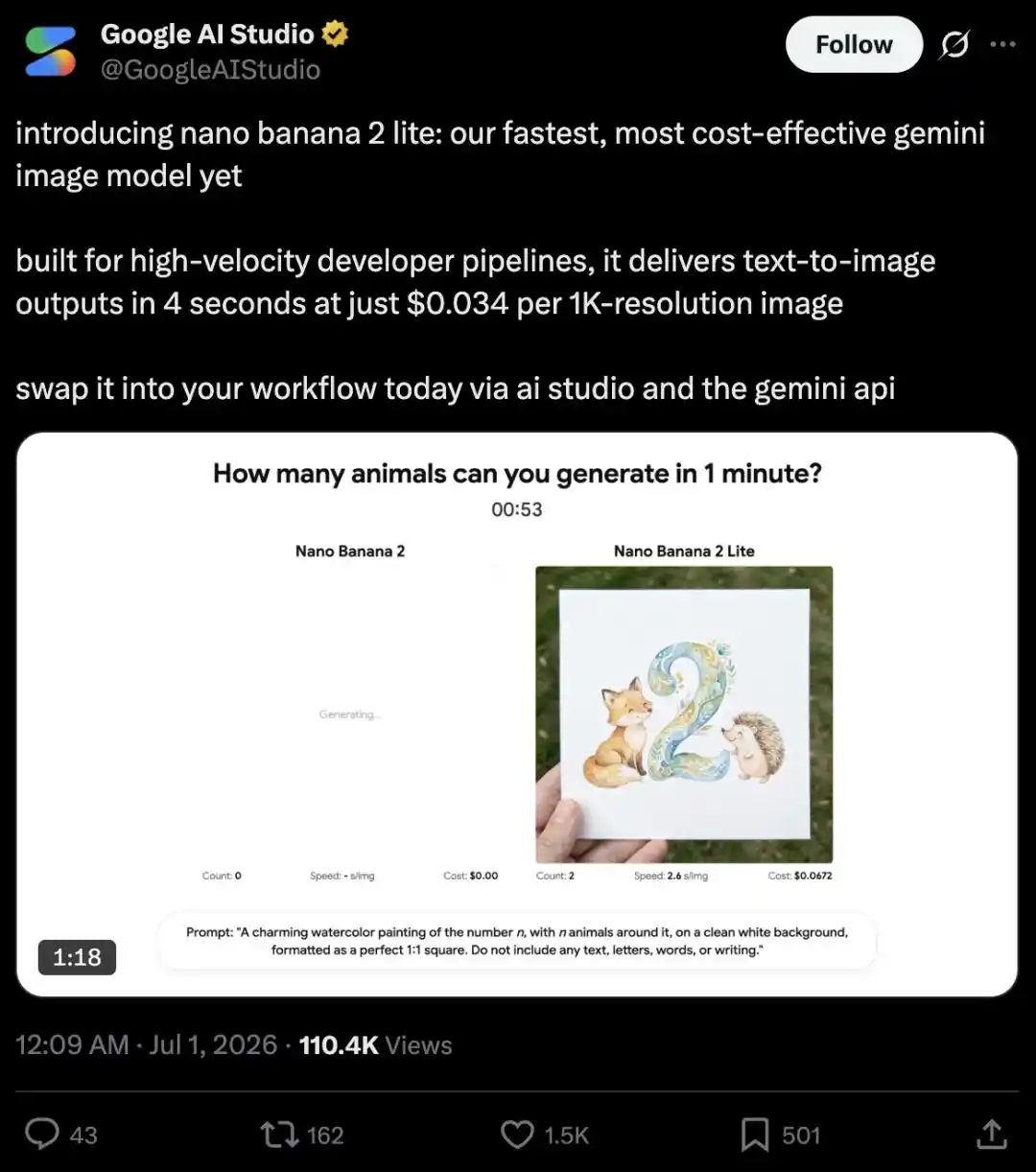
Compared side-by-side with Nano Banana 2, this speed is practically taking off.

Not to mention GPT Image 2, which takes 3 minutes for a single image generation...

No wonder Gemini 3.5 Pro hasn't been released yet—they probably spent all their time on their beloved multimodality, right, Hassabis!!

Gemini Omni Flash

First unveiled at Google I/O 2026, Gemini Omni Flash deeply integrates Gemini's multimodal reasoning capabilities with video generation and editing, garnering significant attention then.

Now, this model is officially available to developers via the Gemini API and Google AI Studio. It can easily generate and edit high-quality videos based on various inputs like text, images, and video.

Four key capabilities:

Conversational Video Editing: Modify and refine videos using natural language, just like editing a Lark document.

Multimodal Reference: Combine image, text, and video inputs to maintain scene control and consistency.

Real-World Knowledge: Leverage Gemini's knowledge in history, biology, narrative logic, etc., to construct videos, saving you from writing three pages of prompts to describe architectural styles.

Text and Action Synchronization: Connect text and graphics directly to video actions through simple prompts.
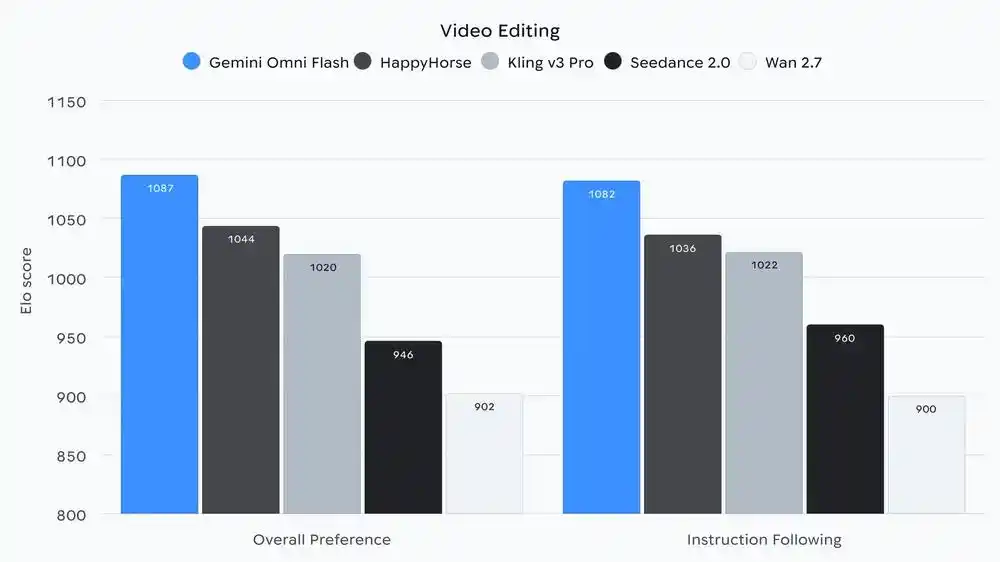
The pricing is also very competitive: $0.10 per second of video output, on par with Veo 3.1 Fast.

In terms of positioning, Omni Flash, also a lightweight video generation model, emphasizes Gemini's world knowledge and fully aligns with the Gemini ecosystem.

But Google is also quite candid, proactively listing a bunch of current limitations:

1. Currently only supports 10-second video generation; longer support will come later.

2. Does not yet support audio reference uploads or scene expansion.

3. The API supports video reference uploads up to 3 seconds, but the model currently cannot correctly process such inputs.

4. There are still limitations in character consistency during scene changes and camera movements.

Nano Banana 2 Lite

Nano Banana 2 Lite (also known as gemini-3.1-flash-lite-image) is designed specifically for high-speed processing.

Through targeted optimization, it aims at real-time application scenarios that are extremely sensitive to latency and require processing large volumes of images in a short time—such as bulk generation of e-commerce materials, rapid iteration of ad creatives, and automated content pipelines.

Two core selling points—

Lightspeed: Image generation latency is about 4 seconds, one-fifth of Nano Banana 2's (which is about 20 seconds).

Dirt Cheap: A 1K image costs about $0.034, half the price of Nano Banana 2 and one-quarter of Nano Banana Pro.

Speed and price are cut, but image generation and editing capabilities haven't noticeably shrunk. Nano Banana 2 Lite still maintains excellent text rendering effects, benchmarking on par with models like Grok.
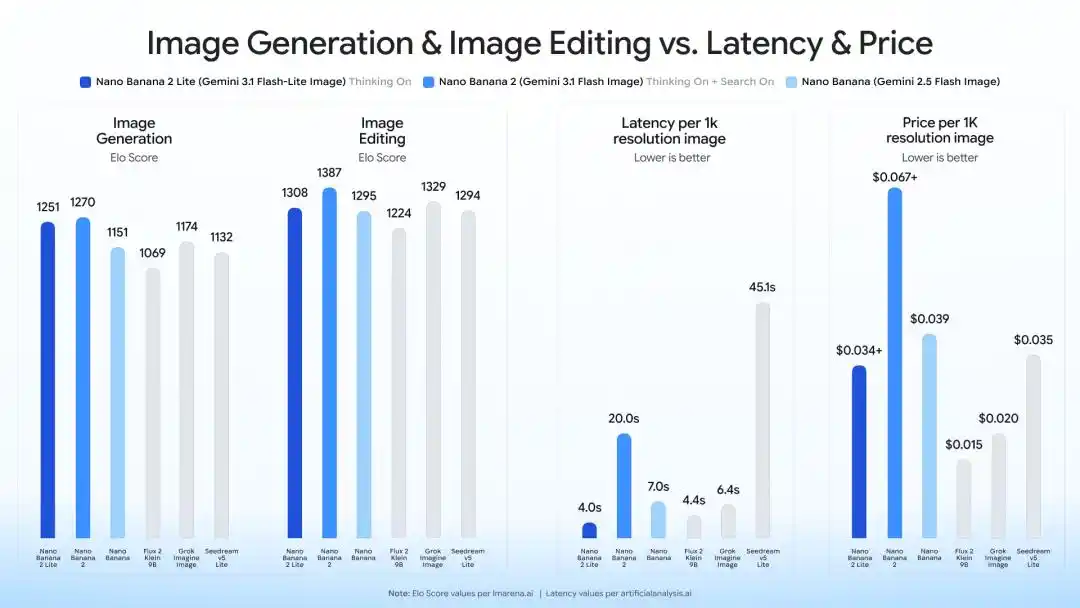
Therefore, Google's suggestion is: If you're still cheaping out with the first-gen Nano Banana, swap it now. The Lite version already comprehensively outperforms it in all key metrics.

Twin Blades United

Wait, hold on.

You might think this is just the parallel release of two models, but Google indicates there's more.

The real magic lies in chaining these models together.

As we all know, AIGC creation requires repeated iteration, and asset management can be quite troublesome.

Now, with these two models, you no longer need to repeatedly upload files—image generation and video creation are seamlessly connected.

Specifically, you can first use Nano Banana 2 Lite to generate images at high speed, then feed the generated images as reference material to Gemini Omni Flash to transform them into videos with one click.

To showcase this magical 1+1>2 workflow, Google even created 3 Demo APPs:

1、Anywhere

Take a selfie or upload a photo, and NB2 Lite instantly Photoshopped you into dozens of landmark scenes.

Then click on the image, and Omni Flash turns the static scene into a dynamic short video.

Cyber tourism, now also end-to-end.

2、Space Lift

This is a bit scary. Combined with the Genie world model in the future, it might threaten many traditional interior design SaaS companies.

Upload a photo of a room. NB2 Lite first generates various interior design styles. Find one you like, click the video button, and Omni can directly create a cinematic space walkthrough for you.

3、Omni product studio

A boon for cross-border e-commerce.

Take a white-background photo of a product. NB2 Lite generates various contextual product images. Omni Flash then turns the static images into e-commerce short videos.

From "product" to "advertising material", the entire chain runs automatically.

So, what's the use of multimodality anyway?

Google has surely been asked this countless times.

Especially in 2026, where Coding ability has become almost synonymous with model intelligence. Everyone is fiercely competing in Coding.

Obsessing over multimodality, for what?

Forget the whole AGI narrative for a moment. In the short term, Google's suite of multimodal models can indeed empower many of its products—Stitch is one, the built-in photo editing in Pixel is another, and the emergence of NotebookLM was quite impressive.

The two new models released this time reveal even more potential for multimodality to land in vertical scenarios. E-commerce, interior design, short videos... the demand in these businesses is real, and so is the money.

Plus, with the Android ecosystem supporting it, there's little worry about commercialization.

Google might not catch up in Coding for now, but at the multimodality poker table, Google might be the only player with a full deck.

But...

When is Gemni 3.5 Pro coming out already!!!

Reference:[1]https://blog.google/innovation-and-ai/models-and-research/gemini-models/gemini-omni-flash-nano-banana-2-lite/

This article comes from the WeChat public account "QbitAI", author: Following Cutting-Edge Tech

Kripto yang Sedang Tren

Pertanyaan Terkait

QWhat are the two new Gemini models announced, and what are their primary functions?

ATwo new models are announced: Gemini Omni Flash and Nano Banana 2 Lite. Gemini Omni Flash is a multimodal video generation and editing model that can create videos from text, image, and video inputs. Nano Banana 2 Lite is an ultra-fast and cost-effective image generation model.

QWhat are the key features and performance claims for the Nano Banana 2 Lite image model?

ANano Banana 2 Lite is claimed to be the fastest and most cost-effective Gemini image model. It generates a 1K resolution image in about 4 seconds at a cost of approximately $0.034 per image. It maintains strong text rendering capabilities while being significantly faster and cheaper than its predecessor.

QHow does Gemini Omni Flash leverage its 'world knowledge' capability, and what is one of its stated limitations?

AGemini Omni Flash can call upon Gemini's knowledge in areas like history, biology, and narrative logic to inform video generation, reducing the need for detailed user prompts. One stated limitation is that it currently only supports generating videos up to 10 seconds in length, with longer support planned for the future.

QAccording to the article, how can the two models be used together in a workflow? Provide one example.

AThe models can be used in a seamless 'image-to-video' workflow. For example, you can first use Nano Banana 2 Lite to quickly generate an image (like a product scene). Then, you can feed that generated image as a reference directly into Gemini Omni Flash to create a video based on it, eliminating the need to manually upload files between steps.

QWhat is the article's perspective on Google's focus on multimodal AI compared to coding capabilities?

AThe article suggests that while Google may be lagging in the 'Coding' race (often used as a proxy for model intelligence), it is a strong contender in multimodal AI. It argues that multimodal models have clear, immediate commercial applications in fields like e-commerce and content creation, and Google, with its ecosystem, is well-positioned to capitalize on this.

Bacaan Terkait

XRP menampilkan sinyal beli teknis langka setelah berminggu-minggu mengalami penurunan – Apa yang berbeda kali ini?

XRP menunjukkan sinyal beli teknis langka dari indikator SuperTrend untuk pertama kalinya sejak pertengahan Juni, membangkitkan optimisme setelah pekan-pekan tekanan penurunan. Sinyal ini mengikuti fase korektif yang berkepanjangan dan mencerminkan pola yang sebelumnya mendahului reli harga 14%. Data on-chain Santiment mengungkapkan rasio MVRV 30-hari dan 365-hari XRP terjun ke level terendah sejarah, masing-masing -45% dan -47%, menunjukkan baik pemegang jangka pendek maupun panjang mengalami kerugian signifikan. Kondisi ekstrem ini, yang sering muncul setelah periode kapitulasi, justru dapat meningkatkan profil risk-reward jangka panjang dengan mengurangi tekanan jual. Namun, kekhawatiran muncul dari rasio NVT (Network Value to Transactions) yang melonjak 470,92% menjadi 194,71 dalam 24 jam, mengindikasikan valuasi pasar meningkat lebih cepat daripada aktivitas transaksi dasar. Ini menandakan pemulihan harga mungkin belum didukung oleh peningkatan penggunaan jaringan yang kuat. Secara teknis, XRP berhasil mempertahankan level support kunci di $1,0385 dan mencatatkan perdagangan di sekitar $1,1014. Indikator MACD pada grafik harian menunjukkan perbaikan dengan garis MACD melintas di atas garis sinyal, menandakan melemahnya tekanan bearish. Untuk mengonfirmasi tren bullish yang lebih luas, XRP perlu menembus resistan utama di level $1,2352.

ambcrypto4j yang lalu

XRP menampilkan sinyal beli teknis langka setelah berminggu-minggu mengalami penurunan – Apa yang berbeda kali ini?

ambcrypto4j yang lalu

Trading

Spot

Artikel Populer

Cara Membeli 4

Selamat datang di HTX.com! Kami telah membuat pembelian 4 (4) menjadi mudah dan nyaman. Ikuti panduan langkah demi langkah kami untuk memulai perjalanan kripto Anda.Langkah 1: Buat Akun HTX AndaGunakan alamat email atau nomor ponsel Anda untuk mendaftar akun gratis di HTX. Rasakan perjalanan pendaftaran yang mudah dan buka semua fitur.Dapatkan Akun SayaLangkah 2: Buka Beli Kripto, lalu Pilih Metode Pembayaran AndaKartu Kredit/Debit: Gunakan Visa atau Mastercard Anda untuk membeli 4 (4) secara instan.Saldo: Gunakan dana dari saldo akun HTX Anda untuk melakukan trading dengan lancar.Pihak Ketiga: Kami telah menambahkan metode pembayaran populer seperti Google Pay dan Apple Pay untuk meningkatkan kenyamanan.P2P: Lakukan trading langsung dengan pengguna lain di HTX.Over-the-Counter (OTC): Kami menawarkan layanan yang dibuat khusus dan kurs yang kompetitif bagi para trader.Langkah 3: Simpan 4 (4) AndaSetelah melakukan pembelian, simpan 4 (4) di akun HTX Anda. Selain itu, Anda dapat mengirimkannya ke tempat lain melalui transfer blockchain atau menggunakannya untuk memperdagangkan mata uang kripto lainnya.Langkah 4: Lakukan trading 4 (4)Lakukan trading 4 (4) dengan mudah di pasar spot HTX. Cukup akses akun Anda, pilih pasangan perdagangan, jalankan trading, lalu pantau secara real-time. Kami menawarkan pengalaman yang ramah pengguna baik untuk pemula maupun trader berpengalaman.

775 Total TayanganDipublikasikan pada 2025.10.20Diperbarui pada 2026.06.02

Cara Membeli 4

Diskusi

Selamat datang di Komunitas HTX. Di sini, Anda bisa terus mendapatkan informasi terbaru tentang perkembangan platform terkini dan mendapatkan akses ke wawasan pasar profesional. Pendapat pengguna mengenai harga 4 (4) disajikan di bawah ini.

活动图片