Critical Game Week: BTC Retracement Confirmation vs. HYPE Support Battle | Guest Analysis

marsbitDipublikasikan tanggal 2026-06-22Terakhir diperbarui pada 2026-06-22

Abstrak

This weekly analysis outlines a critical juncture for BTC and HYPE markets, focusing on key price level confirmations. **BTC Analysis:** BTC is at a pivotal point after a five-wave rally from the June 5th low of $59,100. The price has broken below a short-term rising channel's lower boundary, with the current move seen as a pullback to test this breakdown. Failure to reclaim this level could lead to a retest of the $59,000-$60,000 support zone. The core scenario hinges on this channel retest outcome. * **Key Levels:** Resistance at $64,500-$65,000 (channel boundary) and $69,500-$70,500. Support at $59,000-$60,000 and $55,000. * **Strategy:** A core bearish stance is maintained (20% short from last week), with short-term plans for tactical trades. Three detailed contingency plans (A/B/C) are provided for short positions on resistance tests or breakdowns, emphasizing strict stop-loss discipline. **HYPE Analysis:** HYPE shows strong momentum but is currently in a corrective phase after hitting a new high of $76.94. The price is retesting the crucial $64-$66 support area. * **Key Levels:** Resistance near $77 and $80-$82. Support at $64-$66 and $52-$54. * **Strategy:** The short-term approach is "buy on dips, avoid chasing rallies." A long position is considered only if clear stabilization signals appear at the $64-$66 or deeper $52-$54 support zones, with tight risk controls. **General Risk Management:** A standardized trailing stop-loss protocol is emphasized: set in...

This week, the market enters a critical phase of contention.

At the macro level, marginal changes in Federal Reserve policy expectations continue to dictate the pricing rhythm of risk assets. In the crypto market, after the previous period of consolidation, the divergence between bulls and bears is intensifying around key price levels.

This weekly review maintains the consistent framework: based on multi-timeframe structural analysis and combined with quantitative model signals, it assesses the market outlook for BTC and HYPE this week and formulates specific short- to medium-term trading plans.

It is crucial to note that all content herein represents personal technical analysis records, serving solely as a reference framework and review basis for my own trading decisions, and does not constitute any form of investment advice. The market is always more complex than predictions. Strict adherence to risk control and stop-loss discipline remains the top priority.

Summary of Core Trading Views for This Week:

  • BTC Hourly Timeframe Structure Analysis (Detailed in Part 1)
  • BTC Weekly Outlook & Medium/Short-Term Trading Strategies (Detailed in Part 2)
  • HYPE Hourly Timeframe Structure Analysis (Detailed in Part 3)
  • HYPE Weekly Outlook & Short-Term Trading Strategy (Detailed in Part 4)

Market Verification of Last Week's Trading Strategies & Core Views:

  • BTC Market Outlook Verification: Last week, strictly following trading discipline, we promptly established an approximately 20% short position when market entry opportunities emerged. The medium-term trading plan outlined in the weekly review article was executed.

I. In-depth Analysis of Bitcoin's Hourly Timeframe Structure

Bitcoin _4-Hour K-line Chart
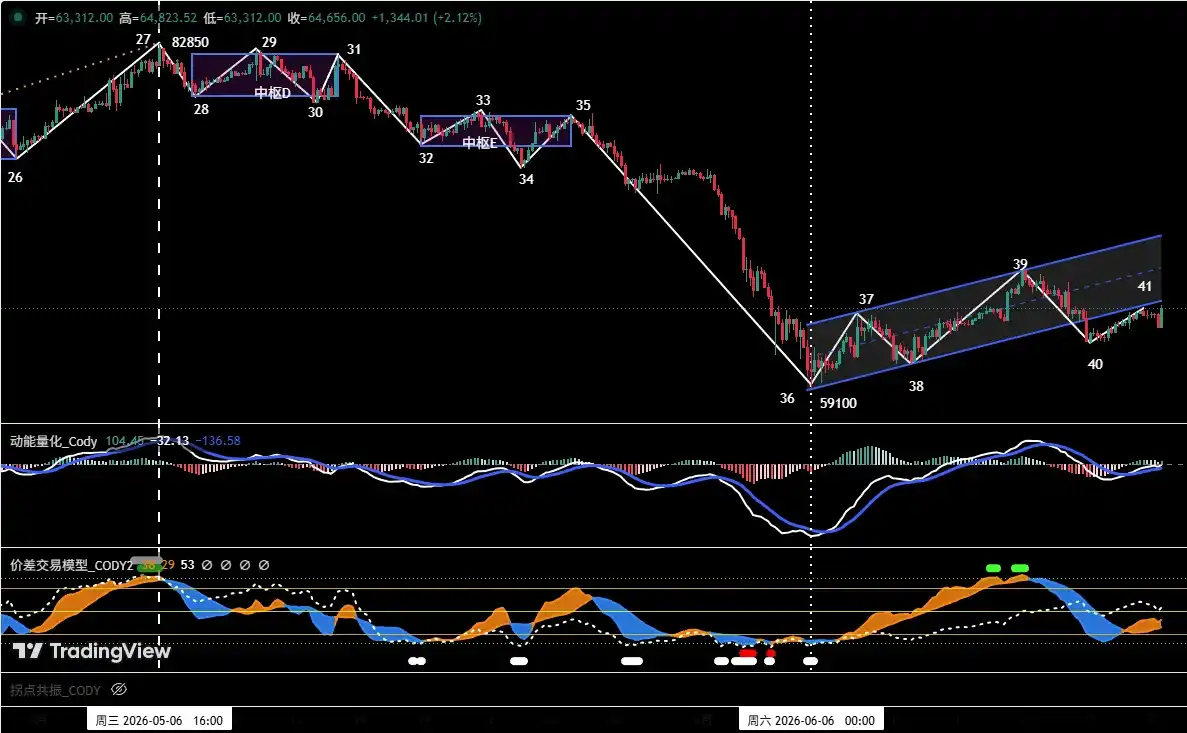
Figure 1

1 As shown in (Figure 1): From a 4-hour structural perspective, the price rebound initiated from the June 5th low of $59,100 can be subdivided into a five-wave structure, corresponding sequentially to segments 36-37, 37-38, 38-39, 39-40, and 40-41.

2 The overall trend presents a short-term rising channel pattern (blue channel in the chart): its upper bound is formed by connecting the two rebound highs at (point 37) and (point 39), while the lower bound is established by connecting the two correction lows at (point 36) and (point 38). The chart shows that the price has already breached the channel's lower bound at (point 40). The current (40-41) rebound segment can be viewed as a retracement confirmation phase for the breakdown below the channel's lower bound. If (point 41) fails to decisively reclaim a position above the channel's lower bound, the probability of the price revisiting the previous low support around $59,100 will significantly increase.

II. Bitcoin Weekly Outlook and Trading Strategies

1. BTC Weekly Market Outlook:

Core View for the Week: Focus on the outcome of the price's retracement confirmation of the short-term channel's lower bound.

  • If it holds firmly above, the price may continue its rebound along the short-term rising channel, potentially challenging the core resistance zone of $69,500~$70,500.
  • If it fails to hold, the market may retest the core support zone of $59,000~$60,000.

2. Core Resistance Levels:

  • First Resistance Zone: $64,500~$65,000 area (near the short-term rising channel's lower bound)
  • Second Resistance Zone: $69,500~$70,500 area (previous high-volume congestion zone)

3. Core Support Levels:

  • First Support Level: $59,000~$60,000 area (previous significant support level)
  • Second Support Level: Around $55,000 (previous significant support level)

4. Trading Strategies for This Week (Excluding Unexpected News Impact)

1 Medium-Term Strategy:

Bitcoin _ Daily K-line Chart (Position Monitoring Model)
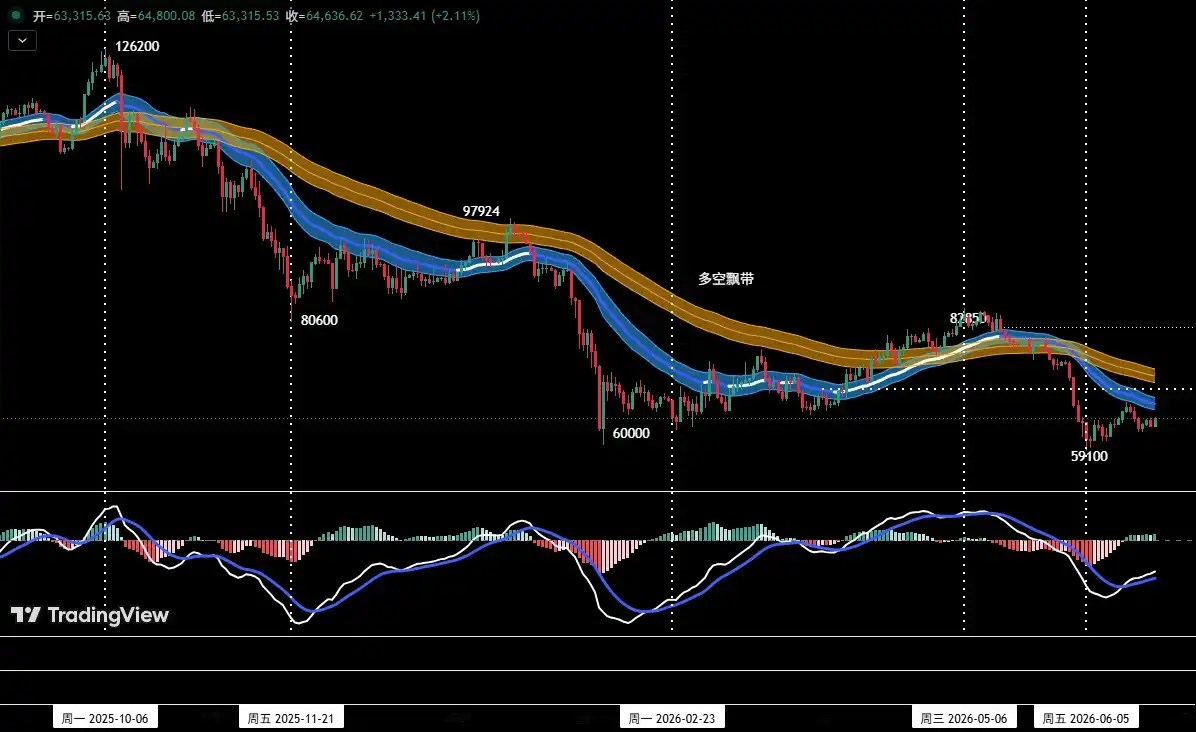
Figure 2

Position Monitoring Model: As shown in (Figure 2), the current price has decisively broken below the "Bull-Bear Channel," confirming a shift in market structure to a bear-dominated regime. Following the pre-set plan last week, we entered a short position around $64,500, with the initial medium-term position controlled at approximately 20% of total capital. Subsequent actions will adhere to stop-loss discipline, awaiting the next opportunity to add to the position.

2 Short-Term Strategy: Utilize 30% of capital, set stop-loss points, and seek "spread" trading opportunities based on support and resistance levels (using 30-minute/60-minute cycles).

3 To dynamically respond to the market's complex evolution in short-term operations, we have pre-formulated three specific contingency plans: A, B, and C.

Plan A: Tentative Positioning in Resistance Zone

  • Entry: If the price rallies to the $64,500~$65,000 zone showing signs of exhaustion, combined with a quantitative model top signal, an initial short position of around 15% can be established.
  • Risk Control: Set an initial stop-loss.
  • Exit: When the correction approaches significant support levels and aligns with model signals, gradually close positions to take profits.

Plan B: Adding to Position in Strong Resistance Zone

  • Addition: If the price breaks above the $65,000 resistance and continues to rally to the $69,500~$70,500 zone showing pressure signs, combined with a quantitative model top signal, increase the short position to within 30%.
  • Risk Control: Set an initial stop-loss.
  • Exit: When the correction approaches significant support levels and aligns with model signals, gradually close positions to take profits.

Plan C: Following the Break Below Support to Add Shorts

  • Addition: If the price decisively breaks below the $65,000 support, continues its decline, and loses the $59,000~$60,000 support zone, consider adding to the short position (within 30%) when price shows weakness during a retracement confirmation.
  • Risk Control: Set an initial stop-loss.
  • Exit: When the decline reaches significant support levels and aligns with model signals, gradually close positions to take profits.

III. HYPE Hourly Timeframe Structure Analysis

HYPE_4-Hour K-line Chart
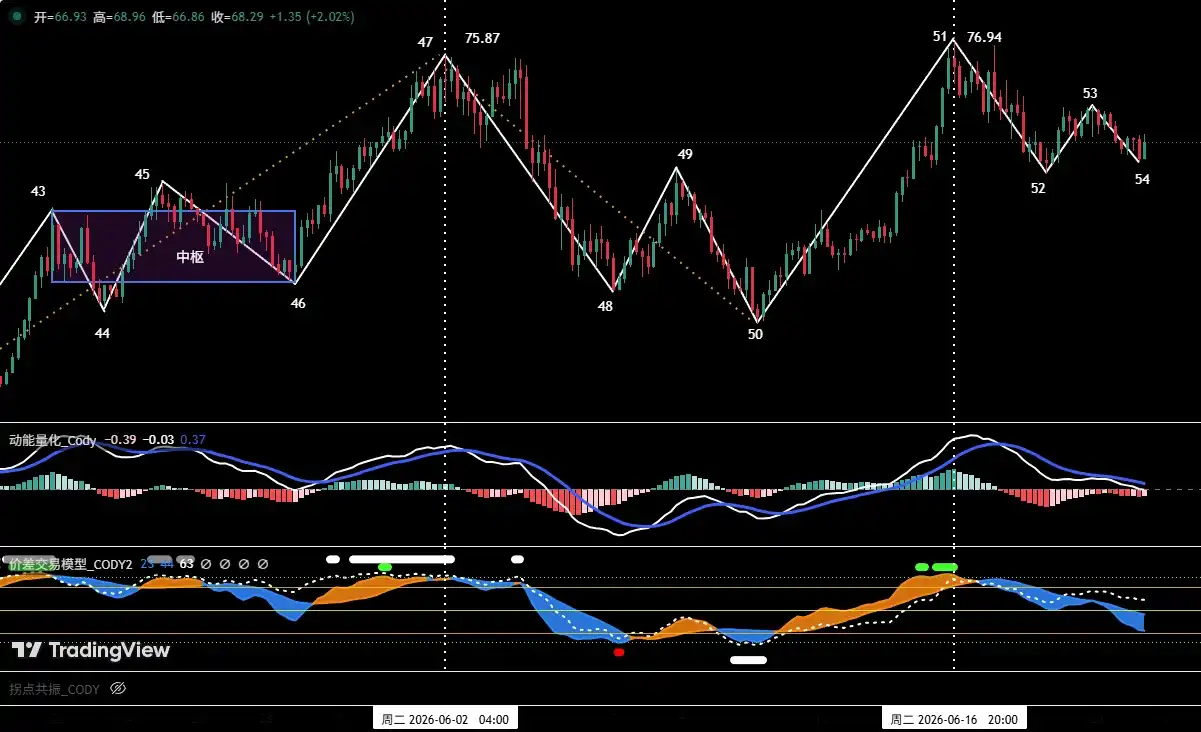
Figure 3

1 As shown in (Figure 3), on the 4-hour timeframe, HYPE initiated a correction from the June 2nd high of $75.87 (point 47), finding support near $52.62 (point 50) on June 10th, a correction lasting about 9 trading days. Subsequently, the market began a strong upward wave (segment 50-51), breaking the previous high within 6 trading days to reach a new high of $76.94 since the January rally, indicating that bullish momentum remains strong.

2 The decline from the new high presents a clear three-wave corrective structure (51-52, 52-53, 53-54). The price has currently retraced back to the critical support zone of $64~$66.

  • Bullish Scenario: If the price finds effective support in this zone, the uptrend from (point 50) is likely to continue, with subsequent prices challenging new highs.
  • Bearish Scenario: If this level is lost, the correction period will extend, and the price may retest the core support band of $52~$54, which marks the starting point of the previous uptrend.

IV. HYPE Weekly Outlook and Short-Term Trading Strategy

1. HYPE Weekly Market Outlook:

1 Core Resistance Levels:

  • First Resistance Level: Around $77
  • Second Resistance Zone: $80~$82 area

2 Core Support Levels:

  • First Support Level: $64~$66 area
  • Second Support Level: $52~$54 area

Core View for HYPE This Week:

  • Observe the outcome of the battle between bulls and bears over the $64~$66 zone.

2. HYPE Short-Term Trading Strategy for This Week (Long on Support)

This week's short-term HYPE trading should adhere to the strategy of "buying the dip, avoiding chasing rallies."

Short-Term Strategy: Testing Longs on Support Zone Stabilization

When the HYPE price retests and finds support, showing signs of stabilization in the $64~$66 key support zone or the deeper $52~$54 zone, and this aligns with bottom signals triggered by the two models, consider a light long position trial. Position size must be controlled below 30%, and strict stop-loss discipline must be maintained.

V. Special Notes:

  1. Upon Entry: Immediately set the initial stop-loss.
  2. Upon Reaching 1% Profit: Move the stop-loss to the entry price (break-even point), ensuring capital safety.
  3. Upon Reaching 2% Profit: Move the stop-loss to the position of 1% profit.
  4. Continuous Tracking: Thereafter, for every additional 1% profit gained, move the stop-loss up by 1%, dynamically protecting and locking in profits.

Financial markets change rapidly. All market analysis and trading strategies require dynamic adjustment. All views, analytical models, and operational strategies mentioned in this article are derived from personal technical analysis, intended solely for personal trading log purposes, and do not constitute any investment advice or operational basis. Markets involve risk, investment requires caution. Please do not make decisions based solely on this content.


Kripto yang Sedang Tren

Pertanyaan Terkait

QWhat is the key technical situation for Bitcoin according to the analysis?

AThe key technical situation for Bitcoin is its current position in a short-term rising channel on the 4-hour chart. The price has already broken below the channel's lower rail at point 40. The current move (40-41) is seen as a retest to confirm this break. If point 41 fails to hold above the lower rail, the probability of a retest of the previous low at $59,100 increases significantly.

QWhat are the two main scenarios for HYPE this week based on its price action?

AFor HYPE, there are two main scenarios based on its price action around the key support zone of $64-$66. In the bullish scenario, if the price finds effective support in this zone, the uptrend from point 50 is expected to continue, potentially challenging new highs. In the bearish scenario, if this support is decisively broken, the correction will likely extend, and the price may test the more critical support band of $52-$54.

QWhat is the core medium-term trading strategy for Bitcoin, and what action was already taken?

AThe core medium-term strategy for Bitcoin is bearish, as the price has broken below the 'Bull-Bear Channel' on the daily chart, confirming a market structure shift to bearish dominance. Following the plan, a short position of approximately 20% of total capital was established near $64,500 last week. The strategy involves holding this initial position while waiting for potential opportunities to add to it.

QAccording to the analysis, what is the primary short-term trading approach recommended for HYPE?

AThe primary short-term trading approach for HYPE is to 'buy on dips and avoid chasing rallies.' The specific strategy is to attempt long positions on support levels. When the price retests and shows signs of stabilization in the key support zones of $64-$66 or $52-$54, and this is confirmed by bottom signals from the analysis models, a light long position (under 30% of capital) can be considered, with strict adherence to stop-loss discipline.

QWhat are the three contingency plans (A, B, C) outlined for Bitcoin's short-term trading?

AThe three contingency plans for Bitcoin's short-term trading are: Plan A (Resistance Zone Test): Initiate a ~15% short position if the price shows signs of stalling in the $64,500-$65,000 resistance zone with a model top signal. Plan B (Strong Resistance Zone): Increase the short position to under 30% if the price rallies further and faces pressure in the $69,500-$70,500 zone with a model top signal. Plan C (Breakdown Follow-through): Add to the short position (to under 30%) if the price decisively breaks below $65,000 and then $59,000-$60,000 support, showing weakness on any retest.

Bacaan Terkait

AI Melanda Dunia, Mengapa Crypto + AI Terlihat Lesu?

**Ringkasan:** Meskipun AI melanda dunia, kombinasi Crypto + AI tampak suram. Analisis dari sisi permintaan mengungkap empat bidang utama dan tantangannya: 1. **Komputasi & Penyimpanan Terdesentralisasi:** Menawarkan kedaulatan data dan biaya potensial lebih rendah, tetapi belum memberikan keunggulan teknologi yang meyakinkan bagi perusahaan yang sudah terikat dengan penyedia cloud tradisional. Risiko ketidakstabilan menghalangi adopsi. 2. **Pasar Data & Validasi Model/Privasi:** Teknologi seperti ZKML memecahkan masalah transparansi dan kepemilikan data, tetapi ini bukan prioritas mendesak bagi bisnis saat ini. Permintaan kemungkinan akan mengikuti regulasi (misalnya, Undang-Undang AI UE). 3. **Infrastruktur Agen AI:** Mengembangkan dasar untuk interaksi otonom antar agen, tetapi fokus pasar saat ini adalah otomatisasi proses internal. Permintaan belum matang untuk infrastruktur tahap berikutnya ini. 4. **Pembayaran Agen AI:** Satu-satunya bidang di mana blockchain bersaing langsung dengan keuangan tradisional. Keduanya belum sepenuhnya memecahkan masalah pembayaran mikro real-time antar mesin. **Masalah Inti: Ketidaksesuaian Pasokan-Permintaan.** Visi blockchain (desentralisasi, transparansi) tidak selaras dengan kebutuhan mendesak industri AI (kinerja, stabilitas, ROI). Kurangnya kasus penggunaan percontohan skala besar semakin menghambat adopsi. **Nilai Jangka Panjang:** Kombinasi ini memiliki logika yang kuat, tetapi perkembangannya bergantung pada kemampuannya beradaptasi dengan kebutuhan pasar saat ini atau menunggu permintaan masa depan (seperti ekonomi agen otonom) menjadi matang. Jalannya akan ditentukan oleh keselarasan dengan kebutuhan pasar yang nyata.

Foresight News8m yang lalu

AI Melanda Dunia, Mengapa Crypto + AI Terlihat Lesu?

Foresight News8m yang lalu

ETF Alami Keluar Bersih Berkelanjutan, Apakah Institusi Sedang Keluar?

Selama enam minggu terakhir, dana ETF Bitcoin spot ASR mengalami arus keluar bersih sekitar $6 miliar, mencatat periode mingguan terpanjang dengan penurunan sejak diluncurkan pada tahun 2024. IBIT milik BlackRock, dana terbesar, menjadi penyumbang utama, dengan $1,3 miliar mengalir keluar dalam satu minggu terakhir saja. Data on-chain menunjukkan penjualan terutama berasal dari dana konfigurasi yang membeli ETF melalui akun broker, bukan dari pemegang jangka panjang (>155 hari) yang masih menguasai ~83% pasokan yang beredar. Perilaku ini menyerupai penyesuaian portofolio untuk mengurangi risiko (*de-risking*) karena meningkatnya inflasi, suku bunga, dan aliran modal ke sektor lain seperti infrastruktur AI dan IPO. Kerugian yang direalisasi melonjak 78%, dengan banyak penjual menjual pada kisaran biaya $55.000-$68.000. Meski kecepatan arus keluar melambat signifikan (dari $1,72 miliar menjadi $226,8 juta), tekanan struktural tetap ada karena skala besar IBIT menciptakan tekanan jualnya sendiri. Tanpa pembeli baru yang masuk dari sisi ETF atau pasar spot, harga sulit bertahan. Arah pasar selanjutnya bergantung pada apakah arus keluar IBIT melambat dan Bitcoin dapat bertahan di atas $60.000, atau jika penjualan besar berlanjut dan harga jatuh di bawah $58.000, yang akan menguji kemampuan pembeli non-ETF dalam menyerap tekanan jual. ETF, meski mempermudah akses, tidak menghilangkan volatilitas aset.

marsbit51m yang lalu

ETF Alami Keluar Bersih Berkelanjutan, Apakah Institusi Sedang Keluar?

marsbit51m yang lalu

Konsep Model Dunia untuk Pemula: Sebuah Kisah dari Psikologi hingga Medan Utama AI

**Ringkasan Konsep Model Dunia: Dari Psikologi ke Medan Utama AI** Model Dunia adalah konsep yang sangat hangat di dunia AI namun sering membingungkan banyak orang. Pada dasarnya, model dunia bertujuan memberi mesin "papan pasir mental" untuk mensimulasikan dan memprediksi kejadian di dunia nyata sebelum bertindak. Kemampuan ini, yang dalam psikologi disebut "model mental", memungkinkan AI berlatih dan bereksperimen secara virtual, mengurangi ketergantungan pada data dunia nyata yang mahal dan terbatas. Konsep ini berakar dari ide psikolog Kenneth Craik (1943) tentang bagaimana otak membangun model internal untuk memprediksi peristiwa. Di AI, pionir seperti Marvin Minsky dengan "Teori Kerangka" dan peneliti seperti David Ha serta Jürgen Schmidhuber (2018) menghidupkan kembali konsep ini dalam pembelajaran mendalam. Para ahli memiliki pandangan berbeda: * **Yann LeCun** (Meta) mengkritik LLM dan mengadvokasi model prediktif seperti JEPA yang memahami struktur fisika dunia, bukan hanya menghasilkan konten. * **Fei-Fei Li** (Stanford/World Labs) mengklasifikasikan model dunia menjadi tiga jenis berdasarkan siklus "aksi-observasi": **Perender** (menghasilkan piksel/visual), **Simulator** (menghasilkan status dunia dengan akurasi struktural/fisik), dan **Perencana** (menghasilkan aksi). * **Tim FIB-Lab Tsinghua** membaginya menjadi dua fungsi inti: **Memahami Dunia** (mendukung pengambilan keputusan) dan **Memprediksi Masa Depan** (menghasilkan status/video masa depan). Perusahaan teknologi besar juga mendefinisikannya sesuai kebutuhan: * **OpenAI** menyebut **Sora** sebagai "simulator dunia" berbasis video. * **Google DeepMind** membangun **Genie 3** sebagai model dunia 3D interaktif waktu-nyata. * **NVIDIA** mengembangkan **Cosmos** sebagai platform "model fondasi dunia" untuk AI fisik. * **Perusahaan China** seperti Alibaba, Tencent, Huawei, dan pembuat mobil (NIO, XPeng, Li Auto) mengembangkan solusi serupa untuk simulasi mengemudi, robotika, dan dunia virtual, meski sering menggunakan nama berbeda. Secara teknis, ada tiga jalur pendekatan utama: 1. **"Melukis" (Generatif)**: Model pembuat video seperti Sora. Keunggulan visual, tetapi konsistensi fisika lemah. 2. **"Kalkulasi Mental" (Prediktif Abstrak)**: Seperti JEPA LeCun. Memprediksi representasi abstrak, efisien dan lebih stabil mempelajari fisika, tetapi kurang terinterpretasi. 3. **"Menyusun Balok" (Simulasi 3D Eksplisit)**: Seperti NVIDIA Omniverse. Menghasilkan lingkungan 3D dengan properti geometri dan fisika. Tepat dan dapat dikontrol, tetapi memerlukan data khusus dan mahal. Perkembangan terkini bergerak menuju **Model Aksi Dunia (WAM)** yang menggabungkan prediksi keadaan masa depan dan pembuatan aksi dalam satu model, mencapai "pengetahuan dan tindakan yang selaras" untuk robotika. Industri model dunia mulai terbentuk dalam tiga lapisan: * **Lapisan Dasar**: Data, daya komputasi (didominasi GPU NVIDIA), dan sensor. * **Lapisan Platform Teknis**: Platform serbaguna (Omniverse, Pangu) dan platform vertikal (untuk mobil otonom, konstruksi). * **Lapisan Aplikasi**: Mobil otonom (paling matang), robotika, game, konstruksi cerdas, layanan spasial, simulasi medis. Kekacauan dalam penamaan dan definisi sebenarnya adalah tanda awal revolusi teknologi, mirip dengan fase awal komputasi awan atau AI. Semua pendekatan, meski berbeda, mengarah pada tujuan yang sama: memberdayakan mesin dengan model internal dunia yang dapat disimulasikan untuk bertindak lebih aman, efisien, dan cerdas di dunia nyata. Konsep akan menyatu ketika teknologinya matang. Saat ini, ketidakseragaman justru menandakan bahwa model dunia telah memasuki medan pertempuran utama pengembangan AI.

marsbit1j yang lalu

Konsep Model Dunia untuk Pemula: Sebuah Kisah dari Psikologi hingga Medan Utama AI

marsbit1j yang lalu

IBIT Alami Outflow Rp 185 Triliun dalam Seminggu, ETF Bitcoin Terbesar Berubah Menjadi Tembok Tekanan Jual yang Harus Ditembus Bull

IBIT, ETF Bitcoin terbesar dari BlackRock, menyumbang 73% dari total aliran keluar bersih ETF Bitcoin spot AS pekan lalu, dengan penarikan dana sebesar $1,3 miliar dalam satu minggu. Hal ini mengubah narasi ETF yang sebelumnya menjadi saluran masuk utama modal institusional menjadi sumber tekanan jual potensial. Aliran keluar yang terkonsentrasi di produk terbesar dan paling likuid ini menguji ketahanan Bitcoin di level kritis sekitar $60.000. Data dari Farside Investors menunjukkan bahwa pada sesi perdagangan 26 Juni, seluruh aliran keluar bersih harian sebesar $444,5 juta berasal dari IBIT. Tekanan ini muncul saat harga Bitcoin sudah tertekan, memperumit upaya pemulihan. Mekanisme ETF memungkinkan penebusan dilakukan baik secara tunai maupun dalam bentuk Bitcoin fisik, sehingga aliran keluar tidak selalu sama dengan penjualan spot langsung. Namun, ini menciptakan risiko transmisi dan pertanyaan tentang siapa yang akan menyerap likuiditas jika pemegang ETF terus keluar. Skenario ke depan terbagi dua: Jika aliran keluar IBIT melambat dan Bitcoin berhasil bertahan di atas $59.000-$62.000, tekanan pekan ini dapat dilihat sebagai proses pembersihan. Namun, jika IBit terus mendominasi aliran keluar dan Bitcoin gagal reclaim level $60.000, narasi "dinding tekanan jual" akan menguat, mengharuskan pembeli di luar ekosistem ETF untuk menopang pasar tanpa bantuan narasi permintaan institusional yang sebelumnya didorong oleh ETF. Hari-hari perdagangan mendatang akan menentukan jalurnya.

marsbit2j yang lalu

IBIT Alami Outflow Rp 185 Triliun dalam Seminggu, ETF Bitcoin Terbesar Berubah Menjadi Tembok Tekanan Jual yang Harus Ditembus Bull

marsbit2j yang lalu

Trading

Spot

Artikel Populer

Cara Membeli HYPE

Selamat datang di HTX.com! Kami telah membuat pembelian Hyperliquid (HYPE) menjadi mudah dan nyaman. Ikuti panduan langkah demi langkah kami untuk memulai perjalanan kripto Anda.Langkah 1: Buat Akun HTX AndaGunakan alamat email atau nomor ponsel Anda untuk mendaftar akun gratis di HTX. Rasakan perjalanan pendaftaran yang mudah dan buka semua fitur.Dapatkan Akun SayaLangkah 2: Buka Beli Kripto, lalu Pilih Metode Pembayaran AndaKartu Kredit/Debit: Gunakan Visa atau Mastercard Anda untuk membeli Hyperliquid (HYPE) secara instan.Saldo: Gunakan dana dari saldo akun HTX Anda untuk melakukan trading dengan lancar.Pihak Ketiga: Kami telah menambahkan metode pembayaran populer seperti Google Pay dan Apple Pay untuk meningkatkan kenyamanan.P2P: Lakukan trading langsung dengan pengguna lain di HTX.Over-the-Counter (OTC): Kami menawarkan layanan yang dibuat khusus dan kurs yang kompetitif bagi para trader.Langkah 3: Simpan Hyperliquid (HYPE) AndaSetelah melakukan pembelian, simpan Hyperliquid (HYPE) di akun HTX Anda. Selain itu, Anda dapat mengirimkannya ke tempat lain melalui transfer blockchain atau menggunakannya untuk memperdagangkan mata uang kripto lainnya.Langkah 4: Lakukan trading Hyperliquid (HYPE)Lakukan trading Hyperliquid (HYPE) dengan mudah di pasar spot HTX. Cukup akses akun Anda, pilih pasangan perdagangan, jalankan trading, lalu pantau secara real-time. Kami menawarkan pengalaman yang ramah pengguna baik untuk pemula maupun trader berpengalaman.

391 Total TayanganDipublikasikan pada 2024.12.11Diperbarui pada 2026.06.02

Cara Membeli HYPE

Diskusi

Selamat datang di Komunitas HTX. Di sini, Anda bisa terus mendapatkan informasi terbaru tentang perkembangan platform terkini dan mendapatkan akses ke wawasan pasar profesional. Pendapat pengguna mengenai harga HYPE (HYPE) disajikan di bawah ini.

活动图片