Xpeng and NIO Compete on Computing Power, Li Auto Shifts Architecture

marsbitDipublikasikan tanggal 2026-06-16Terakhir diperbarui pada 2026-06-16

Abstrak

On June 15, 2026, Li Auto unveiled details of its self-developed chip, Mahe M100, for its new L9 Livis model. CTO Xie Yan stated the goal was not just a faster chip, but a fundamentally different one, targeting the chip architecture itself. While competitors like NIO, Xpeng, and Huawei highlight TOPS (computing power) figures for their self-developed chips, Li Auto’s Mahe M100 focuses on redesigning the underlying architecture. It employs a "dynamic data flow architecture" to address memory bandwidth bottlenecks in large model inference, claiming up to 3x the effective computing power of Nvidia's Thor U for its specific workloads and a 40% reduction in latency. The chip's design was peer-reviewed and accepted at ISCA 2026. However, this performance is highly optimized for Li Auto's own VLA2.1 algorithm, meaning it may not generalize as well to other tasks. Li Auto aims to achieve full-stack in-house development with Mahe M100, covering chip, compiler, OS, AI algorithms, and domain controller—a level of vertical integration few competitors match. Beyond the chip, CEO Li Xiang introduced a new strategic narrative: the "embodied intelligent vehicle," defined as an integration of an EV, a professional driver, an AI computer, and a life assistant. This shifts competition from features like large screens to systemic AI capabilities. A key commitment was that Li Auto's Mahe VLA autonomous driving model will match Tesla's FSD V14 by Q4 2026, with specific OTA milestones set for J...

On June 15th, Li Auto detailed the specifics of its in-house developed chip, Mahe M100, during a launch event. This chip is designed for the next-generation L9 Livis. CTO Xie Yan emphasized: It's not just about creating a chip that's faster than before, but about creating a fundamentally different type of chip. This 'difference' refers to the chip architecture.

In 2026, amidst a wave of automakers developing their own chips, TOPS is the most commonly used marketing metric. The NIO Shenji NX9031, Xpeng Turing, and Huawei MDC 810 Pro all prominently feature their computational power figures. Li Auto has chosen to fundamentally alter the underlying architecture.

The Mahe M100 aims to prove that architecture is more important than raw compute numbers. But whether it's right or not still needs to be tested by the market.

01. The Divergence in Chip Development Amidst Compute Power Inflation

Developing in-house chips has become a common choice for leading domestic automakers.

The NIO Shenji NX9031 is the world's first 5nm high-performance autonomous driving chip. Its special feature is its self-developed ISP, which improves pedestrian recognition rate by 40% in low-light conditions of 1 lux at night, showing significant reinforcement at the perception layer.

Xpeng's Turing chip also demonstrates clear customization, specifically designed for Xpeng's autonomous driving large model, with plans to extend to flying cars and robots.

Huawei has taken another path, using Ascend for MDC, emphasizing complete alignment between cloud training and vehicle-side inference, "one minute of training in the cloud, one minute of following in the vehicle."

These companies' chips are variants of the von Neumann architecture: a central processing unit, with data being shuttled back and forth between computing units and memory. The more advanced the process node, the faster the data moves, but the Mahe M100 aims to change the very act of moving data itself.

02. Altering the Underlying Logic

The von Neumann architecture wasn't a problem in the era of general-purpose computing, but large model inference is a different computational paradigm. VLM inference involves large-scale matrix parallelism, not sequential instruction execution. The bottleneck is almost entirely in memory bandwidth; the overhead of data repeatedly moving in and out of memory directly consumes a significant portion of the effective computing power.

The concept of the dynamic dataflow architecture is to allow data to flow along the computational graph, eliminating the need to repeatedly store it back in memory. Li Auto claims the result is that a single Mahe M100 chip offers approximately 3 times the effective computing power of NVIDIA's Thor U, with a 40% reduction in end-to-end latency.
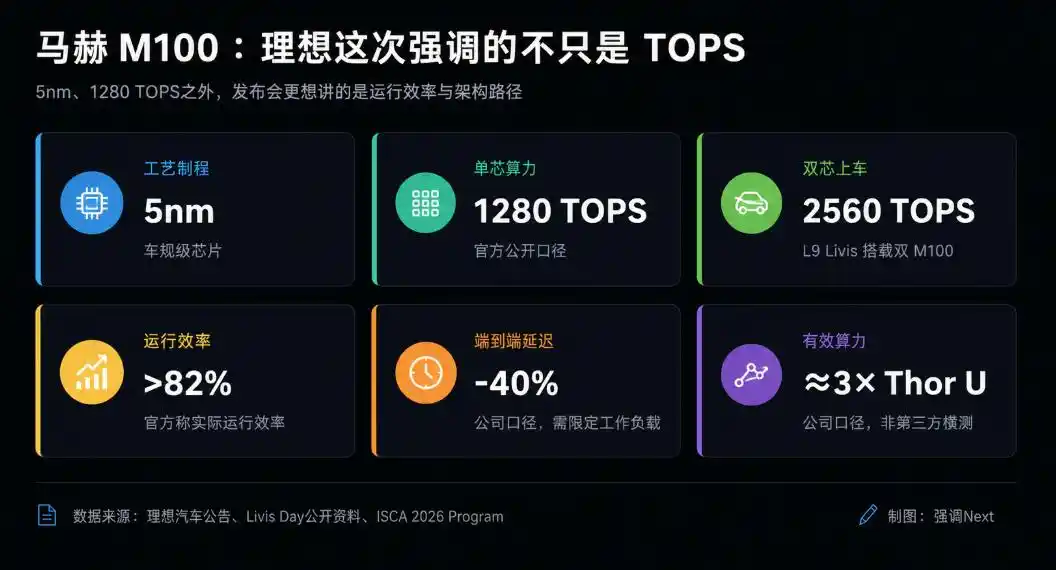
How credible is this "3 times" claim? There is one piece of external verification. The architecture paper for the Mahe M100 was accepted into the Industry Track of ISCA 2026. ISCA is a top-tier academic conference in computer architecture. Papers in the Industry Track undergo peer review, and the design details of the architecture are public. Li Auto is the first automobile manufacturer ever to be selected for this track since its establishment.

However, the 3x figure comes with its prerequisites. Effective computing power depends on the specific workload. The 3x performance achieved while running Li Auto's VLA2.1 algorithm may not hold up under a different system. The Mahe M100 is an algorithm-native chip, developed simultaneously with the model, deeply optimized for the company's own algorithms. It runs its own models best; performance on general tasks may vary.

This shares similarities with the design logic of Xpeng's Turing chip and Tesla's FSD Chip. The difference is that Tesla and Xpeng didn't make a paradigm shift at the architecture level; the Mahe M100 has made fundamental changes to the underlying logic. Whether an automaker can successfully bring a completely new architecture to reliable mass production is itself an unprecedented challenge.

With the deployment of the Mahe M100, Li Auto has achieved full-stack in-house development across chips, compilers, operating systems, AI algorithms, and domain controllers. This closed-loop system is uncommon among its peers.

NIO has its own chip but different levels of OS dependency. Xpeng develops its own chip but its compiler and OS still rely on external solutions. Huawei has a closed loop, but it is not a vehicle manufacturer. The strategic significance of Li Auto's chain lies in making it less susceptible to NVIDIA's supply chain control, keeping data within its own platform, and fully owning the optimization space for software-hardware synergy.

03. First-Mover Positioning in "Embodied AI"

The chip was only one of the stars of the launch event. Li Xiang also proposed a "Four-in-One" definition for embodied AI cars during the presentation: an electric vehicle, a professional driver, an AI computer, and a life assistant.

This marks a significant departure from Li Auto's past brand narrative.

In 2023, the L9 penetrated the 300,000 to 500,000 RMB market with its "Large Six-Seat Family SUV" positioning, followed by a generation of similarly styled models. The problem with this positioning is its low replication cost. Competitors like the AITO M9, NIO ES9, and Zeekr 9X have entered the fray. Refrigerators, screens, and large sofas have become industry standards, making it hard for any player to differentiate, leading only to price wars.

The "Embodied AI Car" shifts the competitive dimension from configurations to system capabilities. Within this framework, refrigerators and rear-seat screens are basic features. The differentiation point becomes "whose system can perceive, think, and grow." Defining a new category itself is a strategic asset; whoever articulates it first gains positioning.

Li Auto has matched this narrative with a relatively complete technological chain: the Mahe M100 computing foundation, the Mahe VLA2.1 autonomous driving large model, the Mahe Mind-Pro and Mind-Edge edge-side foundation models, and the Starlink OS for full-stack integration, with each layer having corresponding product implementations.

The launch event demonstrated features like the vehicle moving to music, a 4D racing simulator, and command-based parking – these are tangible experiences. Li Xiang also stated during the launch that autonomous driving is only the "first half" of embodied AI, with general-purpose humanoid robots being the "second half," but the specific timeline and implementation path for the second half remain unclear.

04. The Q4 Mandate

There was another crucial statement during the launch: Li Auto's autonomous driving large model, Mahe VLA, will comprehensively benchmark against Tesla's FSD V14 in Q4 of this year.

Li Xiang's consistent style is to make public commitments, using external pressure to drive internal execution. Having stated Q4 benchmarking against FSD V14, everyone will use that ruler to measure them by year-end.

In terms of technical route, Li Auto's choice is highly isomorphic to Tesla's: end-to-end + VLA large model + primarily vision-based. Huawei follows a path of lidar + multi-sensor fusion + a hybrid of rules and neural networks, offering stable short-term engineering implementation with lower compute demands. However, in the long run, if the vision-based + large model route ultimately prevails, Huawei's system may face greater switching costs. Li Auto is betting on the same technological belief as Tesla. Whether this judgment is correct will become clearer by year-end.

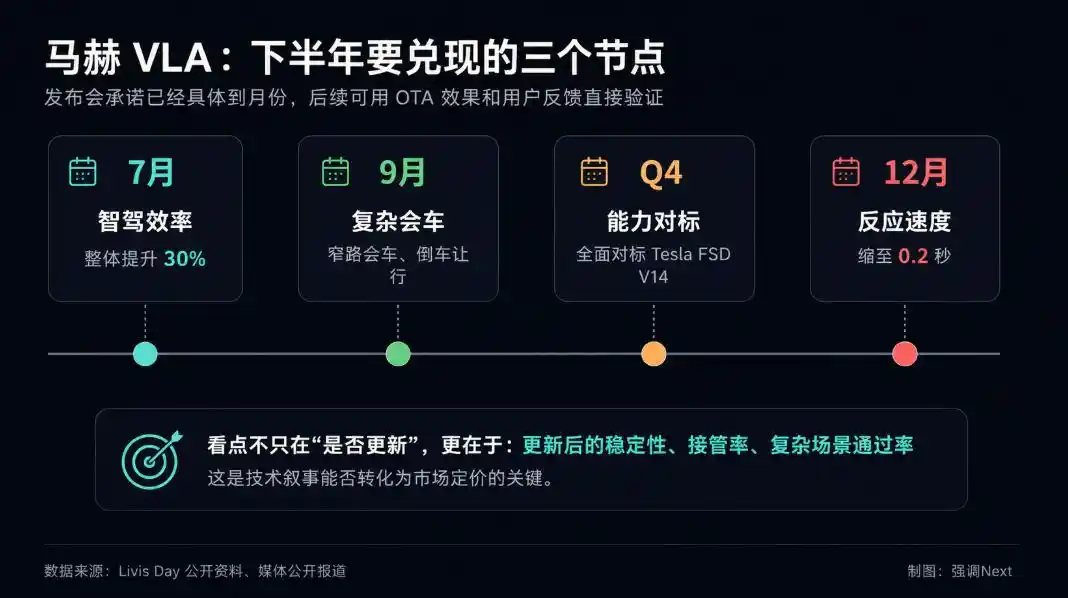
The OTA promises for the second half of the year are specified by month. July: a 30% improvement in autonomous driving efficiency. September: implementation of narrow-road meeting/backing-up yielding. December: vehicle response speed reduced to 0.2 seconds. Each milestone has clear technical indicators, providing data for comparison by year-end.
05. Several Data Points Beyond the Launch Event

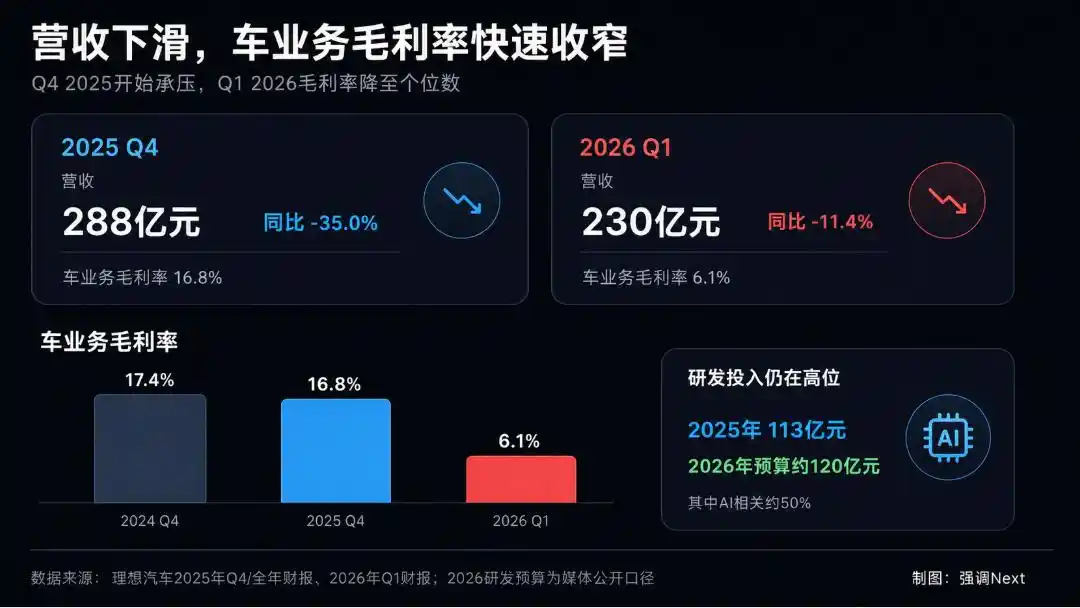
Li Auto's current financial situation is not easy. Since Q4 2025, its revenue has declined year-over-year, and automotive business gross margins have noticeably narrowed. Meanwhile, the R&D budget for 2026 remains around 12 billion RMB, with approximately 50% allocated to AI-related areas, essentially flat compared to 11.3 billion RMB and 50% in 2025. R&D investment is not decreasing, yet profitability pressure persists.
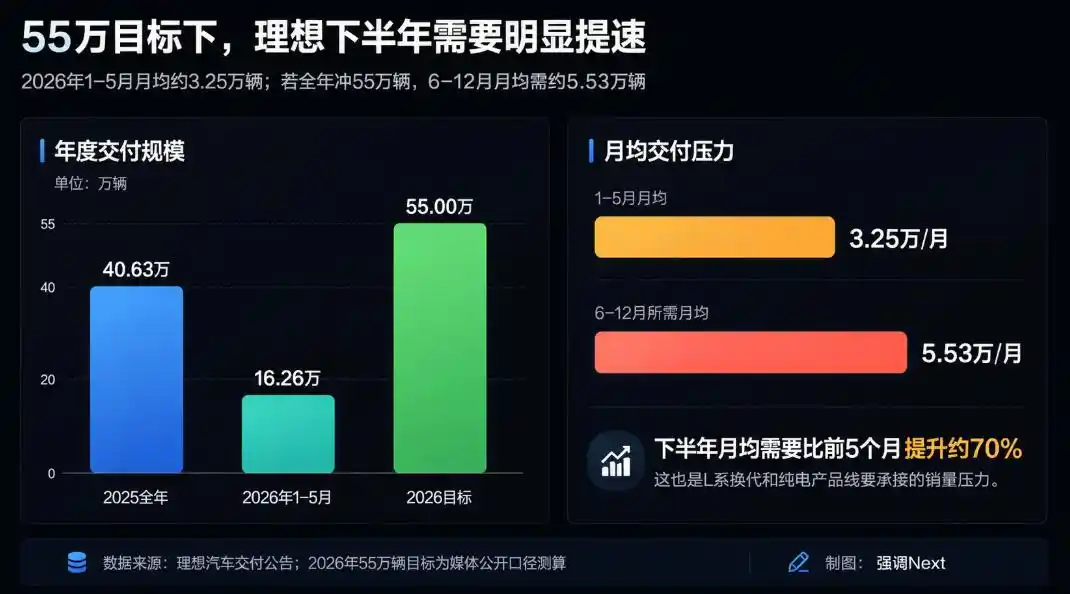
In terms of sales, Li Auto's target for 2026 is 550,000 units. Actual deliveries in 2025 were 406,000 units. May 2026 saw single-month deliveries of 33,000 units, still showing a year-over-year decline. The L9 Livis received over 10,000 non-refundable deposits within two weeks of launch, showing stable performance in the 500,000+ RMB market. However, overall delivery volume still relies on the full model changeover of the L series and the release of the pure electric product line in the second half of the year.
At the chip level, the deep binding of the Mahe M100 with its own algorithms is a design choice that brings advantages in software-hardware synergy efficiency. This also means that if future technological routes require adjustment, the switching cost would be higher than for manufacturers using third-party chip solutions. Xpeng's Turing, NIO's Shenji, and Tesla's FSD Chip face similar situations; this is an industry-wide characteristic of in-house developed, algorithm-native chips.

06. Q3 Will Reveal the Cards

The initial effects of the new L9 launch, the subsequent L8 update, and the first July OTA milestone will all be reflected in the Q3 financial report.

Xie Yan said he needed to create a completely different chip. Having the architecture paper pass peer review counts as external validation of the design concept. But the journey from design to mass production, and then to real user feedback in daily driving, is still long. The July OTA milestone is the first test; the year-end benchmarking against FSD V14 is an even more critical one.

This article is from the WeChat public account "EmphasizeNext" (ID: leo89203898), author: Yixiu, editor: Xiaobai


Pertanyaan Terkait

QWhat is the key design choice that differentiates Li Auto's self-developed Mach M100 chip from its competitors?

ALi Auto's Mach M100 chip adopts a dynamic dataflow architecture, moving away from the traditional von Neumann architecture. This approach focuses on reducing the data movement bottleneck (data shuttling between memory and compute units) inherent in AI model inference, aiming to improve effective computing power and lower latency, rather than just increasing raw TOPS.

QAccording to the article, what is Li Auto's strategic goal with its 'Embodied Intelligent Vehicle' concept, and how does it differ from its previous branding?

ALi Auto's strategic goal with the 'Embodied Intelligent Vehicle' concept is to shift the competitive dimension from hardware configurations (like large screens and refrigerators) to system capabilities in perception, reasoning, and growth. This differs from its previous 'family SUV' branding focused on space and comfort. The new concept aims to establish a new product category and gain a first-mover positioning in the evolving smart car market.

QWhat specific public commitment did Li Xiang make regarding Li Auto's autonomous driving technology for Q4 2026?

ALi Xiang committed that Li Auto's Mach VLA intelligent driving large model will be comprehensively benchmarked against Tesla's FSD V14 in the fourth quarter of 2026. This public commitment uses external pressure to drive internal execution, with the results being measurable by year-end.

QWhat are the potential advantages and risks associated with Li Auto's full-stack in-house development approach (chip, OS, AI algorithm, etc.)?

AAdvantages: It creates a closed-loop system that prevents supply chain constraints (e.g., from Nvidia), keeps data within its own platform, and allows for deep, autonomous software-hardware co-optimization. Risks: The chip is algorithm-native, deeply optimized for its own models. This creates high switching costs if future technology paths require significant changes, and it may not perform as well on generic tasks compared to more general-purpose chips.

QWhat financial and sales challenges does Li Auto face in 2026, according to the article?

AFinancially, Li Auto faces pressure with year-on-year revenue decline since Q4 2025 and narrowing gross margins for its vehicle business, while maintaining high R&D investment (around 12 billion RMB, 50% AI-related). Sales-wise, it aims for 550,000 deliveries in 2026, but actual 2025 deliveries were 406,000, and monthly deliveries in May were down year-on-year. It relies on the new L9 Livis and upcoming full-line model refreshes and pure-electric products to boost sales in the second half of the year.

Bacaan Terkait

Peta Ekosistem Privasi Solana: Tumpukan Privasi Lengkap dari Komputasi ke AI

**Ringkasan: Peta Ekosistem Privasi Solana, dari Komputasi hingga AI** Ekosistem privasi Solana masih dalam tahap awal. Untuk menciptakan tumpukan privasi yang matang dan dapat dikomposisikan, elemen-elemen seperti verifikasi formal, tanpa komite, kekekalan, dan kode sumber terbuka diperlukan. Arsitektur unik Solana memungkinkan skalabilitas tanpa bergantung pada rollup yang persisten. Dua bidang utama pengembangan privasi di Solana adalah Neobanks dan Private DeFi. Dari segi teknologi, solusi akhir kemungkinan akan menggabungkan FHE (Fully Homomorphic Encryption) dan ZK (Zero-Knowledge Proofs). **Komputasi Privasi (Private Compute):** * **Arcium:** Menyediakan komputasi privasi melalui MPC (Multi-Party Computation), dengan data diproses di MXEs (Multi-Party eXecution Environments) dan diselesaikan di Solana. Mereka juga membangun standar token Confidential SPL (C-SPL) untuk transaksi rahasia. * **Magic Block:** Menggunakan TEE (Trusted Execution Environment) untuk membuat lingkungan eksekusi pribadi (Private Ephemeral Rollup) yang menjaga kerahasiaan, skalabilitas, dan komposabilitas. Kedua infrastruktur ini mendukung pembuatan buku order privat, kolam gelap (dark pool), dan aplikasi DeFi privat. **Transfer dan Saldo Privasi:** * **Umbra:** Dibangun di atas Arcium, memperkenalkan Encrypted Token Accounts (ETAs) yang menyembunyikan jumlah transaksi, saldo, dan menghubungkan pengirim dengan penerima melalui pool pencampur dan bukti ZK. Juga menawarkan fitur kepatuhan. * **Privacy Cash & Hush:** Menggunakan pool pencampur seperti Tornado untuk SOL. Hush mengintegrasikan yield staking (jitoSOL) dan penukaran privat melalui Jupiter. **Tanpa Jejak di Chain (No Onchain Trail):** Solusi untuk melindungi strategi perdagangan dari front-running dan MEV: * **encifherio:** Antarmuka DeFi privat yang merutekan transaksi melalui Jupiter sambil mengenkripsi detailnya menggunakan ElGamal. Pemrosesan terjadi di TEE. * **VanishTrade:** Infrastruktur yang merutekan transaksi melalui likuiditas terselubung untuk melindungi strategi. * **Darklake:** Membangun infrastruktur likuiditas native-ZK dan kolam gelap, termasuk zk-AMM yang menyembunyikan data slippage sebelum eksekusi untuk mencegah serangan sandwich. **Pasar Prediksi Privasi (Private Prediction Markets):** Protokol seperti **Melee Markets** memanfaatkan infrastruktur MPC Arcium untuk mengenkripsi buku order di pasar prediksi, memungkinkan peserta bertaruh tanpa mengungkapkan posisi mereka secara publik hingga penyelesaian. **AI Privasi (Private AI):** Sebagai agen AI semakin banyak beroperasi di on-chain, **Loyal** membangun protokol cerdas yang terdesentralisasi dan anti-sensor. Dengan memanfaatkan rollup sementara Magic Block dan komputasi terenkripsi Arcium, Loyal menyimpan data pengguna (percakapan, preferensi) dalam bentuk terenkripsi di Solana, dengan aturan akses ketat. Pengguna memiliki dan dapat mengelola data mereka, sekaligus melakukan transaksi dan manajemen dana secara privat.

Foresight News10m yang lalu

Peta Ekosistem Privasi Solana: Tumpukan Privasi Lengkap dari Komputasi ke AI

Foresight News10m yang lalu

7 Pertanyaan Kunci tentang "DeepSeek Selesaikan Pendanaan Lebih dari 50 Miliar Yuan"

DeepSeek dikabarkan telah menyelesaikan putaran pendanaan pertamanya dengan nilai lebih dari 50 miliar yuan RMB, mendorong valuasi perusahaan melampaui 50 miliar dolar AS. Laporan dari The Information menyebutkan pendanaan ini belum dikonfirmasi secara resmi. Putaran pendanaan yang dimulai April 2026 ini menonjol karena struktur khususnya: sebagian besar investor, termasuk Tencent, CATL, JD.com, dan IDG Capital, menanamkan dana ke dalam kemitraan terbatas yang dikendalikan oleh pendiri DeepSeek Liang Wenfeng, dengan periode penguncian saham 5 tahun dan tanpa hak suara. Pengecualian diberikan kepada Dana Industri Kecerdasan Buatan Nasional yang berinvestasi langsung dengan hak suara. Struktur ini dirancang untuk mempertahankan kendali absolut Liang Wenfeng atas perusahaan dan memastikan investor adalah modal sabar yang sejalan dengan visi jangka panjang DeepSeek menuju AGI (Kecerdasan Buatan Umum), bukan keuntungan jangka pendek. Investasi strategis dari Tencent didasari sinergi bisnis yang ada, sementara CATL tertarik pada potensi solusi energi untuk pusat data AI DeepSeek. Keikutsertaan dana negara mencerminkan pentingnya strategis DeepSeek dalam lanskap AI nasional. Dana yang terkumpul akan digunakan untuk pengembangan model baru (termasuk dukungan gambar/audio), infrastruktur seperti pusat data di Mongolia Dalam, dan perekrutan talenta. Tantangan ke depan adalah menyeimbangkan visi idealis pendiri dengan ekspektasi komersial dari investor.

marsbit56m yang lalu

7 Pertanyaan Kunci tentang "DeepSeek Selesaikan Pendanaan Lebih dari 50 Miliar Yuan"

marsbit56m yang lalu

Piala Dunia Tiba, Perang Pintu Masuk Pasar Prediksi Telah Dimulai

Dengan dimulainya Piala Dunia 2026, pasar prediksi (Prediction Market) menjadi sorotan sebagai alat baru bagi penggemar untuk terlibat lebih dari sekadar menonton. Platform seperti Polymarket memungkinkan orang bertaruh pada berbagai hasil, mulai dari juara hingga pencetak gol terbanyak, mengubah kebijaksanaan kolektif menjadi peluang finansial. Namun, tantangan utama adopsi massal adalah kompleksitas teknis seperti dompet kripto dan transaksi on-chain. Di sinilah peran bursa terpusat (CEX) seperti Gate menjadi krusial. Gate, sebagai CEX pertama yang mengintegrasikan Polymarket, menyederhanakan prosesnya. Pengguna dapat berpartisipasi hanya dengan akun Gate dan USDT, menghilangkan hambatan seperti pembuatan dompet dan biaya gas. Platform ini menawarkan dua mode: mode "Prediksi" yang sederhana untuk pemula dan mode "Perdagangan" yang lebih canggih dengan buku pesanan dan grafik. Gate juga membangun ekosistem pendukung yang mencakup peringkat "uang pintar" (smart money), pelacakan alamat dompet, umpan Live, dan analisis AI untuk membantu pengguna membuat keputusan berdasarkan informasi. Menyambut Piala Dunia, Gate meluncurkan hub khusus yang mengagregat jadwal, klasemen, dan pasar prediksi terkait turnamen, menyatukan pengalaman menonton dan berpartisipasi. Intinya, masa depan pasar prediksi terletak pada kemampuan menjangkau audiens yang lebih luas. Dengan menyembunyikan kompleksitas blockchain dan memberikan pengalaman pengguna yang lancar, gatekeeper seperti Gate berperan penting dalam mentransformasi pasar prediksi dari alat niche di ekosistem kripto menjadi pasar yang dapat diakses oleh publik mainstream, di mana setiap orang dapat memperdagangkan penilaian dan pengetahuan mereka.

Odaily星球日报1j yang lalu

Piala Dunia Tiba, Perang Pintu Masuk Pasar Prediksi Telah Dimulai

Odaily星球日报1j yang lalu

Trading

Spot
Futures

Artikel Populer

Cara Membeli HOUSE

Selamat datang di HTX.com! Kami telah membuat pembelian Housecoin (HOUSE) menjadi mudah dan nyaman. Ikuti panduan langkah demi langkah kami untuk memulai perjalanan kripto Anda.Langkah 1: Buat Akun HTX AndaGunakan alamat email atau nomor ponsel Anda untuk mendaftar akun gratis di HTX. Rasakan perjalanan pendaftaran yang mudah dan buka semua fitur.Dapatkan Akun SayaLangkah 2: Buka Beli Kripto, lalu Pilih Metode Pembayaran AndaKartu Kredit/Debit: Gunakan Visa atau Mastercard Anda untuk membeli Housecoin (HOUSE) secara instan.Saldo: Gunakan dana dari saldo akun HTX Anda untuk melakukan trading dengan lancar.Pihak Ketiga: Kami telah menambahkan metode pembayaran populer seperti Google Pay dan Apple Pay untuk meningkatkan kenyamanan.P2P: Lakukan trading langsung dengan pengguna lain di HTX.Over-the-Counter (OTC): Kami menawarkan layanan yang dibuat khusus dan kurs yang kompetitif bagi para trader.Langkah 3: Simpan Housecoin (HOUSE) AndaSetelah melakukan pembelian, simpan Housecoin (HOUSE) di akun HTX Anda. Selain itu, Anda dapat mengirimkannya ke tempat lain melalui transfer blockchain atau menggunakannya untuk memperdagangkan mata uang kripto lainnya.Langkah 4: Lakukan trading Housecoin (HOUSE)Lakukan trading Housecoin (HOUSE) dengan mudah di pasar spot HTX. Cukup akses akun Anda, pilih pasangan perdagangan, jalankan trading, lalu pantau secara real-time. Kami menawarkan pengalaman yang ramah pengguna baik untuk pemula maupun trader berpengalaman.

460 Total TayanganDipublikasikan pada 2025.04.27Diperbarui pada 2026.06.02

Cara Membeli HOUSE

Diskusi

Selamat datang di Komunitas HTX. Di sini, Anda bisa terus mendapatkan informasi terbaru tentang perkembangan platform terkini dan mendapatkan akses ke wawasan pasar profesional. Pendapat pengguna mengenai harga HOUSE (HOUSE) disajikan di bawah ini.

活动图片