$100 Trillion Crypto Boom? Macro Experts Say It’s Closer Than You Think

bitcoinistDipublikasikan tanggal 2025-06-10Terakhir diperbarui pada 2025-06-10

Abstrak

Global Macro Investor’s head of research Julien Bittel used a marathon X thread on 9 June to stitch together what...

Trusted Editorial content, reviewed by leading industry experts and seasoned editors. Ad Disclosure

Global Macro Investor’s head of research Julien Bittel used a marathon X thread on 9 June to stitch together what he calls “The Everything Code”―a demographic-debt-liquidity feedback loop that he believes will catapult the digital-asset complex from today’s roughly $3.5 trillion capitalization to $100 trillion within a decade.

Speaking against the backdrop of a crypto market that has already doubled since the start of 2024, Bittel lays the groundwork with a blunt diagnosis of the developed world’s labour market. “The labor force participation rate isn’t going to rise anytime soon – it’s set to keep declining over time. This is a structural problem,” he writes, adding that “humans are already being replaced by AI and robots at a staggering pace, and that shift is only just beginning. This is deflationary.” In his view, shrinking workforces meet unyielding entitlement promises in a cocktail that “reinforces the need for ongoing stimulus to keep the system afloat. Fewer workers. More tech. Same debts.”

Bittel’s next step is the fiscal arithmetic. With public and private liabilities already hovering near 120% of global GDP, “the only answer is more debt… That’s how the system survives,” he warns. Should growth sputter, “Debt-to-GDP is going to keep rising over time,” a trend he expects policymakers to absorb through monetary debasement rather than austerity.

Debasement, he reminds readers, is the hidden eight-percent annual loss of purchasing power that piles on top of headline inflation. “Cash has quietly become one of the riskiest assets out there,” Bittel argues, forcing savers to seek double-digit nominal returns simply to stand still.

The $100 Trillion Crypto Supercycle

From there the thread pivots to liquidity, the variable Bittel and GMI founder Raoul Pal have elevated to first-principles status. When GMI combines central-bank balance-sheet expansion with commercial-bank credit creation across major economies, the resulting “Total Liquidity” gauge explains about 90% of Bitcoin’s moves and 95% of the Nasdaq-100’s, he writes. “Fewer workers. More tech. Same debts,” means liquidity must keep rising to prevent a credit contraction, and that liquidity, in Bittel’s models, “is the tide that lifts scarce, risk-sensitive assets.”

Scarcity is the bridge to Bitcoin. “Bitcoin has been compounding purchasing power faster than any asset in human history—annualizing nearly 150 percent in excess of the debasement rate since 2010,” Bittel notes, while even the Nasdaq’s stellar 13 percent real return “is down 99.94 percent versus Bitcoin since the start of 2012. Shocking…” The superlatives serve a purpose: they frame Bitcoin as the only macro-scale antidote to the policy cocktail of demographic drag, rising leverage and forced liquidity.

All of that funnels into his headline projection. “We’re still in the early stages of a global race—a scramble by institutions, sovereigns, and individuals—to accumulate as much Bitcoin as possible,” Bittel writes. That scramble, he believes, will propel the crypto universe “from a $3 trillion asset class today to $100 trillion over the next seven to ten years.”
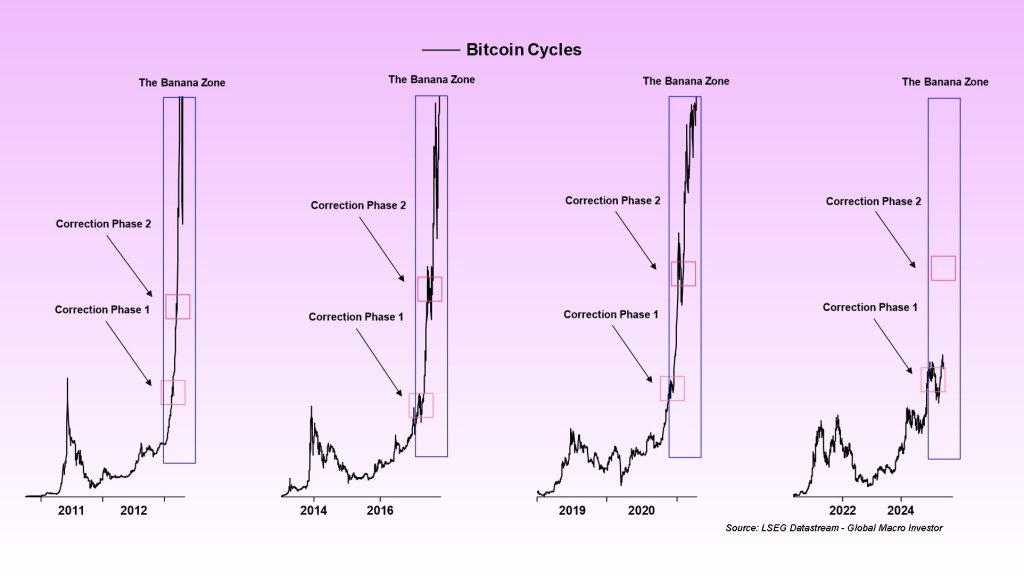
Bitcoin cycles
“The Banana Zone” | Source: X @BittelJulien

Doing the math, a jump from the current $3.55 trillion market capitalisation implies a 40% compound annual growth rate over a decade, or roughly 61% if the window compresses to seven years—both aggressive, but neither without precedent in earlier crypto cycles.

Bittel concedes the path will be “both incredibly challenging and unimaginably rewarding—the worst of times and the best of times,” but he insists Bitcoin is “part of the solution.” He and Pal have called the coming chase for scarce assets “the single greatest wealth-creation opportunity of our lifetimes,” and Bittel closes the thread by declaring that if GMI’s call plays out, it will be “remembered as the greatest macro trade of all time. This is The Everything Code.”

Pal, whose own presentation at Real Vision’s Sui Basecamp in May framed crypto as “a supermassive black hole that outperforms and sucks in every other asset,” reaches similar conclusions. He places Bitcoin in what he calls the “banana zone,” a reflexive phase in which expanding liquidity and herd behaviour interact to drive parabolic gains, with a cycle target of roughly $450,000 per coin. Pal’s estimates implies a Bitcoin capitalization only well above $40 trillion even without altcoins—complementing Bittel’s upper-bound scenario.

At press time, the total crypto market cap stood at $3.37 trillion.
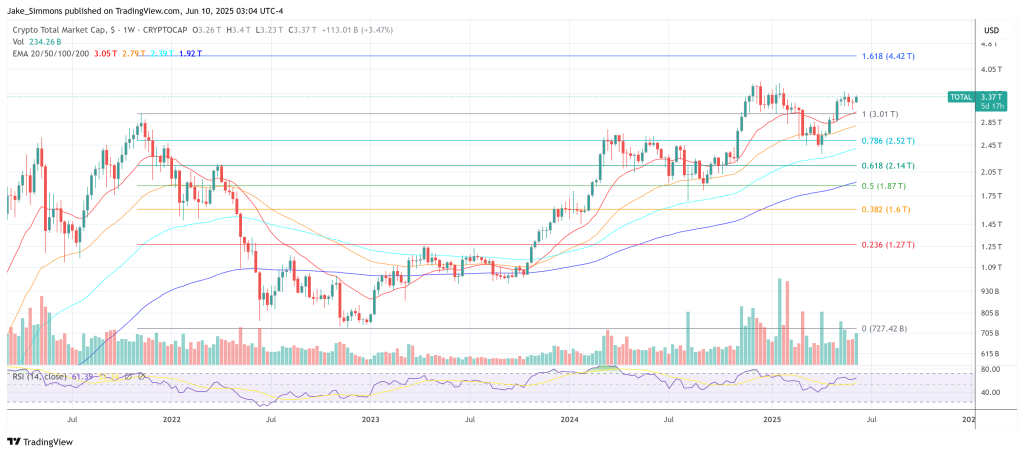
Crypto market cap
Total crypto market cap, 1-week chart | Source: TOTAL on TradingView.com
Featured image created with DALL.E, chart from TradingView.com
Editorial Process for bitcoinist is centered on delivering thoroughly researched, accurate, and unbiased content. We uphold strict sourcing standards, and each page undergoes diligent review by our team of top technology experts and seasoned editors. This process ensures the integrity, relevance, and value of our content for our readers.

Jake Simmons has been a Bitcoin enthusiast since 2016. Ever since he heard about Bitcoin, he has been studying the topic every day and trying to share his knowledge with others. His goal is to contribute to Bitcoin's financial revolution, which will replace the fiat money system. Besides BTC and crypto, Jake studied Business Informatics at a university. After graduation in 2017, he has been working in the blockchain and crypto sector. You can follow Jake on Twitter at @realJakeSimmons.

Bacaan Terkait

Tiger Research: Zuckerberg Mulai Bertaruh pada Pasar Prediksi, Sedangkan Negara-Negara Asia Masih Menganggapnya Sebagai Perjudian

Pasar prediksi telah berkembang dari konsep akademis menjadi industri yang signifikan dengan volume perdagangan bulanan melebihi $14 miliar dan valuasi gabungan sekitar $400 miliar. Keikutsertaan Meta, dengan aplikasi Arena yang dipimpin langsung oleh Mark Zuckerberg, menandakan matangnya industri ini. Pasar prediksi berakar dari taruhan politik informal abad ke-18 dan pengembangan pasar elektronik untuk penelitian akademis pada 1988. Beroperasi dengan logika kontrak biner (ya/tidak), harga yang terbentuk secara organik melalui buku pesanan mencerminkan probabilitas suatu peristiwa. Mekanisme "skin in the game" — di mana peserta mempertaruhkan uang mereka sendiri — meningkatkan akurasi prediksi dibandingkan jajak pendapat tradisional, sebagaimana terbukti dalam prediksi kebijakan moneter AS dan pemilihan Korea Selatan. Namun, pendekatan regulator di Asia sangat berbeda dengan AS. Sementara pengadilan AS mengakui pasar prediksi sebagai instrumen keuangan, banyak yurisdiksi Asia masih mengklasifikasikannya sebagai perjudian. Hal ini menciptakan tiga masalah utama: arbitrase regulasi yang mendorong pengguna ke platform luar negeri, hilangnya kedaulatan atas data informasi penting, dan kurangnya perlindungan pengguna. Artikel ini menyerukan pergeseran diskusi kebijakan di Asia dari pelarangan menjadi pengaturan yang konstruktif, untuk mengintegrasikan pasar prediksi ke dalam sistem formal, memanfaatkan data yang dihasilkannya sebagai aset nasional, dan melindungi pengguna.

marsbit2j yang lalu

Tiger Research: Zuckerberg Mulai Bertaruh pada Pasar Prediksi, Sedangkan Negara-Negara Asia Masih Menganggapnya Sebagai Perjudian

marsbit2j yang lalu

Ethereum 10 Tahun ke Depan dalam Pandangan Vitalik

Pada Juli 2026, Vitalik Buterin mempublikasikan peta jalan jangka panjang "Lean Ethereum", yang diposisikan sebagai evolusi besar ketiga Ethereum setelah "The Merge". Rencana ini mencakup serangkaian peningkatan protokol yang akan diluncurkan bertahap dalam tiga hingga empat tahun ke depan, bertujuan untuk merekonstruksi hampir semua modul inti protokol. Peta jalan ini menetapkan lima tujuan strategis: finalitas L1 yang lebih cepat, throughput L1 mencapai 1 gigagas per detik, skalabilitas L2 level teragas, keamanan kriptografi kuantum, dan transaksi privat native di L1. Perubahan teknis inti meliputi peralihan dari verifikasi re-eksekusi ke model verifikasi berbasis bukti (proof) seperti STARK rekursif, peningkatan keamanan kuantum, pemisahan konsensus untuk finalitas lebih cepat, penetapan harga gas multidimensi, dan reformasi struktur state menjadi dua lapisan untuk biaya yang lebih rendah. Privasi juga ditingkatkan menjadi tujuan utama desain protokol. Sebuah proposal kontroversial adalah mengganti mesin virtual EVM dengan arsitektur yang lebih ramah-proof seperti RISC-V atau leanISA, yang dapat memengaruhi ekosistem L2 yang ada seperti Arbitrum. Mengenai dampak pada harga ETH, peta jalan berpotensi meningkatkan aktivitas dan pembakaran gas di L1 jika target peningkatan kapasitas terpenuhi. Namun, ini adalah proses jangka panjang, dan nilainya bergantung pada adopsi aktual, bukan hanya peningkatan kapasitas. Implementasi akan dipantau melalui indikator seperti peningkatan batas gas di upgrade Glamsterdam, pertumbuhan blob, pendapatan fee L1, dan kinerja ETH relatif terhadap BTC.

链捕手4j yang lalu

Ethereum 10 Tahun ke Depan dalam Pandangan Vitalik

链捕手4j yang lalu

Trading

Spot
活动图片