Saylor Responds To Bitcoin Proof Of Reserve Demand — And Shocks Everyone

bitcoinistDipublikasikan tanggal 2025-05-27Terakhir diperbarui pada 2025-05-27

Abstrak

When Michael Saylor stepped onto a side-stage at the Bitcoin 2025 conference on May 26, the audience expected the usual...

Trusted Editorial content, reviewed by leading industry experts and seasoned editors. Ad Disclosure

When Michael Saylor stepped onto a side-stage at the Bitcoin 2025 conference on May 26, the audience expected the usual boosterism from the man who has converted a software company into a de-facto Bitcoin holding vehicle. Instead they received a meticulous, almost scathing deconstruction of the industry’s favorite transparency meme: on-chain proof-of-reserves.

Why A Bitcoin Proof Of Reserves Is A Bad Idea

The spark came from Blockware Solutions head analyst Mitchell Askew. Identifying himself as “a huge fan of everything you’ve done,” Askew asked whether Strategy planned to publish on-chain addresses so that outsiders could verify its multibillion-dollar hoard. Saylor did not hedge.

“Yeah, proof-of-reserves. It’s an interesting thing,” he began. “People learn stuff from FTX and Mt. Gox, but I’m not sure they learn the things that the institutional community needs to learn going forward.” His contention is two-pronged: first, today’s PoR implementations are positively dangerous; second, even a “perfect” PoR would be insufficient because it omits liabilities—the other half of solvency.

Saylor’s rhetorical opener was vivid. Publishing institutional wallets, he said, resembles “publishing the address and the bank accounts of all your kids and the phone numbers of all your kids and then thinking somehow that makes your family better.” What many retail users praise as radical transparency is, for him, an “attack vector for hackers, nation-state actors, every type of troll imaginable.”

He invited the audience to run a thought experiment with generative AI: “Go to the AI, put it in deep-think mode, and then ask it what are the security problems of publishing your wallet… It will write you a book. It will be fifty pages of security problems.”

The issue is structural, Saylor argued. Once a public entity doxes its cold storage, every subsequent movement of coins becomes visible, allowing adversaries to deduce treasury timing or exploit change-address heuristics. “The current conventional, insecure proof-of-reserves … actually dilutes the security of the issuer, the custodians, the exchanges, and the investors.”

Assets Without Liabilities Are A Bitcoin “Parlor Trick”

Even assuming an airtight method for proving assets, PoR as currently practiced ignores the creditor side of the balance sheet. “It’s proof of assets that is insecure, and it is not proof of liabilities… So you own $63 billion worth of Bitcoin—do you have a hundred billion dollars of liabilities?” He hammered the point with institutional caricature: “Institutional investors would laugh at me if I said, ‘Here’s a wallet that has $72 billion… Don’t you worry your pretty little head about liabilities.’”

To satisfy the capital-markets audience he courts, Saylor laid out a different standard: “You want an institutional-grade proof of assets and proof of liabilities with them netted out. And the best practice is not to publish the wallet. The best practice… would be to have a Big Four auditor that checks to make sure you actually have the Bitcoin, then checks to make sure the company hasn’t rehypothecated or pledged the Bitcoin… Then you have to wash it through a public company where the CFO signs, then the CEO signs, then the chairman and all the outside directors are civilly and criminally liable for it.”

Related Reading: 2,000MW Of Pakistan’s Extra Electricity Now Reserved For Bitcoin Rigs

Why elevate auditor attestation over cryptographic proofs? Because, Saylor said, jail concentrates the mind. “You wonder why people trust US companies? Because of Sarbanes-Oxley, because you go to jail if you lie.” In his view, the threat of prison constitutes a stronger deterrent than any public Merkle tree snapshot.

The corporate cadence he described is familiar to securities lawyers but rarely discussed at Bitcoin meet-ups: quarterly Form 10-Qs, the annual Form 10-K, blackout periods that forbid capital-markets activity until those filings clear. “If a company can’t file a 10-K it means its auditors won’t sign off on its books, which means it maybe isn’t solvent.” By contrast, missing a self-imposed PoR deadline carries no statutory bite.

A Solution For The Future?

Saylor did concede a hypothetical future in which Strategy might participate. “At some point, I can see implementing some kind of proof-of-reserves if you can come up with a zero-knowledge proof that blinds everybody from being able to track the underlying wallets.” Even then, governance hurdles remain: custodians, exchanges, auditors, risk managers, officers and directors would all have to sign off, and the method would still have to mesh with GAAP audit scopes.

Where many advocates cite collapsed exchanges as evidence that more on-chain data is required, Saylor flips the lesson. “Don’t do business with shaky offshore exchanges run by juvenile tweakers. And if you’re a crypto person, hold your own crypto.” PoR, in his telling, is a distraction from basic counterparty discipline.

The principle applies equally to corporate treasuries, he continued. Strategy’s own Bitcoin, today distributed across multiple regulated custodians, is inaccessible except through documented, multi-signatory workflows. “It’s okay at a small level, but really [PoR] isn’t God’s gift. And I think people give too much credence to it on X.”

At press time, BTC traded at $108,656.
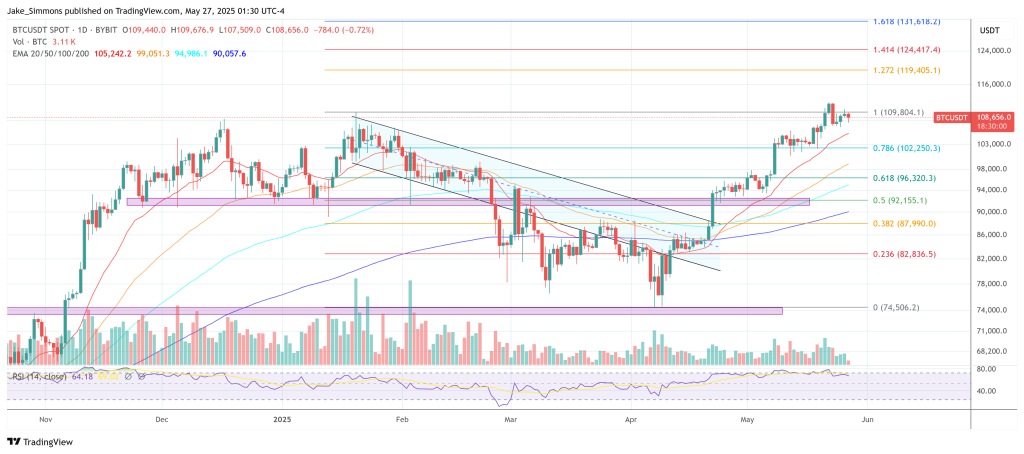
Bitcoin price
BTC price, 1-day chart | Source: BTCUSDT on TradingView.com
Featured image from YouTube, chart from TradingView.com
Editorial Process for bitcoinist is centered on delivering thoroughly researched, accurate, and unbiased content. We uphold strict sourcing standards, and each page undergoes diligent review by our team of top technology experts and seasoned editors. This process ensures the integrity, relevance, and value of our content for our readers.

Jake Simmons has been a Bitcoin enthusiast since 2016. Ever since he heard about Bitcoin, he has been studying the topic every day and trying to share his knowledge with others. His goal is to contribute to Bitcoin's financial revolution, which will replace the fiat money system. Besides BTC and crypto, Jake studied Business Informatics at a university. After graduation in 2017, he has been working in the blockchain and crypto sector. You can follow Jake on Twitter at @realJakeSimmons.

Bacaan Terkait

Warsh Diam-Diam Membentuk Ulang Fed Melalui Lima Kelompok Kerja

Penulis: Qinbafrank Hari ini, The Fed mengumumkan susunan pemimpin lima kelompok kerja reformasi. Kesan pertama adalah Kevin Warsh sedang membangun lapisan desain kebijakan paralel yang dipimpin Ketua The Fed: kewenangan pengambilan keputusan formal tetap berada di FOMC dan Dewan Gubernur, namun kewenangan penetapan agenda, produksi pengetahuan, akses data, dan narasi publik tampak semakin terkonsentrasi pada Ketua dan para ahli eksternal pilihannya. Ada nuansa serupa dengan "kelompok kerja pusat" yang sering digunakan dalam reformasi lembaga Partai Komunis Tiongkok. Kelima kelompok kerja ini secara resmi dinamai "Kelompok Kerja Advancing Monetary Policy for the Chair." Kelima belas ko-pemimpinnya semuanya dari luar The Fed, didukung staf The Fed, melakukan penelitian secara independen, dan pada akhirnya menyampaikan kesimpulan kepada FOMC. Lima kelompok ini mencakup seluruh "sistem operasi" kebijakan moneter: input data → model produktivitas, ketenagakerjaan, dan inflasi → alat neraca keuangan → komunikasi eksternal. Karakteristik kelompok kerja ini menunjukkan keahlian Warsh: 1) Diluncurkan langsung oleh pimpinan tertinggi; 2) Melintasi batas departemen lama; 3) Membangun saluran pelaporan informasi paralel; 4) Menghindari kelambanan birokrasi rutin dan kepentingan departemen; 5) Mengatur ulang agenda kebijakan dengan cepat melalui "desain puncak"; 6) Memusatkan kewenangan koordinasi dan pengetahuan melalui organisasi khusus. Di masa depan, sebelum hasil studi kelompok kerja reformasi keluar, kemungkinan besar Warsh akan menahan diri untuk tidak bertindak. Perlu diperhatikan apakah kelompok kerja ini akan bertahan dalam jangka panjang, apakah kesimpulannya akan disamakan dengan kebijakan tetap Ketua, dan apakah FOMC akhirnya hanya bertugas mengesahkannya.

marsbit11m yang lalu

Warsh Diam-Diam Membentuk Ulang Fed Melalui Lima Kelompok Kerja

marsbit11m yang lalu

WEEX TradFi Trading Competition Sedang Berlangsung Panas, Hadiah 50,000 USDT Untuk yang Duluan, Buka Posisi Langsung Dapat 5 U

Pasar kripto saat ini sedang mengalami penyesuaian siklus, dengan Bitcoin turun lebih dari 50% dari puncaknya. Namun, pertukaran kripto seperti WEEX berhasil menghindari penurunan volume perdagangan tradisional dengan menghadirkan aset TradFi (Keuangan Tradisional) yang ditokenisasi. Melalui WEEX, pengguna dapat berpartisipasi dalam perdagangan saham global (seperti NVIDIA, Apple, Tesla), ETF (seperti SPY, QQQ), komoditas (emas, minyak), dan bahkan saham pra-IPO seperti OpenAI menggunakan USDT. Untuk memperkenalkan ekosistem TradFi-nya, WEEX meluncurkan "Kompetisi Perdagangan TradFi" dari 9 hingga 23 Juli, dengan total hadiah 50,000 USDT. Hadiahnya meliputi: 1. **Hadiah Pendatang Baru**: 200 USDT untuk pengguna baru setelah melakukan setoran dan perdagangan tertentu. 2. **Kompetisi untuk Semua**: Hadiah bertingkat (3, 10, 50 USDT) berdasarkan volume perdagangan kontrak TradFi. 3. **Hadiah Partisipasi**: 5 USDT untuk setiap pengguna yang membuka posisi kontrak TradFi apa pun. Keunggulan WEEX TradFi: * **Hedging Antar Aset**: Alihkan aset kripto ke aset TradFi selama pasar bearish. * **Akses Mudah**: Gunakan USDT, setoran instan, perdagangan fraksional (mulai dari $5). * **Perdagangan 24/7**: Perdagangan kontrak tersedia sepanjang waktu, bahkan di luar jam pasar saham biasa. Ikuti kompetisi dan tangkap peluang keuangan global dengan mudah di WEEX.

marsbit16m yang lalu

WEEX TradFi Trading Competition Sedang Berlangsung Panas, Hadiah 50,000 USDT Untuk yang Duluan, Buka Posisi Langsung Dapat 5 U

marsbit16m yang lalu

Ganti Rantai Lalu Mulai Bisnis Lagi, Benarkah Bisa "Mengubah Nasib"?

Penulis: momo, ChianCatcher Baru-baru ini, beberapa proyek secara berturut-turut mengumumkan migrasi ke ekosistem blockchain publik baru. Berbeda dengan sekadar mengejar tren atau alasan keamanan, migrasi kali ini juga dibarengi dengan transformasi bisnis, seperti memulai bisnis baru di tempat lain. Namun, tanggapan komunitas kripto terhadap migrasi ini tampak tidak terlalu optimis. Setelah Secret Network mengumumkan rencana migrasi ke Arbitrum, tokennya merosot lebih dari 30% dalam 24 jam. Base dan Arbitrum menjadi tujuan bagi banyak proyek lama yang mencari peluang pertumbuhan baru. Contohnya, Sophon (dari ZKsync) dan Moonbeam (dari Polkadot) bermigrasi ke Base, sementara Secret Network (dari Cosmos) berencana pindah ke Arbitrum. Proyek-proyek ini umumnya berasal dari ekosistem seperti Polkadot dan Cosmos yang dianggap kurang aktif, dan setelah migrasi mereka banyak berfokus pada narasi baru seperti AI atau aplikasi konsumen. Meski migrasi bukan hal baru, dan bisa menjadi pilihan pragmatis untuk akses ke ekosistem yang lebih berkembang, namun efektivitasnya untuk mengubah nasib proyek diragukan. Ada contoh kasus seperti y00ts dan Synthetix yang hasil migrasinya tidak memuaskan bahkan akhirnya kembali. Dalam kondisi pasar saat ini yang lebih matang dan rasional, tantangan untuk "mengubah nasib" melalui migrasi tampak lebih besar. Baik proyek yang bermigrasi maupun blockchain tujuan sama-sama menghadapi tantangan untuk menemukan dan mempertahankan skenario aplikasi nyata dan pengguna.

链捕手26m yang lalu

Ganti Rantai Lalu Mulai Bisnis Lagi, Benarkah Bisa "Mengubah Nasib"?

链捕手26m yang lalu

Trading

Spot
活动图片