Ripple CTO David “JoelKatz” Schwartz has outlined how RLUSD—the upcoming stablecoin on the XRP Ledger—could initially trade at highly inflated prices, possibly even $1,200, despite its intended $1 peg. Speaking via X, he highlighted early supply bottlenecks, speculative fervor, and the fundamental market mechanics of stablecoins as factors likely to drive any short-lived spike.
Why The Ripple Stablecoin RLUSD Could Hit $1,200
In a reply to community chatter around a screenshot that showed an RLUSD value of $1,200 on the Xaman wallet, Schwartz confirmed such a price is theoretically possible. He remarked that “as RLUSD goes live, there may be supply shortages in the very early days before the market stabilizes. There actually is someone willing to pay $1,200/RLUSD for a tiny fraction of one RLUSD. Tools will show you the highest price anyone is willing to pay, even if it’s just for a tiny bit. Maybe someone wants the ‘honor’ of buying the first bit of RLUSD on the DEX.”
However, he was quick to stress that “the price will come back to very close to $1 as soon as supply stabilizes,” suggesting that any eye-popping listing would be more of a novelty event than a real market assessment of RLUSD’s long-term value. “But rest assured, the price will come back to very close to $1 as soon as supply stabilizes. […] If you want to spend a lot of money to get a tiny bit of RLUSD before anyone else does, you can. But please don’t expect the price to stay over $1 once things stabilize, which I expect they will do very quickly.”
Part of the reason for these anomalies, according to the Ripple CTO, lies in the basic minting and burning mechanics that underpin stablecoins. Minting the Ripple stablecoin involves creating new units when demand rises, while burning is the process of removing units from circulation when demand falls. Both processes help maintain the $1 peg but can lag behind real-time trading. At launch, an imbalance between the number of tokens available (supply) and those seeking to buy them (demand) could generate extreme initial price distortions.
Schwartz’s remarks on social media echoed points he made at the Emergence conference in Prague. He discussed “weird failure scenarios” that might occur when a stablecoin first goes live, jokingly referring to the possibility that “people might spend extra just to own RLUSD first.”
A scenario he described was someone paying $3—rather than $1—just to say they are an original holder of the stablecoin. While that still pales in comparison to $1,200, the principle remains: such anomalies, he said, could lead some buyers to mistakenly believe that the Ripple stablecoin might be a speculative asset rather than a stablecoin.
“Obviously it’s going to come back down from $3 to $1 as soon as somebody mints enough of it,” the Ripple CTO noted, adding that this is where arbitragers play a pivotal role. When the price of a stablecoin floats significantly above or below its peg, traders seize on the mismatch, either selling at a premium or buying at a discount and redeeming at face value. This process locks the price back to its target.
Schwartz also cautioned, “please don’t FOMO into a stablecoin! This is not an opportunity to get rich.”
Ripple Software Engineer Neil Hartner recalled that GateHub USDC was “regularly over $2 per GateHub USD” during its initial automated market maker (AMM) phase, especially on weekends when GateHub’s own mint-and-burn processes were offline.
There are a lot of weird failure scenarios you might not think of when launching a stablecoin 😂 @JoelKatz in Prague about 10 days ago. $RLUSD to the moon! 🤣
Funny stuff in this crypto space. pic.twitter.com/z71gwIJcL2— 🌸Crypto Eri 🪝Carpe Diem (@sentosumosaba) December 15, 2024
A vital takeaway here is that many stablecoins rely on an external entity or protocol for minting and redemption. When those processes aren’t operational 24/7—or when liquidity is restricted outside of business hours—prices can decouple from the $1 peg on specific exchanges or trading venues.
Hartner cited Circle’s USDC depegging incident in March 2023 as another cautionary parallel. “Price distortions can happen if minting and burning aren’t available 24/7. Same thing happened when USDC depegged over a weekend in March 2023 because markets panicked and Circle had limited liquidity operations outside business hours, Hartner wrote.
Community member Khaled Elawadi.XRP, questioned how halting minting or burning could logically distort a stablecoin’s price if redemptions for fiat ultimately remain $1. “Surely, there should be a fixed buy and sell price on the DEX and on the other listed exchanges?” he remarked.
In response, Hartner underscored that the peg is enforced not by a universal algorithmic price fix but by traders themselves. “You don’t cash out stablecoins from exchanges, you trade them for fiat with other traders,” he explained. If more stablecoins are being sold than there are buyers willing to pay $1, the price on that particular exchange can slip until market participants or liquidity providers step in.
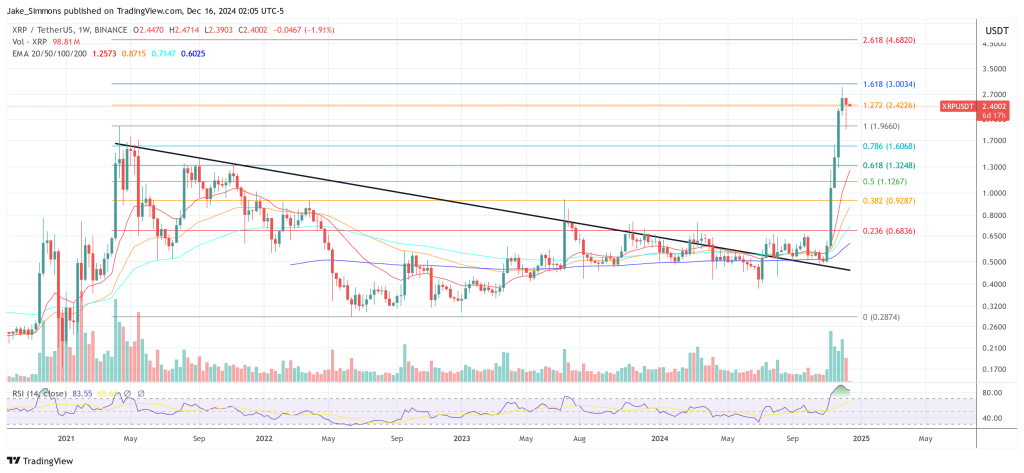
At press time, XRP traded at $2.40.

Related Posts