Japan’s Crypto Policy Shift Raises Questions for the Market Ahead of Key Macro Decisions

bitcoinistPublished on 2025-12-16Last updated on 2025-12-16

Abstract

Japan is redefining its approach to digital assets through regulatory and tax reforms, shifting crypto oversight from the Payment Services Act to the Financial Instruments and Exchange Act. This move treats cryptocurrencies more as financial products than payment tools, aligning them with securities rules and emphasizing investor protection, including stricter disclosure requirements for token offerings and bans on insider trading. Simultaneously, a proposed tax reform would lower crypto gains tax from up to 55% to a flat 20%, matching the treatment of stocks and aiming to retain capital and innovation domestically. Despite these changes, market reaction has been muted due to broader factors. Upcoming macro decisions from the Bank of Japan, including potential rate hikes and the cautious unwinding of large ETF holdings, are expected to have a more immediate impact on liquidity and risk appetite, making policy shifts a background factor rather than a direct catalyst.

Japan is quietly reimagining how digital assets fit into its financial system, and the timing is drawing attention. While global markets are already sensitive to upcoming macro decisions from the Bank of Japan (BoJ), Tokyo is advancing parallel reforms that touch crypto regulation, taxation, and broader liquidity conditions.

Related Reading: Ex-Terra Insider Calls Do Kwon Case ‘Backwards’ In Explosive X Thread

Together, these moves are forcing investors to reassess how Japan may influence crypto markets in the months ahead, not just through headlines, but also through structural changes.

The Financial Services Agency (FSA) has outlined plans to shift crypto oversight away from the Payment Services Act toward the Financial Instruments and Exchange Act.
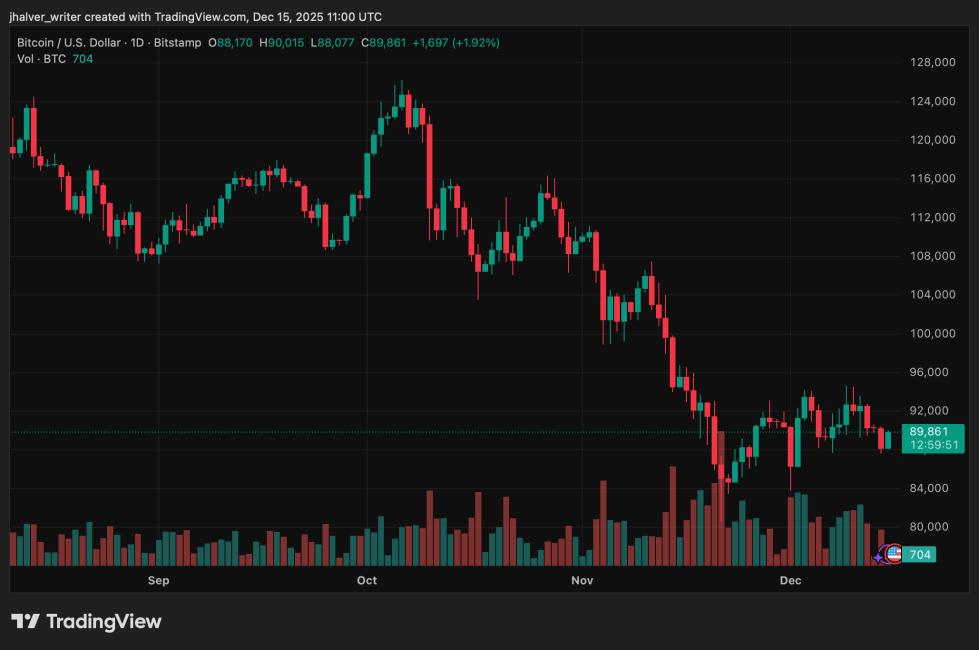
BTC's price moves sideways following an important crash, as seen on the daily chart. Source: BTCUSD on Tradingview

Crypto Moves From Payments to Investment Rules

Under the proposed framework, cryptocurrencies would be treated more explicitly as financial products rather than payment tools. Oversight would move under securities-style rules, aligning crypto trading closer to traditional investment markets.

The FSA has emphasized stronger investor protection, particularly around token offerings. Exchanges handling initial exchange offerings would be required to provide detailed disclosures, including the identities of issuers, token distribution methods, and independent code audits.

The framework mirrors elements seen in the EU’s MiCA regime and South Korea’s crypto laws, including explicit bans on insider trading and tighter controls on unregistered or overseas platforms serving Japanese users. Rather than signaling deregulation, the shift suggests Japan is standardizing its crypto space.

Tax Reform Sends a Different Signal

Alongside tighter oversight, Japan is preparing a significant tax reform. Crypto gains, currently taxed as miscellaneous income at rates that can reach 55%, are set to move to a flat 20% rate. This would place digital assets on similar footing with stocks and other capital assets.

The proposal reflects years of pressure from investors and startups, who have argued that punitive taxation has pushed activity offshore.

While the regulatory net tightens, the tax cut points toward an effort to keep capital and innovation within Japan, potentially improving long-term participation rather than encouraging short-term speculation.

Macro Pressure Still Shapes Market Behavior

Despite policy shifts that appear supportive on paper, market reaction has been muted. Assets such as XRP have remained range-bound even amid Japan-related developments, reflecting low volumes and liquidity fragmentation rather than enthusiasm or fear.

Similarly, macro forces loom larger. The BoJ is expected to hike rates later this month, a move that has historically coincided with risk-off behavior in crypto as yen liquidity tightens. Japan is also preparing to offload over $500 billion in ETFs at a slow pace, underscoring policymakers’ caution about destabilizing markets.

Related Reading: Bitcoin Makes The Cut As Brazil’s Largest Private Bank Issues 2026 Guidance

Japan’s crypto policy reset looks less like a catalyst and more like a backdrop. Whether it ultimately supports prices may depend less on regulation itself and more on how liquidity, rates, and risk appetite settle once key macro decisions are out of the way.

Cover image from ChatGPT, XRPUSD chart from Tradingview

Related Reads

Interlace: The World's Leading Agentic Payment and Stablecoin Infrastructure Platform, Building the Next-Generation Digital Financial Foundation

Interlace: A Leading Agentic Payment and Stablecoin Infrastructure Platform Interlace is a global stablecoin infrastructure platform bridging traditional and crypto finance. It addresses the fragmentation between crypto assets, global payments, and enterprise treasury management by integrating stablecoin payments, digital business banking, asset management, virtual card issuance, and AI payment capabilities into a unified global financial network. Key product pillars include: 1. **Next-Generation Payment Network**: Features **Agent Card** for AI agents (enabling autonomous spending with controls) and **Scan to Pay** for seamless stablecoin (USDT/USDC) to fiat payments via QR codes in emerging markets. 2. **Stablecoin Payment & Card Issuance**: Offers **Infinity Card** for corporate spend management, **CaaS (Card as a Service)** for embedded card issuance APIs, and **Infinity Launch** for turnkey white-label financial systems. 3. **Enterprise Accounts & Banking**: Provides **Business Accounts** for multi-currency management and **BaaS (Banking as a Service)** APIs for embedded global payments and banking capabilities. 4. **Crypto Finance Infrastructure**: Enables **On/Off Ramp** services for fiat-crypto conversions and ensures security with PCI DSS Level-1 certification, MPC wallets, and global compliance licenses. 5. **Integrated Financial Ecosystem**: Includes **Yield Treasury** for idle cash management and a full suite of APIs, serving over 12,000 businesses across 180+ countries. Interlace aims to make stablecoins viable for everyday payments and empower AI agents with secure spending, building the foundational infrastructure for the future of digital finance.

链捕手10m ago

Interlace: The World's Leading Agentic Payment and Stablecoin Infrastructure Platform, Building the Next-Generation Digital Financial Foundation

链捕手10m ago

Stanley Druckenmiller: From Soros' Comrade-in-Arms to the Godfather of Macro Investing—System, Disciples, and Latest Thoughts

Stanley Druckenmiller is a pivotal figure in global macro investing, renowned for his partnership with George Soros, his legendary fund Duquesne Capital, and a decades-long track record of near-30% annualized returns without a single annual loss. His methodology uniquely blends value, growth, macro, and trend investing. A key early experience was as a bank stock analyst, grounding him in both company fundamentals and macro forces. His most famous trade, shorting the British Pound in 1992, exemplified his approach: identifying unsustainable structural contradictions and concentrating capital on high-probability, high-payoff opportunities. The "Duquesne System" is built on four pillars: macro-directional analysis, concentrated bets on best ideas, rapid error correction, and acute awareness of liquidity. His famous phrase "Invest, then investigate" reflects a dynamic approach of entering a position based on a strong initial thesis and then adjusting based on market feedback. This differs fundamentally from Warren Buffett's focus on long-term intrinsic business value; Druckenmiller focuses on marginal changes, cycles, and capital allocation at inflection points. His influence extends through protégés like Scott Bessent (market execution) and Kevin Warsh (policy insight), representing the dual market-and-institutional understanding he embodies. He closed his flagship fund in 2010 at its peak, prioritizing flexibility and performance over asset-gathering. Recent moves highlight his core logic: reducing AI exposure as expectations became crowded while investing in copper, recognizing the underlying infrastructure and resource demands of the AI boom. He remains concerned about long-term US dollar purchasing power due to fiscal deficits and monetary policy. His core skill is judging risk/reward payoff, not just prediction accuracy. For ordinary investors, key lessons are to focus on marginal changes, align position size with conviction and risk, and seek second-order opportunities beneath surface-level narratives. Ultimately, Druckenmiller is a strategist who combines macro insight with price discipline, decisive action with rigorous risk management, succeeding by identifying major market mispricings, acting before full consensus, and exiting swiftly when proven wrong.

marsbit55m ago

Stanley Druckenmiller: From Soros' Comrade-in-Arms to the Godfather of Macro Investing—System, Disciples, and Latest Thoughts

marsbit55m ago

Morning Report | xAI Launches Skills; Duan Yongping Takes First Position in Circle in Q1 2026; Polymarket Partners with Nasdaq to Launch Prediction Market

**Title:** Daily Brief: Musk's xAI Launches "Skills"; Duan Yongping's First Circle Investment; Polymarket Partners with Nasdaq **Key Highlights:** * **AI Developments:** Elon Musk's xAI released "Skills," enabling its Grok AI to retain memory across conversations. OpenAI co-founder Andrej Karpathy joined rival Anthropic. * **Crypto & DeFi:** May saw 14 crypto hack incidents, including 3 major DeFi attacks in 5 days (Echo Protocol, THORChain, Verus). The Ethereum Foundation faces another exodus with two core members departing. * **Corporate Moves:** Investor Duan Yongping disclosed a new $19M position in Circle. Analog Devices is in talks to acquire AI chip firm Empower Semiconductor for ~$1.5B. * **Financials & Partnerships:** Canaan reported Q1 2026 revenue of $62.7M and record-high crypto reserves. Prediction market Polymarket partnered with Nasdaq to launch markets for private companies. * **Market Data:** VanEck predicts digital credit markets could reach $2.5T in a decade, with Bitcoin potentially hitting $1M. Top trending meme tokens on ETH, Solana, and Base networks are listed. **Featured Articles:** Three analysis pieces explore: 1) potential regulatory pressures on DEXs like Hyperliquid, 2) challenges to Solana's "internet capital market" narrative, and 3) the future emergence of a dedicated capital market for autonomous AI agents (Agents).

链捕手1h ago

Morning Report | xAI Launches Skills; Duan Yongping Takes First Position in Circle in Q1 2026; Polymarket Partners with Nasdaq to Launch Prediction Market

链捕手1h ago

Why is HYPE Still Surging? Has It Topped Out?

The article analyzes the reasons behind the continued surge of the HYPE token, despite the current market conditions. The primary drivers identified are: 1. **ETF Inflows and a New Buyback Mechanism:** The launch of two ETFs (THYP by 21Shares and BHYP by Bitwise) has opened a channel for traditional capital. Crucially, Bitwise announced it will allocate 10% of BHYP's management fee income to acquire and stake HYPE, creating a potential source of recurring buy pressure linked to the ETF's growth. 2. **USDC Integration and New Revenue Stream:** The return of USDC to Hyperliquid, facilitated by Coinbase and Circle, is significant. It establishes a protocol revenue-sharing model from USDC reserve yields. Community estimates suggest this could generate substantial daily income (approx. $440k), which could be used for HYPE buybacks, decoupling token demand from just trading fees and linking it to the platform's stablecoin deposits. 3. **Expansion into New Markets:** Hyperliquid is broadening beyond being just a Perp DEX. Its HIP-4 feature launches it into the prediction market space, already showing high volume. This requires HYPE staking for market creation, directly increasing token utility and staking demand. Furthermore, the platform's Real-World Asset (RWA) trading has seen Open Interest hit a new high of $2.6B, indicating growth in trading traditional assets like stocks and commodities. 4. **Regulatory Tailwinds for RWA:** Potential SEC exemptions for tokenized stock trading could further accelerate Hyperliquid's RWA business, turning a niche into a major battleground for on-chain trading. In summary, the market is re-rating HYPE as Hyperliquid evolves from a single-purpose DEX into a comprehensive on-chain trading system with multiple growing revenue streams (trading fees, reserve yields, prediction markets) and expanding asset classes (crypto, RWAs). However, the article notes that despite the strong long-term fundamentals, short-term price action is currently volatile due to a large-scale showdown between whale long and short positions exceeding $60 million.

marsbit1h ago

Why is HYPE Still Surging? Has It Topped Out?

marsbit1h ago

Trading

Spot
Futures

Hot Articles

Discussions

Welcome to the HTX Community. Here, you can stay informed about the latest platform developments and gain access to professional market insights. Users' opinions on the price of S (S) are presented below.

活动图片