Ethereum Takes The Lead In DeFi Lending Revenue, Leaving Rivals Behind – See How

bitcoinistОпубликовано 2025-12-19Обновлено 2025-12-19

Введение

Despite facing selling pressure, Ethereum has solidified its dominance in DeFi lending revenue, capturing 80-90% of all activity and fees. Data from Leon Waidmann shows Ethereum remains the core settlement layer for DeFi, significantly outpacing rivals like Base and Arbitrum. Aave drives over 50% of lending funds and 60% of active loans on Ethereum, generating $885 million in fees in 2025 alone. While Layer 2s improve user experience, the mainnet continues to be reinforced as the trusted hub for liquidity and credit markets. Additionally, active Ethereum addresses are nearing all-time highs, with 2.4 million weekly users, signaling strong retail and institutional engagement.

Ethereum’s price may be hampered by selling pressure, but the leading network continues to experience heavy utilization from developers and users. After robust interaction from the participants, the blockchain giant emerged once again as the leader in Decentralized Finance (DeFi) lending.

DeFi Lending Still Pays Best On The Ethereum Network

A recent report has underscored Ethereum’s growing dominance within the blockchain sector. The network is solidifying its position as the financial foundation for decentralized finance lending, and the data is starting to present a convincing picture.

A look at the data shared by Leon Waidmann, a market expert and the head of research at On-Chain Foundation, shows that ETH is now the revenue center of DeFi lending. This implies that most of the revenue flowed through the ETH ecosystem, outpacing other major chains like Base, Plasma, and Arbitrum.

From borrowing fees to interest paid by active users, the ETH network continues to be the key settlement layer where value is persistently created. ETH is at the center of the revenue outlines the network’s usage in addition to its ongoing dominance as the fundamental infrastructure driving DeFi’s most lucrative lending activity.
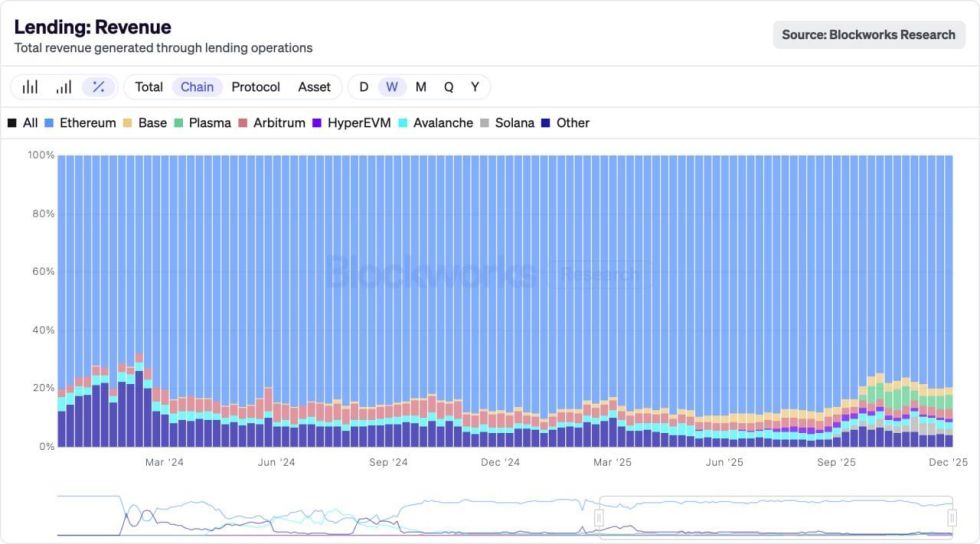
Source: Chart from Leon Waidmann on X

As seen on the chart, Ethereum mainnet steadily secured over 80% to 90% of all DeFi lending revenue and activity, reinforcing its increasing role in the financial landscape. Interestingly, this share has remained a dominant force even with the vigorous expansion of the Layer 2 and alt-Layer 1 chains.

Data shows that usage may be fragmented, but fees do not. Meanwhile, at the protocol layer, Waidmann highlighted that concentration is quite stronger. Amid this rising DeFi revenue lending, Aave is the core revenue engine on the Ethereum mainnet, attracting more than 50% of the total lending funds.

This part of the network was also responsible for over 60% of all active loans on ETH. In the end, the project generated approximately $885 million in fees in 2025 alone, reflecting the significant usage of the network.

While Ethereum mainnet secures balance sheets and profits, layer 2s are optimizing execution and User Experience (UX). Waidmann noted that where confidence and liquidity are greatest, DeFi credit markets converge. “Ethereum Mainnet is not being disrupted, but is being reinforced,” the expert added.

Active ETH Addresses Targeting Its Peak

Another instance of robust engagement across the Ethereum network is a spike in active wallet addresses. Joseph Young, a crypto enthusiast, previously highlighted that the active users on the network are drawing close to its all-time high. Such a rise in active addresses suggests a resurgence of interest and conviction among larger and retail investors.

At the time of the post, about 2.4 million wallet addresses were actively interacting with the network every week. This is an indication that tokenization, stablecoins, and privacy infrastructure are all converging on Ethereum. Currently, Young stated ETH is dominating the big three metas, while expressing his conviction in the network’s prospects.

ETH trading at $2,954 on the 1D chart | Source: ETHUSDT on Tradingview.com

Связанные с этим вопросы

QAccording to the article, which blockchain network is the leader in DeFi lending revenue?

AEthereum is the leader in DeFi lending revenue, securing over 80% to 90% of all activity.

QWhat is the name of the expert and head of research at On-Chain Foundation cited in the report?

AThe expert cited is Leon Waidmann, the head of research at On-Chain Foundation.

QWhich protocol is highlighted as the core revenue engine on the Ethereum mainnet for DeFi lending?

AAave is the core revenue engine on the Ethereum mainnet, attracting more than 50% of the total lending funds.

QWhat does the significant increase in active Ethereum wallet addresses suggest, according to the article?

AThe spike in active wallet addresses suggests a resurgence of interest and conviction among both larger and retail investors.

QWhat role do Layer 2 networks play in relation to the Ethereum mainnet, as described in the article?

ALayer 2 networks are optimizing execution and User Experience (UX), while the Ethereum Mainnet secures balance sheets and profits, thereby being reinforced rather than disrupted.

Похожее

BNB Chain Releases Research Report, Exploring Post-Quantum Cryptography Migration Path for BSC

BNB Chain, a leading Layer-1 blockchain ecosystem, has released a research report exploring the potential migration path for BNB Smart Chain (BSC) to post-quantum cryptography. The study evaluates replacing traditional cryptographic systems with quantum-resistant alternatives, specifically examining the use of ML-DSA-44 for transaction signing and pqSTARK for aggregating validator consensus signatures. While quantum computers are not currently a practical threat to existing blockchain cryptography, the research represents a proactive effort to ensure long-term network security and infrastructure resilience. The report assessed several core areas of the BSC tech stack, including post-quantum transaction signing, validator signature aggregation, transaction validation, public key storage, and network performance under increased data loads. A key finding is that achieving post-quantum readiness is technically feasible today but requires significant trade-offs in scalability. Test data indicates: • Transaction size would increase from ~110 bytes to ~2.5 kilobytes. • Block size would grow from ~110 kilobytes to ~2 megabytes. • Native transfer TPS would decrease from 4,973 to 2,997. The primary performance bottleneck is not signature verification itself, but the increased network transmission overhead caused by larger transaction and block sizes. Conversely, the pqSTARK aggregation technology proved highly efficient, compressing validator signatures by an approximately 43:1 ratio, which helps manage consensus-layer overhead. The report notes that post-quantum alternatives for areas like P2P handshakes and KZG commitments were not within the scope of this evaluation and require further research and broader ecosystem coordination. BNB Chain emphasizes this work is a research-oriented exploration and not a response to any imminent security threat.

marsbit29 мин. назад

BNB Chain Releases Research Report, Exploring Post-Quantum Cryptography Migration Path for BSC

marsbit29 мин. назад

After Developer Numbers Halved: Crypto Isn't Dead, It's Just Giving Up Talent to AI

The title "After a 50% Drop in Developer Count: Crypto Isn't Dead, It's Just Ceding Talent to AI" suggests a shift, not an end. The article analyzes GitHub data showing a significant drop in overall Crypto developer activity from a peak of 45K monthly active developers in 2022 to about 23K in 2026. However, this masks a deeper trend of "talent deleveraging." The exodus consists mainly of newcomers who entered during the bull market for hype-driven roles (e.g., NFT contracts, forked DeFi protocols), with over 50% of developers with less than one year of experience leaving. In contrast, established developers (2+ years of experience) have hit record highs, contributing roughly 70% of the code. They are consolidating in ecosystems with real users and revenue, like Bitcoin and Solana. These experienced builders possess unique skills forged in Crypto's "code is law" environment: the ability to build trust and functional systems from scratch in the absence of external authority or rules, with zero tolerance for error. The article argues that AI's scaling faces structurally similar trust, coordination, and verification problems—particularly regarding compute aggregation, multi-agent incentive alignment, and autonomous payments. Crypto builders are already applying these skills in AI. Examples include CoreWeave (mining to AI compute), OpenRouter (NFT marketplace routing to AI model routing), and projects like Hyperbolic (using crypto-native mechanisms for decentralized compute verification) and EigenLayer (applying restaking logic to AI agent governance). Stablecoin infrastructure is becoming critical for AI agent micro-payments (e.g., x402 protocol). The role of these builders is evolving from writing smart contracts to "designing trusted mechanisms for autonomous AI systems." This shift is reflected in new hiring trends at major exchanges and significant venture capital flowing into the crypto-AI convergence (e.g., funds from Paradigm, Haun Ventures). The article concludes that while developer numbers have halved, the core density of talent has increased, and their uniquely cultivated skills are finding a new, larger stage in the AI era.

marsbit38 мин. назад

After Developer Numbers Halved: Crypto Isn't Dead, It's Just Giving Up Talent to AI

marsbit38 мин. назад

After the Developer Count Halved: Crypto Is Not Dead, It's Just Ceding Talent to AI

Following a significant decline in the total number of open-source crypto developers, from a peak of 45K in 2022 to approximately 23K by 2026, this article argues the industry is undergoing a "talent deleveraging" rather than a collapse. The exodus primarily consists of newcomers who entered during the bull market, while the core of experienced developers (2+ years) has grown to a record high, contributing around 70% of code. These established builders are concentrating in ecosystems with real users and revenue, like Bitcoin and Solana. The article posits that crypto has cultivated a unique skill set in building trustless, autonomous systems with near-zero tolerance for error—a capability now finding high demand in the AI era. As AI scales, it faces structural gaps in decentralized compute aggregation, multi-agent coordination/incentive alignment, and autonomous payment infrastructure. Crypto builders are transitioning their expertise to address these exact problems. Examples include CoreWeave (mining to AI compute), Hyperbolic (decentralized compute verification), EigenLayer (extending restaking mechanisms to AI agent governance), and the x402 protocol (enabling AI agent micro-payments via stablecoins). The role of the crypto builder is evolving from writing smart contracts to designing the rule-based, trust-minimized frameworks necessary for AI-native systems. Venture capital is increasingly funding this convergence, viewing it as a structural opportunity rather than a narrative shift. The core talent and systemic design principles from crypto are not disappearing but being re-priced and applied to the foundational challenges of scalable AI.

链捕手42 мин. назад

After the Developer Count Halved: Crypto Is Not Dead, It's Just Ceding Talent to AI

链捕手42 мин. назад

Торговля

Спот
Фьючерсы

Популярные статьи

Manyu: восходящая мем-звезда на Ethereum, готовая открыть новую эру культуры Shiba

Manyu - это мемтокен на Ethereum, который приносит децентрализованную культурную и развлекательную ценность через вирусное влияние в соцсетях и вовлечённость сообщества.

1.9k просмотров всегоОпубликовано 2025.11.27Обновлено 2025.11.27

Manyu: восходящая мем-звезда на Ethereum, готовая открыть новую эру культуры Shiba

Неделя обучения по популярным токенам 14: Glamsterdam — самое ожидаемое обновление Ethereum в 2026 году

Ordinals/Runes по-прежнему стимулируют доходы от комиссий за блоки и активность разработчиков, рассматриваются как отправная точка «нативной эмиссии активов» в сети.

1.3k просмотров всегоОпубликовано 2026.04.29Обновлено 2026.04.29

Неделя обучения по популярным токенам 14: Glamsterdam — самое ожидаемое обновление Ethereum в 2026 году

Обсуждения

Добро пожаловать в Сообщество HTX. Здесь вы сможете быть в курсе последних новостей о развитии платформы и получить доступ к профессиональной аналитической информации о рынке. Мнения пользователей о цене на ETH (ETH) представлены ниже.

活动图片