A Major Bitcoin Pivot? Realized Loss Drops Below The Key Threshold – Here’s What It Means

bitcoinistPublished on 2025-12-12Last updated on 2025-12-12

Abstract

Bitcoin's price nears $90,000 amid renewed volatility, while key on-chain metrics suggest a potential shift in market sentiment. According to analyst Ali Martinez, the realized loss metric for BTC traders has dropped below the critical -37% threshold to -18%, indicating that panic selling may be subsiding. Historically, such declines have signaled buy-the-dip opportunities and a transition from capitulation to accumulation. However, recovery remains constrained by a lack of incoming liquidity. Stablecoin inflows into exchanges have fallen 50% since August, reflecting weakened demand. For a sustained bullish trend, new liquidity is essential—current minor rebounds are due to reduced selling pressure rather than increased buying interest.

As the market volatility heats up again, the price of Bitcoin witnessed a pullback, bringing it closer to the $90,000 threshold. While BTC’s price faces a pullback, key on-chain metrics are beginning to follow suit, reaching levels that could shape or determine the next trajectory of the market.

A Crucial Breakdown In Bitcoin Realized Loss

Given the bearish state of the market, on-chain indicators for Bitcoin are flashing a slight but crucial signal in its dynamics. BTC On-Chain Trader Realized Price and Profit/Loss Margin, one of the most important metrics, has now dropped below a crucial level as the market and BTC’s price fluctuate.

According to Ali Martinez, a seasoned crypto analyst and trader, this drop in the metric is offering a clue to the next potential path for the BTC market. Following weeks of increased capitulation-driven losses, the drop in realized losses indicates that market players are no longer selling coins at sharp discounts.

While the wave of panic selling that clouded recent market turbulence may finally be dissipating, this crucial indicator is providing traders with new grounds to reevaluate the short-term course of Bitcoin. This implies that sentiment is gradually stabilizing, pointing to an early shift from capitulation to accumulation.
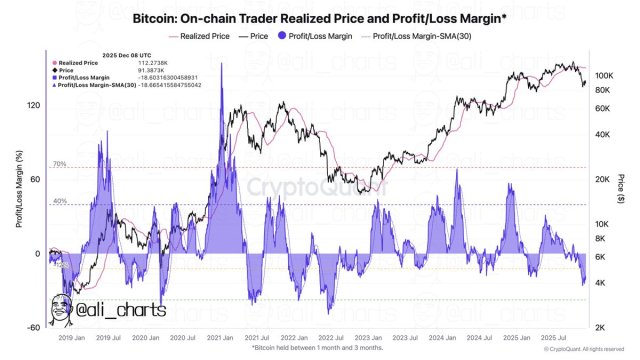
Source: Chart from Ali Martinez on X

In the post, Ali Martinez highlighted that the metric has fallen below the critical -37%, now located at -18%. The drop may appear increasingly negative, but it is hinting at a pivotal junction for the broader Bitcoin market.

Historically, this drop in the metric below this level has led to a rebound in investors’ confidence in the market. Martinez claims that some of the best buy-the-dip opportunities have emerged when Bitcoin on-chain traders’ realized loss falls below -37%.

BTC’s Rebound Requires Fresh Liquidity

Since the sharp pullback from its all-time high, Bitcoin has failed to bounce back strongly. Darkfost, a market and author at CryptoQuant, claims that one of the major reasons why BTC is currently struggling to recover is the absence of incoming liquidity. This is the biggest issue in the market now.

Liquidity here refers solely to stablecoins. According to Darkfost, monitoring these flows makes it easier to assess if new liquidity is poised to enter the market or if it is still lacking. Data shows that since August, stablecoin inflows into exchanges have steadily declined from 158 billion to around $76 billion.

This sharp drop represents a 50% decrease in incoming liquidity. Additionally, the 90-day average has dropped, from $130 billion in stablecoin inflows to $118 billion. A drop in liquidity suggests that Bitcoin is battling with a decline in demand, which has not been strong enough to absorb the selling pressure impacting the market.

Presently, the trend is still negative, and the minor rebounds observed are primarily a consequence of reduced selling pressure rather than more purchasing demand. For BTC to regain a genuine bullish trend, Darkfost stated that the key rests on new liquidity entering the market.


BTC trading at $92,397 on the 1D chart | Source: BTCUSDT on Tradingview.com

Related Reads

Winter for Crypto IPOs: Consensys and Ledger Withdraw Applications

The crypto IPO window is tightening significantly in 2026, marked by prominent companies delaying or pausing their public listing plans. Following a successful 2025 "harvest year" that saw Circle, Bullish, and Gemini go public amidst a bull market, the tide has turned. Consensys, developer of MetaMask, recently postponed its IPO until at least fall 2026. Hardware wallet leader Ledger also suspended its planned US listing due to unfavorable market conditions, with Kraken having previously delayed its own plans. This shift is driven by a cooling market in 2026, characterized by a significant Bitcoin price correction, declining trading volumes, and reduced investor risk appetite for crypto stocks. The poor post-IPO performance of 2025 listings like Circle and Bullish, which saw major share price declines, has heightened investor caution. This contrasts sharply with the current AI sector, where companies like SpaceX, OpenAI, and Anthropic are commanding massive valuations and investor enthusiasm based on narratives of stable, exponential growth. Crypto companies now face pressure to transition from hype-driven models to demonstrating reliable cash flows and robust compliance. While the paused IPO plans may lead to valuation resets and affect ecosystem liquidity, they also accelerate industry consolidation toward stronger, more compliant infrastructure players. A potential recovery in Bitcoin's price and clearer regulations could reopen the IPO window in the latter half of 2026.

marsbit1h ago

Winter for Crypto IPOs: Consensys and Ledger Withdraw Applications

marsbit1h ago

ChatGPT Can Manage Your Money for You. Would You Trust It with Your Bank Account?

OpenAI has launched a personal finance tool for ChatGPT, currently in preview for US-based ChatGPT Pro users. This feature allows users to connect their bank and investment accounts (via Plaid, supporting over 12,000 institutions) directly to ChatGPT. It analyzes transactions, generates visual dashboards, and offers conversational financial advice—such as budgeting or planning for major purchases—based on the user's actual data. This move follows OpenAI's acquisitions of fintech startups Roi and Hiro Finance, signaling a strategic push into vertical "super assistant" applications, similar to its earlier health-focused feature. However, the launch has sparked significant privacy concerns. Critics question the safety of granting such sensitive financial access to an AI, especially amid ongoing lawsuits alleging OpenAI shared user chat data with third parties like Meta and Google. OpenAI emphasizes that ChatGPT only reads data (no transaction capabilities), deletes it within 30 days if disconnected, and offers opt-out options for model training. Yet, trust remains a major hurdle. The trend reflects a broader industry shift: AI companies like Anthropic and Perplexity are also targeting high-value, data-rich domains like finance and health. While technically promising, the tool operates in a regulatory gray area—it provides personalized guidance but disclaims formal financial advice or liability. Ultimately, OpenAI's challenge is convincing users to trust an AI with their most private financial information.

marsbit1h ago

ChatGPT Can Manage Your Money for You. Would You Trust It with Your Bank Account?

marsbit1h ago

Trading

Spot
Futures

Hot Articles

Discussions

Welcome to the HTX Community. Here, you can stay informed about the latest platform developments and gain access to professional market insights. Users' opinions on the price of S (S) are presented below.

活动图片