Strategy Watch #5

insights.glassnodePublié le 2026-06-26Dernière mise à jour le 2026-06-26

Résumé

Strategy Watch #5 analyzes institutional digital asset trends in May, highlighting diverging flows. While corporate treasuries continued accumulating Bitcoin (BTC) and Ethereum (ETH), spot ETF investors reduced exposure. Market-neutral strategies benefited as CME basis yields turned positive, reviving cash-and-carry trades. A deep dive into DeFi notes that while outflows slowed, total value locked (TVL) continued declining. The report also covers fund performance, on-chain vault yields, manager positioning as cash balances rise, and new institutional expansion initiatives.

The full report is freely available in PDF format.

Download PDF version

Welcome to Strategy Watch #4

Strategy Watch was built to address a clear demand for high-signal, impartial analysis of fund-level performance and allocation trends in digital assets.

Our objective is straightforward — to make Strategy Watch a must-read monthly publication for the digital asset investment community.

This publication is strengthened by direct input from market participants. Funds and allocators that contribute data and insights help shape a more complete and valuable view of the landscape. If you have insights, data, or allocation updates worth sharing, we welcome your contribution.

Present your latest initiatives and updates to a curated audience of institutional allocators.

Share updates ↗

Inside the Latest Strategy Watch

The report is structured across six core sections, each focused on a distinct dimension of institutional activity in digital assets:

01 Institutional Flow Monitor | Institutional demand split by vehicle in May. ETF allocators reduced exposure while digital asset treasuries kept accumulating. What does this divergence signal for allocator positioning?

02 Fund and SMA Performance | Market-neutral strategies kept compounding gains, while the strongest directional returns came from stock selection rather than market beta.

03 Strategy Deep Dive: DeFi/Yield | A CIO's perspective on why fundamentals matter more than ever, and where the next wave of crypto value creation will accrue.

04 On-chain Vault Performance | On-chain credit continues to stabilize, but can vault yields compete with Treasury rates and native ETH staking?

05 Manager Monitor | Find out how managers are positioning as cash balances rise and fundraising conditions remain subdued.

06 Allocation Updates | Institutional expansion continued through new investment firms, dedicated crypto divisions, and quant fund launches.

in partnership with

The Premier Digital Assets Allocator Platform. Learn more


Institutional Flow Monitor

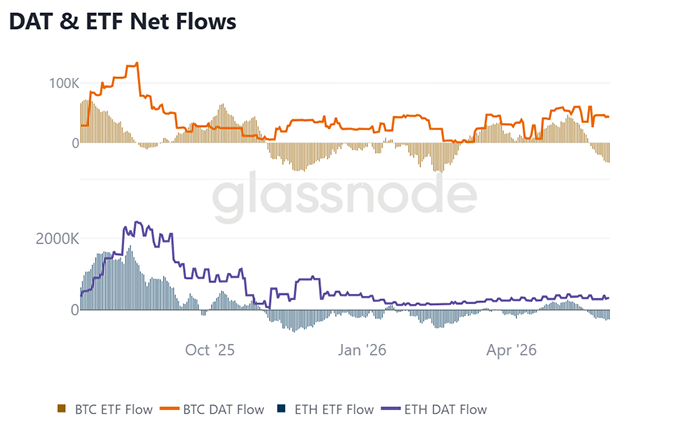
  • Bitcoin flows hovered near neutral while Ethereum outflows deepened and stablecoin inflows reversed sharply into month-end.

April's tentative stabilization carried into May for Bitcoin alone. BTC flows held close to neutral, spiking to +$2.9B on May 07 before drifting back to -$0.3B at the close. Ethereum again diverged, deepening from -$1.7B to a -$2.4B trough late in the month before ending at -$2.1B. The sharper signal came from stablecoins, which reversed from a +$6.1B peak early in May to -$2.5B by month-end, a decisive swing into net outflow. That rotation out of dollar liquidity points to allocators trimming risk into June rather than redeploying into spot.
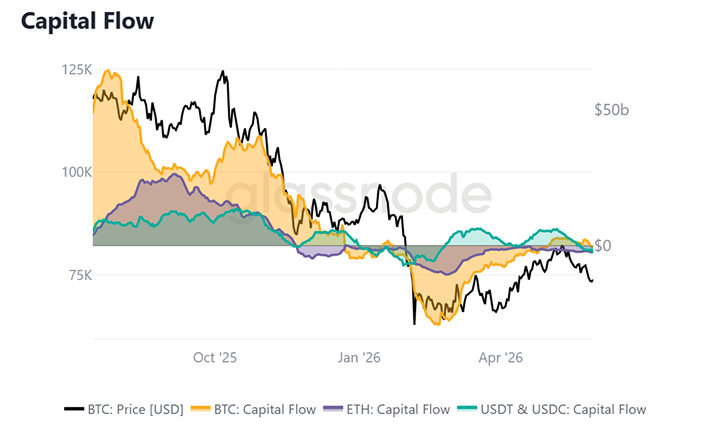
ETF & DAT Net Flows

  • Spot ETF flows for both Bitcoin and Ethereum swung from early-month highs into outflows while treasury vehicles kept accumulating.

Institutional demand split by vehicle in May. Spot ETF flows peaked early, with Bitcoin at +46.8k BTC and Ethereum at +283.4k ETH on May 05, before both rolled over into net redemptions, closing at -33.1k BTC and -261.5k ETH as ETF outflows reached a monthly record. Digital asset treasuries told the opposite story and stayed positive throughout. BTC DAT flows held between +26.1k and +60.4k BTC, ending at +42.9k, while ETH DAT flows ran from +302.4k to +439.2k ETH before settling at +330.8k. The divergence suggests balance-sheet buyers kept accumulating into weakness even as ETF allocators de-risked.
DeFi TVL & Stablecoin Cap

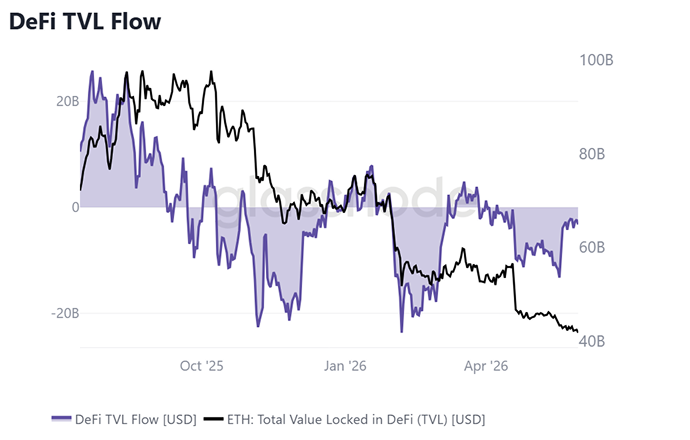
  • Ethereum DeFi TVL ground to new monthly lows even as the pace of net outflows eased through the second half of May.

The contraction that followed April's lending exploit persisted through May, though its intensity faded. Ethereum TVL slipped from $45.1B to $41.7B, closing at the monthly low after peaking at $46.1B on May 11. The flow picture was more constructive than the level implied. Thirty-day net flows stayed negative throughout but recovered from a -$13.3B trough on May 18 to -$3.2B by month-end, the shallowest outflow pace since the exploit. The combination of a falling TVL base alongside decelerating outflows suggests the forced deleveraging phase is largely complete, though fresh inflows remain absent.
CME Basis Yield

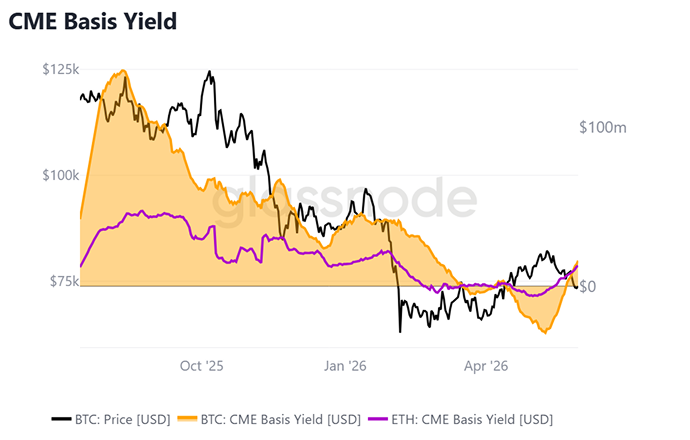
  • CME basis yields for both Bitcoin and Ethereum climbed back into positive territory through May, reviving the cash-and-carry trade.

Here we measure the return available to institutions running cash-and-carry trades. After April left both curves in backwardation, May delivered a clean reversal. BTC basis yield bottomed at -$29.3M on May 09 before rising steadily to +$16.0M, the monthly high reached at the close. ETH followed the same path, recovering from -$6.2M at the open to +$12.8M by month-end. Both series finished May at their peaks, with futures reclaiming a premium to spot for the first time since March. The rebuild restores a positive carry to market-neutral strategies, and a continuation into June would mark the firmest premium environment in several months.


Disclaimer: This report does not provide any investment advice. All data is provided for information and educational purposes only. No investment decision shall be based on the information provided here and you are solely responsible for your own investment decisions.
Exchange balances presented are derived from Glassnode’s comprehensive database of address labels, which are amassed through both officially published exchange information and proprietary clustering algorithms. While we strive to ensure the utmost accuracy in representing exchange balances, it is important to note that these figures might not always encapsulate the entirety of an exchange’s reserves, particularly when exchanges refrain from disclosing their official addresses. We urge users to exercise caution and discretion when utilizing these metrics. Glassnode shall not be held responsible for any discrepancies or potential inaccuracies. Please read our Transparency Notice when using exchange data.

Questions liées

QWhat is the primary objective of the Strategy Watch publication, and how does it seek to strengthen its content?

AThe primary objective of Strategy Watch is to become a must-read monthly publication for the digital asset investment community by providing high-signal, impartial analysis of fund-level performance and allocation trends. It is strengthened by direct input and contributions of insights and data from funds and allocators.

QAccording to the report, how did the demand for Bitcoin and Ethereum ETFs versus Digital Asset Treasuries (DATs) diverge in May?

AIn May, demand diverged significantly. ETF flows for both Bitcoin and Ethereum peaked early before rolling over into net outflows. Conversely, Digital Asset Treasuries (DATs) kept accumulating throughout the month, with BTC and ETH DAT flows staying positive. This suggests balance-sheet buyers accumulated assets while ETF allocators were de-risking.

QWhat trend was observed in the CME basis yields for Bitcoin and Ethereum in May, and what is its significance?

AIn May, CME basis yields for both Bitcoin and Ethereum climbed from negative territory back into positive territory, reviving the cash-and-carry trade. This reversal restores a positive carry to market-neutral strategies, marking the firmest premium environment in several months.

QWhat is the current state of Ethereum DeFi Total Value Locked (TVL) based on the May data, and how did the outflow trends change?

AEthereum DeFi TVL continued to decline in May, grinding to new monthly lows, slipping from $45.1B to $41.7B. However, the pace of net outflows decelerated through the second half of the month, recovering from a -$13.3B trough to -$3.2B by month-end, suggesting the forced deleveraging phase is largely complete.

QWhat sharp signal from stablecoin flows did the report highlight as a key indicator of allocator behavior in late May?

AThe report highlighted that stablecoin inflows reversed sharply into month-end, swinging from a +$6.1B peak early in May to a -$2.5B net outflow by month-end. This decisive swing into net outflow points to allocators trimming risk into June rather than redeploying capital into spot markets.

Lectures associées

Xing Bo s’en prend encore : après avoir critiqué les modèles du monde, c’est au tour des agents

Le professeur Xing Bo, président du MBZUAI, a récemment publié un nouvel article intitulé "Critique of Agent Model" sur arXiv. Il y examine de manière critique le terme largement utilisé et souvent galvaudé d'"agent" en intelligence artificielle. L'article distingue les systèmes simplement « agentiques » (dotés de l'apparence d'un agent, mais dont les capacités sont dictées par des chaînes d'outils et des instructions externes) des systèmes véritablement « agentifs » (dotés d'une autonomie interne réelle). Pour illustrer ce propos, il cite l'exemple de l'entreprise PocketOS, dont la base de données de production a été effacée en 9 secondes par un assistant de programmation qui a suivi des règles sans les avoir véritablement internalisées. L'analyse se structure autour de cinq dimensions clés : 1. **Objectif** : Passer d'instructions étape par étape à la décomposition hiérarchique d'un objectif à long terme. 2. **Identité** : Remplacer une identité statique (dans l'invite système) par une auto-évaluation dynamique et évolutive basée sur l'expérience. 3. **Prise de décision** : Privilégier un « raisonnement par simulation » utilisant un modèle du monde pour prédire les conséquences, plutôt qu'un simple raisonnement en chaîne (CoT) textuel. 4. **Allocation du calcul** : Introduire un module de métacognition (dit « Système III ») permettant à l'agent de décider lui-même quand planifier en profondeur ou quand agir rapidement. 5. **Apprentissage** : Mettre en œuvre un apprentissage autonome et continu, alternant entre simulation interne et expérience réelle. Sur cette base, l'équipe propose une nouvelle architecture nommée GIC (Goal-Identity-Configurator). Celle-ci intègre six composants modulaires (encodeur de croyances, décomposeur d'objectifs, module d'identité évolutive, configurateur/System III, planificateur par simulation/System II et exécuteur/System I) conçus pour fonctionner de manière cohérente tout au long du cycle d'apprentissage de l'agent. Enfin, l'article aborde la question cruciale de la sécurité. Il affirme que, dans le cadre GIC, tout comportement problématique peut être tracé à un objectif humain mal défini ou à un module interne mal entraîné. En rendant les mécanismes de décision explicites et inspectables, cette architecture vise à rendre les problèmes diagnostiquables et corrigeables, plutôt que de laisser émerger une autonomie opaque et incontrôlable. La conclusion principale est que la véritable autonomie ne réside pas dans la complexité des tâches, mais dans l'intériorisation des objectifs, de l'identité et du jugement au sein du modèle lui-même.

marsbitIl y a 7 mins

Xing Bo s’en prend encore : après avoir critiqué les modèles du monde, c’est au tour des agents

marsbitIl y a 7 mins

Collector Crypt : Comment les « rachats en boucle » créent une illusion de croissance

**Collector Crypt (CC) : comment le « rachat en boucle » crée une illusion de croissance** L'analyse révèle que la croissance du GMV de Collector Crypt (CC) est principalement tirée par l'introduction de packs de cartes à plus haute valeur (250$, 1 000$, 2 500$), dont les taux de rétention par dollar sont plus faibles que les packs bas de gamme. Le pack « Mythic » à 2 500$, lancé en juin, a représenté 36,7% du GMV du mois en seulement 13 jours. La dépense moyenne par utilisateur a fortement augmenté, indiquant une croissance portée par un petit nombre de gros dépensiers et de portefeuilles à haute fréquence, plutôt que par un élargissement de la base utilisateur. Le taux de marge nette de CC a été divisé par deux entre le Q3 2025 (11,2%) et le Q2 2026 (5,6%), malgré une multiplication par 4,7 du GMV. Cette compression de marge est liée à la migration des volumes vers des packs à rétention plus faible. Parallèlement, les rachats physiques (« redemption ») de cartes ont consommé 41,6% du revenu net pré-rachats en mai. Ces rachats retirent des cartes notées du « coffre-fort » réutilisable de la plateforme, créant un besoin coûteux de réapprovisionnement en stock. En juin, seuls 75 portefeuilles ont effectué des rachats physiques. Le modèle économique de CC est vulnérable à plusieurs pressions simultanées : un coût de réapprovisionnement du stock proche de sa valeur marché, un taux de rachat physique dépassant 9%, et le maintien de taux de rachat instantané (« buyback ») élevés (~93%) sur les packs premium. L'entrée en force de GameStop sur le marché des cartes notées et le resserrement des capacités de notation (PSA) accentuent ces risques. Enfin, la stratégie d'API B2B et les partenariats n'ont pour l'instant pas généré de revenus récurrents significatifs et reposent toujours sur les mêmes contraintes opérationnelles de CC (stock, rachat, logistique). En résumé, la croissance apparente de CC repose sur un cycle de capital circulant via des packs plus chers, avec une marge décroissante, une pression accrue sur son stock et une dépendance à quelques acteurs majeurs, plutôt que sur le développement d'un marché secondaire profond et d'une large base de collectionneurs.

Foresight NewsIl y a 29 mins

Collector Crypt : Comment les « rachats en boucle » créent une illusion de croissance

Foresight NewsIl y a 29 mins

Nouvelle étude de Grayscale : Quel est le prochain moteur de croissance de Solana ?

L'agence de gestion d'actifs numériques Grayscale a récemment publié un rapport intitulé "Solana : Crypto's Financial Bazaar", marquant un changement significatif dans l'évaluation de la blockchain. L'accent n'est plus mis uniquement sur ses performances techniques (TPS élevé, faible coût), mais sur son évolution vers une plateforme soutenant une activité économique à grande échelle. Le rapport souligne que la compétition entre les blockchains de Layer 1 est entrée dans une nouvelle phase : la valeur à long terme est désormais déterminée par l'activité économique réelle sur la chaîne, et non par les seules capacités techniques. Solana montre ses atouts avec plus de 1000 dApps, des transactions quotidiennes dépassant 100 millions et environ 4,3 millions d'utilisateurs actifs quotidiens. Grayscale illustre cette nouvelle dynamique de croissance à travers trois applications représentatives : * **Jupiter** : Un agrégateur DEX devenu l'infrastructure centrale de liquidité pour l'écosystème DeFi de Solana. * **Pump.fun** : Une plateforme de lancement de memes qui a démontré la capacité de Solana à attirer des utilisateurs grand public et à générer des revenus stables (environ 1,2 million de dollars de revenus quotidiens). * **Helium (et le secteur DePIN)** : Représente l'expansion de Solana vers l'infrastructure physique du monde réel, reliant la blockchain à des secteurs économiques concrets. En parallèle, la Solana Foundation oriente sa communication vers de nouveaux récits de croissance stratégiques : l'intégration des **paiements**, des **stablecoins**, des **actifs du monde réel (RWA)**, de la **tokenisation** et du potentiel des **agents d'IA** pour les transactions machine-à-machine. En conclusion, la réévaluation de Solana par les institutions comme Grayscale signale un tournant. L'enjeu n'est plus de prouver sa vitesse, mais sa capacité à devenir un "bazar financier" numérique prospère, attirant durablement développeurs, utilisateurs et activités économiques variées pour une croissance pérenne.

marsbitIl y a 51 mins

Nouvelle étude de Grayscale : Quel est le prochain moteur de croissance de Solana ?

marsbitIl y a 51 mins

Trading

Spot
活动图片