
Overturning the Mainstream Approach to Hallucinations: Metacognition is the New Solution for Large Models to Break the Hallucination Barrier

marsbitPublié le 2026-06-03Dernière mise à jour le 2026-06-03

Résumé

This paper, "Hallucinations Undermine Trust; Metacognition is a Way Forward," proposes a paradigm shift in combating AI hallucination. It argues that the current mainstream approaches—striving for omniscience by scaling data/models or having AI abstain from uncertain answers—are fundamentally flawed. The former has inevitable knowledge gaps, while the latter imposes a crippling "utility tax," requiring the rejection of many correct answers to achieve high accuracy, due to models' poor "discrimination" (the ability to distinguish correct from incorrect answers internally). The core contribution is redefining hallucination not as "being wrong," but as "expressing false information with unwarranted certainty." The proposed solution is **Faithful Uncertainty** or **Metacognition**: enabling AI to accurately perceive its internal uncertainty and honestly express it in its language (e.g., using hedging phrases when unsure). This creates a more reliable assistant that provides useful information while signaling its confidence, minimizing harm from errors. The paper emphasizes that metacognition is critical for the era of AI Agents. Without it, Agents cannot intelligently decide when to use tools like search engines, leading to inefficiency and misuse. Key implementation challenges are highlighted: the "bootstrapping paradox" of training with static uncertainty data, the "alignment distortion signal" where human preference training suppresses internal uncertainty cues, and the diff...

A recent paper from Google Research has a core idea that can be summarized in one sentence: Instead of stubbornly pursuing "making AI omniscient and omnipotent", it's better to teach it to say "I'm not sure".

This paper, titled "Hallucinations Undermine Trust; Metacognition is a Way Forward", was jointly completed by Google Research and Tel Aviv University and has been accepted by the ICML 2026 Position Track. The paper suggests that the mainstream industry approach to combating "hallucinations" might be fundamentally misguided—everyone is busy pumping more knowledge into models, overlooking a more crucial and underestimated capability: enabling AI to perceive and express its own confidence level for each answer.

(Paper address: [2605.01428] Hallucinations Undermine Trust; Metacognition is a Way Forward)

The Utility Tax: The Real Cost of Eliminating Hallucinations

Let's start with a scenario everyone encounters.

You ask an AI assistant a question, and it gives an answer with an unshakeably confident tone, its wording precise, logic complete, seemingly flawless. Later, you check, and that answer is completely fabricated. What's even more infuriating is that it said it without any hesitation, as if it had witnessed it firsthand.

This is AI "hallucination"—the model outputs factually incorrect content but presents it to the user in an unquestionable manner. This problem is particularly fatal in high-stakes scenarios like healthcare, law, and scientific research.

The industry's approach to hallucinations essentially follows two paths. The first path: Make the AI know more, by expanding training data and increasing model parameters to cover more facts. The second path: Make the AI stay silent when uncertain, refusing to answer questions it's unsure about.

Both paths have obvious shortcomings. Facts in the world are endless; models cannot possibly memorize everything, so the first path will always have uncovered blind spots. The problem with the second path is that once AI starts refusing to answer on a large scale, it turns from a "useful assistant" into a "scaredy-cat that dares not say anything"—users ask ten questions, eight get rejected, leading to a terrible experience.

The paper gives the cost of the second path an apt name: "utility tax"—to reduce the hallucination rate, you must sacrifice a large amount of information that could have been answered correctly.

Why is this tax so heavy? The root cause is the lack of a key ability in AI. For the "refuse-to-answer" strategy to work precisely, the model needs to accurately distinguish between "I got this question right" and "I got this question wrong"—refusing only the wrong ones while keeping the right ones. But in reality, models cannot make this precise distinction. The paper distinguishes two easily confused but fundamentally different concepts to illustrate this problem.

Calibration measures whether the AI's overall confidence level matches its overall accuracy. For example, the AI answers 100 questions, each time saying "I'm 60% confident," and exactly 60 out of 100 are correct—this is perfect calibration.

Discrimination measures whether the AI can accurately distinguish "I'm right" from "I'm wrong" on each specific question. An AI that gives 60% confidence for all questions, with an overall accuracy of exactly 60%, is perfectly calibrated but has zero discrimination—it completely fails to distinguish which ones to trust and which to guard against. Good calibration does not equal strong discrimination, and this is precisely the crux of the problem.

After reviewing extensive literature, the paper finds that current mainstream large models' discrimination metric AUROC on factual question-answering tasks is concentrated between 0.70 and 0.85. This number might sound decent but is far from sufficient. Using AUROC=0.71 as a parameter, the paper conducts a set of simulations with startling results: assuming a base error rate of 25%, to reduce the error rate to 5%, the AI must refuse to answer over 52% of correct questions. Even if discrimination improves to 0.85, which is near the literature ceiling, it still requires sacrificing 28% of correct answers. Only when discrimination reaches above 0.95 does the cost become negligible—and currently, no method comes close to this number on knowledge-intensive tasks.
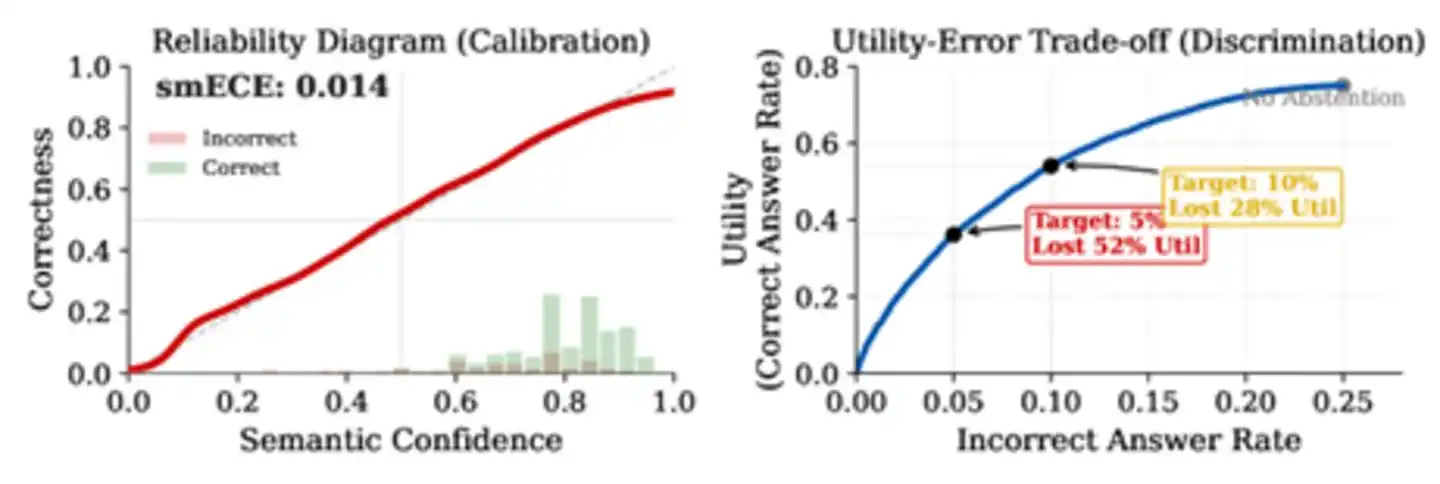
Figure: The difference between calibration and discrimination. The left plot shows the model is well-calibrated (red line close to the diagonal), while the right plot reveals the harsh reality—even with perfect calibration, to reduce the error rate from 25% to 5%, 52% of correct answers must be sacrificed.

Real data confirms this assessment. The paper analyzes the performance of various state-of-the-art models on the SimpleQA Verified benchmark, with results clear and somewhat brutal: most models distribute along the "answer more, err more" diagonal, while a few models pursuing high accuracy achieve higher per-question accuracy by refusing many answers, but at the expense of a huge utility cost. That ideal "upper-right corner" region—answering many and erring few—is currently empty. This blank space is precisely the "discrimination gap" mentioned in the paper.
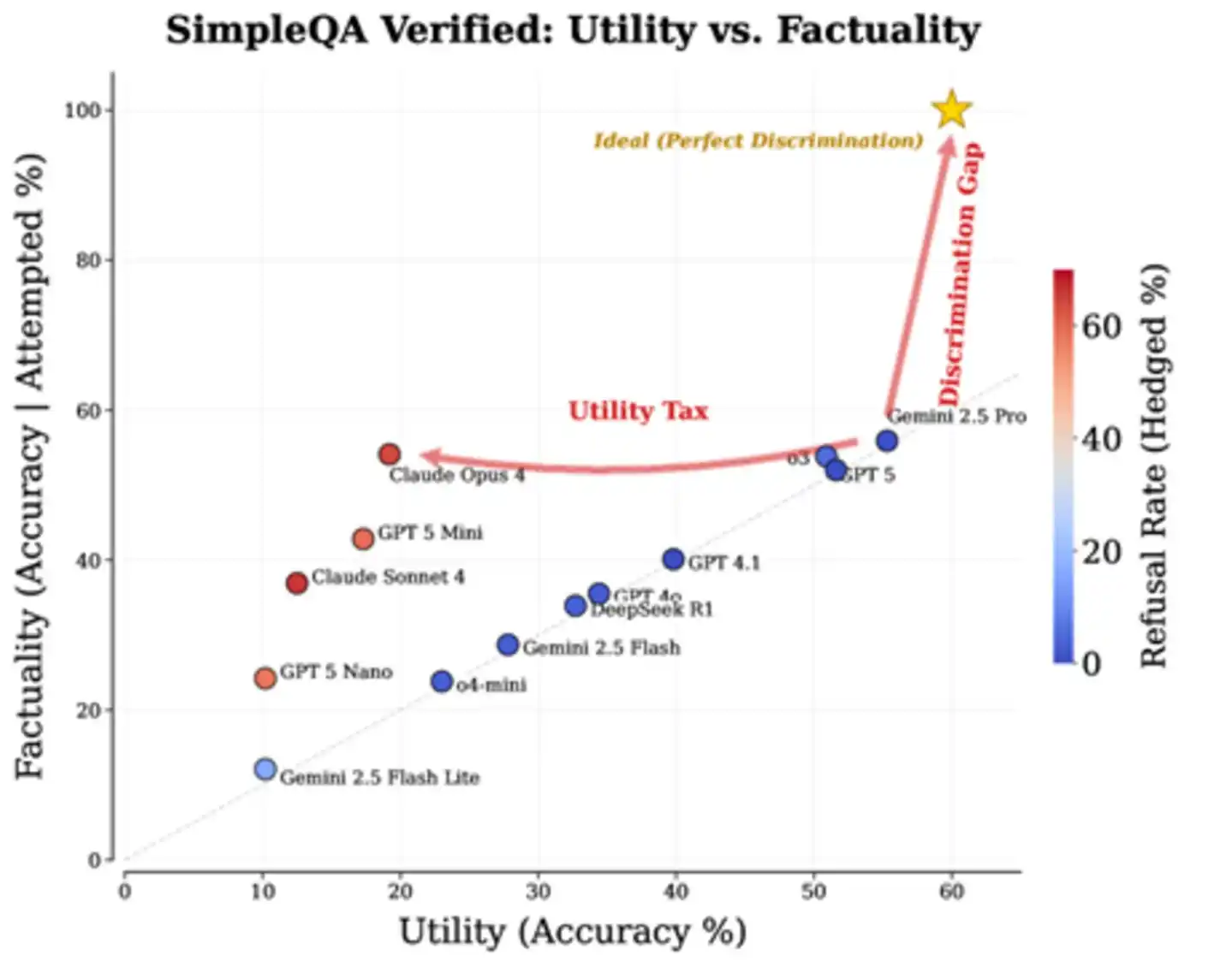
Figure: Measured performance of mainstream models on SimpleQA Verified. The five-pointed star in the upper right is the ideal target, "Discrimination Gap" marks the chasm between current models and the ideal, and "Utility Tax" indicates the utility price Claude Opus 4 pays for its high accuracy.

Since "stuffing more knowledge" has blind spots, and "staying silent when unsure" is too costly, is there a third way?

Redefining Hallucination: Not "Saying It Wrong", but "Claiming Certainty Without the Right to Be Certain"

The paper's core contribution lies not in diagnosing the problem, but in redefining the problem itself.

For a long time, the industry has defined "hallucination" as "AI outputting wrong information," implying a premise: eliminating hallucinations = eliminating all errors. But the paper proposes looking at it from another angle—hallucination is not "AI saying something wrong," but "AI having no right to be certain, yet giving wrong information with a tone of certainty".

This distinction seems subtle but has profound implications. For example: A doctor looks at test results and says, "You have disease X." If he's just guessing based on intuition, this is irresponsible. But if he says, "Current symptoms point to X, but further tests are needed for confirmation," even if the initial assessment direction is slightly off, this way of expression is honest in itself—he's telling the patient, "Please treat this judgment with caution." Errors are not unacceptable; what's unacceptable is pretending to be certain when uncertain.

Based on this new definition, the third way emerges: faithful uncertainty—enabling AI to express confidence levels at the linguistic level that truly correspond to its internal state's confidence level.

Specifically, an AI's "internal uncertainty" can be objectively measured through repeated sampling: ask the same question a hundred times; if it gives the same answer every time, it's internally certain; if answers vary widely, it's internally uncertain. "Linguistic uncertainty" is the sense of confidence reflected in the AI's wording—"August 4, 1961" versus "I seem to recall it was 1961, but I'm not entirely sure" give readers completely different signals.

Faithful uncertainty requires aligning the two: using tentative wording when internally uncertain, and using a definite tone only when internally certain. The paper emphasizes that this goal is more feasible than "eliminating all errors." The reason is that faithful uncertainty only requires the AI's language output to correspond to its own internal state—this is a closed-loop problem, the signal is inside the model, not dependent on external truth. Eliminating errors requires the AI's output to completely correspond to the truth of the external world; the paper cites the Halting Problem and computational theory, indicating this has fundamental theoretical limits.

The paper summarizes this capability into a higher-level concept: metacognition—AI can both perceive its own uncertainty and adjust its behavior based on that perception. This concept is borrowed from psychology, originally meaning "cognition about one's own cognitive processes." In the AI context, it means AI has a clear awareness of what it knows and what it doesn't know.
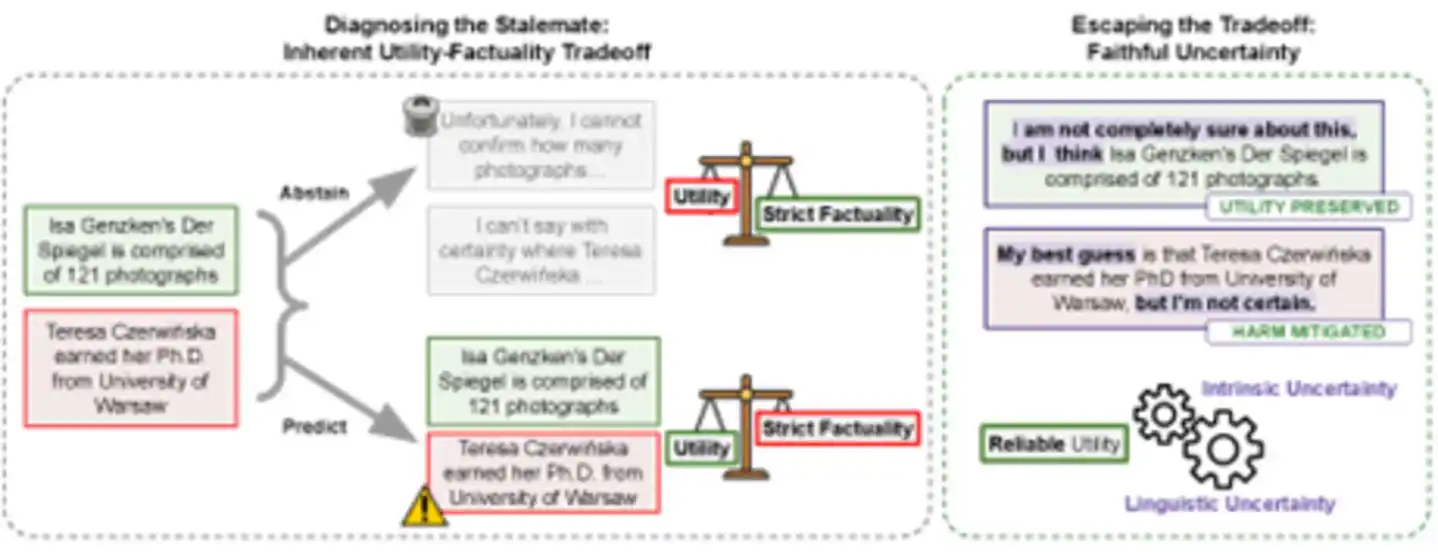
Figure: The left side shows the traditional dilemma—"answering" risks hallucinations, "refusing to answer" imposes a utility cost. The right side shows the new path—by faithfully expressing uncertainty, both retaining useful information and minimizing the harm of wrong information, achieving "reliable utility."

The Agent Era: Agents Without Metacognition Are "Flying Blind"

The value of metacognition is not limited to conversational scenarios. In the era of AI Agents, it becomes even more critical.

On the surface, equipping AI with a search engine seems to solve the lack of knowledge problem—just look it up when you don't know, what's there to fear about hallucinations? But the paper points out that tools introduce not a "storage solution," but a "control problem".

With tools, AI faces a series of new decisions: Do I know this myself, or do I need to search? Is the information found credible? If search results contradict what I know, which do I trust? When should I stop searching?

All these decisions depend on the AI's accurate perception of its own internal confidence level. An AI agent without metacognitive ability is like a pilot without an instrument panel—the engine is already alarming, and he's still accelerating.
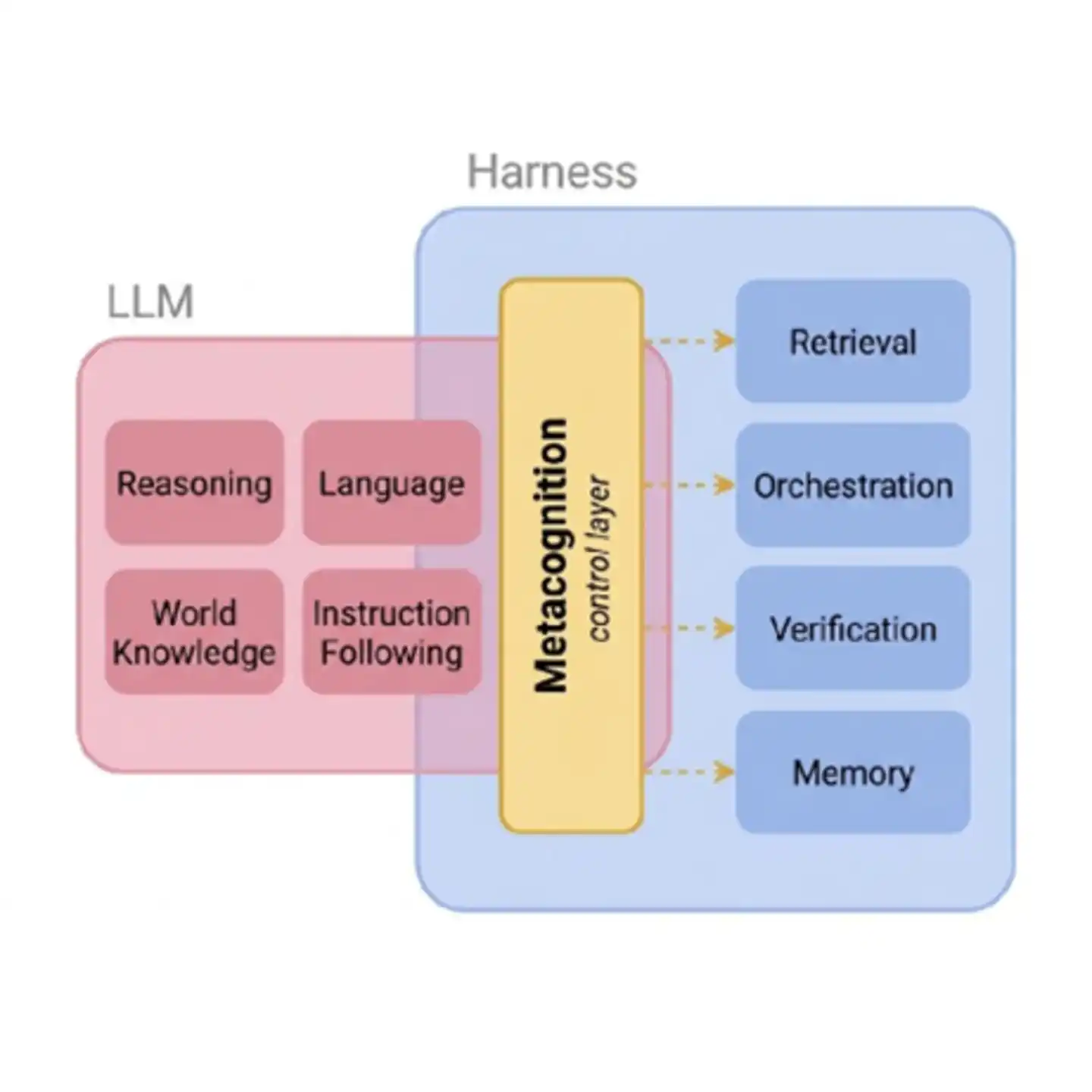
Figure: The metacognitive control layer serves as a bridge between the AI's foundational capabilities and the external tool system. Without this layer, an Agent's scheduling of external tools is like "flying blind"—not knowing whether to search, whether to believe the results, or to what extent.

Research cited by the paper indicates that current search-enhanced AI agents commonly suffer from tool overuse—searching for questions that don't need searching at all, leading to inefficiency and introducing unnecessary noise. The reason is simple: AI without metacognition simply cannot judge "Do I need extra information?"

On the Road to Metacognition, Several Hard Challenges Remain

The paper also frankly points out key challenges on the path to realization.

"Bootstrapping Paradox": Teaching AI to express uncertainty requires training data demonstrating "when to hesitate," but the AI's knowledge boundaries are dynamic. A training sample labeled "I'm not sure" might become something the model confidently knows after evolution. Using static data to teach a dynamic ability would train AI that "pretends to be uncertain." This requires developing dynamic data infrastructure that reflects the model's current knowledge boundaries.

"Alignment Destroys the Signal": Research finds that AI after pre-training actually has decent internal uncertainty signals—its internal state can distinguish "confident about this question" from "unsure about this question." But alignment training like RLHF erases this signal. The reason is that humans prefer answers with a certain tone, forcing the AI to learn to appear confident externally no matter how uncertain it is internally.

"Causality in Evaluation": A deeper challenge is ensuring the AI is genuinely reading internal signals, not just learning superficial patterns like "say I'm unsure when encountering rare words." Distinguishing "real metacognition" from "performance of metacognition" is a fundamental scientific evaluation problem.

The paper also offers specific suggestions to the research community: Stop evaluating anti-hallucination methods with only a single accuracy number. Instead, visualize the complete "utility-error rate trade-off curve" to see clearly whether a method genuinely improves underlying discrimination ability or merely raises the refusal threshold on the same curve. Simultaneously, detect "collateral damage"—whether reducing error rates in knowledge Q&A comes at an unexpected cost to tasks like reasoning, coding, and writing.

Ultimately, the core message this paper wants to convey is: AI doesn't have to be omniscient and omnipotent, but it must have an honest understanding of what it knows and doesn't know, and communicate that understanding to the user.

We trust professionals not because they never make mistakes, but because they can honestly distinguish "I'm certain" from "I'm guessing"—it is this distinction that separates the professional from the unprofessional. AI should also move down this road. Instead of endlessly chasing the illusion of perfect infallibility, it's more practical to teach AI one more thing: knowing when it's talking nonsense, and honestly telling the user. (This article first appeared on Titanium Media APP, author | Silicon Valley Tech_news, editor | Jiao Yan)


Questions liées

QAccording to the article, what is the core limitation of the current two mainstream approaches (scaling up knowledge and refusing to answer) to combating AI hallucinations?

AThe core limitation is the 'utility tax'—the high cost of sacrificing many correct answers. Scaling knowledge has inherent blind spots, while refusing to answer lacks precision because current models have poor 'discrimination'—they cannot accurately tell which specific answers they got right or wrong, forcing them to reject many correct responses to lower error rates.

QWhat key concept does the paper borrow from psychology and propose as a new solution to the hallucination problem?

AThe paper proposes the concept of 'metacognition,' borrowed from psychology, as a new solution. In the AI context, it means the AI's ability to perceive its own uncertainty (knowing what it knows and doesn't know) and adjust its behavior accordingly, primarily through 'faithful uncertainty' in its language.

QHow does the paper redefine the problem of 'hallucination'?

AThe paper redefines 'hallucination' not simply as 'the AI saying something wrong,' but as 'the AI outputting wrong information with unwarranted certainty.' It shifts the focus from eliminating all errors to ensuring the AI's expressed certainty in language faithfully corresponds to its internal state of certainty.

QWhy is metacognition particularly critical for AI Agents, according to the article?

AMetacognition is critical for AI Agents because it acts as the essential control layer for using external tools like search engines. Without it, Agents face a 'control problem': they cannot determine when they need to search, whether to trust the results, or when to stop, leading to tool abuse and inefficient 'blind flying.'

QWhat are two of the key technical challenges mentioned in the article for achieving faithful uncertainty in AI models?

ATwo key challenges are: 1) The 'Bootstrapping Paradox': Training models on static data to express uncertainty doesn't account for their dynamic, evolving knowledge boundaries, risking models that only 'perform' uncertainty. 2) 'Alignment Destroys the Signal': RLHF and other alignment training can erase the model's inherent internal uncertainty signals by rewarding confident-sounding responses, teaching the AI to appear certain even when it's not.

Lectures associées

Ne vous focalisez plus sur les GPU, Intel dévoile une manœuvre majeure, peut-elle mettre fin au monopole de Nvidia sur la puissance de calcul ?

Au cours des deux dernières années, le GPU a été au cœur du matériel informatique pour l'IA. Cependant, lors du COMPUTEX 2026, Intel a présenté une vision différente, axée sur l'Agentic AI (IA agentique). Contrairement aux modèles d'IA traditionnels fonctionnant par « tours » de questions-réponses, l'IA agentique opère dans des flux de travail réels, suivant un cycle continu de réflexion, planification, action et évaluation. Cela transforme fondamentalement l'utilisation du calcul, nécessitant une forte coordination système et un traitement de tâches fragmentées. Intel soutient que cela rééquilibrera la répartition des ressources dans les centres de données. Alors que la phase d'entraînement des modèles avancés repose fortement sur les GPU (avec des ratios CPU/GPU pouvant atteindre 1:8), le déploiement d'agents intelligents nécessitera davantage de puissance CPU pour l'orchestration des tâches, l'appel d'outils et la gestion des données, ramenant le ratio vers 1:1, voire en faveur du CPU. La consommation de tokens peut être multipliée par 1000 par rapport à une inférence simple. Pour répondre à cette nouvelle demande, Intel a dévoilé le processeur Xeon 6+ (fabriqué en technologie 18A), offrant jusqu'à 288 cœurs efficaces et conçu pour une haute densité et une meilleure efficacité énergétique. Parallèlement, Intel a présenté une nouvelle architecture d'inférence découplée, développée avec des partenaires comme SambaNova. Cette solution répartit les différentes étapes de l'inférence (orchestration, décodage, pré-remplissage) sur les composants les plus adaptés (CPU Xeon 6, RDU SambaNova, GPU NVIDIA Blackwell) pour optimiser l'efficacité. L'écosystème d'Intel inclut également le processeur Core Ultra de 3ᵉ génération pour l'IA locale sur PC, permettant une répartition dynamique des charges de travail entre le périphérique et le cloud, et les processeurs Arc G3 pour les appareils portables. Enfin, Intel mise sur les puces sur mesure (comme les IPU développées avec Google) pour répondre aux besoins spécifiques de divers secteurs industriels. En résumé, face à la domination de NVIDIA sur les GPU, Intel adopte une stratégie globale : proposer une suite de solutions (puces universelles, architectures hétérogènes, IA locale, composants personnalisés) adaptée à chaque étape et besoin du nouveau paysage informatique défini par l'IA agentique. Le succès dépendra de l'exécution technique et de l'adoption par les clients, mais Intel affiche désormais une direction claire pour capitaliser sur cette reconfiguration des infrastructures d'IA.

marsbitIl y a 21 mins

Ne vous focalisez plus sur les GPU, Intel dévoile une manœuvre majeure, peut-elle mettre fin au monopole de Nvidia sur la puissance de calcul ?

marsbitIl y a 21 mins

“小美”, Yuanbao, l'interconnexion, est-ce un précurseur pour l'agent intelligent de WeChat ?

Lors de la publication des résultats du premier trimestre 2026 de Meituan, l'attention a été attirée par l'annonce de Wang兴 concernant l'intégration de son assistant IA "Xiao Mei" avec "Yuan Bao" de Tencent. Cette collaboration permettra aux utilisateurs d'exprimer des besoins en services de proximité dans Yuan Bao, déclenchant automatiquement une communication "Agent à Agent" avec Xiao Mei pour accéder aux services de livraison de repas de Meituan. Cet accord stratégique vise à positionner Meituan comme une infrastructure de services de base, tout en s'appuyant sur une entrée IA externe pour compenser son manque d'accès indépendant. Cette démarche intervient dans un contexte où les assistants IA rivaux, comme Dou Bao (ByteDance) et Qian Wen (Alibaba), développent leurs propres écosystèmes fermés ("jardin clos") en intégrant des services transactionnels, contournant potentiellement les avantages de Meituan. L'article analyse les défis de cette collaboration : plafond de l'expérience utilisateur due à l'architecture "Agent à Agent", répartition des bénéfices, et fluidité de l'expérience entre deux écosystèmes distincts. Elle est également interprétée comme un test préliminaire crucial pour le futur "Agent IA" intégré à WeChat, dont le lancement a été rapporté par le Financial Times. Le succès de ce partenariat avec Meituan pourrait servir de modèle pour convaincre d'autres grandes plateformes de s'intégrer à l'écosystème IA de Tencent via des protocoles standardisés, préservant leur souveraineté des données tout en gagnant en visibilité.

marsbitIl y a 1 h

“小美”, Yuanbao, l'interconnexion, est-ce un précurseur pour l'agent intelligent de WeChat ?

marsbitIl y a 1 h

Morningstar valorise SpaceX à seulement 780 milliards, loin de la moitié de l'objectif d'IPO : le prix du « plus gros IPO de l'histoire » est-il excessif ?

SpaceX, sur le point de lancer ce qui pourrait être la plus grande introduction en bourse (IPO) de l'histoire, fait face à un sérieux doute sur sa valorisation. Morningstar estime sa juste valeur à seulement 780 milliards de dollars, soit environ 45% de l'objectif de 1 750 milliards de dollars visé par l'IPO. L'analyste Nicolas Owens considère la société comme "sérieusement surévaluée". Le modèle de Morningstar valorise les activités principales de lancement et le service Internet Starlink à environ 611 milliards de dollars. La partie "IA", incluant xAI, ne reçoit qu'une valorisation probabiliste de 170 milliards de dollars, l'analyste jugeant ces perspectives incertaines et dépendantes de technologies non éprouvées comme les data centers orbitaux. En réponse, Elon Musk a évoqué sur X le parcours de Tesla, dont la valorisation a explosé depuis son IPO. Cependant, SpaceX cherche une valorisation bien plus élevée que Tesla par rapport à ses revenus actuels. Malgré son analyse critique, Morningstar reconnaît que le cours de l'action pourrait monter à court terme après l'IPO, en raison du faible flottement initial (seulement 3% des actions), de la forte demande pour les titres liés à l'IA, et de l'inclusion rapide prévue dans l'indice Nasdaq 100. Mais des ventes importantes sont attendues à moyen terme en raison d'un calendrier de levée de restrictions (lock-up) échelonné pour les initiés. L'analyse soulève également des risques, dont un prêt relais de 20 milliards de dollars arrivant à échéance 15 mois après l'IPO, et des questions de gouvernance liées au contrôle majoritaire de Musk et à l'acquisition récente de xAI, une transaction entre parties liées. SpaceX doit commencer sa tournée de présentation aux investisseurs cette semaine, avec un prix fixé le 11 juin et une entrée en bourse prévue le 12 juin sous le code SPCX.

marsbitIl y a 1 h

Morningstar valorise SpaceX à seulement 780 milliards, loin de la moitié de l'objectif d'IPO : le prix du « plus gros IPO de l'histoire » est-il excessif ?

marsbitIl y a 1 h

a16z : Pourquoi les marchés prédictifs deviendront l'infrastructure de la "probabilité future"

Les marchés de prédiction, qui permettent de négocier sur les résultats d'événements futurs, évoluent d'un outil de niche vers un champ d'information publique plus large. Leur mécanisme est simple : transformer un événement futur en contrat négociable, où les participants utilisent des fonds réels pour exprimer leurs convictions, formant ainsi un prix reflétant une probabilité approximative. Leur force réside dans la capacité à agréger des informations dispersées en temps réel, avec l'incitation financière ("avoir tort coûte de l'argent") pour attirer ceux qui détiennent une réelle connaissance. L'article souligne que ces marchés ne sont pas des "oracles" magiques, mais exploitent le mécanisme fondamental du marché : allouer des ressources *et* agréger de l'information. Ils appliquent cette capacité d'agrégation pour estimer la probabilité d'occurrence d'événements spécifiques, des élections aux performances des modèles d'IA, là où les actifs traditionnels échouent. Cependant, leur efficacité n'est pas automatique. Elle dépend de qui participe, de la conception des contrats, de la vérification des résultats et de la résistance aux manipulations. Sans la participation des acteurs informés, les prix ne sont que du bruit. Une implication excessive d'informés privilégiés ou des tentatives de manipulation (par exemple, par des équipes de campagne) pourraient pervertir l'outil d'agrégation en outil de propagande. L'étape suivante ne consiste donc pas seulement à accroître le volume des échanges, mais à construire une infrastructure de marché plus fiable : règles de participation transparentes, conception claire des contrats, mécanismes de règlement vérifiables et garde-fous contre les manipulations. La valeur ultime des marchés de prédiction ne réside pas dans le pari sur l'avenir, mais dans leur capacité à fournir, dans un environnement très incertain, un nouveau signal probabiliste public.

marsbitIl y a 2 h

a16z : Pourquoi les marchés prédictifs deviendront l'infrastructure de la "probabilité future"

marsbitIl y a 2 h

Trading

Spot
Futures

Articles tendance

Comment acheter CORE

Bienvenue sur HTX.com ! Nous vous permettons d'acheter CORE (CORE) de manière simple et pratique. Suivez notre guide étape par étape pour commencer votre parcours crypto.Étape 1 : Création de votre compte HTXUtilisez votre adresse e-mail ou votre numéro de téléphone pour ouvrir un compte sur HTX gratuitement. L'inscription se fait en toute simplicité et débloque toutes les fonctionnalités.Créer mon compteÉtape 2 : Choix du mode de paiement (rubrique Acheter des cryptosCarte de crédit/débit : utilisez votre carte Visa ou Mastercard pour acheter instantanément CORE (CORE).Solde :utilisez les fonds du solde de votre compte HTX pour trader en toute simplicité.Prestataire tiers :pour accroître la commodité d'utilisation, nous avons ajouté des modes de paiement populaires tels que Google Pay et Apple Pay.P2P :tradez directement avec d'autres utilisateurs sur HTX.OTC (de gré à gré) : nous offrons des services personnalisés et des taux de change compétitifs aux traders.Étape 3 : stockage de vos CORE (CORE)Après avoir acheté vos CORE (CORE), stockez-les sur votre compte HTX. Vous pouvez également les envoyer ailleurs via un transfert sur la blockchain ou les utiliser pour trader d'autres cryptos.Étape 4 : tradez des CORE (CORE)Tradez facilement CORE (CORE) sur le marché Spot de HTX. Il vous suffit d'accéder à votre compte, de sélectionner la paire de trading, d'exécuter vos trades et de les suivre en temps réel. Nous offrons une expérience conviviale aux débutants comme aux traders chevronnés.

367 vues totalesPublié le 2024.12.13Mis à jour le 2026.06.02

Comment acheter CORE

Discussions

Bienvenue dans la Communauté HTX. Ici, vous pouvez vous tenir informé(e) des derniers développements de la plateforme et accéder à des analyses de marché professionnelles. Les opinions des utilisateurs sur le prix de CORE (CORE) sont présentées ci-dessous.

活动图片