Bill Gates' Latest Long-Form Article: The Real Trouble with AI is That We Aren't Ready

marsbitPublié le 2026-08-28Dernière mise à jour le 2026-08-28

Résumé

Bill Gates' latest essay, "The turbulent AI era is here. The choices we make now are critical," warns that society is unprepared for the profound social and economic transition AI will bring. While optimistic about AI's long-term potential in healthcare, education, and other fields, Gates focuses on the "transition period" over the next 10-20 years. He argues this transition differs from past technological shifts like the Industrial Revolution because AI automates cognitive labor itself, potentially reducing the total number of future jobs. Risks like enhanced cyber-attacks and social disruption are already emerging, not distant future threats. A key concern is "low-cost intelligence substitution," where AI performs defined tasks cheaper than humans, gradually thinning workforces. Gates introduces the concept of "Human Reserved" jobs—roles like nursing or delivering serious medical news—where human judgment and empathy should remain central, even if AI is technically capable. To manage the transition, he calls for new governance, stronger social safety nets, retraining, and international cooperation, especially between the US and China. Crucially, he proposes taxing AI usage and robots to slow displacement and fund social programs. The core dilemma Gates presents is that AI could become humanity's "greatest equalizer" or its "worst source of injustice," depending on whether its immense productivity gains are broadly shared or concentrate wealth and power. The fundamental c...

By | Deng Ding Kexuan

On August 26, Bill Gates published a long-form article about AI on Gates Notes:

The turbulent AI era is here. The choices we make now are critical.(The Turbulent AI Era Has Arrived, The Choices We Make Now Are Critical)

Original article on Bill Gates' Gates Notes:
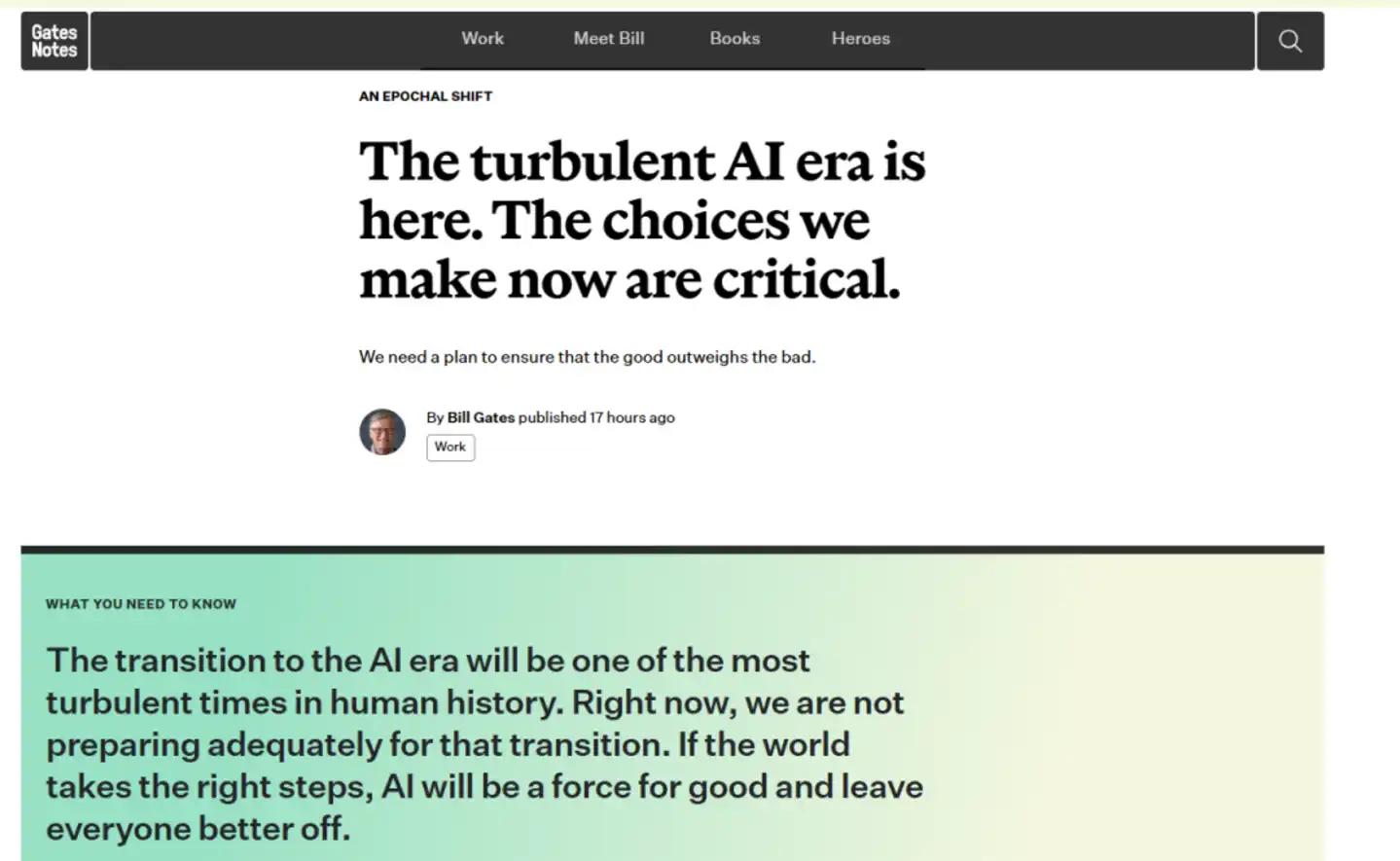
Core gist of the original article: AI could become the most powerful tool for equality, or a major source of inequality. Gates believes we need to start planning for this transition now.

This article is highly readable. Gates has not become an AI pessimist, nor does he deny AI's long-term value. He still believes AI will drive significant progress in fields like healthcare, education, agriculture, energy, and scientific research.

But his focus has changed.

In recent years, he talked more about what AI could ultimately create. This time, he spends considerable space discussing another question:

What will happen on the path from today to that future?

If the entire article were condensed into one sentence, it would probably be:

AI's long-term benefits could be enormous. But the 'transition period' between now and that future could become one of the most dramatic social transformations in human history. And we have barely established institutions for it.

Gates still believes in AI's long-term value. What worries him now is: how we get through the next decade or so in the middle.

He writes directly in the original text: "Unfortunately, we are not preparing for it now."

First Level: Gates believes this time cannot be simply compared to the Industrial Revolution

This is a point I consider very important and easily missed by news headlines.

Faced with the question 'Will AI take jobs?' in the past, a standard answer was: The steam engine eliminated some jobs but created new ones; the internet did the same, so AI will ultimately create new jobs too.

Gates now expresses clear skepticism about this analogy. Previous technologies primarily replaced physical labor or specific capabilities. New jobs ultimately still required human cognition.

The special thing about AI is: it is itself replacing cognitive labor.

The default cycle of the past two hundred years

Old jobs disappear → New jobs appear → Humans transition to them

Gates directly mentions law, customer service, healthcare, software, and manufacturing in the original text, later listing jobs like sales, software engineering, paralegal, loan approval, data analysis, and patient triage.

His assessment is: New jobs will still emerge, but without appropriate policies, the number of future positions may be far fewer than today's.

This assessment considers a deeper issue than the usual 'AI taking jobs'. For the past two hundred years, we assumed technological progress would ultimately create more, more complex jobs that also required human cognition.

But what if what's being scaled and made cheaper is 'cognitive capability' itself? The validity of this historical experience then becomes uncertain.

The biggest impact of AI on employment might not be a sudden wave of mass unemployment. A more likely change is that the same company, the same business, will need far fewer people in the future.

One person plus a few Agents can complete work that previously required a small team.

Jobs won't vanish overnight, but new job creation will slow, teams will thin out, and companies will become increasingly unwilling to pay the previous price for 'cognitive labor that can be done by AI'.

Second Level: The risk is no longer a post-AGI problem, it's happening now

Another important context for Gates's shift in stance this time.

He explained to MIT Technology Review why he is speaking out now specifically.

He believes several previously discussed 'danger thresholds' are actually starting to be crossed, including: biological capabilities, cyber attack capabilities, psychological and social influence, job market disruption, and AI controllability.

Especially Coding. Advances in Claude Code, long context, and Agentic Coding made him realize AI is crossing more than just a programming capability threshold.

An Agent capable of writing code at scale could also become a powerful tool for cyber attacks.

The stronger AI's capabilities, the better defenders become at finding vulnerabilities and patching systems. But the cost for attackers to find vulnerabilities and launch attacks using the same capabilities is also falling.

Gates also mentions this issue in the original text. The new capabilities attackers are gaining are rapidly increasing, while defenders cannot patch all weaknesses simultaneously.

Capabilities are crossing lines, governance remains stuck in the discussion stage.

Third Level: His biggest worry isn't just unemployment, but 'low-cost intelligent substitution'

There's one line from the MIT interview I find even more intriguing than the main text:

For well-defined jobs, AI will be cheaper and will do them better.

The examples he gives are very ordinary: telemarketing, customer service, finance departments, month-end closing, discount judgment, etc. A large number of white-collar jobs with clear processes, defined rules, and describable digitally will increasingly be easily done by low-cost AI.

The most crucial word here might not be 'substitution', but: cheaper.

The reality likely won't be a sudden switch where AI = 1, human = 0. It might be a department that previously needed 10 people now only needing 6.

The information processing required for entry-level positions is first handled mostly by Agents. A person's work hours used to dictate the speed of business expansion; now software can process vast numbers of tasks in parallel.

The core of the change is the marginal cost of labor and intelligence.

Following this line of thought further, Gates proposes an idea rarely heard from him: For some jobs, even if AI can do them, society may still want to leave them to people.

Fourth Level: A very interesting new concept – Human Reserved

Can be translated as: 'Human Reserved Domains.' Gates uses a vivid analogy: nature reserves.

Of course, roads and buildings could be built in nature reserves. We choose not to because the cost of losing them is too high. Human Reserved follows similar logic: even if AI can do it, we still decide to have humans do it.

This idea comes from his father's later years.

Gates's father had Alzheimer's disease. In his final years, a group of caregivers looked after him around the clock. Sometimes, his father could no longer express that he was hungry, but the caregivers could still understand him.

Gates writes there is something 'irreplaceably human' in this kind of care. Education and mental health might adopt a 'human + AI' approach, with humans bearing final responsibility and AI extending human capabilities.

Another example in healthcare: Technically, a robot could certainly tell a person 'You have an incurable disease.' Gates believes it should not.

The meaning of 'human work' in the future may no longer be determined solely by efficiency.

Fifth Level: Therefore, taxes and social security must be redesigned

If AI and robots continuously reduce labor demand, existing systems will encounter a very practical problem.

The current tax base

People work → Companies pay wages → Wages are taxed

If more and more work becomes: AI / robots work → Companies gain productivity benefits, the original tax base could be affected.

Therefore, Gates again raises the idea of a robot tax, and states it very directly:

"I believe we should tax AI tokens and robots."

"I believe we should tax AI tokens and robots."

When a company hires a person, it must pay payroll tax based on the salary. Purchasing a robot can often be immediately written off as a business expense.

Gates believes the current tax system actually incentivizes companies to replace humans with machines faster.

Taxation could, on one hand, slightly slow the pace at which companies move away from human labor, and on the other hand, raise funds for retraining and a stronger social safety net.

This touches on the flip side of the issue I previously considered when writing 'The Bill for AI Won't Just Be Paid by Tech Companies'.

If these investments ultimately do create huge productivity gains, who will the gains flow to?

Sixth Level: AI could simultaneously become 'the greatest equalizer' and 'the worst source of injustice'

This is the overarching thesis of the article.

"AI will either be the greatest equalizer ever invented, or the worst source of injustice."

AI will either be the greatest tool for equality ever invented by humanity, or the most severe source of injustice.

If the marginal cost of AI healthcare, AI education, AI agriculture, and AI research is low enough, capabilities previously available only to affluent regions have the opportunity to reach more ordinary people.

The same technology could also amplify existing disparities.

AI ownership is concentrated in a few companies.

Capital captures the main productivity gains.

The value of ordinary people's labor declines.

Affluent regions gain AI benefits first.

Low-income groups bear the brunt of job impacts first.

So the question is no longer just: 'Can AI create wealth?', but also: 'Who ultimately gets the wealth AI creates?'

Finally, the three categories of action he suggests

First, establish a new AI transition governance system.

Existing government agencies were not designed for a technology that spans employment, national security, education, healthcare, taxation, energy, finance, and cybersecurity.

Second, proactively manage job market impacts.

Including strengthening the social safety net, vocational retraining, adjusting tax systems, and unconventional solutions like Human Reserved.

Third, international coordination is needed; the US and China cannot be absent.

Cybersecurity, biological risks, and model proliferation all cross borders. Gates explicitly writes that a certain degree of cooperation between the US and China is needed.

The most hotly debated view in this article is his prediction about the future

Gates is discussing an AI transition period problem:

The endpoint of AI may be abundance, but there is no automatically smooth path between the 'abundant society' and the present.

An abundant society is at least a decade away. The entire transition process could last the next 10–20 years.

Sam Altman, Dario Amodei, and others often describe where AI can ultimately push productivity. Gates is discussing another period this time:

What exactly will happen between now and that abundant society?

This question is more realistic for ordinary people than 'When will AGI arrive?': Companies stop hiring so many new people. A department starts using Agents to do the work of several. Certain professional services become very cheap.

New productivity gains flow more to those who own the models, compute, and capital. But tax, education, social security, and employment systems still operate in the old way.

These changes don't need to wait for AGI to appear; some have already begun. The hardest part of AI may not just be making models powerful enough.

Once technology enters society, there is a slower, harder problem:

Do we have the capacity to make society adapt to it?

  • References:Bill Gates / Gates Notes; MIT Technology Review Interview; Anthropic Claude Code materials.


Cryptos en tendance

Questions liées

QAccording to Bill Gates, what is the main concern regarding AI's future development?

AAccording to Bill Gates, the main concern is not AI's ultimate potential but the "transition period" leading up to that future. This period could be one of the most dramatic social transformations in human history, and he believes we are largely unprepared for the institutional changes required to manage issues like employment disruption and inequality during this time.

QWhy does Bill Gates argue that the AI transition is not a simple repeat of the Industrial Revolution?

ABill Gates argues that past technological revolutions, like those driven by steam engines or the internet, primarily replaced physical labor or specific tasks, eventually creating new jobs that still required human cognition. AI is different because it is replacing cognitive labor itself, the very foundation upon which new jobs have historically been created. This calls into question whether the historical pattern of 'old jobs disappear → new jobs appear' will hold true.

QWhat is the concept of "Human Reserved" that Bill Gates introduces?

A"Human Reserved" refers to certain jobs or domains that society should purposefully reserve for humans, even if AI becomes technically capable of performing them. Gates uses the analogy of a nature preserve. Examples include certain aspects of caregiving (like for his father with Alzheimer's), education, and delivering serious medical news. The idea is that the human element in these roles provides an irreplaceable value that should be protected for social, not just efficiency, reasons.

QWhat specific policy recommendation does Bill Gates make to address potential economic disruptions from AI?

ABill Gates recommends implementing a "robot tax" or a tax on AI tokens. He argues that current tax systems, which tax human labor through payroll taxes but often allow immediate write-offs for capital investments in robots/AI, incentivize the rapid replacement of human workers. Taxing AI and robots could slow this transition and generate revenue to fund retraining programs and strengthen social safety nets for those affected by job displacement.

QWhat are the two potential, opposing outcomes that Bill Gates sees for AI's impact on society?

ABill Gates states that AI will either become "the greatest equalizer ever invented" or "the worst source of injustice." It could be an equalizer by drastically lowering the cost of access to high-quality services like healthcare and education, making them available to more people globally. Conversely, it could exacerbate inequality if the ownership and productivity gains from AI are concentrated among a few companies and capital owners, while the labor value of the majority declines and lower-income groups bear the brunt of job losses.

Lectures associées

Malgré la récente hausse du Bitcoin, un analyste reste prudent : « Je n’ai pas encore vu ce que je voulais voir »

Bien que la récente reprise du Bitcoin ait ravivé les attentes haussières sur le marché des cryptomonnaies, Joao Wedson, fondateur d'Alphractal, adopte une position plus prudente. Selon ses analyses des données blockchain, le prix minimum définitif du cycle du Bitcoin pourrait ne pas encore avoir été atteint. Il estime que, sur la base de certains indicateurs historiques, le BTC pourrait encore chuter jusqu'à 53 000 dollars, voire en deçà. Wedson met en avant l'indicateur MVRV Z-Score, utilisé pour mesurer le comportement des investisseurs et la valeur réalisée du marché. Il compare la structure actuelle du marché au cycle de 2017-2018. Après avoir atteint son pic historique en 2017, l'indicateur MVRV Z-Score avait formé une base avant que le Bitcoin ne subisse une nouvelle chute brutale fin 2018. Dans le cycle actuel (2024-2025), Wedson note que le MVRV Z-Score a également atteint trois pics distincts, bien que l'enthousiasme ait été plus modéré qu'en 2017. L'indicateur a récemment formé une base similaire à celle de 2018, puis a remonté, entraînant la hausse du prix du Bitcoin. Le risque principal identifié par l'analyste est que le MVRV Z-Score n'est pas encore entré en territoire négatif, une zone historiquement associée aux creux cycliques majeurs du Bitcoin. Selon lui, les données on-chain ne fournissent pas encore suffisamment de signaux pour affirmer avec certitude que le récent creux constitue le point bas définitif. Wedson souligne que son analyse, qui n'est pas une recommandation financière, remet en question les données plutôt que le sentiment haussier actuel. Il conclut qu'à ce stade, les indicateurs suggèrent que les risques de baisse ne sont pas entièrement écartés et qu'il n'est pas clair si le marché a véritablement touché son fond.

cryptonews.ruIl y a 25 mins

Malgré la récente hausse du Bitcoin, un analyste reste prudent : « Je n’ai pas encore vu ce que je voulais voir »

cryptonews.ruIl y a 25 mins

Le président de la Fed, Warsh, "prend un ton de faucon", Goldman Sachs ne croit toujours pas à une "hausse des taux en septembre", JPMorgan affirme qu'"il faut attendre les chiffres de l'emploi et de l'IPC d'août"

Le président de la Fed, Kevin Warsh, a adopté un ton plus ferme ("hawkish") lors de son discours à Jackson Hole, soulignant que l'inflation restait une "préoccupation primordiale". Il a indiqué que la tendance sous-jacente ne s'améliorait pas substantiellement et que des mesures pourraient être nécessaires. Suite à ses propos, les rendements des obligations d'État à 2 ans ont augmenté et les probabilités de marché d'une hausse des taux en septembre ont dépassé 50%. Cependant, les grandes banques d'investissement maintiennent des prévisions plus prudentes. Morgan Stanley et Goldman Sachs ne voient pas une hausse en septembre comme le scénario de base. Morgan Stanley maintient sa prévision d'une hauxe en décembre, soulignant que les prochaines données sur l'emploi et l'IPC d'août seront déterminantes. Goldman Sachs estime qu'une hausse en septembre ne serait possible qu'en cas de données inflationnistes nettement plus fortes que prévu, anticipant plutôt une augmentation modeste de l'inflation sous-jacente. Dans son discours, Warsh a également clarifié sa position sur l'objectif d'inflation à 2%, qu'il a décrit comme ferme, et a réaffirmé le rôle central du taux des fonds fédéraux. Il a évalué l'économie comme robuste, avec des dépenses de consommation saines et une forte croissance des investissements des entreprises, notamment liés à l'IA. Il a jugé que les conditions financières actuelles ne pouvaient être décrites comme restrictives.

marsbitIl y a 1 h

Le président de la Fed, Warsh, "prend un ton de faucon", Goldman Sachs ne croit toujours pas à une "hausse des taux en septembre", JPMorgan affirme qu'"il faut attendre les chiffres de l'emploi et de l'IPC d'août"

marsbitIl y a 1 h

Sélection Hebdomadaire de la Rédaction Weekly Editor's Picks (22-28 Août)

Voici une sélection hebdomadaire d'analyses approfondies pour filtrer le bruit des flux d'information. **Situation macroéconomique :** Les institutions de Wall Street anticipent que le Trésor américain pourrait, dès novembre, privilégier l'émission de bons du Trésor à court terme et élargir ses rachats pour apaiser les pressions sur les rendements obligataires de longue durée. Parallèlement, Goldman Sachs maintient sa prévision d'or à 4900 $/oz fin 2026, notant une demande synchronisée des fonds chinois et occidentaux. **Investissement & Crypto :** Arthur Hayes, dans une interview, prédit 30 000 $ pour l'ETH, estimant que les crypto-monnaies constituent la principale soupape face aux politiques monétaires expansionnistes. Le marché des altcoins montre un rebond significatif, la capitalisation totale dépassant à nouveau 1000 milliards de dollars. Des actions comme Circle ont connu des hausses importantes, portées par la croissance de l'USDC et les attentes autour de son réseau de paiement. **IA & Stockage :** Les résultats de Nvidia confirment une demande d'IA toujours accélérée, la société s'orientant vers un rôle d'« organisateur de capital » pour les infrastructures. SK Hynix a annoncé un programme de rachat d'actions de 40 000 milliards de wons. **CeFi & DeFi :** Galaxy Digital propose désormais des lignes de crédit adossées à un portefeuille de crypto-actifs (BTC, ETH, SOL). Dans le DeFi, les projets à revenus élevés comme UNI, AAVE ou JUP attirent l'attention. **Divers :** Le prix du BTC a retrouvé les 80 000 $. Des rumeurs sur un éventuel nouveau jeton lié à Trump ont été démenties par sa famille. La concentration de près de 5% de l'offre totale d'ETH par BitMine soulève des discussions sur les risques et les perspectives, certains experts visant 10 000 $ pour l'ETH.

marsbitIl y a 1 h

Sélection Hebdomadaire de la Rédaction Weekly Editor's Picks (22-28 Août)

marsbitIl y a 1 h

Cadre de Strive : Repenser la roue de la hausse du prix du Bitcoin

L'auteur, Joe Burnett de Strive, revisite la trajectoire à long terme du bitcoin. Il reconnaît que le modèle de loi de puissance (power law) a bien décrit la diminution des rendements et de la volatilité au fil des cycles. Cependant, il avance que cette phase de "maturation" (phase 2) prépare en réalité une troisième phase où le prix pourrait réaccélérer. Le raisonnement est le suivant : la baisse de volatilité améliore le rendement ajusté au risque du bitcoin, permettant aux investisseurs d'allouer plus de capitaux. De plus, un actif moins volatile devient un collatéral de meilleure qualité. Cela permet d'emprunter davantage (en dollars) contre ce collatéral, à un coût moindre. Les capitaux propres et le crédit nouvellement créé se disputent alors l'offre fixe de bitcoin (21 millions), créant un cercle vertueux : hausse des prix -> valeur du collatéral en hausse -> capacité d'emprunt accrue -> nouvelle pression acheteuse. L'auteur utilise une analogie avec la fatigue des métaux : après une phase de propagation stable de la fissure (loi de puissance, phase 2), arrive une phase d'accélération menant à la rupture (phase 3). Ici, la "fissure" est la pression sur le système de crédit en dollar, et la "rupture" serait le moment où le prix du bitcoin en dollars dépasse sa trajectoire de loi de puissance. Ainsi, la diminution apparente des rendements pourrait précéder une nouvelle phase de forte expansion, alimentée par l'adoption financière et le levier.

marsbitIl y a 1 h

Cadre de Strive : Repenser la roue de la hausse du prix du Bitcoin

marsbitIl y a 1 h

Trading

Spot

Articles tendance

Comment acheter BILL

Bienvenue sur HTX.com ! Nous vous permettons d'acheter Billions Network (BILL) de manière simple et pratique. Suivez notre guide étape par étape pour commencer votre parcours crypto.Étape 1 : Création de votre compte HTXUtilisez votre adresse e-mail ou votre numéro de téléphone pour ouvrir un compte sur HTX gratuitement. L'inscription se fait en toute simplicité et débloque toutes les fonctionnalités.Créer mon compteÉtape 2 : Choix du mode de paiement (rubrique Acheter des cryptosCarte de crédit/débit : utilisez votre carte Visa ou Mastercard pour acheter instantanément Billions Network (BILL).Solde :utilisez les fonds du solde de votre compte HTX pour trader en toute simplicité.Prestataire tiers :pour accroître la commodité d'utilisation, nous avons ajouté des modes de paiement populaires tels que Google Pay et Apple Pay.P2P :tradez directement avec d'autres utilisateurs sur HTX.OTC (de gré à gré) : nous offrons des services personnalisés et des taux de change compétitifs aux traders.Étape 3 : stockage de vos Billions Network (BILL)Après avoir acheté vos Billions Network (BILL), stockez-les sur votre compte HTX. Vous pouvez également les envoyer ailleurs via un transfert sur la blockchain ou les utiliser pour trader d'autres cryptos.Étape 4 : tradez des Billions Network (BILL)Tradez facilement Billions Network (BILL) sur le marché Spot de HTX. Il vous suffit d'accéder à votre compte, de sélectionner la paire de trading, d'exécuter vos trades et de les suivre en temps réel. Nous offrons une expérience conviviale aux débutants comme aux traders chevronnés.

603 vues totalesPublié le 2026.05.07Mis à jour le 2026.06.02

Comment acheter BILL

Discussions

Bienvenue dans la Communauté HTX. Ici, vous pouvez vous tenir informé(e) des derniers développements de la plateforme et accéder à des analyses de marché professionnelles. Les opinions des utilisateurs sur le prix de BILL (BILL) sont présentées ci-dessous.

活动图片