540 Million Token Airdrop About to Be Confiscated? OP Governance Vote Descends into Civil War

marsbitPublié le 2026-08-18Dernière mise à jour le 2026-08-18

Résumé

Optimism Foundation has proposed reallocating the remaining 546.9 million OP tokens from the user airdrop pool into a new "Strategic Ecosystem Fund," a move requiring a governance vote from August 14 to 20. The fund would target institutional partnerships and on-chain growth. While support currently leads with ~9.1 million OP votes versus ~4.26 million opposed, participation falls short of the ~16.54 million quorum. The proposal follows a strategic shift away from broad user airdrops and Retro Funding, with no new airdrops since May and reduced annual token issuance. Critics argue it centralizes control and diminishes user incentives, as highlighted by a major voter's first-ever opposition vote. OP's price hovers around $0.08, with its TVL significantly down from peak levels. The outcome remains uncertain pending final voter turnout.

Original author: Ma He, Foresight News

In early August, the Optimism Foundation formally submitted a proposal on the governance forum, planning to reallocate the remaining 546.9 million OP tokens from the user airdrop allocation to a "Strategic Ecosystem Fund." As this may materially affect token holders' expectations regarding future airdrops, it requires a vote for approval. The voting commenced at 12:07 Beijing Time on August 14 and will close at 12:07 Beijing Time on August 20.
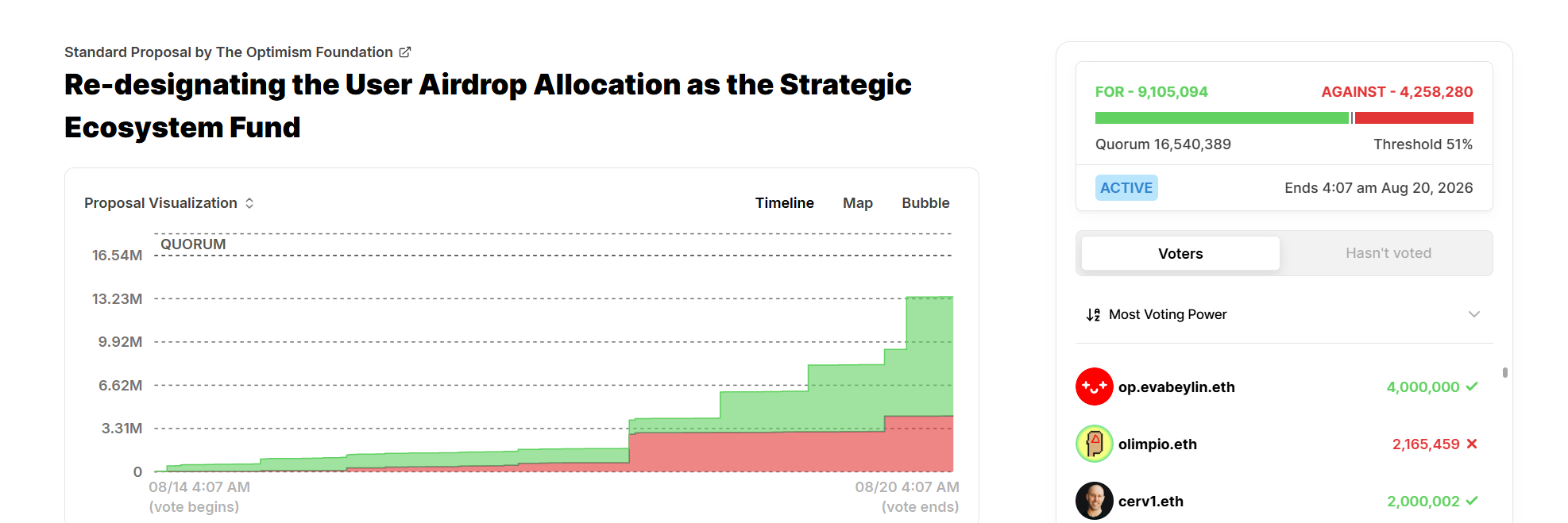
According to the latest on-chain data available, there are approximately 9.105 million OP tokens in support votes and about 4.258 million OP tokens in opposition votes. The quorum requirement is approximately 16.54 million OP tokens, and there remains a significant gap between the current participation level and reaching the required threshold. The final voting outcome has not yet been decided, and community contention continues.

OP Buybacks Halted After May This Year

The initial total supply of OP is approximately 4.295 billion tokens. Of this, 19% (about 816 million tokens) was explicitly reserved for user airdrops. While this arrangement is not a formal legal obligation, Optimism has repeatedly confirmed it in public communications over the years, including as recently as October 2024 when Airdrop 5 was distributed, still mentioning that approximately 550 million tokens could be used for future airdrops.

The actual execution shows: between 2022 and 2024, five rounds of airdrops were completed, distributing a cumulative total of about 269.1 million OP tokens, accounting for approximately 33% of the reserved total. The first round accounted for the highest proportion. Subsequent rounds continuously adjusted criteria, shifting from early usage and gas consumption towards delegated governance, OP Mainnet activity, NFT creators, and Superchain activities, among others.

The fourth year (May 2025 to April 2026) saw no new airdrops, with the official clearly pivoting towards "targeted growth projects with measurable retention and revenue outcomes."
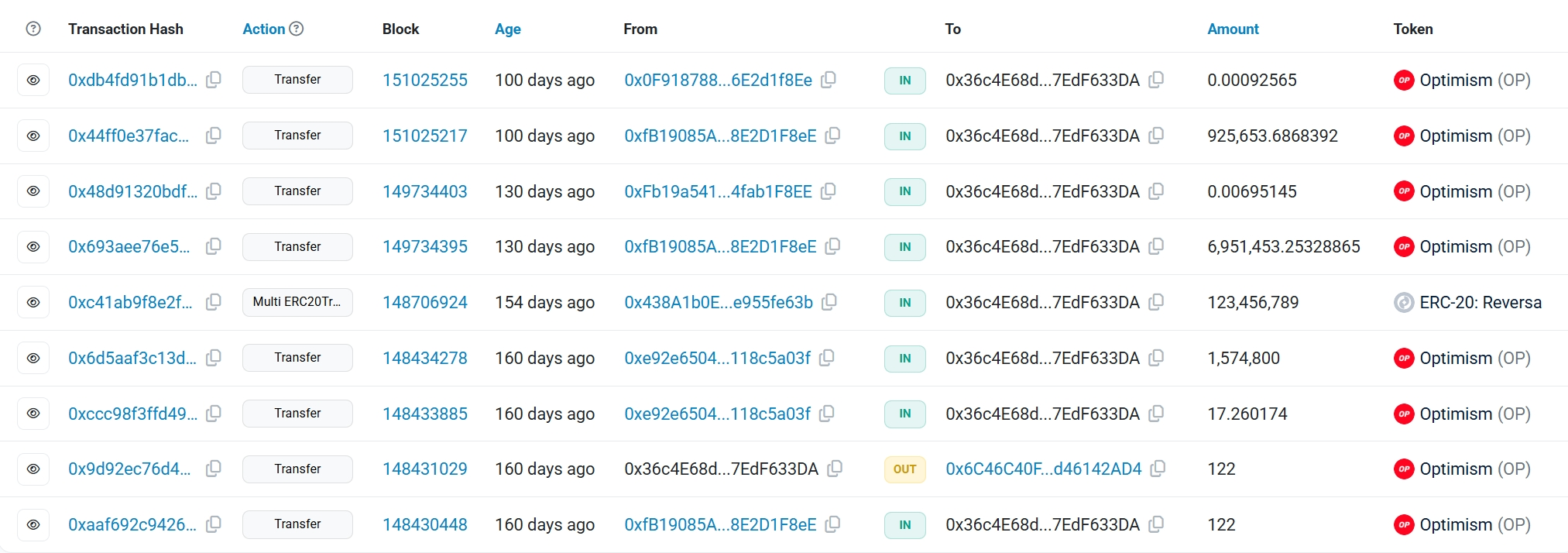
On-chain data also indicates that Optimism has not followed through with its original plan to buy back OP after May. After completing the second and third rounds (March and April) of monthly community buybacks, the official unilaterally halted the subsequent buyback plan. In March, the foundation spent 367.905 ETH to buy back 6,951,453 OP, and in April, 50.16 ETH to buy back 925,654 OP. To date, its cumulative buyback of OP tokens stands at 9,451,924 OP, valued at approximately $756,200 based on the latest price of $0.08.
The foundation stated it will reassess after the 12-month period ends and does not commit to a long-term continuation.

Simultaneously, the overall OP deployment volume for the fourth year decreased by approximately 35% compared to the third year. New circulating supply from the Governance Fund decreased by 53% year-on-year, Retro Funding (a public goods funding mechanism where OP rewards are distributed based on actual contributions) expenditures dropped by 30%, and airdrops were zeroed. The foundation also released a fourth-year budget update and fifth-year outlook, projecting approximately 273 million new OP tokens entering circulation in the fifth year (excluding the potential reallocation from this airdrop quota), with about 200 million OP expected to be deployed from the Ecosystem Fund.

According to DefiLlama data, its Total Value Locked (TVL) has significantly dropped from a peak of $5.5 billion to $526 million.

Strategic Shift Towards Enterprise Growth

The Layer 2 network crypto market is currently facing issues like user attrition and a lack of innovation. According to the latest data from Token Terminal, its core developers have dwindled to 42, compared to 144 at its peak at the end of 2024.
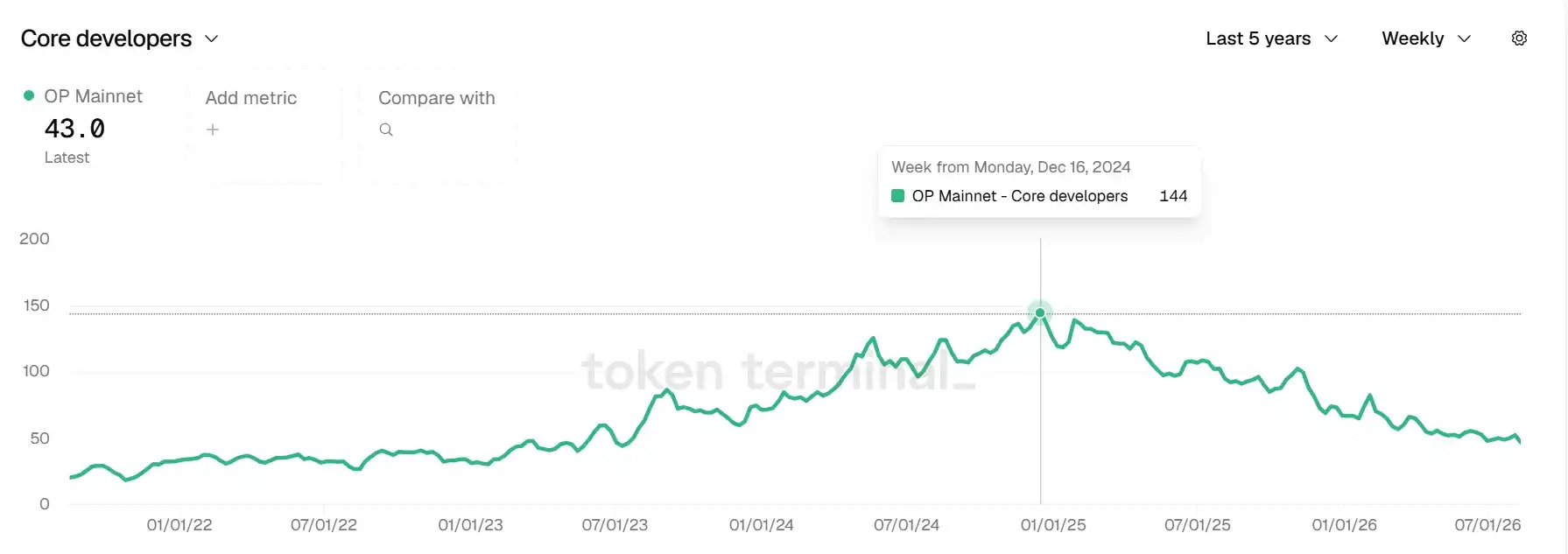
Currently, Optimism is pivoting towards the enterprise market, including fintech, exchanges, payment institutions, and traditional financial institutions. Current partnerships include Bitpanda, Ink, and Dunamu, among others.

Specifically, the proposal requires:

  • Creating a new allocation category called "Strategic Ecosystem Fund";
  • Reallocating the remaining 546.9 million OP tokens from the user airdrop category into this fund;
  • The fund's use includes facilitating partnership deals to bring chains, protocols, institutions, and infrastructure to the OP Stack, deepening incentives for on-chain activity and liquidity on OP Mainnet, and expanding collaborations with top-tier brands and institutions.

The already distributed Rounds 1 to 5 airdrops will not be affected. If the proposal passes, the foundation will update the token allocation documentation and public accounting records and will continue using the existing grant oversight and annual budget reporting mechanisms. The fifth-year budget outlook itself already assumes zero airdrop deployment and notes that this outlook is independent of this reallocation proposal.

After being initiated by the official, early voting leaned in favor. However, as community discussions intensified, opposition voices quickly rose. Main criticisms focus on three points: the portion originally reserved for users is being reallocated to foundation-controlled enterprise growth funds, effectively allowing the official team to reclaim tokens under the guise of DAO governance; and with airdrops and Retro Funding successively phased out, incentive pathways for ordinary users are further narrowed.

The changing stance of the airdrop whale olimpio.eth, a long-time participant in Optimism governance, has drawn attention. This account previously maintained a high participation rate in over 120 governance votes. Its voting record shows it cast 2,165,459 votes in opposition, which the community views as its first-ever vote against a proposal in Optimism governance history. Some participating players criticized

Community discussions repeatedly feature calls to "preserve the right to future airdrops." Conversely, there are also views that even if the proposal fails, the official currently has no plans for new airdrops, making the practical impact limited.

If the proposal ultimately passes, Optimism's token allocation structure will formally shift further from the dual-track model of "user airdrops + ecosystem incentives" towards a greater tilt towards enterprise and institutional growth. This aligns with its OP Enterprise product line, Superchain expansion, and the overall trend of expenditure discipline. For token holders, this may strengthen the expectation of "growth prioritized over broad distribution" in the short term, potentially putting greater pressure on the token price.

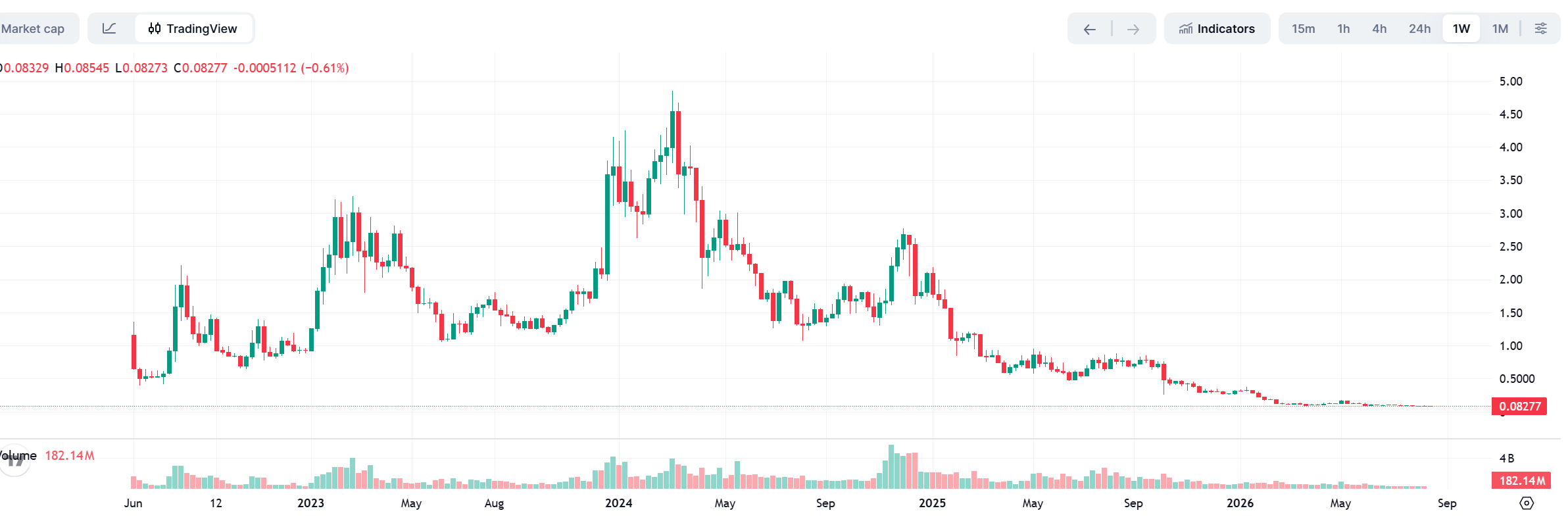
There remains about a two-day window before the voting deadline, leaving room for a change in the final outcome. As of the time of writing, market data shows that the Optimism (OP) token's current market capitalization is approximately $185 million, with the token price fluctuating around $0.08, and a Fully Diluted Valuation (FDV) of $348 million.


Cryptos en tendance

Questions liées

QWhat is the main purpose of the new proposal submitted by the Optimism Foundation?

AThe proposal aims to reallocate the remaining 546.9 million OP tokens, originally reserved for future user airdrops, into a newly created 'Strategic Ecosystem Fund'.

QWhat are the main criticisms from the community regarding this proposal?

ACommunity criticisms primarily focus on three points: 1) The reallocation of user-reserved tokens to a fund for enterprise-focused growth, seen as the foundation reclaiming tokens under the guise of DAO governance. 2) The narrowing of incentive pathways for ordinary users after airdrops and Retro Funding have been reduced or halted. 3) Concerns that the move prioritizes corporate and institutional growth over broad user distribution.

QWhat significant change in Optimism's strategy does the article highlight?

AThe article highlights a strategic shift for Optimism from broad user incentive programs like airdrops towards focusing on the enterprise market, including financial technology firms, exchanges, payment institutions, and traditional financial institutions.

QAccording to the article, what was the change in Optimism's Total Value Locked (TVL)?

AAccording to DeFiLlama data cited in the article, Optimism's Total Value Locked (TVL) has significantly decreased from its peak of $5.5 billion to $526 million.

QWhat was notable about the voting behavior of the account 'olimpio.eth'?

AThe account 'olimpio.eth', a long-term participant and a whale in Optimism governance, cast over 2.16 million OP votes against the proposal. This was noted by the community as its first opposition vote in its history of participation in Optimism governance.

Lectures associées

Le président de la CFTC montre ses cartes : Prochaines étapes, marché crypto, marché de la puissance de calcul et marchés prédictifs

Rédaction : KarenZ, Foresight News Le président de la CFTC, Michael S. Selig, a dévoilé une « feuille de route pour la nouvelle frontière de la finance » lors de la première réunion du comité consultatif sur l'innovation. Cette feuille de route se concentre sur trois domaines principaux : 1. **Crypto-actifs** : Selig privilégie une législation du Congrès, mais si celle-ci stagne, la CFTC est prête à utiliser ses pouvoirs existants pour créer un cadre réglementaire. Cela pourrait permettre aux plateformes d'échange d'être désignées comme des « marchés de crypto-actifs » sous la surveillance de la CFTC. Les protocoles DeFi sont également dans le champ d'étude. 2. **Marchés de la puissance de calcul (AI)** : La CFTC vise à développer des marchés (au comptant, à terme) pour la puissance de calcul (Compute), traitée comme une nouvelle classe d'actifs, afin de permettre la découverte des prix et la couverture des risques pour les entreprises d'IA. 3. **Marchés de prédiction** : Au-delà du débat sur leur légalité, la CFTC travaille à établir des règles concrètes pour les contrats d'événements, concernant leur approbation, la déclaration des données, la protection des investisseurs et la prévention des manipulations. La réunion a été marquée par un vif débat sur les marchés de prédiction, illustrant les défis réglementaires. L'approche globale de la CFTC est de mettre en place des cadres clairs pour que l'innovation puisse se développer dans un environnement régulé, plutôt que d'attendre que les controverses se dissipent.

marsbitIl y a 22 mins

Le président de la CFTC montre ses cartes : Prochaines étapes, marché crypto, marché de la puissance de calcul et marchés prédictifs

marsbitIl y a 22 mins

Le Trésor américain intervient directement pour contenir les taux longs

Le Trésor américain est intervenu directement pour contenir les rendements des obligations à long terme via des opérations de rachat, une mesure ressemblant à un contrôle indirect des taux. L’analyse souligne que cette approche, bien que non strictement assimilable à un contrôle classique des courbes de rendement (YCC), constitue une ingérence active dans le coût de financement de l’État. La situation place la Fed dans une position délicate : alors que certains préconisent un resserrement monétaire pour maîtriser l’inflation et les taux longs, d’autres estiment qu’une telle rigueur pourrait nuire à la croissance nécessaire pour réduire le déficit budgétaire élevé des États-Unis. L’auteur note que la résolution du déficit américain repose largement sur une reprise économique robuste, aujourd’hui attendue du secteur technologique plutôt que des industries traditionnelles. Cependant, si des tensions inflationnistes persistent et que les marchés doutent de la soutenabilité de la dette, le Trésor et la Fed pourraient être contraints de choisir entre la stabilité des prix, le soutien à la croissance et le maintien de la confiance dans le dollar. L’intervention actuelle du Trésor est comparée à des épisodes historiques, comme les rachats de 2000-2002 ou l’opération Twist, mais elle est jugée insuffisante pour adresser les déséquilibres fondamentaux de l’économie américaine, marquée par une divergence sectorielle (économie en K) et des défis structurels. L’attitude future de la Fed sera déterminante : si elle s’associe à ces interventions, cela signalerait un changement de paradigme potentiellement favorable à l’or. Enfin, l’auteur questionne l’efficacité des mesures techniques face aux problèmes de fond, évoquant la difficulté des réformes structurelles et la tentation des solutions apparentes « rapides » mais peu durables.

marsbitIl y a 28 mins

Le Trésor américain intervient directement pour contenir les taux longs

marsbitIl y a 28 mins

Analyse JPMorgan : L'essai INT de Moderna atteint son critère d'évaluation principal, mais le marché l'avait déjà intégré

L'essentiel du rapport de JPMorgan sur Moderna (19 août) : l'essai clinique de phase III du traitement individualisé par néoantigènes (INT) de Moderna, en combinaison avec le Keytruda de Merck pour le mélanome adjuvant, a atteint ses critères d'évaluation principaux (survie sans récidive) et secondaires clés (survie sans métastase à distance). Bien que ces résultats soient cliniquement significatifs, ils étaient largement anticipés par le marché, avec une probabilité de succès pré-établie à 85% par la banque. Par conséquent, JPMorgan estime que ce succès dans le mélanome adjuvant est déjà intégré dans le cours de l'action de Moderna (environ 63 USD à l'époque du rapport). La banque maintient sa recommandation « Underweight » (sous-pondérer) et son objectif de prix à 40 USD, soulignant un potentiel de baisse de 36%. Le raisonnement clé est que l'adaptation du mélanome adjuvant représente un marché relativement limité. La future valorisation de Moderna dépendra essentiellement de la capacité de la plateforme INT à reproduire son succès dans des indications oncologiques plus larges et plus importantes (comme le cancer du poumon). Les données cliniques dans ces autres cancers seront le principal moteur de la réévaluation du titre. La hausse initiale du cours reflète davantage des rachats de positions vendeuses qu'un changement fondamental durable.

marsbitIl y a 29 mins

Analyse JPMorgan : L'essai INT de Moderna atteint son critère d'évaluation principal, mais le marché l'avait déjà intégré

marsbitIl y a 29 mins

Trading

Spot

Articles tendance

Comment acheter WAR

Bienvenue sur HTX.com ! Nous vous permettons d'acheter WAR (WAR) de manière simple et pratique. Suivez notre guide étape par étape pour commencer votre parcours crypto.Étape 1 : Création de votre compte HTXUtilisez votre adresse e-mail ou votre numéro de téléphone pour ouvrir un compte sur HTX gratuitement. L'inscription se fait en toute simplicité et débloque toutes les fonctionnalités.Créer mon compteÉtape 2 : Choix du mode de paiement (rubrique Acheter des cryptosCarte de crédit/débit : utilisez votre carte Visa ou Mastercard pour acheter instantanément WAR (WAR).Solde :utilisez les fonds du solde de votre compte HTX pour trader en toute simplicité.Prestataire tiers :pour accroître la commodité d'utilisation, nous avons ajouté des modes de paiement populaires tels que Google Pay et Apple Pay.P2P :tradez directement avec d'autres utilisateurs sur HTX.OTC (de gré à gré) : nous offrons des services personnalisés et des taux de change compétitifs aux traders.Étape 3 : stockage de vos WAR (WAR)Après avoir acheté vos WAR (WAR), stockez-les sur votre compte HTX. Vous pouvez également les envoyer ailleurs via un transfert sur la blockchain ou les utiliser pour trader d'autres cryptos.Étape 4 : tradez des WAR (WAR)Tradez facilement WAR (WAR) sur le marché Spot de HTX. Il vous suffit d'accéder à votre compte, de sélectionner la paire de trading, d'exécuter vos trades et de les suivre en temps réel. Nous offrons une expérience conviviale aux débutants comme aux traders chevronnés.

747 vues totalesPublié le 2024.12.11Mis à jour le 2026.06.02

Comment acheter WAR

Discussions

Bienvenue dans la Communauté HTX. Ici, vous pouvez vous tenir informé(e) des derniers développements de la plateforme et accéder à des analyses de marché professionnelles. Les opinions des utilisateurs sur le prix de WAR (WAR) sont présentées ci-dessous.

活动图片