Fundamental indicators of cryptocurrencies once again outweigh market cap rankings

cryptonews.ruPublié le 2026-08-16Dernière mise à jour le 2026-08-16

Résumé

Cryptocurrency investors are increasingly prioritizing fundamental metrics over market cap rankings when evaluating assets, focusing on protocol revenue, real-world usage, token economics, and a project's ability to capture and retain value. Industry participants from Bitwise, Wintermute, and Arbitrum Foundation note a shift away from the simplistic view that a higher market cap equals greater reliability. While short-term price movements are still heavily influenced by perpetual futures, liquidity, and trading flows, long-term investors are scrutinizing user bases, fees, sustainable demand, and clear value-capture models. Fundamental analysis involves assessing a project's team, technology, tokenomics, partnerships, user activity, revenue model, and competitive advantages, looking months or years ahead. Technical analysis remains relevant for short-term trading. Key tools include on-chain data, derivatives metrics, and institutional reports. Market cap is no longer the primary benchmark. Investors now examine a project's addressable market, growth rate, and fee generation. Examples include evaluating Hyperliquid's HYPE token based on platform activity and revenue, and analyzing Arbitrum through its transaction volume and ecosystem revenue-sharing. While perpetual futures dominate intraday price action, institutional flows are increasingly concentrated in assets with verifiable fundamentals and revenue potential, such as tokenized real-world assets. Metrics like fee reven...

Fundamental indicators of cryptocurrencies are increasingly becoming the main filter for investors: they look at protocol revenue, real-world usage, token economics, and a project's ability to retain created value, not just its position in the market capitalization table.

Market participants from Bitwise, Wintermute, and Arbitrum Foundation note that cryptocurrency is gradually moving out of the stage where tokens were evaluated on the principle of 'the higher in the ranking, the more reliable.' In the short term, prices are still largely driven by perpetual futures, liquidity, and trading flows. But over months and years, investors are paying closer attention to whether a network has users, fees, sustainable demand, and a clear model for capturing value.
Key takeaways:

  • Investors are increasingly evaluating tokens based on the size of the potential market, actual adoption, and the project's ability to convert activity into value.
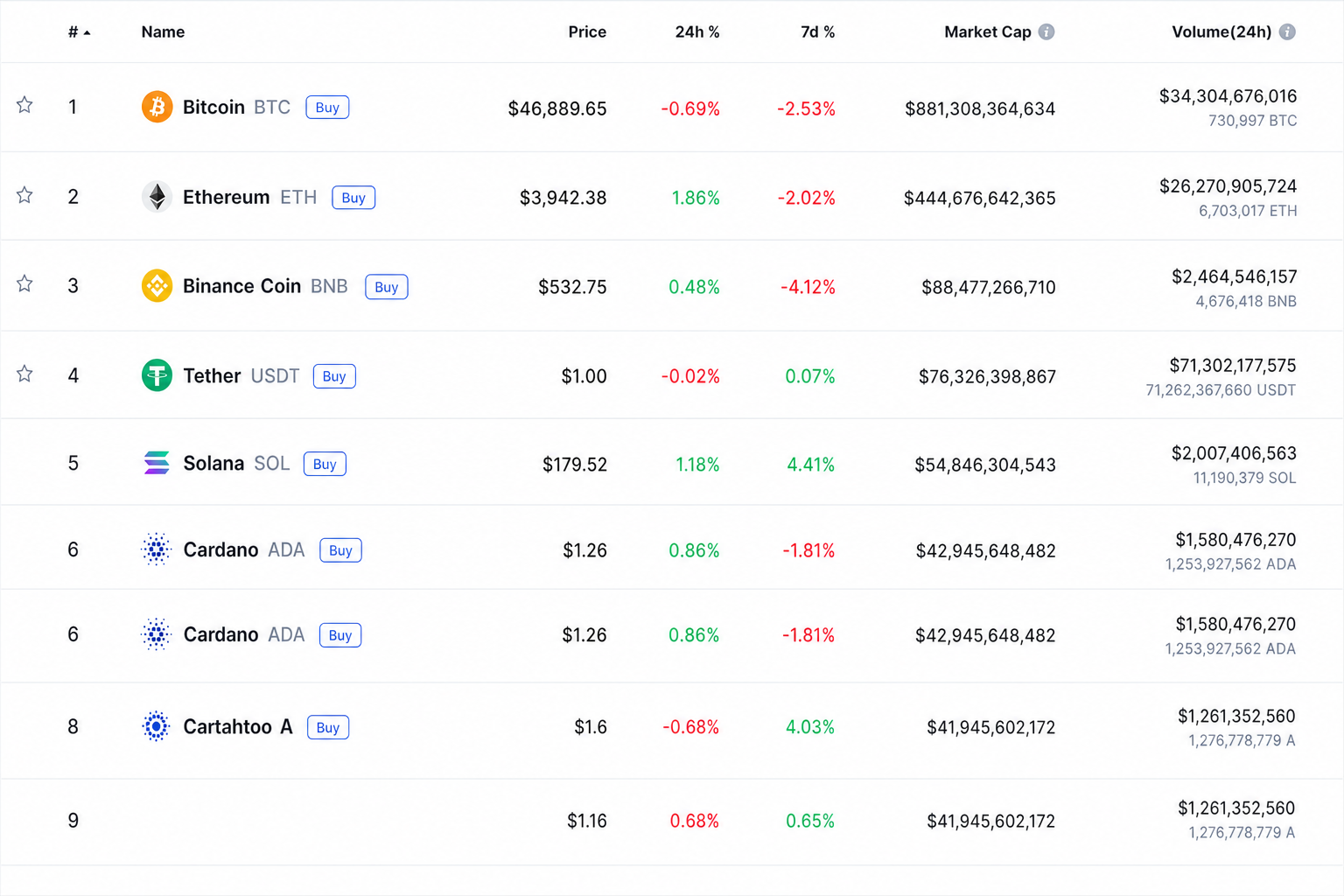
  • Capital managers who are just entering the crypto industry are not limiting themselves to CoinMarketCap rankings and are delving deeper into individual networks and applications.
  • Hyperliquid became one of the early examples of this approach: the $HYPE token is evaluated through platform activity, its revenues, and economic parameters.

What is fundamental analysis of cryptocurrencies

Fundamental analysis of cryptocurrencies, in simple terms, is an attempt to understand what makes a project valuable in the first place. An investor looks not only at the token price, but at users, fees, revenues, technology, tokenomics, and the network's ability to retain created value.

Technical analysis answers a different question: how the price behaves on the chart right now. It helps assess levels, liquidity, perpetual futures, funding rates, and trader behavior. Fundamental analysis is more suitable for evaluating a project over months and years, while technical analysis is for finding entry points and short-term trades.

Fundamental and technical analysis: a brief comparison

  • Criterion: What is studied. Fundamental analysis looks at the protocol's business logic, users, fees, and token economics. Technical analysis looks at the price chart, volumes, liquidity, and derivatives.
  • Criterion: Horizon. Fundamental analysis is more useful over a horizon of months and years. Technical analysis is more often used intraday and for short-term trades.
  • Criterion: Main question. Fundamental analysis asks why an asset should have value. Technical analysis asks where the price might go in the near future.

What to check before evaluating a token

  • Developer team: Experience, public presence, ability to deliver on promises and develop the product.
  • Technology and innovation: What problem the network or application solves and whether the project has a noticeable advantage.
  • Tokenomics: Issuance, token distribution, incentives for participants, and value accumulation mechanism.
  • Partnerships and integrations: Whether they help attract users, capital, and real-world use cases.
  • User activity: Transactions, paying users, fees, and audience retention.
  • Economic model: Whether there are revenues, demand, and a clear link between protocol activity and token value.
  • Competitors: How the project differs from other networks, exchanges, applications, or infrastructure solutions.
  • Roadmap and development plans: How realistic the plans are and whether they support the long-term growth of the ecosystem.

Tools and metrics for fundamental analysis

For fundamental analysis, investors use not one indicator, but a set of sources and metrics. The market capitalization ranking helps to quickly understand the scale of an asset, but by itself it no longer answers the question of how strong a project is.

  • Rankings and aggregators like CoinMarketCap help assess a token's place in the market and compare its capitalization with other assets.
  • On-chain data shows transactions, fees, user activity, and capital that remains within the network.
  • Reports and reviews from managers and market makers, including Bitwise and Wintermute, help to see institutional flows and changes in demand.
  • Data on derivatives, perpetual futures, funding rates, and liquidations help separate short-term price movements from the long-term value of a project.

Market capitalization is the token price multiplied by the number of tokens in circulation. This indicator is important because it helps compare the scale of projects, but it does not replace the analysis of revenues, users, tokenomics, and sustainability of demand.

When evaluating a team, it's worth looking at who develops the project, whether the participants have relevant experience, how they communicate with the community, and whether they fulfill stated plans. When evaluating tokenomics, token distribution, incentives, issuance, token demand, and whether part of the created value is returned to the ecosystem are important.

Government policy and regulation affect the market through rules for investor admission, requirements for exchanges and custodians, tax regime, as well as the approach to stablecoins, tokenized assets, and DeFi instruments. The clearer the rules, the easier it is for large allocators to work with digital assets; sharp uncertainty, on the contrary, increases risk and can put pressure on liquidity.

Why market cap ranking has ceased to be the main benchmark

Bitwise CEO Hunter Horsley describes what is happening as the end of the 'CoinMarketCap ranking' era. In previous market cycles, new layer-1 networks were often evaluated as a scaled-down version of the largest blockchains: if a project was lower on the list, a discount was automatically applied to it.

Now this template works less well. Fundamental analysis comes to the fore: what market a project can capture, how fast its user base is growing, what fees it collects, and how much of the created value remains within the ecosystem. Market capitalization remains a noticeable benchmark, but it no longer replaces a full-fledged evaluation of the protocol's business.

Horsley cites Hyperliquid as an example. When evaluating $HYPE, investors can look not at how similar it is to another blockchain network, but at the trading activity of the derivatives platform, its profitability, and internal economics. Over the past year, the token has risen by about 20%.

When we talk to capital managers at companies that have recently entered this sector, they often don't even know what position an asset occupies on CoinMarketCap. For them, it's just not the main thing, said Hunter Horsley.

Perpetual futures still move the price intraday

Wintermute OTC trader Jasper De Maer emphasizes: fundamental indicators and market flows are important, but they work on different timeframes. Intraday, the price is still often determined by perpetual futures, funding rates, trader positioning, and liquidations.

For most major tokens, the volume of perpetual futures remains several times higher than spot trading. Therefore, technical analysis, liquidity data, and the behavior of the derivatives market retain significance for short-term trades. But for longer-term investments, investors are increasingly returning to revenues, demand, and the quality of user activity.

According to De Maer, over the past 12-18 months, interest has noticeably shifted from pure infrastructure to applications and application-specific blockchains. Such projects are closer to the familiar logic of fintech and venture capital: they are easier to compare by clients, turnover, fees, and user retention.

Fundamental metrics become especially important in decentralized finance, on perpetual futures exchanges, and in decentralized physical infrastructure networks. Mining also falls into this category, where investors have long been accustomed to looking at the cost of production, revenue, and the sustainability of the model, not just the coin price.

Fundamental indicators form the lower boundary of valuation and help create a shortlist of assets, and then trading flows determine the specific price, noted Jasper De Maer.

He adds that revenues and real-world usage help understand which tokens will survive downturns and enter the portfolios of large allocators. But these indicators rarely determine where the price will go today.

Institutional flows are changing the market structure

Wintermute data shows that the main change is not so much a shift from spot to derivatives, but rather who exactly is trading. In the first half of 2026, institutional counterparties accounted for about 72% of the company's spot OTC flow. A year earlier, their share was approximately 59%.

These flows are concentrated in the largest cryptocurrencies and in a limited set of tokens that can generate income. De Maer calls tokenized real assets a separate new category. In this logic, a token is increasingly perceived not only as a speculative instrument, but also as an asset on the balance sheet, whose value must be based on verifiable cash flows or retained capital.

At the same time, De Maer warns: it is not always easy to understand where the market is truly rewarding strong fundamentals, and where it is simply following a fashionable narrative. Tokens with revenue attract attention precisely because the fundamental theme is currently in demand, and these two effects are difficult to separate.

The gap is also noticeable between the crypto assets themselves and public companies related to the industry. In the first half of the year, cryptocurrencies fell by 36%, while crypto company stocks rose by 23%, according to a Bitwise review. This does not mean that the stock as a financial instrument will continue to outperform tokens, but it shows that the securities market and the digital assets market can operate in different modes.

Which metrics do investors consider more reliable

Brendan Ma, Head of Investment Strategy at Arbitrum Foundation, says analysts have become better at understanding revenue structure, transactional activity, and value capture mechanisms compared to a year ago. In his opinion, the most convincing are metrics that require costs to create and are verifiable on the blockchain.

Ma includes fee revenue, users who actually pay fees, and capital remaining in the network as such indicators. These can be stablecoin balances and tokenized assets. Such data is harder to fake than a simple number of addresses or total value locked.

The number of addresses and the total value locked metric can be inflated by incentives or bots. Therefore, transaction growth becomes more important when accompanied by an increase in fees and user retention. In this sense, economics as a science helps to look at blockchain not as a price quote table, but as a system of incentives, demand, and value distribution.

Ma cites Arbitrum as an example of project-level analysis. Throughout its history, the network has processed over 2.7 billion transactions, of which more than 500 million occurred in 2026. According to the foundation, Robinhood Chain generates about $40 million in annual revenue. Under the expansion program, 10% of that network's net protocol revenue is returned to the Arbitrum ecosystem.

Which assets look stronger based on fundamentals

According to the logic of Hunter Horsley, Jasper De Maer, Brendan Ma, and Zach Pandl, assets that look stronger are not just the most prominent tokens, but those with real usage, revenues, capital within the network, and a clear model for capturing value.

  • Bitcoin remains a separate macro asset, demand for which is linked to the search for alternatives to fiat currencies.
  • Ethereum and projects beyond it will undergo stricter scrutiny of their economic model, users, and revenues.
  • $HYPE is evaluated through Hyperliquid's activity, platform profitability, and internal economics.
  • Arbitrum shows how investors can look at transactions, revenue of connected networks, and the return of part of the revenue to the ecosystem.

Bitcoin, Ethereum, and the new chapter of digital assets

Hunter Horsley believes that index products can give investors broad access to the crypto market without the need to pick individual winners. Such solutions are offered by Bitwise, as well as other asset managers, including 21Shares.

Grayscale's Head of Research, Zach Pandl, separates Bitcoin and the rest of the market. In his assessment, Bitcoin remains a macro asset, demand for which is linked to the search for alternatives to fiat currencies. Here, macroeconomics, inflation, and investor attitudes towards monetary policy are important.

Other cryptocurrencies, including Ethereum and projects beyond it, will undergo stricter scrutiny of their underlying economic model. Investors will look at whether the network has real users, sustainable revenues, and a clear logic for value accumulation. In traditional finance, financial reporting plays a similar role: it helps understand to what extent a security or business is backed by real results.

Pandl expects the sector's prospects to remain strong because stablecoins, tokenized assets, and decentralized finance instruments will support demand for digital assets beyond Bitcoin in the coming years.

A small number of tokens with a strong fundamental base will play a key role in the next stage of digital asset development. Weak projects with poor indicators will be left behind, said Zach Pandl.

The main conclusion for the market is simple: capital is increasingly less willing to pay just for a place in the ranking. As the industry matures, verifiable economics, real users, and a project's ability to convert activity into long-term value become more important for investors than a loud narrative.

end-content

Cryptos en tendance

Questions liées

QAccording to the article, why are fundamental indicators becoming more important than market cap rankings for cryptocurrency investors?

AFundamental indicators are becoming more important because investors are increasingly looking at a project's actual business metrics, such as protocol revenue, real usage, tokenomics, and its ability to capture and retain value, rather than just its position in a market cap ranking. Market cap alone no longer answers how strong a project truly is.

QWhat is the main difference between fundamental analysis and technical analysis in crypto, according to the article?

AThe main difference lies in their focus and time horizon. Fundamental analysis looks at the business logic of a protocol, its users, fees, and token economics to understand why an asset should have value, typically over months and years. Technical analysis examines price charts, volume, liquidity, and derivatives to predict short-term price movements, often used for intraday and short-term trading.

QWhat key metrics, as mentioned by Brendan Ma from Arbitrum Foundation, are considered more reliable for fundamental analysis and why?

AMetrics that require cost to create and are verifiable on-chain are considered more reliable. These include fee revenue, users who actually pay fees, and capital that stays within the network (like stablecoin balances and tokenized assets). These metrics are harder to fake compared to easily inflated ones like the number of addresses or total value locked (TVL).

QAccording to Jasper De Maer from Wintermute, what still drives intraday price movements in the crypto market?

AIntraday price movements are still largely driven by perpetual futures, funding rates, trader positioning, and liquidations. For most major tokens, the volume of perpetual futures trading remains several times higher than spot trading, making technical analysis and derivative market behavior significant for short-term trades.

QWhat shift in investor focus does Jasper De Maer note has occurred over the last 12-18 months?

AHe notes a noticeable shift in investor interest away from pure infrastructure projects towards applications and application-specific blockchains. These projects are closer to traditional fintech and venture capital logic, making them easier to compare based on customers, turnover, fees, and user retention.

Lectures associées

Si DeFi n'existait pas, les RWA auraient-ils encore un sens ?

Sans la finance décentralisée (DeFi), la tokenisation d'actifs réels (RWA) conserve une utilité, mais limitée. Elle permet une meilleure distribution, une transparence accrue et un règlement plus efficace. Cependant, sa véritable valeur transformative émerge lorsque ces actifs tokenisés intègrent l'écosystème DeFi. La simple création d'un jeton, comparable à un code-barres sur un conteneur, ne suffit pas. La révolution réside dans la construction d'un marché opérationnel complet autour de l'actif. Pour être véritablement utile dans le DeFi, un RWA doit posséder six couches : un titre juridique exécutoire, une source de données fiable, des règles de transfert claires, une liquidité de marché secondaire, des paramètres de garantie réalistes et un chemin crédible de liquidation. Le défi fondamental est la gestion de multiples « horloges temporelles » : le règlement blockchain en quelques secondes, les mises à jour des oracles, les heures de marché traditionnel et les délais de rachat réels peuvent créer des écarts dangereux lors de liquidations. La liquidité réelle, soit la capacité à vendre sous pression dans un délai imparti, est plus cruciale que le simple TVL. Le levier financier, essentiel pour débloquer l'utilité économique des RWA, amplifie également les risques. Les taux de garantie doivent intégrer non seulement la volatilité, mais aussi la lenteur des mécanismes de règlement physique, parfois rendant un jeton d'obligation d'État plus risqué qu'un actif crypto-natif plus volatil mais plus liquide. Au-delà des obligations d'État, les actifs comme la puissance de calcul (GPU) ou l'énergie présentent des profils de risque complexes. L'arrivée des actions tokenisées et de leurs contrats perpétuels constituera un test majeur, nécessitant une architecture robuste pour prévenir les spirales de risque entre marchés spot et à effet de lever. En conclusion, le jeton n'est que la représentation. C'est le système de marché DeFi – avec ses mécanismes de financement, de couverture, de négociation et de gestion des risques en temps réel – qui lui confère une réelle puissance et sa nature transformatrice. La prochaine étape n'est pas de tokeniser plus d'actifs, mais de construire la couche opérationnelle qui les transforme en composants financiers résilients.

marsbitIl y a 18 mins

Si DeFi n'existait pas, les RWA auraient-ils encore un sens ?

marsbitIl y a 18 mins

L'intervention du gouvernement sur le marché obligataire : qu'est-ce que cela signifie ?

Le 19 août 2026, le département du Trésor américain a annoncé un doublement de ses opérations de rachat de titres d'État à long terme (10 à 30 ans), portant le plafond à au moins 40 milliards de dollars pour la période du 9 septembre au 4 novembre. Cette intervention a immédiatement fait baisser les rendements des obligations (9 points de base pour le 30 ans, 6 points de base pour le 10 ans) et a déclenché des hausses sur les marchés actions, de l'or et du bitcoin. Cette décision fait suite à une forte pression vendeuse sur les obligations américaines, avec un rendement du 30 ans atteignant un pic de 5,34% la veille. Trois facteurs expliquent cette tension : la trajectoire fiscale américaine inquiétante (dette publique dépassant 40 000 milliards de dollars), un environnement inflationniste persistant lié à la géopolitique, et une concurrence accrue des obligations souveraines étrangères à haut rendement. Un déséquilibre structurel entre l'offre et la demande a été mis en lumière lorsque, lors d'une opération de rachat, les soumissions des investisseurs ont atteint 200 milliards de dollars pour une capacité d'achat de seulement 20 milliards. Le rachat d'obligations vise principalement à améliorer la liquidité du marché des titres plus anciens et moins échangés. Il ne réduit pas la dette totale, qui est simplement restructurée en termes d'échéances. Contrairement à l'assouplissement quantitatif (QE), il ne s'agit pas de création monétaire. Pour les investisseurs, cette intervention offre un soutien temporaire aux obligations à longue durée (comme les ETF de type TLT), mais ne modifie pas les pressions structurelles haussières sur les rendements. Les impacts sur les taux hypothécaires resteront probablement limités. La réaction du marché reflète aussi une anticipation d'un soutien plus large de la part des autorités. Les prochaines étapes à surveiller sont le maintien de la baisse des rendements avant le 9 septembre, les données économiques clés (emploi, CPI), les résultats des prochaines ventes aux enchères d'obligations, et la décision du Trésor concernant le programme de rachat après le 4 novembre. Cette annonce est une réponse tactique à un problème structurel persistant.

marsbitIl y a 19 mins

L'intervention du gouvernement sur le marché obligataire : qu'est-ce que cela signifie ?

marsbitIl y a 19 mins

Après le « Bessent Put », combien de temps reste-t-il aux États-Unis avant de relancer le QE ?

Le Trésor américain a annoncé le 19 août une augmentation des rachats de liquidités pour les obligations du Trésor à long terme, portant le montant maximum par opération de 2 à 4 milliards de dollars pour les échéances de 10 à 30 ans. Cette décision, intervenue hors du calendrier habituel de communication et après une forte hausse des rendements obligataires, a été interprétée par les marchés comme un signal potentiel d’intervention pour contenir la hausse des taux longs. Les analystes y voient l’émergence d’une "Bessent Put" – l’idée que les autorités pourraient agir pour empêcher une hausse excessive des coûts de financement à long terme, qui pèserait sur les dépenses publiques et l’économie. Toutefois, cette mesure limitée de gestion de la dette diffère fondamentalement d’un assouplissement quantitatif (QE) ou d’un contrôle des rendements. La pression sur les obligations à long terme résulte de plusieurs facteurs : déficits publics importants, forte offre d’obligations d’entreprises (notamment dans le secteur des infrastructures liées à l’IA), et incertitudes géopolitiques. Si l’annonce a temporairement calmé les marchés, elle ne résout pas ces tensions structurelles. En somme, cette opération relance le débat sur l’évolution de la fonction de réaction des politiques américaines face à la montée des taux, mais un virage vers un QE ou un contrôle explicite des rendements nécessiterait une détérioration bien plus marquée des conditions financières.

marsbitIl y a 23 mins

Après le « Bessent Put », combien de temps reste-t-il aux États-Unis avant de relancer le QE ?

marsbitIl y a 23 mins

Les paiements transfrontaliers ont-ils vraiment besoin des stablecoins ?

L'article questionne l'utilité réelle des stablecoins pour les paiements transfrontaliers, en particulier dans le scénario de conversion de devises (par exemple, des dollars vers des pesos mexicains). Il explique d'abord le système bancaire traditionnel de correspondant, lent et coûteux (environ 15% de frais), puis présente la solution moderne des fintechs comme Wise. Ces dernières utilisent un système de compensation interne (netting) où les fonds ne traversent pas les frontières, offrant des transferts quasi-instantanés à un coût bien inférieur (environ 0,52% pour Wise). Le modèle du "sandwich" stablecoin (conversion en stablecoin, transfert blockchain, reconversion en monnaie locale) est ensuite décrit. L'article note que son expérience utilisateur et son coût final, incluant les frais de sortie, ne sont pas nécessairement supérieurs à ceux des fintechs établies. La valeur fondamentale des stablecoins réside ailleurs : ils démocratisent l'accès au marché des paiements transfrontaliers. Ils dissocient (découplent) les services, transformant un réseau propriétaire fermé en un marché ouvert. Cela réduit considérablement les barrières à l'entrée, permet à des prestataires régionaux de se spécialiser et intensifie la concurrence, notamment sur les couloirs de paiement moins courants. Cette concurrence devrait, à long terme, faire baisser les coûts pour les consommateurs et les entreprises, redistribuant les bénéfices auparavant captés par les intermédiaires.

marsbitIl y a 27 mins

Les paiements transfrontaliers ont-ils vraiment besoin des stablecoins ?

marsbitIl y a 27 mins

Trading

Spot

Articles tendance

Comment acheter CAP

Bienvenue sur HTX.com ! Nous vous permettons d'acheter Cap (CAP) de manière simple et pratique. Suivez notre guide étape par étape pour commencer votre parcours crypto.Étape 1 : Création de votre compte HTXUtilisez votre adresse e-mail ou votre numéro de téléphone pour ouvrir un compte sur HTX gratuitement. L'inscription se fait en toute simplicité et débloque toutes les fonctionnalités.Créer mon compteÉtape 2 : Choix du mode de paiement (rubrique Acheter des cryptosCarte de crédit/débit : utilisez votre carte Visa ou Mastercard pour acheter instantanément Cap (CAP).Solde :utilisez les fonds du solde de votre compte HTX pour trader en toute simplicité.Prestataire tiers :pour accroître la commodité d'utilisation, nous avons ajouté des modes de paiement populaires tels que Google Pay et Apple Pay.P2P :tradez directement avec d'autres utilisateurs sur HTX.OTC (de gré à gré) : nous offrons des services personnalisés et des taux de change compétitifs aux traders.Étape 3 : stockage de vos Cap (CAP)Après avoir acheté vos Cap (CAP), stockez-les sur votre compte HTX. Vous pouvez également les envoyer ailleurs via un transfert sur la blockchain ou les utiliser pour trader d'autres cryptos.Étape 4 : tradez des Cap (CAP)Tradez facilement Cap (CAP) sur le marché Spot de HTX. Il vous suffit d'accéder à votre compte, de sélectionner la paire de trading, d'exécuter vos trades et de les suivre en temps réel. Nous offrons une expérience conviviale aux débutants comme aux traders chevronnés.

538 vues totalesPublié le 2026.06.26Mis à jour le 2026.06.26

Comment acheter CAP

Discussions

Bienvenue dans la Communauté HTX. Ici, vous pouvez vous tenir informé(e) des derniers développements de la plateforme et accéder à des analyses de marché professionnelles. Les opinions des utilisateurs sur le prix de CAP (CAP) sont présentées ci-dessous.

活动图片