Elon Musk Building Terafab: The Largest Chip Factory for AI, Robots, and Space Data Centers

cryptonews.ruPublié le 2026-08-15Dernière mise à jour le 2026-08-15

Résumé

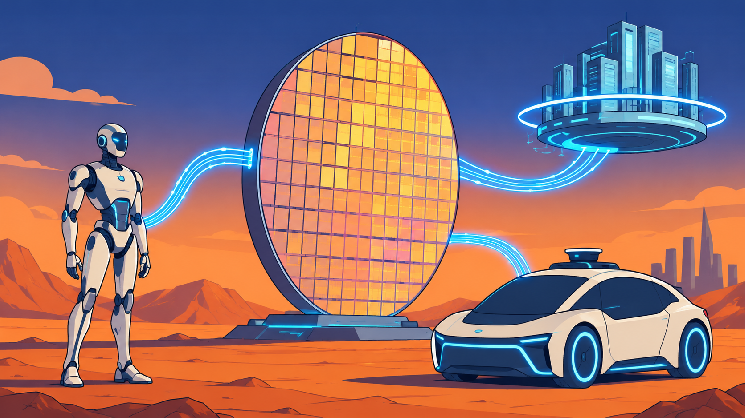
Elon Musk's SpaceX and Tesla have launched the Terafab project to build a massive semiconductor facility in Grimes County, Texas. The plant, exceeding 9.3 million square meters, aims to integrate logic chip manufacturing, memory production, advanced packaging, and testing. The initial phase requires $16.8 billion in capital investment, with a long-term goal of producing over 1 terawatt of computing power annually. This capacity will support Tesla's Optimus robots and Cybercab autonomous vehicles, as well as SpaceX's orbital data centers. Texas Governor Greg Abbott confirmed the project's start in August 2026, highlighting 3,000 new jobs and a $30 million state grant. Elon Musk emphasized the strategic advantage of combining logic, memory, and packaging under one roof. Musk called the future complex the "largest and most valuable building on Earth," with an area roughly 50 times that of the Pentagon. Intel is the key technology partner, with plans to use its 14A process node for chip production. This partnership aims to diversify supply chains currently dominated by TSMC. The project aligns with the U.S. Pax Silica initiative to secure semiconductor supply chains. An AI analysis notes the project's scale and potential challenges, comparing it to delays seen in other U.S. megafab projects like Intel's Ohio facility. It questions whether Terafab can avoid similar pitfalls related to timelines, budgets, workforce, and supply chain stability. The facility's success could signif...

SpaceX and Tesla have launched the large-scale Terafab project to build a semiconductor plant in Grimes County, Texas, which will integrate the production of logic chips, memory, chip packaging, and testing across an area exceeding 9.3 million square meters. The first phase of the complex will require capital investments of $16.8 billion, and its stated long-term goal is to produce computing equipment with a capacity of over 1 terawatt per year to supply Optimus robots, Cybercab autonomous vehicles, and orbital data centers.

State Support and First-Phase Parameters

Texas Governor Greg Abbott confirmed the project's start on August 6, 2026, noting the creation of 3,000 new jobs and the provision of a $30 million grant from the Texas Enterprise Fund. The initiative also qualified for the Texas Jobs, Energy, Technology, and Innovation (JETI) program, securing additional benefits. SpaceX and Tesla CEO Elon Musk emphasized the strategic importance of combining logic design, memory production, and advanced packaging under one roof to accelerate hardware solution development.

On social media X, Elon Musk called the future complex "the largest and most valuable building on Earth," indicating that when fully equipped, its size will exceed that of the Pentagon by approximately 50 times. The planned distribution of production capacity is as follows: about 25% of the output is intended for Tesla robotics, with the remaining 75% for SpaceX's space-based artificial intelligence systems. Earlier tax incentive documents featured estimates for the initial phase of around $55 billion, with a possible total reaching up to $119 billion upon completion of all stages; however, an official confirmation of the total investment amount is currently unavailable.

Technological Partnership and Geopolitical Context

Intel is the key partner for design and production: Musk stated plans back in April 2026 to utilize Intel's 14A process technology for chip manufacturing at the new plant. This decision aims to diversify supply chains, as TSMC maintains a dominant position in contract manufacturing with a market share of about 70–73%, and concentration is even higher on advanced nodes below 5 nm. Vertical integration helps reduce dependence on external suppliers and control critical stages of microelectronics creation.

The Pax Silica initiative, launched by the U.S. Department of State in December 2025, forms an international coalition to ensure reliable supply chains from critical minerals to AI infrastructure. The program unites Japan, the Republic of Korea, the Netherlands, the EU, and the UK, creating an alternative security ecosystem. According to the Stanford AI Index Report 2026, in 2025, the U.S. produced 59 notable AI models compared to 35 from China, and the number of data centers in the country reached 5,427 units, highlighting the need to expand domestic manufacturing capacity.

Construction of the Terafab plant will begin in the coming months following the official announcement, and its commissioning will become a significant milestone in forming a national semiconductor base. The project's realization could shift the balance of power in chip manufacturing and strengthen the U.S. position in global technological competition by establishing a closed-loop cycle for computing equipment development and production.

AI Opinion

From the perspective of machine data analysis, the scale of Terafab should be compared to the history of major semiconductor construction projects in the U.S. in recent years. A similar Intel project in Ohio (New Albany) has been repeatedly delayed: the launch, initially scheduled for 2026, was postponed by the company to 2030 due to corporate difficulties and shifting priorities. Such experience demonstrates that announced timelines and budgets for megafabs often diverge from reality by years, and factors like workforce availability, power supply, and stability of partner chains (in this case, cooperation with Intel on the 14A process) are rarely factored into initial forecasts.

The situation also illustrates an interesting paradox: the larger the project, the higher the dependence on external factors that are difficult to control even for companies like SpaceX and Tesla. Whether Terafab will avoid the fate of similar giant construction projects is a question whose answer will likely not be clear until the end of this decade.

end-content
Cryptos en tendance

Questions liées

QWhat is the main purpose and scale of Elon Musk's Terafab semiconductor factory project as described in the article?

AThe Terafab project, led by SpaceX and Tesla, aims to build the world's largest semiconductor manufacturing facility in Grimes County, Texas. It will integrate logic chip production, memory manufacturing, advanced packaging, and testing on an area exceeding 9.3 million square meters. Its long-term goal is to produce computing hardware with an annual capacity of over 1 terawatt to support Tesla's Optimus robots, Cybercab autonomous vehicles, and SpaceX's orbital data centers.

QWhat are the key details regarding state support and the first phase of the Terafab project?

ATexas Governor Greg Abbott confirmed the project's start in August 2026, highlighting the creation of 3,000 new jobs and a $30 million grant from the Texas Enterprise Fund. The project also qualifies for the Texas Jobs, Energy, Technology, and Innovation (JETI) program, providing additional benefits. The initial phase requires capital investments of $16.8 billion, with earlier tax incentive documents suggesting the total investment could reach up to $119 billion if all phases are completed.

QWhich company is a key technological partner for Terafab, and what is the strategic reason behind this partnership?

AIntel is the key technological partner. Elon Musk announced plans in April 2026 to use Intel's 14A process technology for chip production at Terafab. This partnership is aimed at diversifying the semiconductor supply chain, reducing dependence on the dominant contract manufacturer TSMC, and gaining greater control over critical stages of microelectronics production through vertical integration.

QHow does the article's 'AI Opinion' section assess the feasibility and challenges of the Terafab project?

AThe 'AI Opinion' section expresses skepticism by comparing Terafab to other large U.S. semiconductor projects, such as Intel's delayed Ohio fab. It notes that timelines and budgets for mega-fabs often diverge from reality due to unforeseen challenges like workforce availability, energy supply, and stability of partner chains (like the collaboration with Intel on the 14A process). It concludes that the larger the project, the higher its dependence on uncontrollable external factors, and the true success of Terafab will only be clear by the end of the decade.

QAccording to the article, what broader geopolitical and industrial context makes projects like Terafab significant for the United States?

AThe article highlights the U.S. initiative 'Pax Silica,' launched to build a reliable international supply chain for AI infrastructure, as part of a broader effort to reduce reliance on concentrated manufacturing, particularly in advanced nodes. Citing the Stanford AI Index Report 2026, the U.S. produced 59 notable AI models in 2025 compared to China's 35 and has over 5,400 data centers, underscoring the need for domestic chip manufacturing. Terafab is positioned as a strategic move to strengthen the U.S. position in global tech competition by creating a closed-loop cycle for computing hardware development and production.

Lectures associées

BIT Recherche : MicroStrategy passe du plus grand acheteur au vendeur, comment les 75 milliards de dollars de pression de vente potentielle affecteront-ils le Bitcoin ?

L'entreprise Strategy (anciennement MicroStrategy), autrefois l'un des acheteurs les plus agressifs de Bitcoin avec une politique de « ne jamais vendre », a commencé à vendre ses actifs en Bitcoin. Ces ventes visent à renforcer ses réserves en dollars, payer des dividendes et intérêts sur actions privilégiées, et racheter ses titres de crédit numériques (Digital Credit Securities). Cette inversion de rôle, d'acheteur structurel à vendeur, constitue une pression à la baisse pour le marché du Bitcoin à court terme. Les estimations indiquent que Strategy pourrait devoir vendre environ 4,5 milliards de dollars de Bitcoin dans les deux à quatre prochains mois, principalement pour réduire le volume de ses titres de crédit numériques. Au-delà de cette société, la pression de vente potentielle pourrait être plus large. Parmi 109 entreprises détenant des réserves de Bitcoin, 28 ont une capitalisation boursière inférieure à la valeur de leur portefeuille Bitcoin (ratio mNAV < 1.0). Pour ces sociétés, vendre une partie de leur Bitcoin et racheter leurs actions pourrait être un moyen de réduire cette décote et de créer de la valeur. Le potentiel de vente combiné de l'ensemble de ces entreprises réservistes pourrait atteindre environ 7,5 milliards de dollars. Cette évolution remet en question le modèle économique antérieur de ces sociétés, qui reposait sur une prime de leur action par rapport à la valeur liquidative de leurs actifs en Bitcoin (NAV). Avec la disparition, voire l'inversion de cette prime, leur capacité à lever des fonds pour acheter davantage de Bitcoin est compromise. Elles pourraient devoir se tourner vers des stratégies génératrices de revenus réels, comme la vente d'options couvertes ou le prêt de BTC. Malgré ces pressions de vente à court terme qui pourraient limiter les rebonds, l'analyse suggère que le Bitcoin est toujours en phase de consolidation basse, avec un creux de cycle possible d'ici la fin du mois ou le mois prochain. Les facteurs clés à surveiller seront l'épuisement des ventes de Strategy, le retour éventuel des achats via les ETF Bitcoin, et la capacité des entreprises réservistes à ajuster leur stratégie pour résorber la décote de leur NAV.

marsbitIl y a 43 mins

BIT Recherche : MicroStrategy passe du plus grand acheteur au vendeur, comment les 75 milliards de dollars de pression de vente potentielle affecteront-ils le Bitcoin ?

marsbitIl y a 43 mins

Elon Musk construit Terafab : la plus grande usine de puces pour l'IA, les robots et les centres de données spatiaux

Elon Musk lance Terafab, une méga-usine de puces pour l'IA, les robots et les data centers spatiaux. SpaceX et Tesla ont lancé le projet Terafab, une usine de semi-conducteurs de plus de 9,3 millions de m² au Texas. La première phase nécessitera 16,8 milliards de dollars d'investissements pour produire des équipements de calcul dépassant 1 térawatt par an, destinés aux robots Optimus, aux véhicules autonomes Cybercab et aux data centers orbitaux. Le gouverneur du Texas, Greg Abbott, a confirmé le projet, promettant 3 000 emplois et un financement de 30 millions de dollars. Elon Musk a souligné l'importance stratégique de regrouper sous un même toit la conception de logique, la production de mémoire et l'assemblage de puces. Il a décrit le complexe comme potentiellement "le plus grand et le plus précieux bâtiment sur Terre", avec une capacité de production allouée à 25% pour la robotique Tesla et 75% pour les systèmes d'IA spatiaux de SpaceX. Intel est le partenaire technologique clé, fournissant son procédé de fabrication 14A. Ce choix vise à diversifier la chaîne d'approvisionnement face à la domination de TSMC. Le projet s'inscrit dans le cadre de l'initiative "Pax Silica" des États-Unis, visant à sécuriser les chaînes d'approvisionnement en semi-conducteurs. D'un point de vue analytique, la réalisation d'un projet de cette envergure reste un défi, comme le montre les retards rencontrés par des projets similaires (ex: Intel en Ohio). Le succès de Terafab dépendra de nombreux facteurs externes et ne sera pas confirmé avant la fin de la décennie.

cryptonews.ruIl y a 1 h

Elon Musk construit Terafab : la plus grande usine de puces pour l'IA, les robots et les centres de données spatiaux

cryptonews.ruIl y a 1 h

La faillite du "Dieu de l'IA" entraîne des pertes de 15 milliards de dollars pour Jane Street en juillet, sa première perte mensuelle depuis dix ans

"Jane Street, l'un des géants du trading proprietary les plus secrets et rentables de Wall Street, a subi une perte rare d'environ 15 milliards de dollars au mois de juillet, sa première perte mensuelle depuis environ dix ans. Cette perte est principalement liée à deux facteurs : des investissements dans le fonds spéculatif axé sur l'IA, Situational Awareness, qui a fait face à des appels de marge et a dû liquider massivement ses positions, ainsi que des pertes sur des positions longues sur des actions non liées à l'IA en Asie. Il s'agit essentiellement d'un revers brutal pour des stratégies de trading qui avaient très bien performé au deuxième trimestre, notamment sur les actions technologiques, semiconducteurs et IA, avant un renversement soudain du marché en juillet. Malgré ce choc, Jane Street maintient une rentabilité globale solide, avec un revenu net de trading dépassant 400 milliards de dollars depuis le début de l'année. La société a réagi en réduisant activement son exposition au risque, fermant une partie des positions problématiques et abaissant le niveau de risque sur d'autres stratégies. Parallèlement, Jane Street procède à une importante restructuration de sa dette, d'environ 14,6 milliards de dollars, pour transférer une partie de son financement du marché public vers des investisseurs privés, acceptant des coûts plus élevés pour plus de confidentialité. L'incident met en lumière les risques de la chaîne du prime brokerage moderne, où des fonds très endettés partageant des expositions similaires (comme à l'IA) et des sources de financement communes peuvent amplifier les crises via des ventes forcées. Pour Jane Street, cet épisode représente un ajustement significatif mais ciblé de sa prise de risque, plutôt qu'une remise en cause de son modèle central."

marsbitIl y a 2 h

La faillite du "Dieu de l'IA" entraîne des pertes de 15 milliards de dollars pour Jane Street en juillet, sa première perte mensuelle depuis dix ans

marsbitIl y a 2 h

Trading

Spot

Articles tendance

Comment acheter ELON

Bienvenue sur HTX.com ! Nous vous permettons d'acheter Dogelon Mars (ELON) de manière simple et pratique. Suivez notre guide étape par étape pour commencer votre parcours crypto.Étape 1 : Création de votre compte HTXUtilisez votre adresse e-mail ou votre numéro de téléphone pour ouvrir un compte sur HTX gratuitement. L'inscription se fait en toute simplicité et débloque toutes les fonctionnalités.Créer mon compteÉtape 2 : Choix du mode de paiement (rubrique Acheter des cryptosCarte de crédit/débit : utilisez votre carte Visa ou Mastercard pour acheter instantanément Dogelon Mars (ELON).Solde :utilisez les fonds du solde de votre compte HTX pour trader en toute simplicité.Prestataire tiers :pour accroître la commodité d'utilisation, nous avons ajouté des modes de paiement populaires tels que Google Pay et Apple Pay.P2P :tradez directement avec d'autres utilisateurs sur HTX.OTC (de gré à gré) : nous offrons des services personnalisés et des taux de change compétitifs aux traders.Étape 3 : stockage de vos Dogelon Mars (ELON)Après avoir acheté vos Dogelon Mars (ELON), stockez-les sur votre compte HTX. Vous pouvez également les envoyer ailleurs via un transfert sur la blockchain ou les utiliser pour trader d'autres cryptos.Étape 4 : tradez des Dogelon Mars (ELON)Tradez facilement Dogelon Mars (ELON) sur le marché Spot de HTX. Il vous suffit d'accéder à votre compte, de sélectionner la paire de trading, d'exécuter vos trades et de les suivre en temps réel. Nous offrons une expérience conviviale aux débutants comme aux traders chevronnés.

359 vues totalesPublié le 2024.12.12Mis à jour le 2025.03.21

Comment acheter ELON

Discussions

Bienvenue dans la Communauté HTX. Ici, vous pouvez vous tenir informé(e) des derniers développements de la plateforme et accéder à des analyses de marché professionnelles. Les opinions des utilisateurs sur le prix de ELON (ELON) sont présentées ci-dessous.

活动图片