Trillion-Dollar Chip Giant Executive States: Wafer Prices Will Not Drop Within the Year

marsbitPublié le 2026-08-14Dernière mise à jour le 2026-08-14

Résumé

China's leading semiconductor foundry, SMIC, reports record-breaking Q2 2026 results, with revenue surpassing $3 billion for the first time. Co-CEO Zhao Haijun stated that wafer prices will not decrease within the year, citing strong demand and full order books extending into Q4. The quarter saw revenue growth of 20% QoQ and 36.1% YoY, driven by increased shipments and higher average selling prices. Zhao noted that price increases contributed more to the improved gross margin (25.3%) than capacity optimization. The surge in demand is primarily fueled by AI-related chips, alongside growth in computing, industrial, and automotive segments. Capacity utilization reached 93.7%, with China accounting for 90.2% of regional revenue. Zhao highlighted that future demand will be even greater in computing power segments like data centers and AI. Despite some inventory buildup in areas like mobile chips, overall supply remains tight. For Q3, SMIC forecasts continued shipment growth and stable prices, with revenue expected to grow 2-4% QoQ and gross margin projected between 26% and 28%.

"Orders are already booked through the fourth quarter. We do not see the possibility of wafer prices dropping this year. Current gross margins and capacity utilization rates are sustainable," said Zhao Haijun, Co-CEO of SMIC, during the earnings conference held on the morning of the 14th.

SMIC's 2026 second-quarter earnings, released on the 13th, show that the company's Q2 revenue exceeded $3.006 billion (approximately RMB 20.273 billion) for the first time, setting a historical record, with a sequential increase of 20% and a year-on-year increase of 36.1%. Meanwhile, gross profit, gross margin, and capacity utilization rate all achieved sequential and year-on-year growth.

Zhao Haijun stated that the growth in the company's revenue was primarily driven by a combination of increased shipments and price hikes.

Price Increases Contributed More Than Capacity Optimization

SMIC is an integrated circuit wafer foundry enterprise, providing 8-inch and 12-inch wafer foundry services and technical support to global customers.

According to the announcement, SMIC's second-quarter gross margin was 25.3%, up from 20.1% in Q1 and 20.4% in the same period last year; net profit attributable to shareholders was $479 million (approximately RMB 3.230 billion), up 142.7% sequentially and 399.9% year-on-year.

Zhao Haijun explained during the earnings conference that the 5.2 percentage point sequential increase in Q2 gross margin was mainly due to higher average selling prices and better-than-expected capacity utilization, offsetting the drag from increased depreciation. The average selling price increased 5.7% sequentially this year. He particularly pointed out that among the factors contributing to the gross margin growth, price increases played a larger role than capacity optimization.

The announcement shows that the company's monthly capacity increased from 1,078.3k 8-inch equivalent wafers in Q1 this year to 1,096.5k 8-inch equivalent wafers in Q2. Wafer sales volume in Q2 was 2,869.5k 8-inch equivalent wafers, up 14.4% sequentially and 20.1% year-on-year. Capacity utilization reached 93.7%, higher than the 92.5% in the same period last year.

Zhao Haijun said the increase in shipments in Q2 mainly stemmed from the boost in demand for supporting chips from artificial intelligence and the pull from other customer shipment demands. The company added 8,000 units of monthly capacity (12-inch equivalent), and capacity utilization increased by 0.6% sequentially.

The announcement shows that in Q2, SMIC's main business revenue, categorized by region, was China, the United States, and Euraisa, accounting for 90.2%, 8.2%, and 1.6% respectively. Zhao Haijun noted that revenue amounts increased in all regions, with China seeing the largest growth at 22%, mainly benefiting from strong demand for AI-supporting chips, the return of overseas orders, and continued strengthening of manufacturing capabilities.

By wafer size, revenue from 12-inch and 8-inch wafers accounted for 78.2% and 21.8% respectively.

In the second quarter of 2026, SMIC's capital expenditures were $1.836 billion (approximately RMB 12.382 billion), a sequential increase of 17.5%; cash and cash equivalents were $8.216 billion (approximately RMB 55.410 billion), a sequential increase of 12.9%.

Greater Demand for Computing-Power Related Segments

In Q2, SMIC's wafer revenue by application was categorized as smartphones, computers & tablets, consumer electronics, IoT & wearables, and industrial & automotive, accounting for 16.9%, 15.6%, 44.2%, 6.8%, and 16.5% respectively. In the same period last year, the revenue share for each application was 25.2%, 15.0%, 41.0%, 8.2%, and 10.6% respectively.

Zhao Haijun stated that the company allocated more capacity to areas with tight demand, leading to revenue growth of about 40% sequentially for AI-supporting chips, computers & tablets, and industrial & automotive. Although other applications were affected by the overall downturn in end markets, customers' early stockpiling offset some of the impact, resulting in growth in revenue from smartphones, consumer electronics, and IoT & wearables as well.

The share of automotive and industrial revenue increased from 10.6% in the same period last year to 16.5% in Q2. Zhao Haijun explained that related customer product lines cover multiple fields. Recently, they prioritized placing orders for automotive and industrial chips, leading to an absolute decline in shipments for smartphones and consumer categories, thereby increasing the former's proportion.

During the analyst Q&A session, Zhao Haijun stated that the demand for computing-power related market segments, especially chips for data centers and artificial intelligence, will be greater in the future. With the increase in global AI investment, supporting chips such as logic circuits, BCD (single-chip integration process technology), and optical modules are in short supply, with prices continuing to rise.

Zhao Haijun said that AI-related fields will also be a key investment area for SMIC going forward. However, regarding customer supply, the company will maintain a "first-come, first-served" principle and will not prioritize supply for latercomers even if they offer higher prices.

The announcement shows that in Q2 2026, the company's inventory was $4.361 billion (approximately RMB 29.411 billion), a 20.1% increase from the $3.630 billion (approximately RMB 24.481 billion) at the end of 2025.

Addressing inventory issues, Zhao Haijun noted that within the industry, destocking pressure for smartphone chips is currently apparent, while inventory for consumer products like display driver chips is low but demand is weak. Due to tight capacity supply, there is widespread concern that if demand for smartphones and consumer products recovers next year, existing reserves will be insufficient. Coupled with expectations of supply chain price increases, manufacturers are seeking a balance, moderately stocking up in advance to avoid the risk of difficulty securing capacity and rising costs next year.

Looking ahead to Q3 2026, Zhao Haijun stated that the company expects shipments to continue growing, with prices remaining stable. The revenue guidance is a sequential increase of 2% to 4%, and the gross margin guidance is 26% to 28%. After offsetting the additional depreciation in Q3 and peak summer electricity costs, gross margin is expected to continue improving sequentially.

On August 14, SMIC's A-share closing price was RMB 132.87 per share, up 2.65%, with a total market capitalization of approximately RMB 1.14 trillion.

This article is from the WeChat public account "Zhongxin Jingwei" (ID: jwview), author: Xie Jingwen


Cryptos en tendance

Questions liées

QWhat reason did SMIC co-CEO Zhao Haijun give for the increase in gross margin in the second quarter?

AZhao Haijun explained that the sequential increase of 5.2 percentage points in Q2 gross margin was mainly due to an increase in average selling price (ASP) and better-than-expected capacity utilization, which offset the drag from increased depreciation. He specifically pointed out that the contribution from price hikes was greater than that from capacity optimization in driving the gross margin growth.

QWhat factors contributed to the record-high revenue of SMIC in Q2 2026?

AThe record-high revenue in Q2 2026 was attributed to a dual push from increased shipments and price hikes. Shipment growth was driven by rising demand for AI-companion chips and pull-in orders from customers in other segments.

QWhich application segment saw its revenue share increase significantly from 10.6% to 16.5% in Q2 compared to the same period last year?

AThe Industrial & Automotive application segment saw its revenue share increase significantly from 10.6% in Q2 2025 to 16.5% in Q2 2026.

QWhat is SMIC's outlook for wafer prices and its own performance in the third quarter of 2026?

AFor Q3 2026, SMIC expects shipment volume to continue growing and prices to remain stable. The revenue guidance is a sequential growth of 2% to 4%, and the gross margin guidance is 26% to 28%. After offsetting costs from new depreciation and peak summer electricity rates, the gross margin is expected to increase sequentially.

QAccording to Zhao Haijun, what principle will SMIC adhere to regarding customer supply in the AI sector?

AZhao Haijun stated that regarding customer supply in the AI sector, SMIC will maintain the principle of 'first come, first served.' The company will not prioritize supply to later customers even if they offer higher prices.

Lectures associées

Grayscale : « Si les propositions sont adoptées, les prix de ces deux altcoins pourraient augmenter »

Zach Pandl, responsable de la recherche chez Grayscale, estime que des modifications envisagées de la tokenomique d'Ethereum (ETH) et de Solana (SOL) pourraient ralentir considérablement la croissance de leur offre, exerçant ainsi une pression haussière sur leurs prix. Ces propositions visent à réduire le taux d'inflation annuel des jetons ETH et SOL. Un ralentissement de la création de nouveaux jetons augmenterait la rareté des actifs existants. Grayscale prévoit que, si elles sont adoptées, l'inflation annuelle de l'offre d'Ethereum pourrait tomber à environ 0,4% d'ici fin 2031, se rapprochant ainsi du Bitcoin, tandis que celle de Solana pourrait atteindre environ 1,1%. En comparaison, l'offre d'or croît d'environ 1,8% par an et l'inflation (IPC) aux États-Unis est d'environ 3,3%. Pandl note que les propositions pour Solana semblent rencontrer un soutien plus large et ont donc une probabilité de mise en œuvre plus élevée. Cependant, il souligne un compromis potentiel : une inflation réduite pourrait diminuer les récompenses pour les investisseurs pratiquant le staking, une partie importante de leurs revenus provenant de l'émission de nouveaux jetons. En conclusion, un ralentissement de l'offre pourrait profiter aux prix des deux actifs, les détenteurs de jetons sans staking étant particulièrement bien placés pour en bénéficier. Ces changements restent à l'étude et ne sont pas encore approuvés.

cryptonews.ruIl y a 8 mins

Grayscale : « Si les propositions sont adoptées, les prix de ces deux altcoins pourraient augmenter »

cryptonews.ruIl y a 8 mins

Les experts ont nommé les raisons de la chute du bitcoin après la baisse de l'inflation aux États-Unis

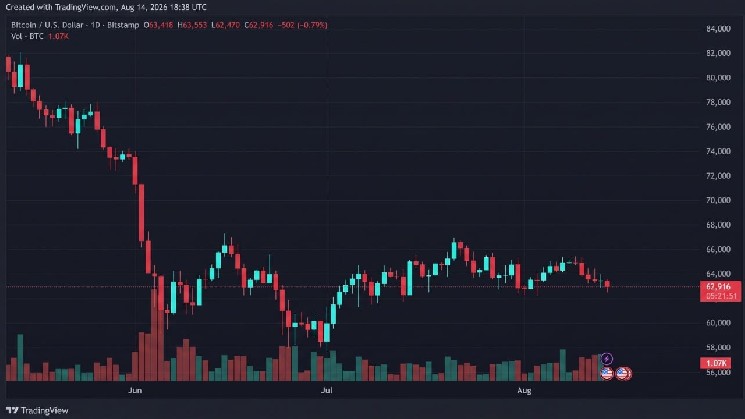
Les données favorables sur l’inflation aux États‑Unis n’ont pas réussi à soutenir le bitcoin. Selon les analystes de CryptoQuant, la principale raison est la faible demande sur le marché au comptant. Le bitcoin n’a pas réagi aux chiffres de l’inflation de juillet, publiés le 12 août, et a même légèrement baissé, passant d’environ 64 500 $ à près de 63 000 $. Pourtant, l’indice des prix à la production (PPI) était meilleur que prévu. Alors que les rendements des obligations du Trésor américain ont reculé et que les marchés actions ont progressé, le bitcoin est resté dans une fourchette de 63 000 à 64 000 $. Cette absence de réaction s’explique notamment par la faible demande au comptant : les entrées de capitaux dans les ETF américains spot de bitcoin restent limitées, et l’indice Coinbase Premium (reflétant l’écart de prix entre Coinbase et les autres grandes plateformes) est négatif depuis mai, indiquant une pression d’achat modérée de la part des investisseurs américains. Dans le même temps, le positionnement des traders sur le marché à terme reste élevé, créant un déséquilibre entre une faible liquidité, une demande spot atone et un volume important de positions à effet de levier. Les analystes estiment que dans ces conditions, même des nouvelles macroéconomiques positives pourraient ne pas déclencher de hausse. Si le prix n’évolue pas malgré un contexte favorable, les traders pourraient commencer à clôturer leurs positions longues à effet de levier, ce qui exercerait une pression supplémentaire à la baisse. Un niveau de résistance clé se situe autour de 68 700 $, coût moyen approximatif pour les détenteurs à court terme, au‑delà duquel une prise de bénéfices est possible. Pour CryptoQuant, une reprise soutenue nécessiterait : une reprise des entrées dans les ETF américains, un retour de l’indice Coinbase Premium en territoire positif, une hausse des volumes de trading au comptant et un franchissement stable des 68 700 $.

cryptonews.ruIl y a 59 mins

Les experts ont nommé les raisons de la chute du bitcoin après la baisse de l'inflation aux États-Unis

cryptonews.ruIl y a 59 mins

Trading

Spot

Articles tendance

Comment acheter CHIP

Bienvenue sur HTX.com ! Nous vous permettons d'acheter USD.AI (CHIP) de manière simple et pratique. Suivez notre guide étape par étape pour commencer votre parcours crypto.Étape 1 : Création de votre compte HTXUtilisez votre adresse e-mail ou votre numéro de téléphone pour ouvrir un compte sur HTX gratuitement. L'inscription se fait en toute simplicité et débloque toutes les fonctionnalités.Créer mon compteÉtape 2 : Choix du mode de paiement (rubrique Acheter des cryptosCarte de crédit/débit : utilisez votre carte Visa ou Mastercard pour acheter instantanément USD.AI (CHIP).Solde :utilisez les fonds du solde de votre compte HTX pour trader en toute simplicité.Prestataire tiers :pour accroître la commodité d'utilisation, nous avons ajouté des modes de paiement populaires tels que Google Pay et Apple Pay.P2P :tradez directement avec d'autres utilisateurs sur HTX.OTC (de gré à gré) : nous offrons des services personnalisés et des taux de change compétitifs aux traders.Étape 3 : stockage de vos USD.AI (CHIP)Après avoir acheté vos USD.AI (CHIP), stockez-les sur votre compte HTX. Vous pouvez également les envoyer ailleurs via un transfert sur la blockchain ou les utiliser pour trader d'autres cryptos.Étape 4 : tradez des USD.AI (CHIP)Tradez facilement USD.AI (CHIP) sur le marché Spot de HTX. Il vous suffit d'accéder à votre compte, de sélectionner la paire de trading, d'exécuter vos trades et de les suivre en temps réel. Nous offrons une expérience conviviale aux débutants comme aux traders chevronnés.

967 vues totalesPublié le 2026.04.21Mis à jour le 2026.06.02

Comment acheter CHIP

Discussions

Bienvenue dans la Communauté HTX. Ici, vous pouvez vous tenir informé(e) des derniers développements de la plateforme et accéder à des analyses de marché professionnelles. Les opinions des utilisateurs sur le prix de CHIP (CHIP) sont présentées ci-dessous.

活动图片