Claude Doesn't Submit Code Directly After Writing It: Runs 4 Skills for Self-Check, Fixes Issues, Then Comes Back to You

marsbitPublié le 2026-07-27Dernière mise à jour le 2026-07-27

Résumé

Claude No Longer Submits Code Directly: 4 Self-Check Skills to Run Before Coming Back to You AI already writes code, but the burden of reviewing it still falls on you. To address this, Anthropic has built a "verification loop" into Claude Code. After writing code, Claude now runs four self-check skills before delivering the work: * `/code-review`: Finds potential bugs and provides review feedback. * `/simplify`: Cleans up the diff, removing redundant or over-complex implementations to reduce future maintenance costs. * `/verify`: Performs end-to-end validation, actually running the application to confirm the feature works, not just appears to. * `/design`: Used only for UI changes; cross-references the implementation against the project's DESIGN.md file. This loop extends the AI agent's workflow from "gather context → execute" to "gather context → execute → auto-verify → fix → re-verify." It tackles the new bottleneck in AI-assisted development: the speed of verifying code now outpaces human review. These skills are built on Claude Code's existing verification foundation (like running apps and using linters). Teams can create their own custom verification skills by documenting their repetitive manual checks in plain language as Markdown files. Verification can be triggered at four levels: manually (Standalone), embedded in a task, chained with other skills, or automatically on every PR (On every PR). The shift signifies that competition in AI programming is movin...

AI has taken over the task of writing code. But the job of acceptance still falls on you.

Whether a piece of code is written correctly or not is not AI's responsibility; ultimately, you still have to go through it line by line. This hurdle has stumped many people.

Recently, Anthropic has also integrated AI acceptance into the loop.

They made Claude, after writing code, not immediately hand it over. Instead, it runs four checks itself first:

/code-review to root out bugs, /simplify to clean up redundant implementations, /verify to perform end-to-end verification, and if the UI was touched this time, use /design to cross-check against the visual specifications in DESIGN.md.

Only after running through all four does it count as delivered.

On July 22nd, the Claude Code team publicly shared this internal "verification loop."
In other words, after Claude writes code, it first finds and fixes errors on its own before coming back to you.

This signifies AI evolving from "being able to write code" to "being able to check the code it wrote."

Agent Work Loop Gains an Extra Verification Step

Anthropic gave this system a name: the verification loop.

The official definition is simple: it's an iterative process where Claude checks and attempts to fix its own work.

What it changes is the agent's work cycle.

Previously, it was "gather context → execute action → manual check." The final step rested on humans: the AI hands over the work, and you have to review it line by line.

Now this line is extended to "gather context → execute action → automatic verification → fix → verify again." Checking and fixing are placed back inside the loop.
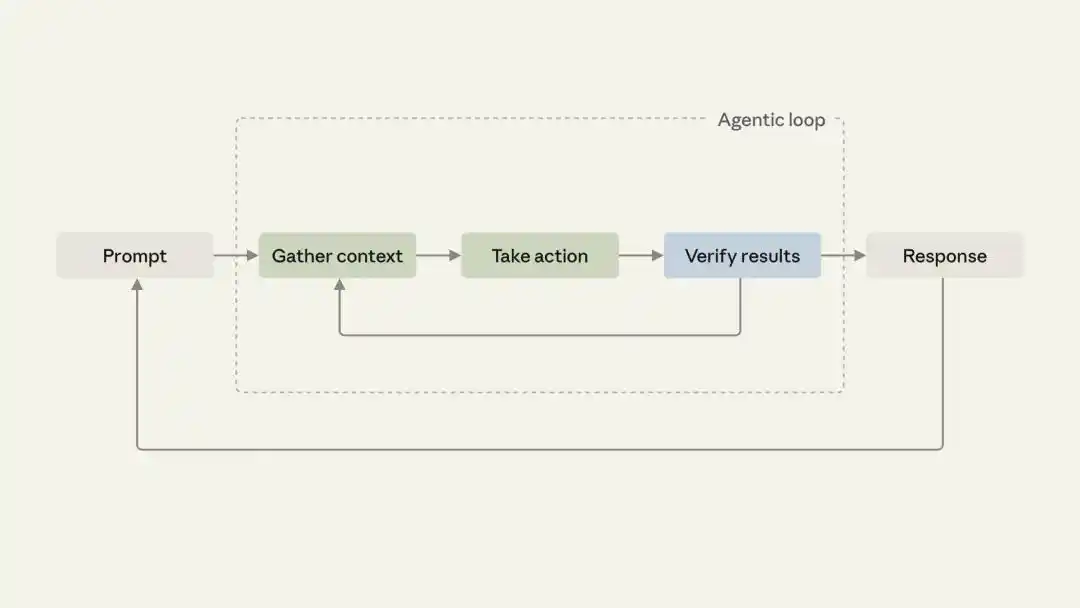
Anthropic's official agent cycle diagram: after a prompt comes in, Claude gathers context, executes actions, verifies results. If verification fails, it loops back; only when it passes does it return.

Some checks Claude already knows how to do. Deterministic signals in the codebase, like type checker, linter, running tests, runtime errors—it can read these and will fix them as it goes.

The real trouble lies with another category: whether the UI changes are correct, whether the user flow is smooth, whether this change has buried unseen pitfalls...

In the past, these could only be caught by humans watching, performing the same checks dozens or hundreds of times.

Anthropic's solution is to write down each of those manual checks you perform every time, package them into Skills, and have Claude execute them automatically for each task.

For decades, all software engineering processes—writing requirements, planning, layer upon layer of reviews, endless meetings—were essentially because: writing code was too slow, and engineers' time was too valuable.

But when AI makes the act of writing code faster and cheaper, this premise disappears.

The Claude Code team's own assessment is: the bottleneck hasn't vanished; it has merely shifted: from "writing code" to verification, code review, security, and other such stages.

Code is generated too quickly. The new problem becomes: are these codes correct, who will maintain them, can people keep up with the pace of reviewing code.

Faced with this new bottleneck, the Claude Code team first experimented on themselves.

The 4 Self-Check Skills the Claude Code Team Uses Daily

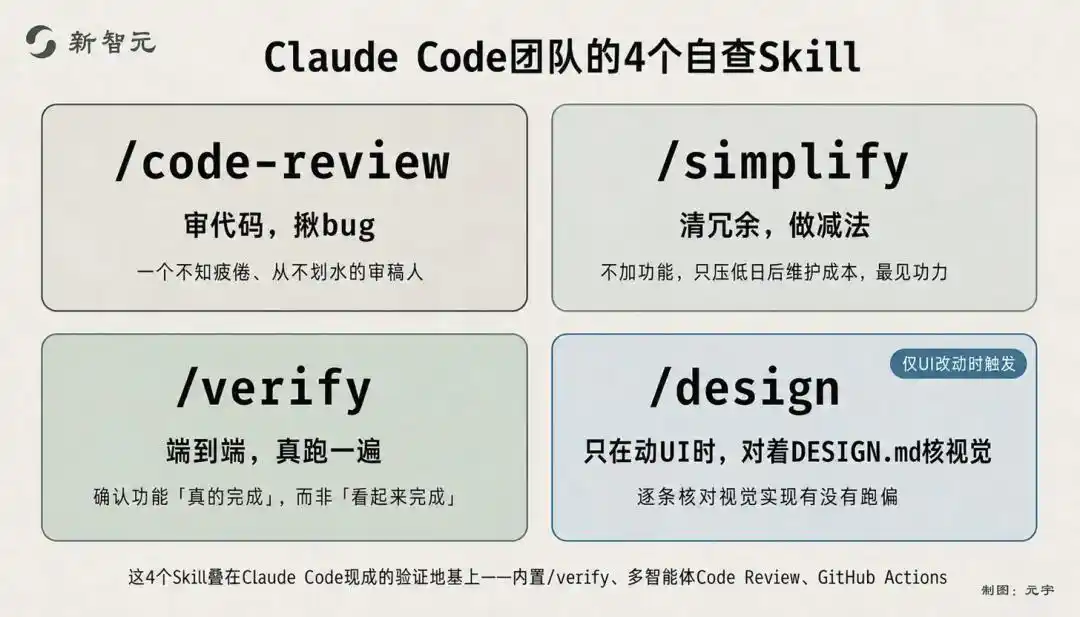
Internally, the Claude Code team uses these four self-check Skills every day.

/code-review, specialized in reviewing code changes, rooting out potential bugs, and providing review comments along the way.

This is like having a tireless reviewer on standby.

/simplify, cleans up the diff for this change, removing convoluted, complex implementations to make the structure simpler.

It doesn't add features for you; instead, it removes redundancy, simplifies implementation, pushing down future maintenance costs.

This point is crucial and requires real skill. Most people write code by adding more; tools that proactively simplify are particularly valuable.

/verify, performs end-to-end verification, actually running things to confirm the feature is truly complete, not just "looks complete."

/design, only comes into play when the UI is touched. It cross-checks against the DESIGN.md in the repository, verifying point by point if your visual implementation has deviated.

These 4 Skills didn't appear out of thin air.

Underlying them, Claude Code has already laid a foundation of existing verification support:

The built-in /verify can run the application to observe changes; you specify the build and test commands in CLAUDE.md, and it follows them. There's also Code Review specifically for multi-agent reviews on PRs, and GitHub Actions that automatically trigger on every commit.

The team's 4 Skills are like adding their own layer of process on top of this general foundation.
How to Write Your Own Verification Skill?

Anthropic's method is also simple:

Write down that manual step you always perform in plain language, as if you were explaining precautions to a new colleague on their first day.

If you're even stuck on how to describe this check step, you can first ask Claude to provide a version of general best practices and then modify it.

Your version will likely differ from the generic approach at a few key points, and those differences are precisely the things most worth documenting.

Checks don't necessarily have to be vague judgments like "feels right or not."

For example: any change that deletes a database field without an accompanying data migration step should be rejected. This is a "local rule" that a generic linter will never catch but is specific to your project.

Any rule you've only been able to enforce by manually watching like a hawk is worth writing into a loop.

What to do after writing it?

Throw it to skill-creator to have it interview you back, or simply drop a Markdown file into .claude/skills/.

The simplest verification Skill is a few lines of instructions plus a body paragraph. Then test it once on a new task to confirm this check step actually runs. If not, fix it.

For Skills you can't modify, like built-in ones or those hosted by plugins, there's a workaround: write a wrapper Skill that first calls the original, then calls your verification. A detour, but it still embeds the check.

Verification Isn't One-Size-Fits-All; It Has 4 Levels

After packaging checks into Skills, the next question is: when should this thing trigger?

Anthropic provides 4 levels of automation, from loose to tight.

Standalone: You remember to manually invoke it.

Embedded: Embedded into a specific task flow, running alongside it.

Chained: Several verification Skills strung into a chain, automatically running one after another.

On every PR: The strictest level, automatically running on every code commit.

The official term for the middle layer transition is "from habit to contract."

What was "I always remember to run /verify after /simplify" as a personal habit becomes "automatically call /verify after /simplify runs" as a fixed contract once chained.

The entire chain completes the development loop on its own, only coming back to you when your approval is needed.

The longer the chain, the higher the reliability, but the official team specifically cautioned: chained verification will genuinely burn through tokens.

So don't immediately set all checks as PR gates that block every commit. The right approach is to first see if it's stable, then gradually add more.

Behind the 4 Skills: AI Programming is Changing Tracks

Behind the 4 Skills, the competition in AI programming is shifting from generation to verification.

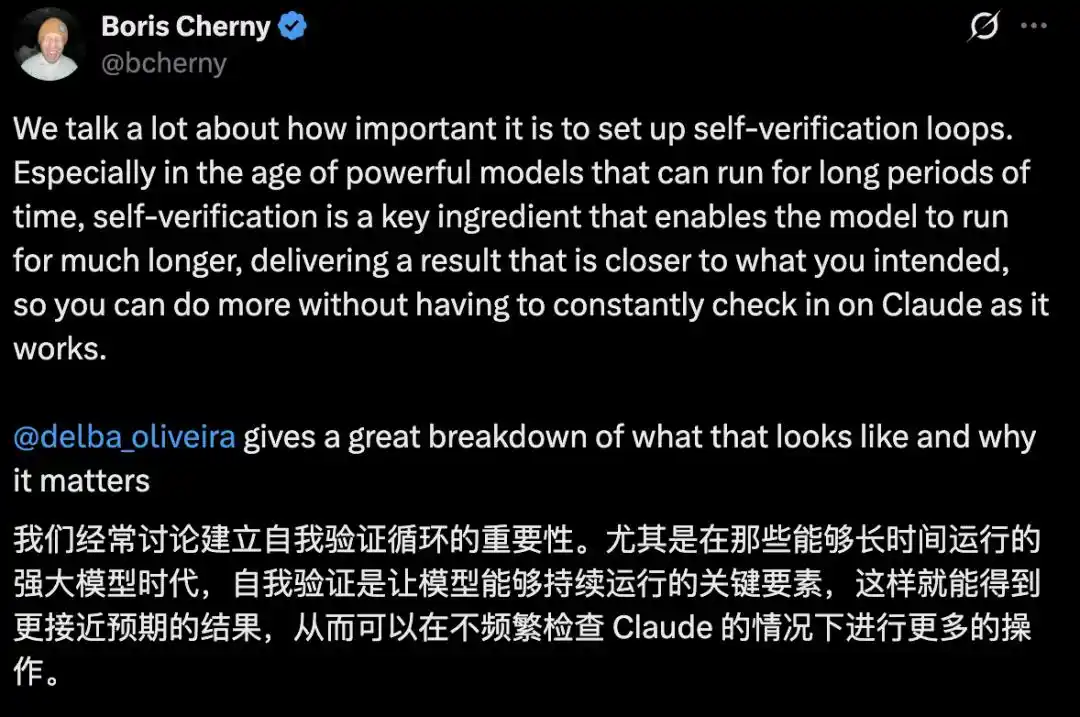
The creator of Claude Code has given the same assessment.

On June 9th of this year, he tweeted: In an era where powerful models can run autonomously for long periods, self-verification is key to letting models run longer and produce results closer to your expectations. You don't have to watch Claude frequently to hand over more work.

Simply put, the more solid the verification, the more confidently an agent can run; the longer it runs, the less hassle for humans.
In the past, we relied on prompts, but they have a ceiling too: they only solve the task at hand; next time you start from scratch.

Let's first correct a common misunderstanding: A Skill is not a piece of Markdown prompt.

It's a capability module containing instructions, file structure, scripts, tool calls, configuration, and an entire workflow. It's about solidifying a team's check steps, design norms, and lessons learned into a package readily available for Claude to reference when needed.

More crucially, Skills are evolving from a feature of Claude Code into an open standard across vendors.

According to industry analysis, GitHub Copilot, Cursor, OpenAI Codex, and Gemini CLI have already adopted the same format.

This means the Skills you solidify for your team won't be locked into one specific tool. They will encapsulate your team's experience, norms, and check processes, turning into reusable capabilities.

This also highlights a stark reality: the same Claude might yield efficiency differences of several times between different teams. This gap isn't due to the model but rather the workflow:

Have you written checks into Skills? Have you set up verification loops? Have you enabled the agent to run its own feedback loop to completion?

Ultimately, an agent's capability is an addition problem: model, plus tools, plus verification mechanisms, plus workflow.

The model aspect is becoming more similar across vendors. What truly creates distance are the latter three items, all of which are in the user's hands.

Of course, what this blog post demonstrates is the process optimization of AI-assisted development, not "AI can already write software independently." It still requires engineers and cannot handle production-grade delivery without humans.

Therefore, it's not about agents coming to take human engineers' jobs, but the direction is already clear.

In the past, we've been teaching AI how to write code. Now we need to start teaching it to verify if what it wrote is correct.

For someone who uses AI to write code every day, the day when "having to manually review everything before leaving work" can finally be entrusted to AI with peace of mind is the day it truly starts carrying the load for you.

References:

https://claude.com/blog/building-verification-loops-in-claude-code-with-skills

https://claude.com/blog/getting-started-with-loops?utm_source=chatgpt.com

This article is from the WeChat public account "New Zhiyuan", author: ASI Revelation

Cryptos en tendance

Questions liées

QWhat is the core innovation described in the article regarding Claude's code generation?

AThe core innovation is the introduction of a 'verification loop' where Claude, after writing code, automatically runs it through four specialized Skill checks (code-review, simplify, verify, design) to find and fix errors before delivering the final code to the user.

QWhat are the four primary verification Skills used by the Claude Code team internally?

AThe four primary Skills are: /code-review (to catch potential bugs and provide review comments), /simplify (to clean up and streamline the implementation), /verify (to perform end-to-end functional verification), and /design (to ensure UI changes align with a project's DESIGN.md file).

QWhat is the key difference between a traditional AI coding workflow and the new 'verification loop' workflow?

AThe traditional workflow is: 'collect context -> execute action -> human review'. The new 'verification loop' workflow extends this to: 'collect context -> execute action -> automatic verification -> repair -> re-verify', embedding the review and repair steps back into an automated loop before returning to the user.

QAccording to the article, what is the main 'bottleneck' that has shifted as AI code generation becomes faster?

AThe main bottleneck has shifted from 'writing code' to the verification, code review, and security aspects. The article states that the new problem is ensuring the rapidly generated code is correct, maintainable, and can be reviewed at the required pace.

QHow does the article describe the nature and importance of 'Skills' compared to simple prompts?

AA Skill is described not as a simple prompt, but as a modular capability package. It contains instructions, file structures, scripts, tool calls, configurations, and workflows. It is a way to encapsulate a team's review steps, design standards, and learned lessons into a reusable asset that Claude can access autonomously.

Lectures associées

Soudain, Google Earth retire en urgence la fonctionnalité de génération d'images Nano Banana 2 !

**Google Earth retire d'urgence la fonctionnalité de génération d'image Nano Banana 2** Google a brièvement intégré son dernier modèle de génération d'image, Nano Banana 2, à Google Earth, permettant aux utilisateurs de transformer, via de simples invites textuelles, des vues satellites ou aériennes en scènes historiques, visualisations architecturales ou créations futuristes, le tout ancré dans les contraintes géospatiales réelles (topographie, perspectives 3D). Cette technologie, baptisée « ancrage géospatial » (Geospatial Grounding), s'appuie sur les données cartographiques et les capacités de recherche de Google pour générer des images crédibles intégrées au paysage. Cependant, cette fonctionnalité a été rapidement retirée après son lancement. Bien que Google ait présenté des cas d'usage potentiels en éducation, tourisme ou urbanisme, les utilisateurs s'en sont rapidement emparés pour créer des contenus fantaisistes, comme transformer le Independence Hall de Philadelphie en ruine post-apocalyptique peuplée de zombies et de clowns maléfiques. Cette expérience, qualifiée par certains de « bouillie d'IA » (AI Slop) pour son manque de rigueur géométrique, a révélé des problèmes de modération. Google a indiqué retirer temporairement l'outil pour « renforcer les mesures de protection » avant un éventuel nouveau déploiement. Cette initiative place Google sur un terrain unique face à des concurrents comme Midjourney ou DALL-E : plutôt que de simplement « bien dessiner », il s'agit de « remodeler la Terre » de manière crédible en s'appuyant sur son immense base de données géographiques, créant ainsi un nouveau champ : la visualisation IA géo-an crée.

marsbitIl y a 36 mins

Soudain, Google Earth retire en urgence la fonctionnalité de génération d'images Nano Banana 2 !

marsbitIl y a 36 mins

Une transformation majeure de la Fed ? Rapport : Walsh envisage de réduire la fréquence des réunions sur les taux, rompant avec une tradition de 40 ans

Le président de la Fed, Walsh, envisage de réduire la fréquence des réunions du Comité fédéral de l'open market (FOMC), ce qui constituerait un changement majeur dans son fonctionnement, en rupture avec la routine établie depuis 1981 de huit réunions par an. Selon des informations du New York Times, Walsh a évoqué cette idée lors de la réunion cette semaine. Un nouvel horaire pourrait être arrêté avant la prochaine réunion de septembre, bien que les changements concrets interviendraient plus tard. Réduire le nombre de réunions diminuerait les opportunités de voter sur les taux et pourrait affaiblir la capacité de réaction de la Fed face à l'évolution de l'économie, tout en réduisant la transparence de sa politique, inversant une tendance de plusieurs décennies. La loi bancaire de 1935 n'exige qu'un minimum de quatre réunions par an. Walsh avait précédemment déclaré au Congrès que quatre réunions étaient insuffisantes, ce qui contraste avec la direction actuelle des discussions. Le système actuel de huit réunions, instauré sous Paul Volcker, fournit un cadre prévisible. Moins de réunions signifierait moins d'occasions pour le marché de comprendre la trajectoire des taux. Cette initiative s'inscrit dans la volonté plus large de Walsh de réformer l'institution depuis sa prise de fonction en mai, notamment en réduisant la longueur des communiqués et en repensant les conférences de presse. Historiquement, la fréquence des réunions a varié, avec jusqu'à 19 réunions en 1956. Une évaluation interne de 1988 avait conclu que le rythme de huit réunions restait approprié. Le projet de Walsh irait à l'encontre de cette conclusion, et son impact potentiel sur la communication de la Fed et la flexibilité de sa politique sera surveillé de près.

marsbitIl y a 59 mins

Une transformation majeure de la Fed ? Rapport : Walsh envisage de réduire la fréquence des réunions sur les taux, rompant avec une tradition de 40 ans

marsbitIl y a 59 mins

Sélections hebdomadaires de la rédaction (25-31 juillet)

**Résumé éditorial hebdomadaire (25-31 juillet)** Face au flux incessant d'informations, cette sélection met en avant des analyses de fond pour filtrer le bruit et offrir des insights. **Marchés & Investissement :** La Réserve Fédérale américaine a maintenu ses taux lors d'une réunion jugée très incertaine, tiraillée entre des données inflationnistes en baisse et des positions d'hawks. Dans la cryptosphère, Real Vision réfléchit à la valeur à long terme des crypto-monnaies, soulignant l'importance de la conviction face à la volatilité. Une tendance se dessine : les marchés actions globaux, notamment technologiques, adoptent des dynamiques narratives similaires à celles des cryptos. Par ailleurs, la divergence entre la croissance des revenus des protocoles DeFi et la performance de leurs tokens est analysée. **AI & Stockage :** Les marchés s'interrogent sur les risques de crédit liés à l'expansion de l'infrastructure cloud IA, dont Nvidia est un acteur clé. Le secteur du stockage mémoire a connu une forte volatilité, les investisseurs anticipant dès maintenant un risque de surcapacité pour 2027. Le trimestre record de SK Hynix a été jugé « inférieur aux attentes », reflétant la pression sur les valorisations des leaders du secteur. **Politique & Règlementation :** Le Clarity Act, loi crypto américaine cruciale, est dans la dernière ligne droite mais bute sur des désaccords politiques, notamment sur les clauses d'éthique. Son adoption avant la fin de l'année apparaît incertaine. **CeFi, DeFi & Ethereum :** La plateforme TradeXYZ a démontré une précision remarquable pour le prix d'introduction de la société chinoise Changxin Technology. Du côté d'Ethereum, le protocole Lido a entamé une migration massive de plus de 8 millions d'ETH vers une nouvelle architecture de validateurs, un changement structurel pour le staking. **Points chauds de la semaine :** La Fed maintient ses taux ; le règlement MiCA entre en vigueur en Europe ; Sam Altman promet qu'OpenAI va « étonner le monde » dans l'année ; SpaceX a perdu 1 200 milliards de dollars de valorisation depuis son pic ; Apple rejoint le club des 5 000 milliards de dollars de capitalisation.

marsbitIl y a 1 h

Sélections hebdomadaires de la rédaction (25-31 juillet)

marsbitIl y a 1 h

Ne pas investir n'est pas un laissez-passer pour Apple

Face aux géants technologiques comme Meta et Google qui font face à des critiques pour leurs dépenses d'investissement massives dans l'IA, Apple, bien qu'en retard dans ce domaine, se distingue par sa retenue budgétaire. Cette approche lui a même permis de retrouver brièvement la première place mondiale en termes de valorisation boursière. Le rapport trimestriel (T3 2026) d'Apple affiche des performances solides, avec un chiffre d'affaires en hausse de 16,4% et un bénéfice net en progression de 27,1%. L'iPhone et le Mac sont les principaux moteurs de cette croissance, compensant les résultats plus modestes de l'iPad (en baisse) et des services (ralentissement de la croissance). Cependant, le marché réagit négativement après la publication des résultats, en raison des perspectives prudentes pour le trimestre suivant. Apple anticipe des contraintes d'approvisionnement majeures, notamment pour les puces et la mémoire, entraînant des hausses de prix sur ses produits. Contrairement à ses concurrents qui investissent des milliards dans l'infrastructure IA, Apple maintient des dépenses d'investissement (capex) faibles, privilégiant les dépenses de R&D. Malgré cela, l'entreprise n'échappe pas aux répercussions de la frénésie de l'IA, qui exacerbe les tensions sur sa chaîne d'approvisionnement. Ce rapport marque la dernière conférence téléphonique de Tim Cook en tant que PDG, avant son départ prévu en septembre. Il exprime sa confiance dans l'avenir de l'entreprise.

marsbitIl y a 2 h

Ne pas investir n'est pas un laissez-passer pour Apple

marsbitIl y a 2 h

Trading

Spot

Articles tendance

Comment acheter 4

Bienvenue sur HTX.com ! Nous vous permettons d'acheter 4 (4) de manière simple et pratique. Suivez notre guide étape par étape pour commencer votre parcours crypto.Étape 1 : Création de votre compte HTXUtilisez votre adresse e-mail ou votre numéro de téléphone pour ouvrir un compte sur HTX gratuitement. L'inscription se fait en toute simplicité et débloque toutes les fonctionnalités.Créer mon compteÉtape 2 : Choix du mode de paiement (rubrique Acheter des cryptosCarte de crédit/débit : utilisez votre carte Visa ou Mastercard pour acheter instantanément 4 (4).Solde :utilisez les fonds du solde de votre compte HTX pour trader en toute simplicité.Prestataire tiers :pour accroître la commodité d'utilisation, nous avons ajouté des modes de paiement populaires tels que Google Pay et Apple Pay.P2P :tradez directement avec d'autres utilisateurs sur HTX.OTC (de gré à gré) : nous offrons des services personnalisés et des taux de change compétitifs aux traders.Étape 3 : stockage de vos 4 (4)Après avoir acheté vos 4 (4), stockez-les sur votre compte HTX. Vous pouvez également les envoyer ailleurs via un transfert sur la blockchain ou les utiliser pour trader d'autres cryptos.Étape 4 : tradez des 4 (4)Tradez facilement 4 (4) sur le marché Spot de HTX. Il vous suffit d'accéder à votre compte, de sélectionner la paire de trading, d'exécuter vos trades et de les suivre en temps réel. Nous offrons une expérience conviviale aux débutants comme aux traders chevronnés.

713 vues totalesPublié le 2025.10.20Mis à jour le 2026.06.02

Comment acheter 4

Discussions

Bienvenue dans la Communauté HTX. Ici, vous pouvez vous tenir informé(e) des derniers développements de la plateforme et accéder à des analyses de marché professionnelles. Les opinions des utilisateurs sur le prix de 4 (4) sont présentées ci-dessous.

活动图片