Tron Founder Justin Sun Addresses Controversy After Bitcoin Removal From USDD’s Collateral

bitcoinistPublié le 2024-08-23Dernière mise à jour le 2024-08-23

Résumé

Amid the memecoin frenzy on the Tron network, Justin Sun is facing backlash for the controversial removal of over $700...

Amid the memecoin frenzy on the Tron network, Justin Sun is facing backlash for the controversial removal of over $700 million in Bitcoin (BTC) as USDD’s collateral without the Tron DAO Reserve’s vote. Sun has now addressed the situation after the move raised concerns about the stablecoin’s decentralization.

12,000 Bitcoin Removed From USDD Collateral

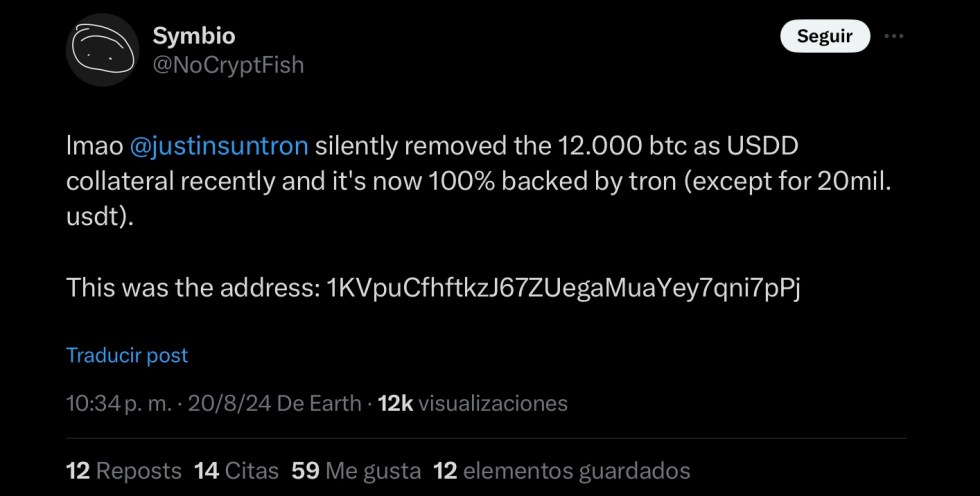
On Wednesday, online reports revealed that 12,000 Bitcoin, worth around $732 million, were removed from Tron’s Decentralized USD (USDD) stablecoin collateral reserves.

USDD is a decentralized over-collateralized stablecoin pegged to the US Dollar through TRX and governed by the Tron DAO Reserve. According to the report, the significant change means the stablecoin is now almost fully backed by TRX, except for 20 million USDT.
Tron

Online reports unveil BTC removal from USDD collateral. Source: Symbio on X

The modification was done “silently” without the DAO’s consultation or approval despite the continued emphasis on community governance. Reportedly, the USDD transparency page listed 12,000 Bitcoin under an address, which has now been removed.

The removal raised questions among investors who criticized the lack of transparency. Many X users questioned the “decentralized stablecoin” narrative claim by the Tron Foundation.

Other community members drew parallels between Sun’s “shady” actions and the behavior that led to the collapses of UST or FTX. Meanwhile, others noted that the news seemed like “100 red flags.”

Veritas Protocol alleged this is not the first issue with USDD’s collateral. Per the post, it “has also faced issues with its collateral, such as storing significant amounts of HTX without consulting the DAO.”

Justin Sun Addresses Concerns

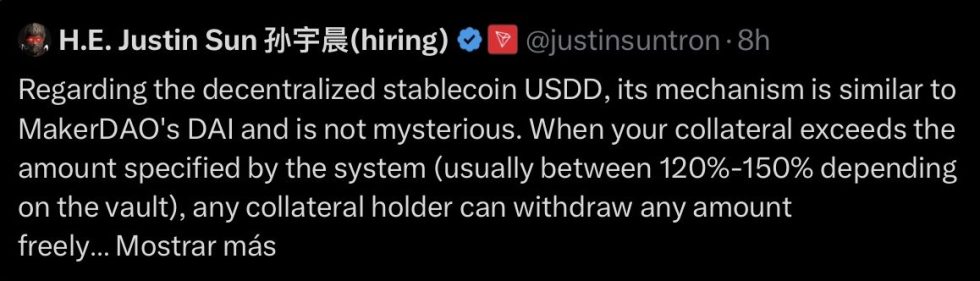
Following the criticism, Justin Sun addressed users’ concerns in an X post. Tron’s founder claimed that USDD’s mechanism is “not mysterious” since it works like MakerDAO’s DAI.

Sun explained that when the collateral exceeds the amount specified by the system, collateral holders can move the funds. Per the post, this amount is usually set between 125% and 150%, and if the collateral falls below a certain level, “it needs to be topped up; otherwise, the collateral may trigger liquidation.”
Tron

Tron's Founder addresses BTC removal without DAO's vote. Source: Justin Sun on X

Based on it, Sun alleges that “any collateral holder can withdraw any amount freely without anyone’s approval.” He also noted that USDD currently “has a long-term collateralization rate exceeding 300%,” which is inefficient for capital utilization and is planned to be upgraded.

Currently, USDD has a long-term collateralization rate exceeding 300%, which means that the capital utilization is not very efficient. The TRON DAO Reserve plans to spend time upgrading USDD in the future to make it a more competitive decentralized stablecoin in the market. Remember, Tron is also a kingdom of stablecoins.

USDD’s X account cited Sun’s response, echoing TRD’s plans to upgrade and enhance the stablecoin. Nonetheless, Bennet Tomlin, co-host of Crypto Critic Pod, questioned Tron founder’s statement. Tomlin claims Sun’s description does not match the issuance process described on USDD’s page.

Moreover, he stated that, according to the whitepaper, the removed Bitcoin is “explicitly supposed to be managed by the TRON DAO Reserve (…), not whatever collateral holders Sun is imagining. At the time of writing, Sun has not responded to the apparent discrepancies raised by Tomlin.
Tron, TRX, TRXUSDT

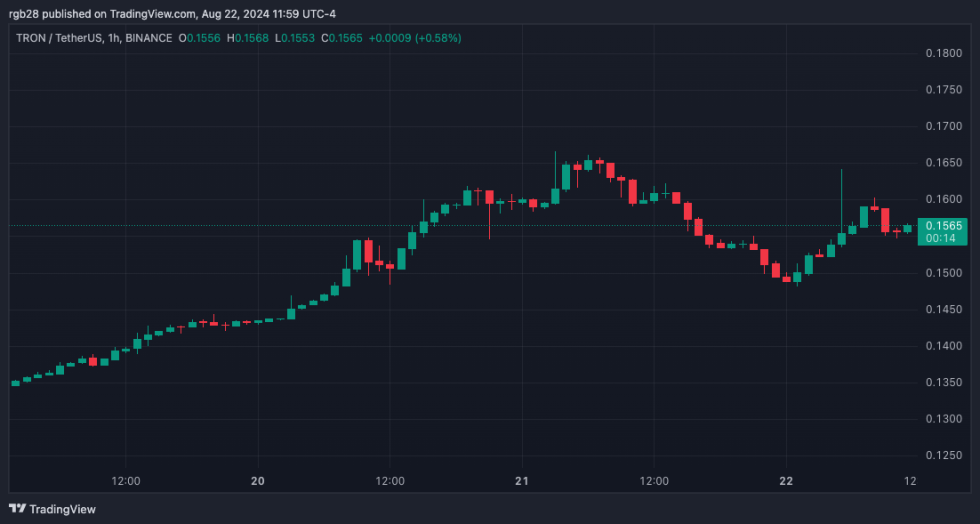
TRX is trading at $0.15 in the three-day chart. Source: TRXUSDT on TradingView
Featured Image from Unsplash.com, Chart from TradingView.com
Rubmar Garcia

Rubmar Garcia

Rubmar is a crypto enthusiast who likes learning and improving constantly. She enjoys reporting on the latest news and developments in the crypto industry. Rubmar also enjoys scrapbooking, crafting, simulation games, and watching football.

Cryptos en tendance

Lectures associées

Les actions chutent plus fort que la crypto, où est passée l’argent ?

En juillet, les marchés boursiers mondiaux ont connu des chutes spectaculaires, en particulier le Kospi sud-coréen qui a déclenché des mécanismes de suspension (circuit breakers) après des baisses de plus de 10% et 6% sur deux jours. Des valeurs technologiques comme SK Hynix, pourtant bénéficiaires, se sont effondrées en raison de résultats légèrement inférieurs aux attentes. Les ETF à effet de levier sur ces titres ont subi des pertes dépassant 80%. Contrairement aux attentes, le Bitcoin n'a pas servi de refuge. Sa relative stabilité s'explique par une correction anticipée en mai-juin, lors de sorties massives des ETF américains. Les capitaux désertant les actions se sont principalement redirigés vers les liquidités, les obligations d'État et surtout l'or, dont le prix a fortement augmenté. L'analyse révèle que le Bitcoin et l'or ne sont plus perçus comme des actifs similaires : l'or est privilégié pour la préservation du capital, tandis que le Bitcoin reste un actif risqué recherchant la performance. La crise actuelle est interprétée comme un « déléveraging » forcé, ciblant les positions les plus spéculatives, notamment dans les semi-conducteurs. Des facteurs comme la hausse des taux au Japon et l'introduction potentielle d'un nouveau concurrent (ChangXin Memory) ont accentué la pression. Les perspectives pour le Bitcoin dépendent désormais d'un assouplissement de la politique monétaire mondiale et d'une clarification réglementaire, comme l'adoption du projet de loi CLARITY aux États-Unis. Bien que n'étant pas un havre de paix immédiat, le Bitcoin, ayant déjà subi sa correction, pourrait retrouver son attractivité pour les investisseurs en quête de diversification une fois la tempête passée.

marsbitIl y a 2 h

Les actions chutent plus fort que la crypto, où est passée l’argent ?

marsbitIl y a 2 h

Trading

Spot

Articles tendance

Comment acheter SUN

Bienvenue sur HTX.com ! Nous vous permettons d'acheter SUN (SUN) de manière simple et pratique. Suivez notre guide étape par étape pour commencer votre parcours crypto.Étape 1 : Création de votre compte HTXUtilisez votre adresse e-mail ou votre numéro de téléphone pour ouvrir un compte sur HTX gratuitement. L'inscription se fait en toute simplicité et débloque toutes les fonctionnalités.Créer mon compteÉtape 2 : Choix du mode de paiement (rubrique Acheter des cryptosCarte de crédit/débit : utilisez votre carte Visa ou Mastercard pour acheter instantanément SUN (SUN).Solde :utilisez les fonds du solde de votre compte HTX pour trader en toute simplicité.Prestataire tiers :pour accroître la commodité d'utilisation, nous avons ajouté des modes de paiement populaires tels que Google Pay et Apple Pay.P2P :tradez directement avec d'autres utilisateurs sur HTX.OTC (de gré à gré) : nous offrons des services personnalisés et des taux de change compétitifs aux traders.Étape 3 : stockage de vos SUN (SUN)Après avoir acheté vos SUN (SUN), stockez-les sur votre compte HTX. Vous pouvez également les envoyer ailleurs via un transfert sur la blockchain ou les utiliser pour trader d'autres cryptos.Étape 4 : tradez des SUN (SUN)Tradez facilement SUN (SUN) sur le marché Spot de HTX. Il vous suffit d'accéder à votre compte, de sélectionner la paire de trading, d'exécuter vos trades et de les suivre en temps réel. Nous offrons une expérience conviviale aux débutants comme aux traders chevronnés.

818 vues totalesPublié le 2024.12.12Mis à jour le 2025.03.21

Comment acheter SUN

Discussions

Bienvenue dans la Communauté HTX. Ici, vous pouvez vous tenir informé(e) des derniers développements de la plateforme et accéder à des analyses de marché professionnelles. Les opinions des utilisateurs sur le prix de SUN (SUN) sont présentées ci-dessous.

活动图片