Two Giants' Credit Expansion: Loan Balances of $9.9 Billion vs. $14.6 Billion, Brazil Emerges as the Main Battlefield

链捕手Publicado a 2026-06-22Actualizado a 2026-06-22

Resumen

Title: Two Giants "Credit" Surge: Loan Balances of 99 Billion vs. 146 Billion USD, Brazil Emerges as Main Battlefield Summary: The article compares the rapid expansion of credit businesses by two major e-commerce and fintech players, Sea (via Monee) and Mercado Libre (via Mercado Pago), in overseas markets like Southeast Asia and Latin America, contrasting with a slowing domestic Chinese credit market. Using Q1 2026 financial data, it highlights their significant growth. Sea's Monee reached a loan balance of $99 billion, up 71% year-over-year (YoY), contributing 17.5% to Sea's total revenue. Mercado Pago's loan balance hit $146 billion, up 87% YoY, contributing 45% to its parent company's revenue. Both maintained stable risk metrics (e.g., Monee's 90+ day NPL at 1.1%) despite rapid scaling. Brazil is identified as a key and accelerating growth market for both. Sea's Brazilian operations saw loan volumes exceed $10 billion, growing 250% YoY, with SPayLater GMV penetration still low (~10%) indicating high potential. Sea also secured a key Brazilian financial credit license (SCFI). Mercado Libre's Brazil segment contributed over half (54%) of total group revenue, with its credit business there generating $11.24 billion in revenue, up 89% YoY and accounting for 12.7% of global revenue. Mercado Pago's credit portfolio, especially credit cards (46% of loans, +105% YoY), is a strategic focus, described as crucial as building logistics was a decade ago. Its net interest margin afte...

Author: Xiaohui, A Fintech Goose

While we see slow growth in the domestic credit market, with major lending platforms and consumer finance companies tightening strategies and adopting cautious volume control, the overseas credit track stands in stark contrast, experiencing a period of rapid expansion.

Southeast Asia and Latin America markets are particularly active, which are also the primary choices for Chinese fintech companies expanding overseas.

Over the past two years, "A Fintech Goose" has been consistently following two highly representative companies in Southeast Asia and Latin America:

1 Shopee's parent company Sea's Monee;

2 Mercado Libre's Mercado Pago fintech division.

Judging from the Q1 financial report data this year, the credit businesses of both companies continue to grow steadily, bringing more momentum to their respective group revenues.
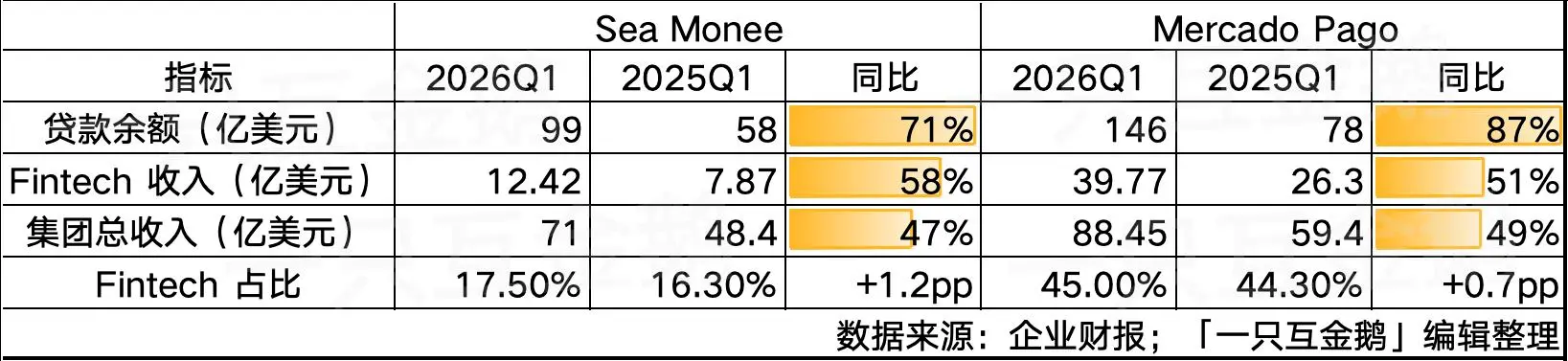
As of the end of Q1 2026:

  • Monee's loan balance reached $9.9 billion (approximately RMB 67 billion), up 71% year-on-year;

  • Mercado Pago's loan balance reached $14.6 billion (approximately RMB 98.7 billion), up 87% year-on-year.

For Q1 2026:

  • Monee's revenue reached $1.242 billion (approximately RMB 8.4 billion), accounting for 17.5% of Sea's total group revenue, up from 16.3% in Q1 2025;

  • Mercado Pago's revenue reached $3.977 billion (approximately RMB 26.9 billion), accounting for 45% of Mercado Libre's total group revenue, up from 44.3% in Q1 2025.

The development logic of "E-commerce + Fintech" for these two companies is not unfamiliar to us. Chinese giants like Ant, JD, and ByteDance all grew by following this path.

However, their differentiated approaches implemented in Southeast Asia and Latin America are also highly valuable as references for domestic fintech and internet giants expanding overseas.

Below, "A Fintech Goose" reviews the key data and development highlights for both giants in Q1 2026.

01 Sea's Monee: Obtained Financial Credit License in Brazil in Q1
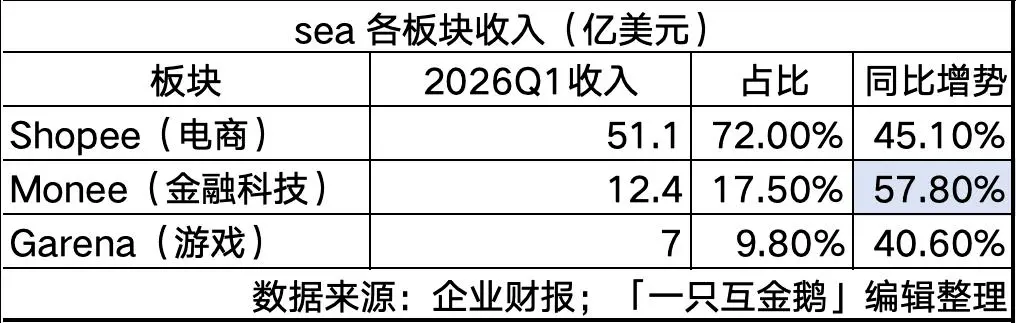
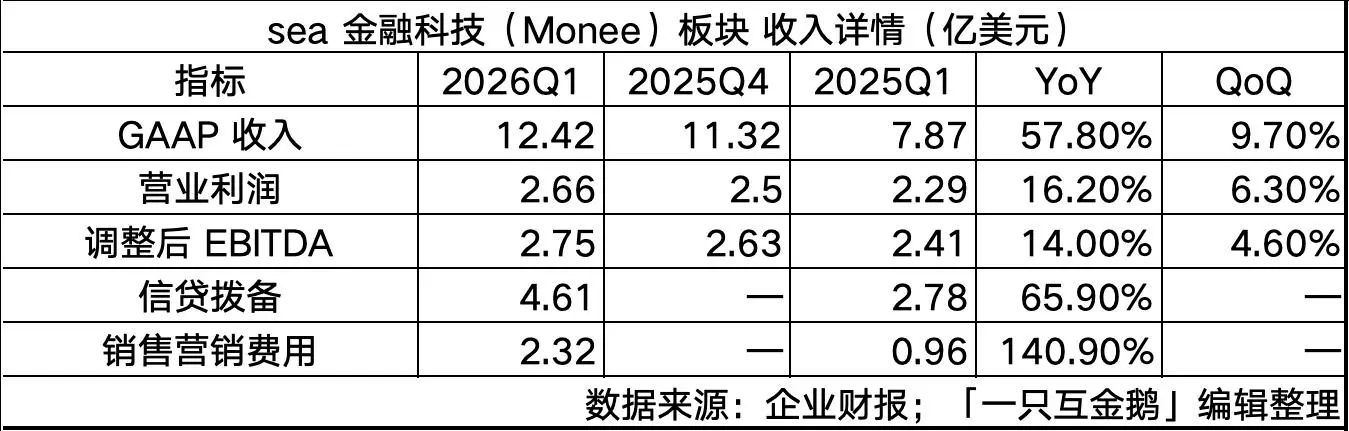
From the data, the fintech segment, i.e., Monee, significantly outperformed in revenue growth (+57.8% YoY) compared to the e-commerce segment Shopee (+45.1%) and the gaming segment Garena (+40.6%).

It's evident that the revenue contribution of the fintech segment Monee within the entire Sea group continues to increase.

Specific data for the fintech segment:

(1) Loan Balance
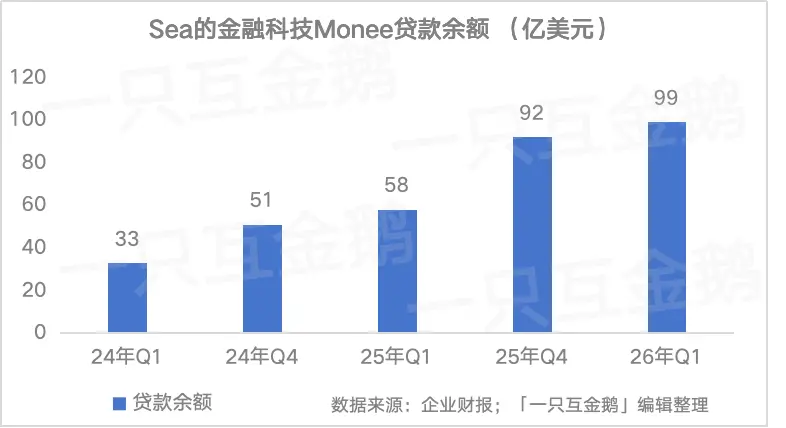
In just two years, the loan balance has grown from $3.3 billion to $9.9 billion, tripling in size.

Each quarter, the loan balance maintains high double-digit growth.

During the investor call, management mentioned that Q1 is typically a consumption off-season, but this year Q1, Sea Monee's loan balance still achieved a sequential growth of +7.5%.

(2) Risk Performance:
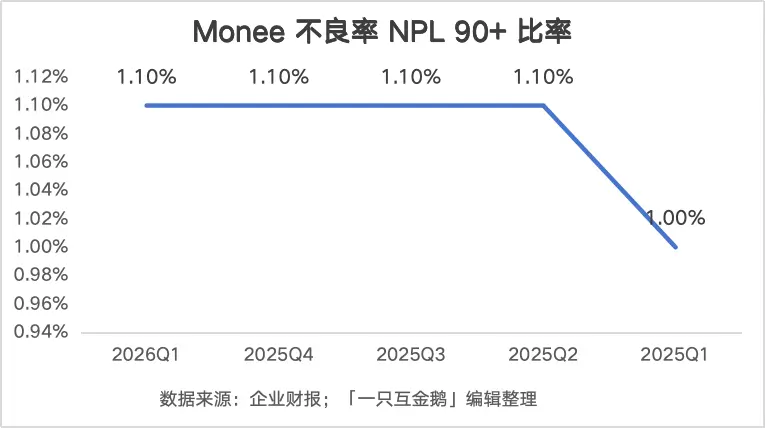
While the loan portfolio grew 71% within a year, the 90+ day NPL ratio only slightly increased from 1.0% to 1.1%, remaining stable at 1.1% for four consecutive quarters.

The stable NPL ratio indicates, to some extent, that their risk model has withstood the test of rapid credit expansion.

Important note on NPL ratio calculation: The denominator for the NPL 90+ ratio includes total loan principal from both "on-book + off-book" loans.

The financial report explains:

Off-book mainly refers to channeling arrangements, where cooperative financial institutions lend on the Sea platform.

(3) Three Growth Paths for Credit Business

Sea clearly outlined three growth paths for Monee's credit business in the conference call:

Path 1: Deepen relationships with existing users

Gradually increase credit limits as understanding of user repayment behavior deepens. This is reflected in the average loan balance per user increasing from $200 to $250 (+25%).

Path 2: Acquire high-quality new users

Launch targeted campaigns for customer segments with better risk scores and stronger spending power, attracting them with competitive pricing, higher credit limits, and longer repayment terms. Management explicitly stated "early signs show success."

Path 3: Expand credit scenarios outside the Shopee ecosystem (Off-Shopee)

This is the most promising growth direction.

In Thailand and Indonesia, Off-Shopee SPayLater loans exceeded 20% of the SPayLater portfolio by the end of Q1.

Notably, strong growth is seen in high-value categories in Indonesia (like electronics and two-wheelers), where installment credit plays a significant role in purchases.

(4) Brazil Market Shines Brightly

In Q1 2026, Brazil became Sea's fastest-growing market.

Both the e-commerce Shopee segment and the fintech Monee segment had highlights:

Shopee Brazil:

  • Q1 was the fastest-growing market while remaining profitable;

  • GMV growth exceeded market average, driven by active buyers, purchase frequency, and average order value;

  • Delivery times improved by over 1 day year-on-year;

  • 3 new fulfillment centers were built, bringing the total to 5;

  • ShopeeMall GMV more than doubled year-on-year, accounting for about 15% of Brazil's total GMV;

  • ShopeeVIP membership program launched in Brazil in April (already over 10 million members in Asia).

Brazil Fintech (Monee Brazil):

  • The combined SPayLater + cash loan credit product launched last year aligns well with Brazilian consumers' credit habits. This drove strong growth in user numbers and repurchase rates.

  • In Q1 2026, Brazil's loan portfolio exceeded $1 billion, up 250% year-on-year, becoming the fourth market with a loan portfolio over $1 billion.
    Note: The other three billion-dollar markets are Indonesia, Thailand, and Malaysia.

  • SPayLater GMV penetration in Brazil is only about 10%, far below mature markets, indicating huge growth potential;

  • Average loan balance per user in Brazil doubled year-on-year, showing extremely strong user stickiness.

  • Crucially – they secured a key license!

In Q1 2026, Sea was approved for Brazil's SCFI license (Sociedade de Crédito, Financiamento e Investimento), also known as the Brazilian financial credit license.

Obtaining this license broadens the range of financial services that can be offered in Brazil. It lays a compliant foundation for independently conducting more diversified credit business in Brazil in the future. This is a key milestone.

02 Mercado Libre: Brazil Credit Business Q1 Revenue $1.124 Billion (approx. ¥8 billion RMB)

Now let's look at Mercado Libre.

Like Sea, Brazil is a significant part of Mercado Libre's operations across all countries.
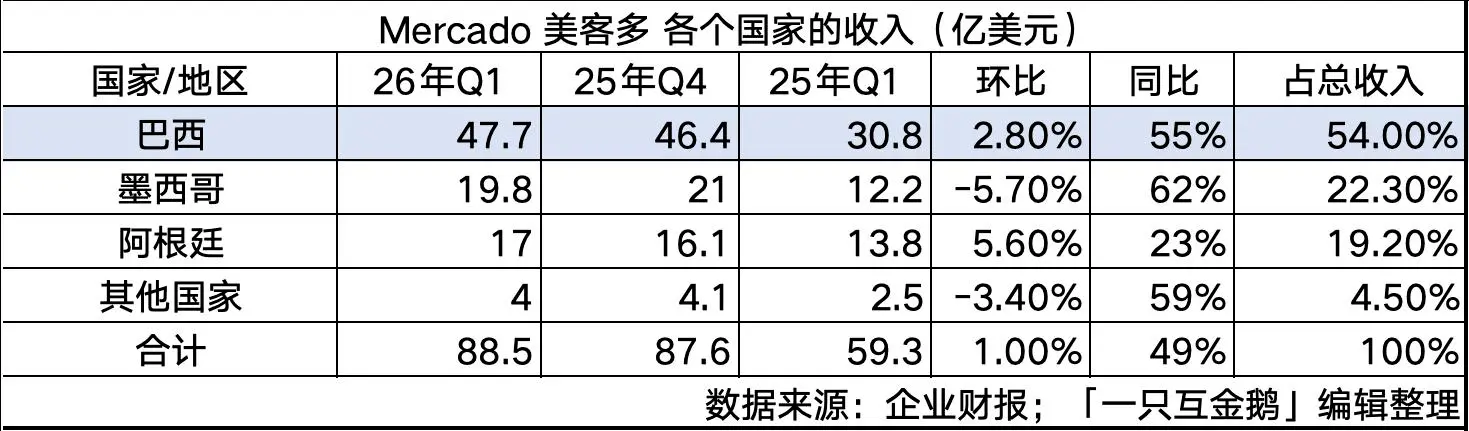
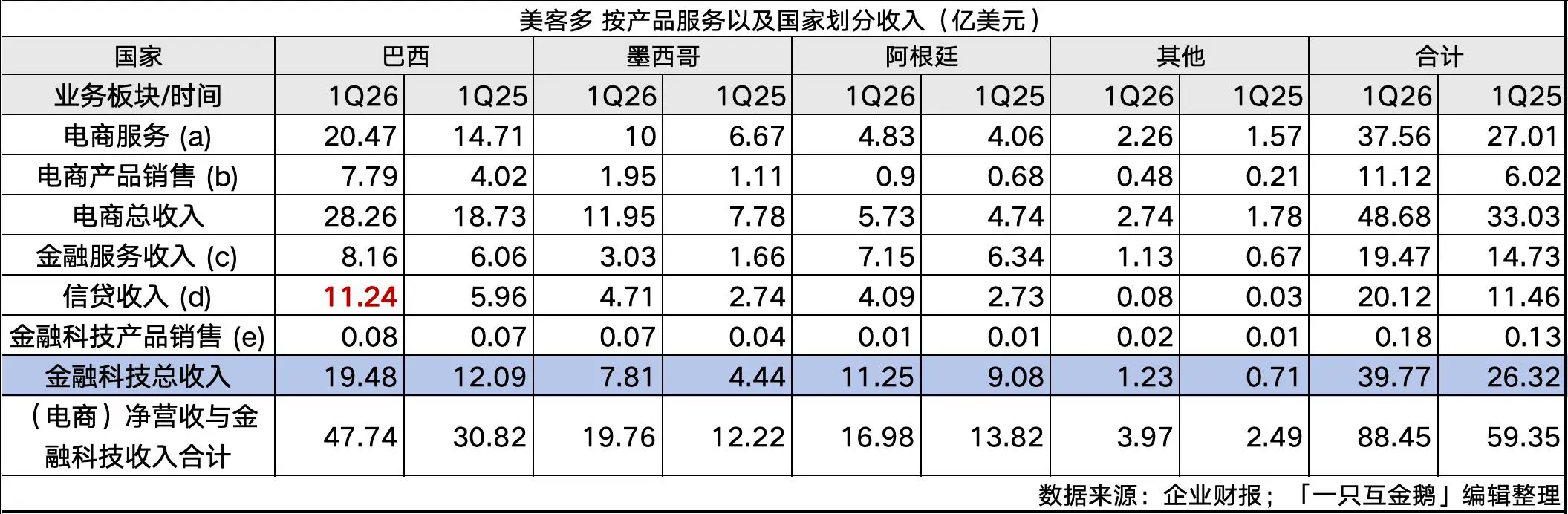
Looking at the Q1 2026 financial report, if revenue is broken down by country:

  • Brazil contributed over half of the total revenue, accounting for 54%;

  • Mexico was the fastest-growing market, with revenue up 62% year-on-year;

  • Argentina saw relatively moderate growth, with revenue up 23%, but considering Argentina's inflation and currency depreciation, the real local currency growth was high;

  • Other countries, including Chile, Colombia, Peru, etc., have a relatively small scale, collectively accounting for only 4.5%.

Looking at business segments in Q1 2026, the e-commerce segment declined slightly quarter-on-quarter (seasonal off-peak), but the Fintech segment bucked the trend with sequential growth of +4.1%.
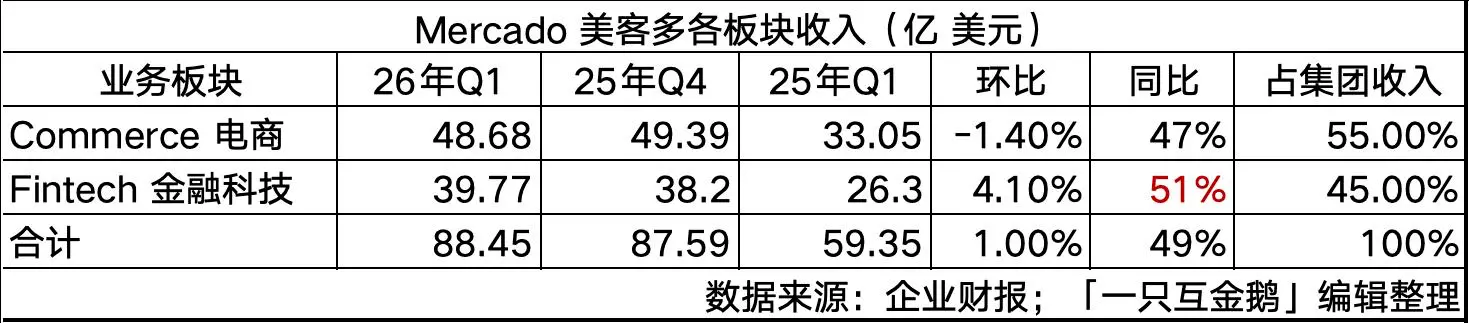
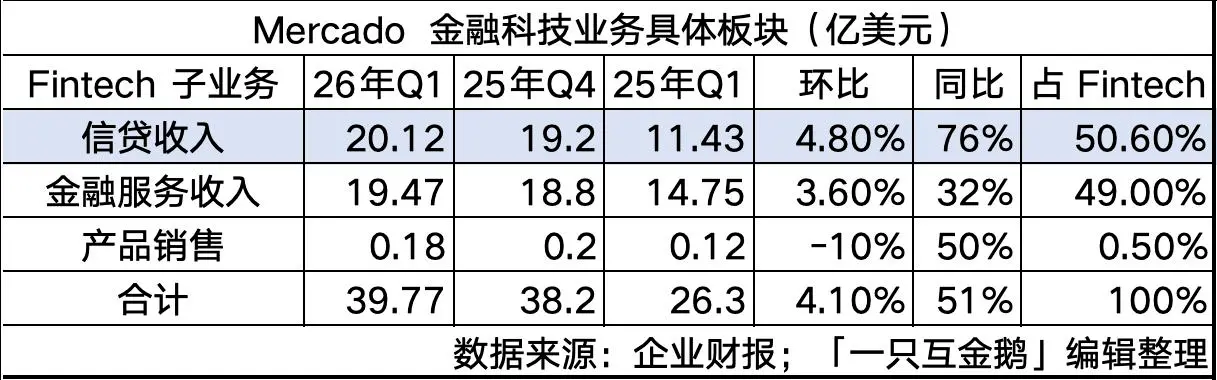
Interestingly, within the fintech segment, credit revenue surpassed financial services revenue for the first time, becoming the largest engine for Fintech.

In other words: the credit business supports the overall performance.

In previous articles, "A Fintech Goose" has detailed Mercado Libre's credit business.

Specifically, it includes:

1 Consumer loans; 2 Credit card business; 3 Merchant loans; 4 Auto loans.
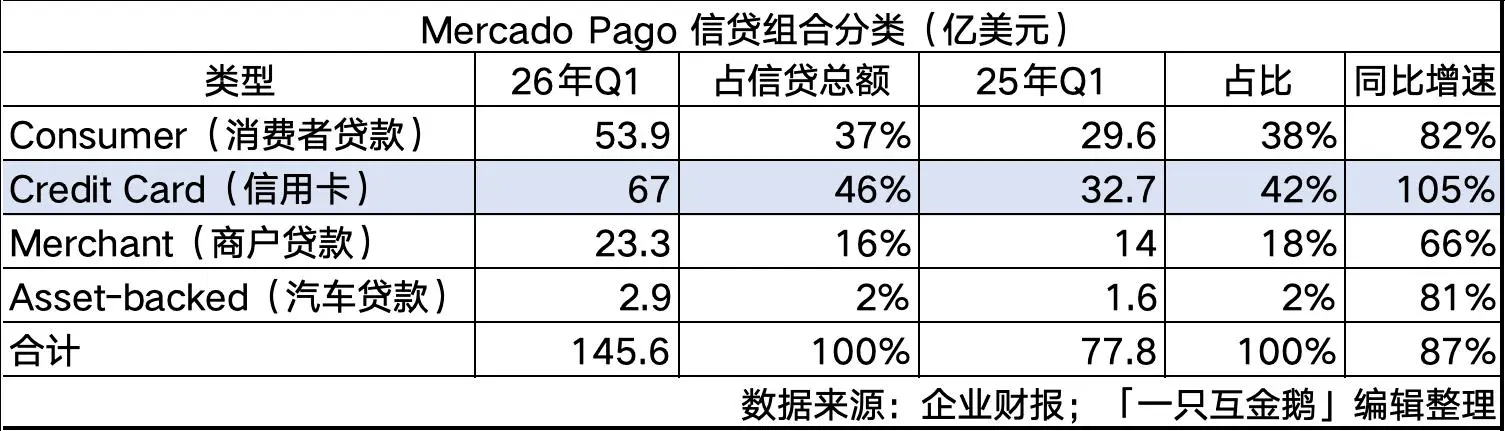
Looking at Q1 2026 data:

The credit card business showed significant loan portfolio growth (+105%), with its size accounting for 46%, taking the largest share.

No matter which country, credit cards are a business with an extremely long investment-return cycle.

In Latin America, Mercado Libre's credit card issuance incurs very high initial costs: zero annual fee + up to 40 days interest-free + up to 18 interest-free installments, plus substantial subsidies for customer acquisition. The required costs are extremely high.

Coupled with Brazilian users' habit of using interest-free installments, it takes a relatively long time from users "grabbing benefits" to "generating interest income."

(1) Strategic Significance of Credit Cards

During the investor call, management repeatedly mentioned the strategic significance of the credit card business.

They even used this phrase to describe it:"Investing in credit cards is as important for Mercado Pago as building our own logistics network was for the e-commerce platform ten years ago."

Key points summarizing Mercado Libre's credit card business:

  • Card issuance: Q1 saw 2.7 million new cards issued, credit card TPV grew 90% year-on-year, MAU grew 68% year-on-year.

  • Cross-selling flywheel: Many credit card users were previously only platform buyers and have now become active Fintech users.

  • Ecosystem effect: Credit cards improve platform conversion rates, GMV per user, and cross-ecosystem transaction volume.

  • 5-year investment in Brazil: Credit cards in Brazil have been invested in for 5 years. Older vintages are maturing as expected, gradually offsetting the dilution effect of new vintages.

  • Acceleration in Mexico: Credit card issuance in Mexico is accelerating, with an attractive payback period.

  • New start in Argentina: Credit cards were just launched in Argentina last August-September, with early performance similar to the initial stage in Brazil.

(2) Credit Risk Performance
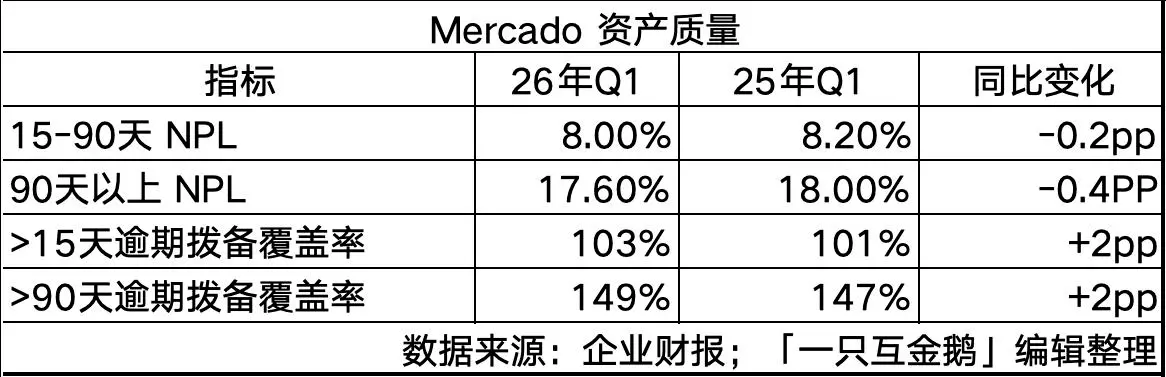
While the credit portfolio grew 87%, the NPL ratio declined year-on-year, and provisions for severely overdue loans exceeded by about 1.5x, strengthening the risk buffer.

Special note: An NPL ratio over 17% seems alarming, but lending rates in the local market are also higher than in China.

Based on Mercado Libre's NIMAL and public information from the Brazilian market, it's estimated:

Personal Loans: Annual interest rate 146%;

Payroll Loans: Annual interest rate 28% (secured, lowest rate);

Credit Card revolving interest annual rate 451% (Central Bank of Brazil, March 2026).

(3) Net Interest Margin Remains Impressive
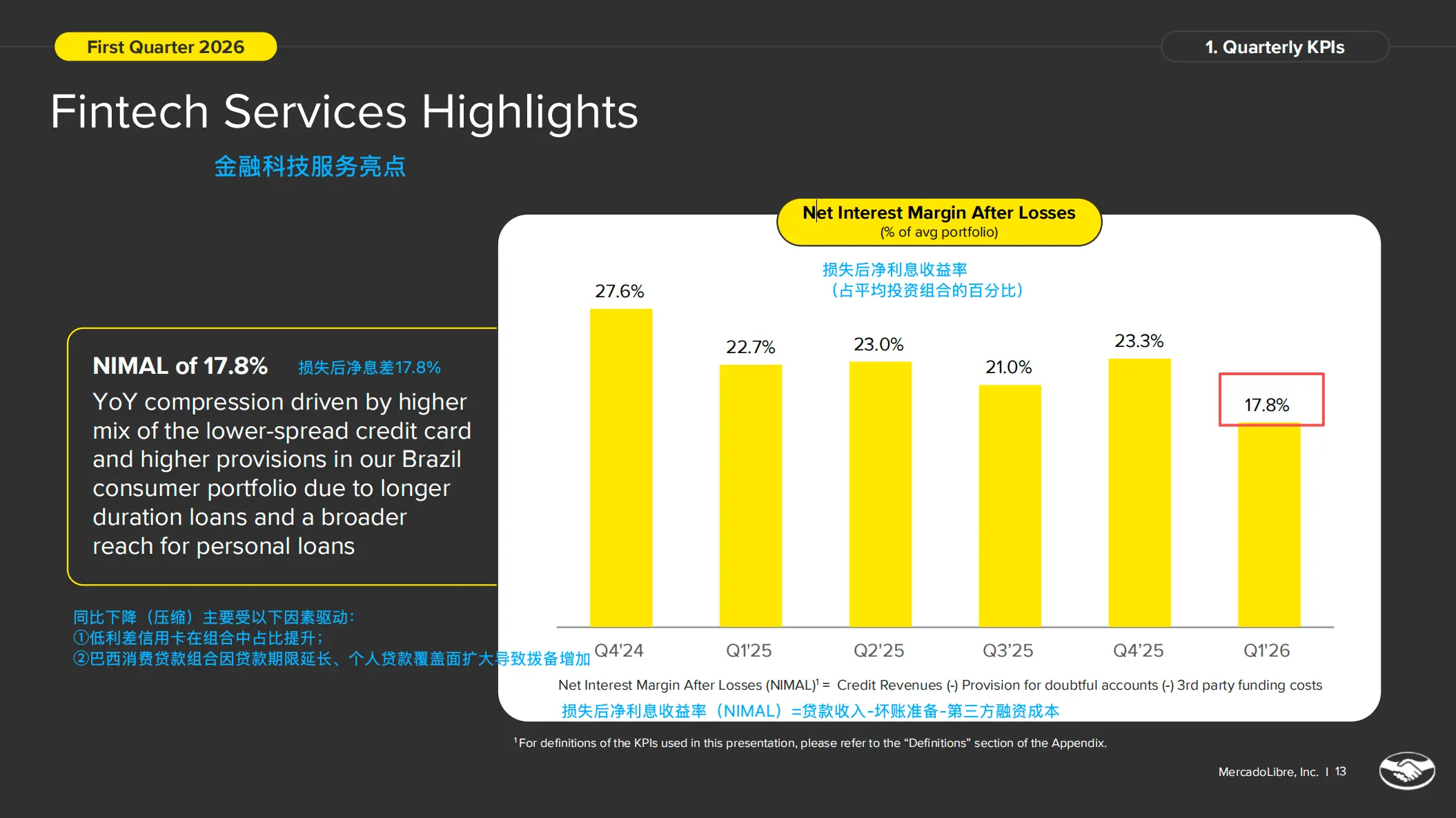
Screenshot from Mercado Libre Investor Report (Click image to enlarge)

Mercado Libre's net interest margin remains impressive.

It declined from 22.7% in Q1 2025 to 17.8% in Q1 2026, a drop of 4.9 percentage points, but this is still an extremely high level.

For comparison, in China, China Merchants Bank's Q1 2026 NIM was only 1.83%; WeBank, China's "profit king" among private banks, had an NIM of only 4.19% in 2025 (pre-provision basis).

Moreover, Mercado Libre's metric calculation is more stringent.

  • Mercado Libre NIMAL = Credit revenue - Bad debt provisions - Funding cost, i.e., Net Interest Margin after deducting bad debts.

  • Domestic bank NIM = (Interest income - Interest expense) / Interest-earning assets, i.e., before bad debt deduction.

Mercado Libre's investor call mentioned: The 4.9ppts year-on-year decline in NIMAL was primarily due to:

  • Increased proportion of credit cards (2/3 of the compression from this factor): Initial NIMAL for credit cards is lower because full expected loss provisions need to be booked at issuance;

  • Longer terms and broader coverage of consumer loans in Brazil (1/3 of the compression): Terms extended from 5 months to 8 months, reaching more credit score segments.

  • Notably, each sub-portfolio remains profitable. Consumer loan portfolio still maintains double-digit margins, merchant loans have the highest spread. Credit cards follow a "first loss, then profit" model, and older vintages in Brazil have already started generating profits.

(4) Brazil Market, the Biggest Surprise

Management expressed pleasant surprise and the importance of the Brazil market in the shareholder letter:

"Twenty-six years after launch, Mercado Libre is growing at startup rates across all of our major markets. Nowhere is this more evident than in Brazil, our largest and most established market, where growth is not just fast – it is accelerating."

Mercado Libre's e-commerce revenue in Q1 2026 was $2.826 billion, up 51% year-on-year.

Specifically in Q1, e-commerce GMV grew 38% year-on-year, items sold grew 56%, and active buyers grew 32%.

This growth primarily stemmed from the decision in 2025 to lower the free shipping threshold, which management called "one of the most important decisions in 2025" – lowering the free shipping threshold to R$19 (approximately RMB 25.49) greatly reduced the psychological barrier for first-time purchases.

Looking at the fintech segment –

  • Fintech in Brazil contributed $1.948 billion in revenue in Q1 2026, accounting for 22.0% of the group's total revenue;

  • Within that, credit-related revenue was $1.124 billion, accounting for 12.7% of the group's total revenue. This revenue was $596 million in Q1 last year, representing 89% year-on-year growth.

Currently, Brazil's credit business is undoubtedly a key growth engine for Mercado Libre.

The credit revenue from a single market already accounts for nearly one-eighth of Mercado Libre's global total revenue.
In short, while both Sea and Mercado Libre are betting big on Brazil, with growth rates often doubling, it is indeed an extremely tempting market.

However, this rapid growth seems to be reserved for the giants. Other fintech players—without e-commerce transaction scene data, without a payment loop to cultivate users—find it extremely difficult to operate credit businesses in Brazil. The local tax system is also particularly complex, making it hard for general players to establish themselves, and it's not recommended.


Preguntas relacionadas

QAccording to the article, how does the credit business performance of Sea's Monee and Mercado's Mercado Pago compare in Q1 2026?

AIn Q1 2026, both Monee and Mercado Pago showed strong growth in their credit businesses. Monee's loan book reached $9.9 billion, a year-on-year increase of 71%, while Mercado Pago's loan book reached $14.6 billion, a year-on-year increase of 87%. Mercado Pago's loan book was larger and grew at a faster rate.

QWhat were the three key growth paths identified for Sea Monee's credit business?

AThe three key growth paths for Sea Monee's credit business are: 1) Deepening relationships with existing users by increasing credit limits as repayment behavior is understood better. 2) Acquiring high-quality new users through targeted campaigns with competitive pricing, higher limits, and longer repayment terms. 3) Expanding credit scenarios outside the Shopee ecosystem (Off-Shopee), such as in Indonesia for high-value categories like electronics and two-wheelers.

QWhy is the Brazilian market considered a 'main battleground' for both Sea and Mercado Libre?

ABrazil is considered a main battleground because it is the fastest-growing and most significant market for both companies. For Sea, Brazil was its fastest-growing market in Q1 2026, with Monee's loan book there exceeding $1 billion and growing 250% year-on-year. For Mercado Libre, Brazil contributed over 54% of its total revenue, with its credit business in Brazil generating $1.124 billion in revenue, accounting for 12.7% of the group's total revenue and growing 89% year-on-year. Both see immense potential due to low credit penetration compared to mature markets.

QWhat strategic importance does the credit card business hold for Mercado Pago, as stated in the article?

AMercado Pago's management compared the strategic importance of investing in credit cards to the significance of building its own logistics network for its e-commerce platform a decade ago. The credit card business is crucial for driving cross-selling, increasing platform conversion rates, boosting per-user GMV, and expanding cross-ecosystem transaction volume. Although it has a long investment payback period, older batches in Brazil have already started to become profitable.

QDespite high delinquency rates, how does Mercado Pago maintain profitability in its credit business, especially in Brazil?

AMercado Pago maintains profitability despite high delinquency rates because the interest rates on its credit products in markets like Brazil are significantly higher than in regions like China. For example, personal loan annual rates can be around 146%, and credit card revolving interest rates can be as high as 451%. This high revenue potential, combined with prudent risk management like maintaining a 1.5x provision coverage for severely delinquent loans, allows the business to remain profitable even with a high NPL ratio.

Lecturas Relacionadas

Interpretación del Informe: JPMorgan Detalla el Sentimiento de los Compradores antes de los Resultados Trimestrales de Micron y la Situación Actual del Sector de Hardware

**Resumen del informe de J.P. Morgan: Sentimiento de compradores antes de resultados de Micron y panorama del sector de hardware** Un informe de J.P. Morgan analiza el sentimiento antes de los resultados de Micron, las tendencias en la cadena de suministro de hardware y las perspectivas de gasto de capital en IA. **Conclusiones clave:** 1. **Micron:** El sentimiento de los compradores sigue siendo muy positivo, siendo la memoria una de las apuestas más consensuadas en IA. Se espera que anuncien más contratos a largo plazo (SCA). Los focos de atención son la sostenibilidad de sus márgenes brutos, superiores al 80%, y el potencial para nuevos aumentos de precios impulsados por la IA. 2. **Cadena de suministro de hardware:** La demanda relacionada con IA en servidores, redes y almacenamiento sigue fuerte, pero con divergencia entre empresas. Destacan: * **Celestica (CLS):** Perspectivas de márgenes mejoradas, mayor confianza en proyectos de redes para IA y mejor capacidad para trasladar costes. * **Western Digital y Seagate:** Se benefician de la mejora continua de precios en un entorno de oferta limitada. * **Fabrinet (FN):** Mayor visibilidad en módulos ópticos para IA; los productos para Amazon comenzarán a generar ingresos. * **Teradyne (TER):** Se espera una caída de ingresos en el 2º semestre, pero Google podría convertirse en un nuevo cliente clave a finales de año. 3. **Gasto en capital de IA revisado al alza:** J.P. Morgan eleva su previsión de crecimiento del mercado de equipos para obleas (WFE) a un 28% en 2026 y un 29% en 2027. El financiamiento mediante deuda para proyectos de IA está aumentando, lo que reduce las restricciones para esta expansión del gasto. **Señales a seguir:** * Detalles de los SCAs y perspectivas de margen de Micron en sus resultados. * Posible mejora de la guía anual de Arista Networks. * Evolución de los ingresos de Fabrinet por módulos ópticos para Amazon. **Fuente:** Informe de J.P. Morgan (Joshua Meyers et al., 21 de junio de 2026).

marsbitHace 2 hora(s)

Interpretación del Informe: JPMorgan Detalla el Sentimiento de los Compradores antes de los Resultados Trimestrales de Micron y la Situación Actual del Sector de Hardware

marsbitHace 2 hora(s)

Interpretación del informe: El debut del nuevo presidente de la Fed, ¿cambio de timonel, pero no de guion?

**Resumen del informe: El debut del nuevo presidente de la Fed - ¿Cambio de liderazgo, pero el mismo guion?** El economista jefe global de Morgan Stanley, Seth B. Carpenter, analiza la primera reunión de la FOMC bajo el nuevo presidente de la Fed, Kevin Warsh. El informe destaca tres conclusiones clave: 1. **Warsh no ofrece una hoja de ruta para las tasas.** Su filosofía de reducir la "orientación prospectiva" es clara. La declaración de la FOMC fue más concisa y no proporciona un camino claro para la política. El gráfico de puntos sugiere solo una subida de tipos este año, pero Carpenter señala que si la inflación cae por debajo de lo esperado (posible ahora que los efectos de inflación de los aranceles se han disipado), la lógica para esa única subida podría desvanecerse, especialmente dado que las proyecciones apuntan a recortes para el próximo año. 2. **La reducción del balance (quantitative tightening, QT) podría ser más agresiva de lo esperado, con un impacto limitado.** La postura de Warsh sobre la reducción del balance es firme. Carpenter argumenta que medidas como reducir a la mitad la cuenta del Tesoro en la Fed podrían reducir el balance en ~$500 mil millones con poco efecto en el mercado. Los ajustes a los requisitos de liquidez y a las tasas de interés de las reservas podrían permitir una reducción mayor de la esperada. El principal riesgo de mercado sería si la Fed vende activos de hipotecas (MBS) de manera activa. 3. **Revisión del marco, pero el objetivo de inflación del 2% se mantiene.** Warsh inició una revisión del marco de política, pero se ha reafirmado el objetivo del 2%. Carpenter subraya que el cambio en el estilo de comunicación (declaraciones más breves, menos orientación prospectiva) es un regreso a la tradición más que un cambio fundamental, ya que la orientación prospectiva solo es crucial cuando las tasas están cerca de cero. **En resumen:** Carpenter sugiere que el pánico del mercado por las subidas de tipos podría ser excesivo, ya que la trayectoria inflacionaria podría no justificarlas. En cambio, la reducción del balance podría ser el aspecto más significativo y con potencial de sorprender en magnitud, aunque su impacto en el mercado podría ser moderado si se gestiona como se prevé. Las claves para seguir serán los datos de inflación (PCE básico), los detalles del camino de reducción del balance y las recomendaciones de la revisión del marco político.

marsbitHace 2 hora(s)

Interpretación del informe: El debut del nuevo presidente de la Fed, ¿cambio de timonel, pero no de guion?

marsbitHace 2 hora(s)

Semana Clave del Juego: Reconfirmación de BTC y Lucha por el Soporte de HYPE | Análisis Invitado

**Resumen del Análisis Semanal: Semana Clave de Confrontación - Confirmación de Retroceso de BTC y Lucha por el Soporte de HYPE** **Panorama General del Mercado:** Esta semana, el mercado entra en una fase crucial de confrontación entre compradores y vendedores. A nivel macro, los cambios marginales en las expectativas de la política de la Reserva Federal continúan dominando el ritmo de valoración de los activos de riesgo. En el mercado de criptomonedas, tras una fase previa de consolidación, las discrepancias entre alcistas y bajistas se están manifestando claramente en niveles de precio clave. **Análisis y Perspectiva para Bitcoin (BTC):** * **Estructura:** En el gráfico de 4 horas, el precio se encuentra en una fase de "retroceso y confirmación" tras romper la línea inferior de un canal alcista a corto plazo. El punto 41 es crucial. * **Pronóstico Semanal:** El escenario depende del resultado de esta confirmación. * **Escenario Alcista:** Si el precio se consolida con éxito por encima del soporte del canal (alrededor de $64,500-$65,000), podría intentar atacar la zona de resistencia clave de $69,500-$70,500. * **Escenario Bajista:** Si el retroceso falla y el precio cae, es probable una nueva prueba del soporte principal entre $59,000 y $60,000. * **Estrategia Operativa:** El modelo de seguimiento de posiciones indica una estructura de mercado dominada por los vendedores. Se mantiene una posición corta inicial del 20% establecida la semana pasada. La estrategia de corto plazo (30% del capital) contempla tres planes (A, B, C) para operar en diferencial, basados en reacciones del precio en los niveles de resistencia ($64.5K-$65K y $69.5K-$70.5K) o en una ruptura del soporte de $59K-$60K. **Análisis y Perspectiva para HYPE:** * **Estructura:** En 4 horas, HYPE muestra una fuerte tendencia alcista (récord en $76.94), seguida de un ajuste correctivo en tres ondas. El precio se acerca ahora a una zona de soporte crítica entre $64 y $66. * **Pronóstico Semanal:** La lucha en la zona de $64-$66 es clave. * **Escenario Alcista:** Un rebote sostenido desde este soporte podría reanudar la tendencia alcista hacia nuevos máximos. * **Escenario Bajista:** Una ruptura de $64-$66 podría extender la corrección hacia la siguiente zona de soporte fuerte en $52-$54. * **Estrategia Operativa:** La estrategia de corto plazo es "comprar en soportes, evitar comprar en máximos". Se considera una posición larga de prueba (con capital <30%) solo si el precio muestra señales claras de estabilización y rebote en las zonas de soporte de $64-$66 o $52-$54, confirmado por señales de los modelos cuantitativos. **Disciplina de Gestión de Riesgos (Aplicable a todas las operaciones):** 1. Establecer un stop-loss inicial inmediatamente al abrir una posición. 2. Mover el stop-loss al precio de entrada (punto de equilibrio) cuando la ganancia alcance el 1%. 3. Mover el stop-loss al nivel del 1% de ganancia cuando esta alcance el 2%. 4. Ajustar el stop-loss para bloquear ganancias de forma dinámica, moviéndolo un 1% adicional por cada 1% adicional de ganancia. **Descargo de responsabilidad:** Este análisis es un registro personal para la toma de decisiones y revisión de operaciones, no constituye asesoramiento de inversión. Los mercados son complejos y la gestión de riesgo y el respeto a los stop-loss son siempre la máxima prioridad.

marsbitHace 3 hora(s)

Semana Clave del Juego: Reconfirmación de BTC y Lucha por el Soporte de HYPE | Análisis Invitado

marsbitHace 3 hora(s)

Interpretación de Informe de Investigación: Citi Asiste a la Cumbre de AWS, Es Optimista sobre la Aceleración del Negocio en la Nube, pero la Gobernanza de Datos Sigue Siendo una Variable Clave

Análisis de Citi sobre la Cumbre de AWS: El Negocio en la Nube se Acelera, pero la Gobernanza de Datos Sigue siendo Clave El equipo de análisis de Citi, tras asistir a la cumbre de AWS en Nueva York, mantiene una calificación "compra" para Amazon, proyectando una aceleración en los ingresos de AWS hasta el 37% en el año fiscal 2027. **Conclusiones Principales:** 1. **Cambio de Enfoque:** AWS ha pasado de las pruebas de concepto a ofrecer soluciones para un **despliegue escalable** de la IA empresarial, con lanzamientos como AWS Context (para gestión de datos y conocimiento), Amazon Quick (asistente transversal) y herramientas de seguridad y desarrollo. 2. **Beneficiarios Directos:** Los proveedores de **infraestructura de datos** (como Snowflake, Elastic, Oracle) se ven favorecidos por la demanda de gestionar las cargas de trabajo de IA. 3. **Reto Crítico:** La **gobernanza de datos** es la variable clave para escalar la IA. AWS Context aborda este desafío al crear una capa unificada de conocimiento y permisos, permitiendo que los agentes de IA accedan de forma segura y precisa a los datos corporativos dispersos. **Perspectiva de Inversión:** Citi sugiere observar la aceleración de los ingresos de AWS, el crecimiento en el uso de sus herramientas de agentes de IA (como Bedrock) y el impacto en los proveedores de datos. Señala que, aunque la optimización de costes de IA es una prioridad, no frena la demanda. La capacidad de resolver la gobernanza determinará si la IA pasa de proyectos piloto a integrarse en los procesos centrales del negocio. *Nota: Este resumen interpreta un informe de Citi. Las proyecciones y valoraciones son del analista, no constituyen recomendación de inversión.*

marsbitHace 3 hora(s)

Interpretación de Informe de Investigación: Citi Asiste a la Cumbre de AWS, Es Optimista sobre la Aceleración del Negocio en la Nube, pero la Gobernanza de Datos Sigue Siendo una Variable Clave

marsbitHace 3 hora(s)

Trading

Spot
Futuros
活动图片