Token Going Global: Selling China's Electricity to the World

marsbitPublicado a 2026-02-26Actualizado a 2026-02-26

Resumen

The article "Token Goes Global: Selling Chinese Electricity to the World" draws a parallel between the 19th-century British Empire's control over global telegraph networks and China's emerging dominance in AI model-based token consumption. By 2026, data from OpenRouter shows Chinese models (like MiniMax M2.5, Kimi K2.5, and GLM-5) account for 61% of the top ten models’ token usage, driven by significantly lower costs—sometimes 17 times cheaper than Western alternatives. This shift accelerated with tools like OpenClaw, which increased token consumption exponentially, leading developers to seek affordable alternatives. Chinese models offer competitive performance at a fraction of the price, thanks to lower electricity costs, efficient MoE architectures, and intense domestic competition. The core idea is that token consumption represents a new form of “electricity export.” While physical electricity remains in China, its value is delivered globally via tokens—avoiding traditional trade barriers. This mirrors China’s earlier role in Bitcoin mining, but tokens now offer more practical, embedded value in developer workflows. However, challenges like data sovereignty and U.S. chip restrictions remain. The situation is framed as a new strategic competition between the U.S. and China, akin to the space race, where control over AI infrastructure could shape global digital influence. The token-driven battle is ongoing, silent, and fought on every developer’s machine.

Author:Black Lobster, Deep Tide TechFlow

In the summer of 1858, a copper-core cable was laid across the Atlantic seabed, connecting London and New York.

The significance of this event was never about transmission speed, but about the power structure. Whoever laid the submarine cable could extract value from the flow of information. The British Empire, with this global telegraph network, held in its grasp intelligence from its colonies, cotton prices, and news of wars.

The empire's strength lay not only in its fleet but also in that cable.

Over 160 years later, this logic is replaying itself in an unexpected way.

In 2026, Chinese large language models are quietly devouring the global developer market. The latest data from OpenRouter shows that among the top ten models on the platform by Token consumption, Chinese models account for 61%, with the top three all来自中国。来自中国。Developers in San Francisco, Berlin, and Singapore send API requests daily that traverse Pacific submarine cables to data centers in China, where computing power is consumed, electricity flows, and results are sent back.

The electricity never leaves China's power grid, but its value is delivered cross-border through Tokens.

The Great AI Model Migration

On February 24, 2026, OpenRouter released weekly data: the total Token consumption of the top ten models on the platform was about 8.7 trillion, with Chinese models独占 5.3 trillion, accounting for 61%. MiniMax M2.5 topped the list with 2.45 trillion Tokens, followed by Kimi K2.5 and Zhipu GLM-5, the top three all来自中国。来自中国。
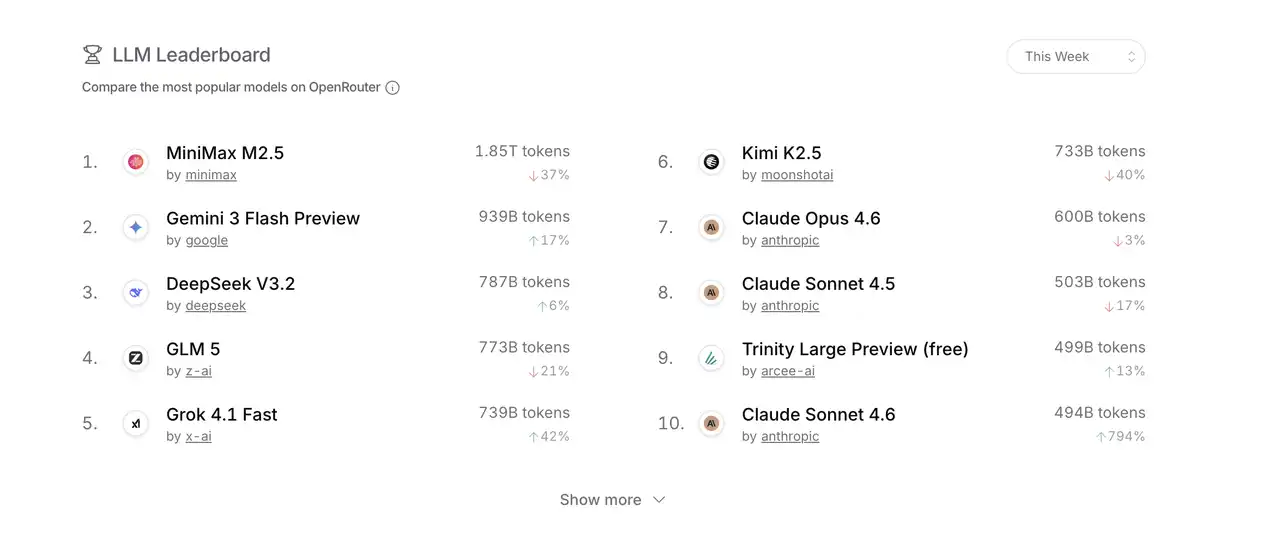
Latest data on February 26

This is no accident; a fuse has been lit.

Earlier this year, OpenClaw emerged, an open-source tool that truly allows AI to "work," capable of directly controlling computers, executing commands, and并行完成复杂工作流。Its GitHub stars surpassed 210,000 within weeks.

John, a finance professional, installed OpenClaw immediately and connected it to the Anthropic API to automatically monitor stock market information and provide trading signals. A few hours later, he stared at his account balance in disbelief: dozens of dollars, gone.

This is the new reality brought by OpenClaw. In the past, chatting with AI consumed a few thousand Tokens per conversation, with negligible cost. After integrating OpenClaw, the AI runs dozens of subtasks in the background, repeatedly calling context and iterating循环。Token consumption isn't linear; it's exponential. The bill is like a car accelerating with the hood open, the fuel gauge dropping, unstoppable.

A "clever trick"随即流传在 developer communities: use OAuth tokens to directly connect Anthropic or Google subscription accounts into OpenClaw, turning the monthly "unlimited" quota into free fuel for AI Agents. This is the method many developers adopted.

Official countermeasures随即到来。

On February 19, Anthropic updated its agreement, explicitly prohibiting the use of Claude subscription credentials for third-party tools like OpenClaw. To access Claude's functionality, one must use the API billing channel. Google更是大面积封禁了 subscription accounts connected to Antigravity and Gemini AI Ultra via OpenClaw.

"The world has long suffered under Qin," John随即投入了国产大模型的怀抱。

On OpenRouter, the国产大模型 MiniMax M2.5 scores 80.2% on software engineering tasks, while Claude Opus 4.6 scores 80.8%, a negligible difference. But the prices are worlds apart: the former costs $0.3 per million input Tokens, the latter $5, a difference of about 17 times.

John switched over. The workflow still ran, but the bill shrunk by an order of magnitude. This migration is happening simultaneously worldwide.

OpenRouter's COO, Chris Clark, put it bluntly: Chinese open-source models have captured a large market share because they account for an unusually high proportion of the agent workflows run by US developers.

Electricity Going Global

To understand the essence of Token出海, one must first understand the cost structure of a Token.

It seems light; one Token is roughly equal to 0.75 English words. An ordinary conversation with AI consumes only a few thousand Tokens. But when these Tokens stack up in trillions, the underlying physical reality becomes heavy.

Breaking down the cost of a Token, there are only two core components: computing power and electricity.

Computing power is the depreciation of GPUs. You buy an NVIDIA H100 for about thirty thousand dollars; its lifespan amortized over each inference is the depreciation cost. Electricity is the fuel for the continuous operation of data centers. A GPU at full load consumes about 700 watts, and加上冷却系统的开销, the annual electricity bill for a large AI data center can easily exceed hundreds of millions of dollars.

Now, map this physical process.

A US developer in San Francisco sends an API request. The data travels from California, via Pacific submarine cables, to a data center somewhere in China. The GPU cluster starts working; electricity flows from China's power grid to those chips. The inference is completed, and the results are sent back. The entire process也许只用了一两秒。

The electricity never leaves China's power grid, but the value of the electricity is delivered cross-border through Tokens.

There is something magical here that ordinary trade cannot achieve: Tokens have no physical form, do not need to go through customs, are not subject to tariffs, and are almost invisible in any current trade statistics. China exports a large amount of computing power and electricity services, but it is almost隐形 on official merchandise trade data.

Tokens have become derivatives of electricity. Token出海 is essentially electricity出海。

This also benefits from China's relatively low electricity prices, about 40% lower than the US on average. This is a physical cost difference that competitors cannot easily replicate.

Additionally, Chinese AI models have algorithmic and "involution" advantages.

DeepSeek V3's MoE architecture activates only a portion of parameters during inference. Independent tests show its inference cost is about 36 times lower than GPT-4o. MiniMax M2.5 similarly activates only 10B out of 229B total parameters.

On top of this is involution: Alibaba, ByteDance, Baidu, Tencent, Moonshot AI, Zhipu, MiniMax... over a dozen companies are trampling on each other on the same track. Prices have long fallen below reasonable profit margins; losing money to gain market share is already the industry norm.

Look closely, this is just like Chinese manufacturing going global, utilizing supply chain advantages and industry involution to drive down Token prices hard.

From Bitcoin to Token

Before Tokens, there was another form of electricity出海。

Around 2015, power station managers in Sichuan, Yunnan, and Xinjiang began to receive some strange visitors.

These people rented abandoned factory buildings, filled them with dense rows of machines, and powered them 24/7. The machines produced nothing but continuously solved a mathematical problem, occasionally calculating a Bitcoin from this endless equation.

This was the first-generation form of electricity出海: converting cheap hydropower and wind power, via the hash calculations of mining rigs, into globally circulating digital assets, which were then cashed out into dollars on exchanges.

The electricity never crossed any border, but the value of the electricity, embodied in Bitcoin, flowed to the global market.

During those years, Chinese computing power once accounted for over 70% of global Bitcoin mining算力。China's hydropower and coal power, in this roundabout way, participated in a global redistribution of capital.

In 2021, this came to an abrupt halt. Regulatory hammers fell, miners scattered, and算力 migrated to Kazakhstan, Texas, USA, and Canada.

But the logic itself never disappeared; it was just waiting for a new shell. Until ChatGPT emerged, large models became the new battlefield, the former Bitcoin mining farms transformed into AI data centers, mining rigs became computing GPUs, the once-produced Bitcoin became Tokens. The only constant is the electricity.

Bitcoin出海 and Token出海 are isomorphic in their underlying logic, but Tokens have more commercial value today.

Mining with rigs is pure mathematical calculation; the output, Bitcoin, is a financial asset whose value comes from scarcity and market consensus, having nothing to do with "what was calculated." The computing power itself is not productive; it's more like a byproduct of a trust mechanism.

Large model inference is different. GPUs consume electricity and output real cognitive services: code, analysis, translation, creativity. The value of a Token comes directly from its utility to the user. This is a deeper embedding. Once a developer's workflow relies on a certain model, the cost of switching increases over time.

Of course, there is another key difference: Bitcoin mining was驱逐出去的 by China, while Token出海 is being主动选择的 by global developers.

Token War

The submarine cable laid in 1858 represented the British Empire's sovereignty over the information highway. Whoever owned the infrastructure could define the rules of the game.

Token出海 is also an undeclared war, fraught with resistance.

Data sovereignty is the first wall. An API request from a US developer is processed by a Chinese data center; the data physically flows through China. For individual developers and small applications, this is not a problem. But for scenarios involving sensitive corporate data, financial information, or government compliance, this is a hard stop. This is why the penetration rate of Chinese models is highest in development tools and personal applications, with almost no presence in core enterprise systems.

The chip ban is the second wall. China's AI development faces export controls on NVIDIA's high-end GPUs. MoE architecture and algorithm optimization can only partially offset this disadvantage; the ceiling still exists.

But the current resistance is just the prologue. A larger battlefield is taking shape.

Tokens and AI models have become a new strategic dimension of博弈 between China and the US, no less important than semiconductors and the internet in the 20th century, or even closer to an older analogy: the space race.

In 1957, the Soviet Union launched Sputnik 1, shocking the United States, which随即启动 the Apollo program, pouring resources equivalent to hundreds of billions of dollars today to绝不落败 in the space race.

The logic of the AI hegemony race is strikingly similar, but its intensity will far exceed the space race. Space is, after all, physical; ordinary people don't feel it. AI渗透的是经济的毛细血管; behind every line of code, every contract, every government decision-making system, a certain country's large model could be running. Whose model becomes the default infrastructure option for global developers gains structural influence over the global digital economy无形中。

This is what truly makes Washington uneasy about China's Token出海。

When a developer's codebase, Agent workflow, and product logic are all built around the API of a certain Chinese model, the migration cost increases exponentially over time. By then, even if the US legislates restrictions, developers will resist with their feet, just as no programmer can abandon GitHub today.

Today's Token出海 might just be the opening chapter of this long game. Chinese large models don't claim to颠覆什么; they simply deliver services to every global developer with an API Key at a lower price.

This time, those laying the cables are the engineering teams writing code in Hangzhou, Beijing, and Shanghai, and the GPU clusters operating day and night in some southern province.

This hegemony has no countdown; it happens 24 hours a day, measured in Tokens, on the battlefield of every developer's terminal.


Criptos en tendencia

Preguntas relacionadas

QWhat is the core concept behind 'Token出海' (Token going global) as described in the article?

AThe core concept is that Chinese AI models are exporting computational power and electricity globally through the delivery of AI-generated tokens. The physical electricity never leaves China's grid, but its value is transmitted internationally via tokens, which represent AI inference services consumed by global developers.

QWhat key event in 2026 triggered a massive shift of global developers to Chinese AI models according to the article?

AThe release of OpenClaw, an open-source tool that allows AI to perform complex workflows and control computers, led to exponentially higher token consumption. When Western providers like Anthropic and Google banned its use with their subscription services, developers switched to cheaper, similarly capable Chinese models on platforms like OpenRouter.

QWhat are the two main physical cost components that determine the price of a token?

AThe two main cost components are computational power (the depreciation cost of GPUs like the H100 used for inference) and electricity (the power required to run the data centers and their cooling systems).

QHow does the article draw a parallel between the historical 'Bitcoin出海' (Bitcoin going global) and the current 'Token出海'?

AThe article states that both are forms of 'power export' where China's cheap electricity is converted into a globally traded digital asset (first Bitcoin, now AI tokens). However, Token出海 is seen as more valuable because the computation produces useful cognitive services (code, analysis) that create user dependency, unlike Bitcoin mining which was a purely mathematical process producing a financial asset.

QWhat does the article identify as the major potential obstacles or 'walls' for the continued expansion of Chinese AI token exports?

AThe major obstacles are data sovereignty concerns (sensitive foreign data physically flowing through Chinese data centers) and the chip ban (export controls on high-end NVIDIA GPUs limiting China's AI development ceiling).

Lecturas Relacionadas

Acciones A malheridas injustamente: Resiliencia, expectativas y confianza

En julio, las acciones tecnológicas globales se debilitaron repentinamente, afectando a mercados como Corea del Sur, Estados Unidos y Japón, lo que también presionó a los sectores tecnológicos de A-shares, con caídas consecutivas en el índice STAR 50 y el índice ChiNext. Sin embargo, este ajuste refleja principalmente la transmisión de riesgos externos, como la reducción del apalancamiento en las acciones coreanas, y no un cambio en los fundamentos. El mercado tecnológico chino es más diversificado que el de Corea del Sur, con narrativas duales: la cadena de suministro global de IA y la sustitución de importaciones en infraestructura de computación nacional. Los datos de ganancias en sectores clave como módulos ópticos y cables de fibra óptica siguen siendo sólidos, respaldando la lógica subyacente de la industria. Ante la volatilidad, el "equipo nacional" (fondos estatales) ha intervenido activamente, con anuncios de inversiones y recompras por cientos de miles de millones de yuanes por parte de empresas estatales, aseguradoras y casas de bolsa. Esto estabiliza la liquidez y las expectativas del mercado, enviando una señal de soporte político. Históricamente, estas intervenciones han coincidido con niveles de piso en el mercado. Más allá de la tecnología, otros sectores claves muestran fortaleza interna. El consumo se beneficia de una inflación al alza (IPC estable por encima del 1%) y signos de recuperación en sectores como el licor, con mejoras en inventarios. Los ciclos, liderados por el aluminio, tienen perspectivas de aumento de precios debido al equilibrio ajustado entre oferta y demanda global, altas ganancias y bajas valoraciones. Los activos financieros, como la banca, ofrecen dividendos estables. En resumen, la corrección tecnológica es un evento impulsado por factores externos. Con la acción estabilizadora del "equipo nacional" y la resiliencia de múltiples sectores (consumo, ciclos, finanzas), que cuentan con fundamentos sólidos y potencial de recuperación, se espera que el mercado de A-shares recupere su estabilidad.

marsbitHace 23 min(s)

Acciones A malheridas injustamente: Resiliencia, expectativas y confianza

marsbitHace 23 min(s)

Aún no llega la computadora cuántica, pero ya es un problema el 1,1 millón de bitcoins de Satoshi Nakamoto

Un problema de 1,1 millones de bitcoins de Satoshi surge antes de que lleguen los ordenadores cuánticos. Una herramienta de prueba de conocimiento cero permite migrar fondos de carteras modernas antes de un ataque cuántico, en tan solo 243 ms. Sin embargo, los antiguos bitcoins extraídos antes de 2012, incluidos aproximadamente 1,1 millones de BTC pertenecientes a Satoshi Nakamoto almacenados en direcciones P2PK, no pueden ser rescatados con esta técnica. Estas direcciones antiguas carecen de una ruta de derivación jerárquica (HD), lo que las hace criptográficamente inaccesibles para la solución. Esto plantea un dilema político, no técnico, para la comunidad Bitcoin. Se discuten cuatro opciones, todas problemáticas: 1) No actuar y permitir el robo, desestabilizando el mercado; 2) Congelar coercitivamente los fondos (como sugiere la propuesta BIP-361), violando el principio de propiedad; 3) Limitar severamente los retiros de direcciones vulnerables para ralentizar una venta masiva; o 4) Redistribuir forzosamente los fondos "abandonados" mediante un hard fork, rompiendo la inmutabilidad del libro mayor. El mercado ya está reaccionando a esta incertidumbre de gobernanza. Instituciones como Jefferies han reducido su exposición a Bitcoin citando este riesgo, a pesar de que los ordenadores cuánticos prácticos aún no existen. El verdadero peligro inmediato no es el hardware cuántico, sino la crisis de fe dentro de la comunidad sobre cómo proteger el valor de Bitcoin sin traicionar sus principios fundamentales de propiedad y código inquebrantable.

marsbitHace 34 min(s)

Aún no llega la computadora cuántica, pero ya es un problema el 1,1 millón de bitcoins de Satoshi Nakamoto

marsbitHace 34 min(s)

¿Dónde está el campo de batalla principal del próximo mercado alcista? La respuesta se esconde en estos dos tipos de activos

**¿Cuál será el foco de la próxima carrera alcista en criptomonedas? La respuesta está en estos dos tipos de activos.** El mercado de criptomonedas muestra signos de tocar fondo, con Bitcoin subiendo y fondos ETF entrando nuevamente. La narrativa central del próximo ciclo alcista será la **convergencia de las finanzas tradicionales y las finanzas en cadena (on-chain)**, impulsada por casos de uso reales como stablecoins, tokenización de activos, operaciones 24/7 y liquidación instantánea. Esta convergencia crea oportunidades de inversión en dos frentes: 1. **Aplicaciones nativas de criptofinanzas con ingresos reales**: Como **Hyperliquid (HYPE)**, una cadena de derivados cuyo volumen incluye ya activos tradicionales. Su ventaja reside en un modelo de negocio sostenible (con ingresos recurrentes) y una economía de token sólida, donde el 99% de los ingresos se usa para recomprar y quemar HYPE. 2. **Empresas tradicionales maduras que adoptan infraestructura cripto**: Ejemplificado por **Robinhood (HOOD)**, que acaba de lanzar su propia blockchain (Robinhood Chain) para operar con acciones tokenizadas y DeFi en 120 países. Su escala y compromiso real le dan una ventaja significativa sobre los meros proyectos piloto. En resumen, los mayores ganadores de la próxima fase serán aquellos proyectos y empresas que estén impulsando activamente la fusión de ambos mundos, aprovechando las ventajas de la tecnología blockchain para transformar los mercados financieros globales.

Foresight NewsHace 38 min(s)

¿Dónde está el campo de batalla principal del próximo mercado alcista? La respuesta se esconde en estos dos tipos de activos

Foresight NewsHace 38 min(s)

El camino lleno de obstáculos de Clarity: el proyecto de ley de criptomonedas en la lucha por un compromiso bipartidista en EE.UU.

Los legisladores estadounidenses buscan avanzar la ley Clarity, una legislación bipartidista para estructurar el mercado de criptoactivos, pero el camino está lleno de obstáculos. Tras un acuerdo inicial en el Comité Bancario del Senado en enero, vetado por el CEO de Coinbase, el proyecto se reanudó en mayo tras un compromiso sobre los rendimientos ("yield"). Sin embargo, los demócratas condicionan su apoyo a la inclusión de fuertes cláusulas éticas para los funcionarios electos, una demanda no resuelta que llevó a una votación partidista en el Comité Agrícola. En julio, los republicanos presionan para una votación en el pleno del Senado, pero las divisiones persisten. Temas como la protección al consumidor, el financiamiento ilícito y las exenciones para desarrolladores generan desacuerdos tanto entre partidos como dentro del Partido Republicano. Aunque existe consenso sobre la necesidad de una ley de estructura de mercado, el compromiso político es difícil. Reuniones recientes con la Casa Blanca buscan un lenguaje ético aceptable, pero algunos senadores demócratas son escépticos. Los objetivos a corto plazo de la comunidad cripto incluyen una acción simbólica en el Senado antes del receso de agosto, sentar las bases para una posible ley en 2026 y trabajar en un marco de compromiso que combine ética, rendimientos y otros aspectos clave. A pesar del terreno difícil, el proceso legislativo tradicional continúa.

marsbitHace 47 min(s)

El camino lleno de obstáculos de Clarity: el proyecto de ley de criptomonedas en la lucha por un compromiso bipartidista en EE.UU.

marsbitHace 47 min(s)

Trading

Spot

Artículos destacados

Cómo comprar CORE

¡Bienvenido a HTX.com! Hemos hecho que comprar CORE (CORE) sea simple y conveniente. Sigue nuestra guía paso a paso para iniciar tu viaje de criptos.Paso 1: crea tu cuenta HTXUtiliza tu correo electrónico o número de teléfono para registrarte y obtener una cuenta gratuita en HTX. Experimenta un proceso de registro sin complicaciones y desbloquea todas las funciones.Obtener mi cuentaPaso 2: ve a Comprar cripto y elige tu método de pagoTarjeta de crédito/débito: usa tu Visa o Mastercard para comprar CORE (CORE) al instante.Saldo: utiliza fondos del saldo de tu cuenta HTX para tradear sin problemas.Terceros: hemos agregado métodos de pago populares como Google Pay y Apple Pay para mejorar la comodidad.P2P: tradear directamente con otros usuarios en HTX.Over-the-Counter (OTC): ofrecemos servicios personalizados y tipos de cambio competitivos para los traders.Paso 3: guarda tu CORE (CORE)Después de comprar tu CORE (CORE), guárdalo en tu cuenta HTX. Alternativamente, puedes enviarlo a otro lugar mediante transferencia blockchain o utilizarlo para tradear otras criptomonedas.Paso 4: tradear CORE (CORE)Tradear fácilmente con CORE (CORE) en HTX's mercado spot. Simplemente accede a tu cuenta, selecciona tu par de trading, ejecuta tus trades y monitorea en tiempo real. Ofrecemos una experiencia fácil de usar tanto para principiantes como para traders experimentados.

414 Vistas totalesPublicado en 2024.12.13Actualizado en 2026.06.02

Cómo comprar CORE

Discusiones

Bienvenido a la comunidad de HTX. Aquí puedes mantenerte informado sobre los últimos desarrollos de la plataforma y acceder a análisis profesionales del mercado. A continuación se presentan las opiniones de los usuarios sobre el precio de CORE (CORE).

活动图片












