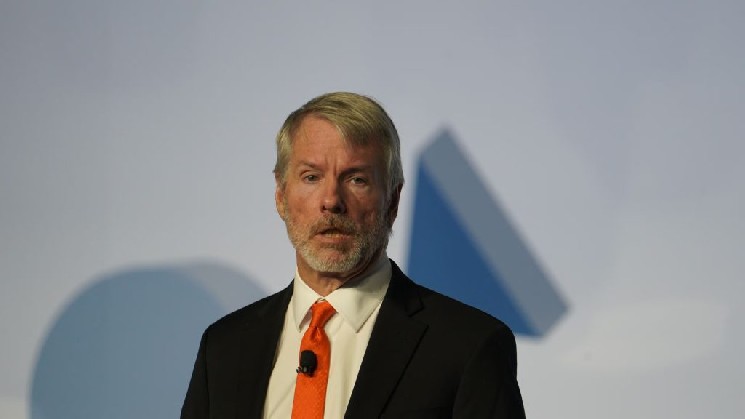
The First Fed Chair with Crypto Holdings? Kevin Warsh Discloses at Least 20 Crypto Investments Including Solana and dYdX

marsbitPublicado a 2026-04-15Actualizado a 2026-04-15

Resumen

Kevin Warsh, a former Federal Reserve governor and nominee for Fed Chair, has disclosed at least 20 cryptocurrency-related investments in a 69-page financial filing submitted to the U.S. Office of Government Ethics. The disclosure, required ahead of his Senate confirmation hearing, reveals indirect holdings in major crypto projects including Solana, dYdX, Optimism, Polychain Capital, Dapper Labs, and Lightning Network, among others. These investments are held through various venture funds and special purpose vehicles. Warsh and his wife, Jane Lauder, have a combined net worth of at least $192 million. While the crypto holdings are described as small, risk-focused positions, they span multiple sectors: L1 and L2 blockchains, DeFi protocols, NFT platforms, payment systems, and AI-integrated chains. Warsh has publicly endorsed Bitcoin in the past, calling it “a very good police for policy” and “the new gold for those under 40.” If confirmed, he would become the first Fed Chair with direct exposure to crypto venture investments. His confirmation hearing is scheduled for April 21, though political opposition remains a potential hurdle.

Author: Claude, Deep Tide TechFlow

Deep Tide Guide: Kevin Warsh, nominated by Trump for Fed Chair, submitted a 69-page financial disclosure revealing combined assets with his wife of at least $192 million, including indirect investments in at least 20 crypto-related entities such as Solana, dYdX, Polychain Capital, Optimism, and Dapper Labs. If confirmed, he would become the first Fed Chair with exposure to crypto venture capital. The confirmation hearing is scheduled for April 21st, but Republican Senator Tillis still threatens to vote no due to the Powell investigation stalemate.
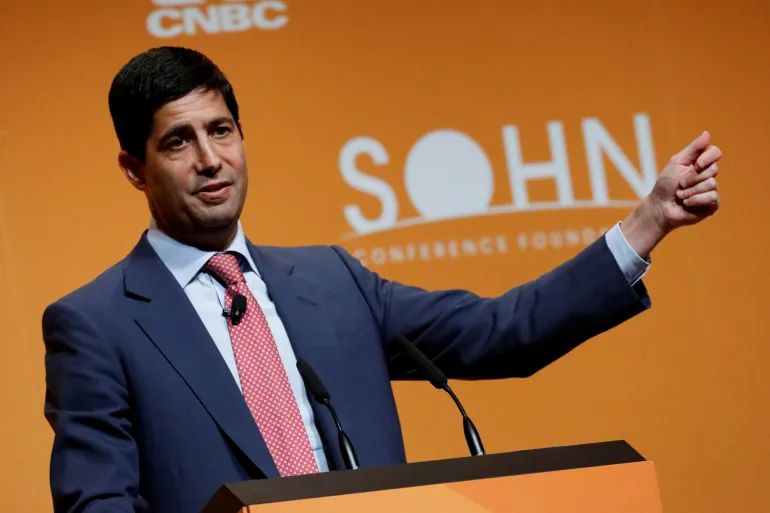
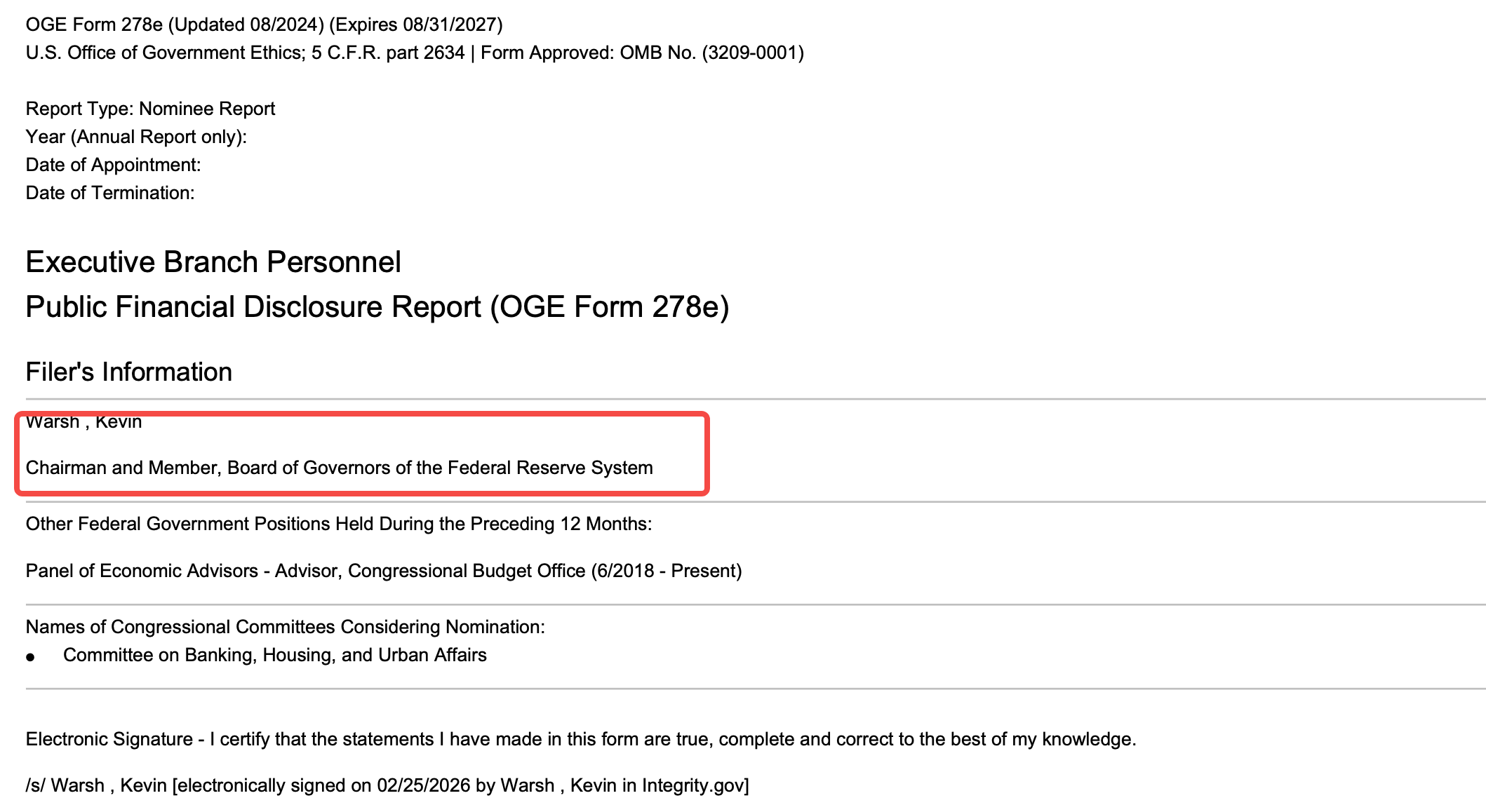
Warsh's crypto holdings list emerged through a 69-page government ethics document.

Fed Chair nominee Kevin Warsh submitted his financial disclosure to the U.S. Office of Government Ethics (OGE) on April 14th, the final procedural step before the Senate confirmation hearing. The document shows that Warsh and his wife Jane Lauder have combined assets of approximately $192 million, potentially more. But what truly captured the crypto industry's attention were the over twenty crypto and Web3-related holdings buried deep within the file.
Warsh had previously stated clearly in a public interview at the Hoover Institution: Bitcoin doesn't make him uncomfortable; he considers it an important asset that can help policymakers judge whether their decisions are correct. Now, the disclosure proves he's gone beyond mere words—his money is indeed on this track.

At Least 20 Crypto Entities: Nearly Full Coverage from L1 Public Chains to DeFi Protocols

Warsh's crypto exposure is distributed across multiple venture capital fund structures. Through the AVGF I fund, he indirectly holds interests in Solana, Optimism, and the Lightning Network; through DCM Investments 10 LLC, he holds stakes in dYdX and Polychain Capital, with the same vehicle also including dozens of fintech and Web3 projects like Compound, Lighter, Lemon Cash, and Blast (an Ethereum L2 protocol).

Under the AVF series of funds, crypto-related holdings also appear including Dapper Labs, Deso, Eulith, Onjuno, Ridian, Friends With Benefits, and Zero Gravity (an L2 AI blockchain platform). Warsh also directly holds shares worth $1,001 to $15,000 in Web3 company Metatheory Inc. through Founder Bets Master SPV LLC.
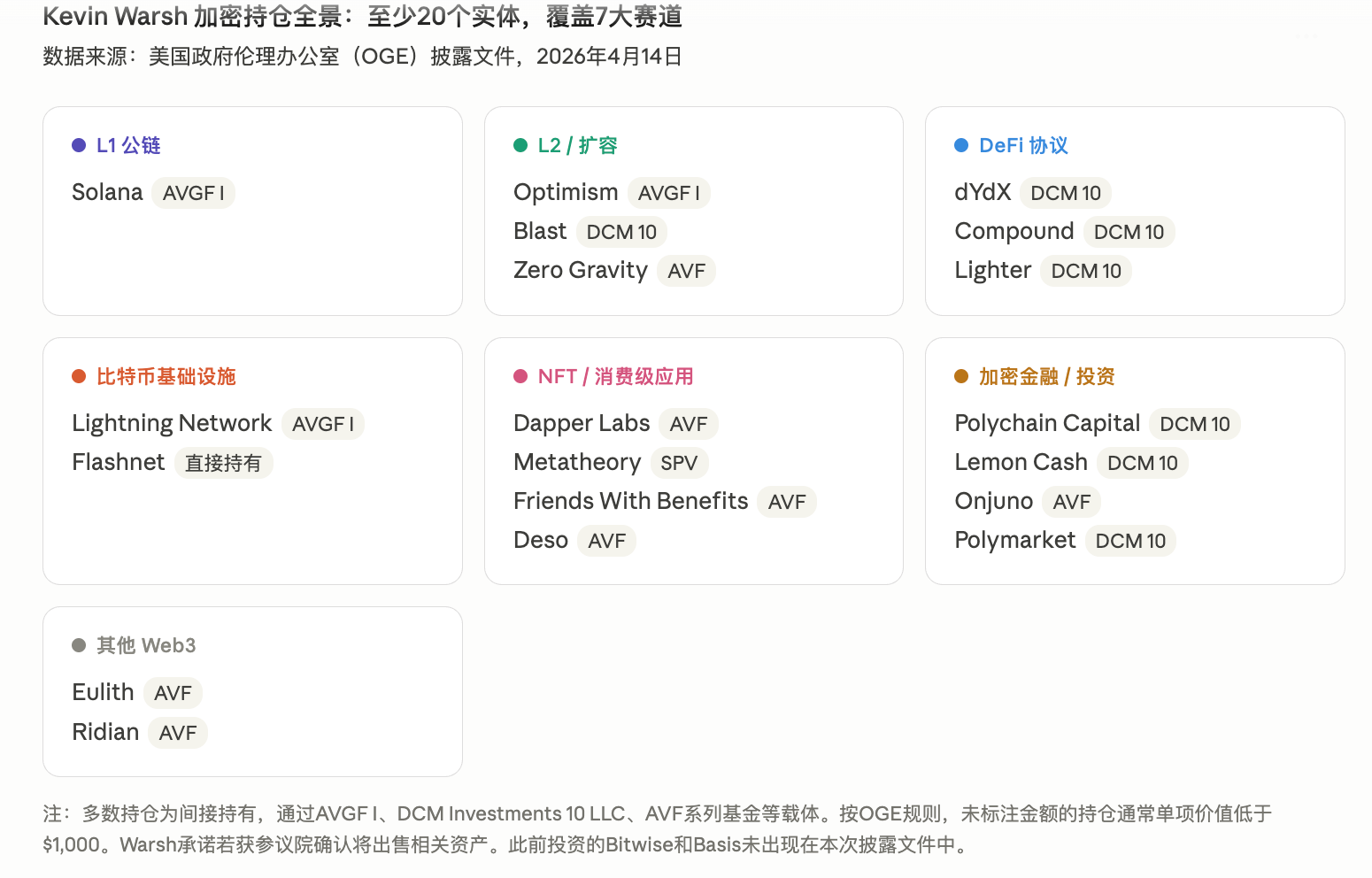
Furthermore, according to Bitcoin Magazine, Warsh also holds equity in Bitcoin payments startup Flashnet, a company positioned as a Bitcoin merchant payment system similar to the Lightning Network. Warsh had previously invested in crypto index management company Bitwise and algorithmic stablecoin project Basis, although these investments did not appear in this disclosure.

In terms of coverage, this holdings list touches nearly every major sector of the crypto industry: L1 public chains (Solana), L2 scaling (Optimism, Blast), DeFi protocols (dYdX, Compound), NFT infrastructure (Dapper Labs), prediction markets (Polymarket), Bitcoin payments (Flashnet, Lightning Network), and even social tokens (Friends With Benefits) and AI blockchain (Zero Gravity).

However, according to OGE rules, holdings without specified amounts typically mean the individual item is valued below $1,000, indicating these crypto positions are mostly small risk bets rather than concentrated positions.

Full Picture of $192 Million in Assets: Druckenmiller Advisory Fees, Juggernaut Fund & Opaque Holdings

Crypto holdings are just one corner of Warsh's vast asset portfolio.

The two largest investments in the file are two positions in the Juggernaut Fund LP, each marked as "over $50 million," but the underlying assets are not disclosed due to confidentiality agreements. Warsh has committed to selling all of these if confirmed. Additionally, about twenty-plus THSDFS LLC series holdings, with individual amounts up to $5 million, also have undisclosed underlying assets due to confidentiality clauses.

Regarding income, Warsh received a $10.2 million advisory fee from the Duquesne Family Office of Wall Street legend Stanley Druckenmiller. He also received $1.55 million from GoldenTree Asset Management, $750,000 from Cerberus Capital Management in advisory fees, and a $750,000 speaking fee from Brevan Howard—all institutions with digital asset trading businesses.

OGE certifying official Heather Jones noted in the review opinion that once Warsh completes the promised asset sales, he will meet the compliance requirements of the Ethics in Government Act.

Warsh's wife, Jane Lauder, is the granddaughter of Estée Lauder's founder, with Forbes estimating her personal net worth at approximately $1.9 billion.

Once Called Bitcoin a "Good Police for Policy," Now His Holdings Confirm His Judgment

Warsh's attitude toward Bitcoin is unique among past and current senior Fed officials.

As early as 2011, Warsh saw the Bitcoin whitepaper from Marc Andreessen at a dinner. In 2018, he wrote in The Wall Street Journal that Bitcoin could become a "sustainable store of value" similar to gold. In 2021, he stated on CNBC that for people under 40, Bitcoin is their new gold.

In 2025, in a Hoover Institution interview, he gave his most complete statement to date: Bitcoin is not a substitute for the dollar, but it can be a very good police for policy. He also characterized software development in the crypto industry as part of U.S. economic competitiveness.

For the crypto industry, Warsh's disclosure is a double-edged signal. On one hand, a Fed Chair with firsthand venture capital exposure to DeFi and blockchain infrastructure may understand the nuances of this technology better than his predecessors; on the other hand, forced sales and recusal obligations may limit his ability to translate these sympathetic attitudes into concrete actions early in his tenure.


Preguntas relacionadas

QWho is Kevin Warsh and what significant financial disclosure did he make?

AKevin Warsh is a nominee for the position of Federal Reserve Chair. He submitted a 69-page financial disclosure to the U.S. Office of Government Ethics, revealing a combined net worth of at least $192 million with his wife and indirect investments in at least 20 crypto-related entities.

QWhat are some of the major crypto projects and companies that Kevin Warsh has indirect investments in?

AHis disclosed crypto investments include Solana, dYdX, Polychain Capital, Optimism, Dapper Labs, Compound, Lightning Network, Blast, and Flashnet, covering sectors like L1 blockchains, L2 scaling, DeFi, NFTs, and Bitcoin payments.

QWhat is the significance of Kevin Warsh potentially becoming the Federal Reserve Chair with these crypto holdings?

AIf confirmed, Kevin Warsh would be the first Federal Reserve Chair to have a venture capital exposure to the cryptocurrency market, indicating a potential for a more nuanced understanding of the technology within the highest levels of U.S. monetary policy.

QWhat was Kevin Warsh's previous public stance on Bitcoin and cryptocurrency?

AWarsh has publicly stated that Bitcoin does not make him uneasy, views it as an important asset that can act as a 'good police' for policy makers to judge their decisions, and has referred to it as 'new gold' for people under 40.

QWhat are the two largest investments in Warsh's portfolio and what is the plan for them if he is confirmed?

AThe two largest investments are two positions in the Juggernaut Fund LP, each valued at 'over $50 million'. Warsh has committed to divest these holdings, along with other specified assets, if his nomination is confirmed to comply with government ethics rules.

Lecturas Relacionadas

NEAR planea distribuir 330,000 tokens en un airdrop, apostando a que su TVL supere los 70 millones de dólares

NEAR Protocol ha lanzado oficialmente su programa de incentivos Near@3.33. Este programa está diseñado para usuarios de la función de ejecución de cadena cruzada privada "Confidential Intents". Cuando el TVL total de Confidential Intents alcance los 70 millones de dólares, se activará una instantánea (snapshot) y se distribuirán las primeras 333,333 tokens "hito" a las cuentas elegibles. Para calificar, los usuarios deben haber realizado al menos una transacción "Confidential" en near.com y mantener un saldo superior a $100 en activos dentro de Confidential. El nivel de actividad influirá en la asignación final, con un límite del 2% del fondo por cartera. Actualmente, el TVL de Confidential Intents supera los 20.69 millones de dólares, por lo que necesita crecer un poco más del triple para alcanzar el objetivo. Las tokens "hito" distribuidas estarán bloqueadas y solo podrán convertirse 1:1 a tokens NEAR cuando el precio promedio ponderado por volumen (VWAP) de NEAR se mantenga en o por encima de $3.33 durante tres días consecutivos. Confidential Intents, lanzado a finales de febrero de 2026, es una capa de ejecución privada construida sobre el protocolo NEAR Intents. Su objetivo es proteger a los usuarios de problemas como MEV, front-running o fugas de estrategia al realizar transacciones entre cadenas. NEAR planea lanzar más rondas de incentivos en el futuro, con condiciones de activación que aumentarán junto con la participación de la comunidad.

Foresight NewsHace 1 hora(s)

NEAR planea distribuir 330,000 tokens en un airdrop, apostando a que su TVL supere los 70 millones de dólares

Foresight NewsHace 1 hora(s)

El mercado se ajusta tras la financiación de 84.700 millones de dólares de Google, y las valoraciones de IA empiezan a mirar la velocidad de recuperación de la inversión

TL;DR: El mercado está reevaluando la inversión en IA, pasando de una narrativa de software de alto crecimiento a un ciclo de infraestructura de activos pesados con altos gastos de capital. El anuncio de Alphabet de una financiación de 84.750 millones de dólares y su mayor guía de gasto de capital para 2026 (180.000-190.000 millones) han centrado la atención en la eficiencia del capital, la velocidad de recuperación de la inversión y las fuentes de financiación. La demanda de capital se extiende más allá de los gigantes tecnológicos a empresas de modelos (OpenAI, Anthropic), operadores de centros de datos y empresas de servicios públicos eléctricos. Se estima que cinco grandes tecnológicas gastarán unos 750.000 millones de dólares en centros de datos de IA en 2026. Esta enorme necesidad de financiación hace que los inversores presten más atención al coste del capital, los flujos de caja libres y la dilución. La lógica de valoración ha cambiado: de premiar el crecimiento y la narrativa futura a priorizar visibilidad de ingresos, contratos a largo plazo y conversión eficiente del capital en flujo de caja. Esto ha provocado una revaluación y divergencia dentro del sector, con mayor presión sobre las acciones de software de IA con valuaciones elevadas y un soporte relativo para activos de infraestructura más tangibles. La clave a futuro será si los mayores gastos de capital se traducen en un crecimiento de ingresos suficiente para cubrir los costes y generar rentabilidad, y si los mercados pueden absorber las continuas necesidades de financiación sin aumentar significativamente el coste del capital.

marsbitHace 1 hora(s)

El mercado se ajusta tras la financiación de 84.700 millones de dólares de Google, y las valoraciones de IA empiezan a mirar la velocidad de recuperación de la inversión

marsbitHace 1 hora(s)

Orbs Lanza Infraestructura Institucional de Trading DeFi

Hoy, Orbs, la infraestructura blockchain de Capa 3 descentralizada para operaciones sofisticadas en cadena, lanzó Orbs Institutional. Esta nueva oferta brinda a mesas de trading, empresas OTC, tesorerías, custodios y plataformas financieras acceso directo a su infraestructura de ejecución en cadena. La tecnología, que desde 2023 ha manejado más de $2,500 millones en volumen de operaciones al contado en más de 10 redes blockchain, ahora está disponible directamente para actores institucionales, habiendo estado previamente accesible a través de plataformas como PancakeSwap y SushiSwap. El núcleo de la oferta es Liquidity Hub, el protocolo de agregación de liquidez de Orbs, que obtiene liquidez de creadores de mercado profesionales y exchanges descentralizados a través de una capa privada de RFQ, diseñada para mejorar la calidad de ejecución y reducir la exposición a MEV y front-running. Las instituciones también tendrán acceso a herramientas de ejecución como dTWAP, dLIMIT y dSLTP. Los activos permanecen bajo control del cliente durante todo el ciclo de ejecución, utilizando infraestructura de custodia existente compatible con EIP-712. Orbs Institutional ofrece dos vías principales de integración: conexión directa mediante APIs para clientes institucionales, e integración white-label o co-branded para custodios, exchanges y otros proveedores. La empresa anticipa una mayor demanda de infraestructura de ejecución transparente, automatizada y con autocustodia, a medida que crece la participación institucional en los mercados de activos digitales, marcando la próxima fase de adopción de DeFi.

TheNewsCryptoHace 1 hora(s)

Orbs Lanza Infraestructura Institucional de Trading DeFi

TheNewsCryptoHace 1 hora(s)

Trading

Spot
Futuros

Artículos destacados

Cómo comprar DYDX

¡Bienvenido a HTX.com! Hemos hecho que comprar dYdX (DYDX) sea simple y conveniente. Sigue nuestra guía paso a paso para iniciar tu viaje de criptos.Paso 1: crea tu cuenta HTXUtiliza tu correo electrónico o número de teléfono para registrarte y obtener una cuenta gratuita en HTX. Experimenta un proceso de registro sin complicaciones y desbloquea todas las funciones.Obtener mi cuentaPaso 2: ve a Comprar cripto y elige tu método de pagoTarjeta de crédito/débito: usa tu Visa o Mastercard para comprar dYdX (DYDX) al instante.Saldo: utiliza fondos del saldo de tu cuenta HTX para tradear sin problemas.Terceros: hemos agregado métodos de pago populares como Google Pay y Apple Pay para mejorar la comodidad.P2P: tradear directamente con otros usuarios en HTX.Over-the-Counter (OTC): ofrecemos servicios personalizados y tipos de cambio competitivos para los traders.Paso 3: guarda tu dYdX (DYDX)Después de comprar tu dYdX (DYDX), guárdalo en tu cuenta HTX. Alternativamente, puedes enviarlo a otro lugar mediante transferencia blockchain o utilizarlo para tradear otras criptomonedas.Paso 4: tradear dYdX (DYDX)Tradear fácilmente con dYdX (DYDX) en HTX's mercado spot. Simplemente accede a tu cuenta, selecciona tu par de trading, ejecuta tus trades y monitorea en tiempo real. Ofrecemos una experiencia fácil de usar tanto para principiantes como para traders experimentados.

203 Vistas totalesPublicado en 2024.12.13Actualizado en 2026.06.02

Cómo comprar DYDX

Discusiones

Bienvenido a la comunidad de HTX. Aquí puedes mantenerte informado sobre los últimos desarrollos de la plataforma y acceder a análisis profesionales del mercado. A continuación se presentan las opiniones de los usuarios sobre el precio de DYDX (DYDX).

活动图片