Latest Stablecoin Report: Real Distribution and Flow Are Far More Important Than Supply

marsbitPublicado a 2026-02-27Actualizado a 2026-02-27

Resumen

A new report on stablecoins emphasizes that real-world distribution, holder concentration, and on-chain activity are more meaningful than total supply figures. While the total supply of the top 15 stablecoins reached $304 billion in January 2026, a 49% year-on-year increase, the data reveals deeper insights. USDT and USDC dominate with 89% market share. However, challenger stablecoins like USDS, PYUSD, and RLUSD saw explosive growth. On-chain analysis shows 800 billion held on centralized platforms, while whale wallets hold $39 billion. Concentration is extreme for newer stablecoins; for example, the top 10 wallets hold 90% of USDS and 99% of USDF. Monthly transfer volume hit $10.3 trillion in January 2026, with USDC processing nearly five times more volume than USDT despite a smaller supply. Activity is heavily concentrated in DeFi: $5.9 trillion in DEX liquidity operations and $1.3 trillion in flash loans. Velocity varies widely: USDC on Base moves 14x daily, while large portions of USDT on Ethereum remain idle. The data shows stablecoins are primarily used for trading, leverage, and liquidity, not just as passive holdings.

Author | @Dune

Compiled by | Odaily Planet Daily (@OdailyChina)

Translator | DingDang (@XiaMiPP)

Editor's Note: While the market is still accustomed to using "total supply" to summarize the stablecoin world, a set of more granular data is revealing another layer of reality. A single supply figure can only answer "how much," but it cannot explain "who holds it," "how it flows," or "why it stays." When we observe supply scale, holding concentration, on-chain circulation velocity, and specific activity categories on the same map, what we see is no longer a static stock but a dynamic structure of how capital migrates, settles, leverages, and reprices on-chain.

This perspective is important because it may correct our intuitive judgments about the past year. The crypto market's weakness and the strong performance of U.S. stocks form a stark contrast. The panic amplified by whales selling and price retracements easily gives the impression that capital is fleeing the crypto world. However, the on-chain data presented in this article, along with signals released by Circle's recent financial report, suggest that the funds may not have disappeared; they may have just temporarily withdrawn from high-volatility risk assets. At the very least, on-chain data proves they are entering incentive-based activities rather than being used for trading demand.
Everyone quotes that supply number. It appears in every report, every earnings call, and every policy hearing. But beyond "a circulating scale of over $300 billion," how much do we really know about stablecoins?

Who holds them? How concentrated are the holdings? How fast do they circulate, and on which chains are they mainly active? What are they actually used for—as DeFi liquidity, payment tools, or simply "cash equivalents" for parking funds?

Meta just announced plans to integrate third-party stablecoin payments into its platform; the OCC (Office of the Comptroller of the Currency) approved a national trust bank charter for Stablecoin; Payoneer announced stablecoin functionality for 2 million businesses; Anchorage Digital launched compliant stablecoin services for non-U.S. banks. Institutions and regulators are accelerating their entry, and the answers they need clearly go beyond just a supply number.

We used the latest stablecoin dataset released by Dune—developed in collaboration with Steakhouse Financial—to answer some of these questions. Here are the results revealed by the data.

Supply Overview

As of January 2026, the fully diluted supply of the top 15 stablecoins on EVM, Solana, and Tron reached $304 billion, a year-on-year increase of 49%. Tether's USDT ($197 billion) and Circle's USDC ($73 billion) still dominate with an 89% market share.

Looking at chain distribution, Ethereum carries $176 billion (58%), Tron $84 billion (28%), Solana $15 billion (5%), and BNB Chain $13 billion (4%). Even though the total supply has nearly doubled, this on-chain distribution structure has seen almost no significant change over the past year.
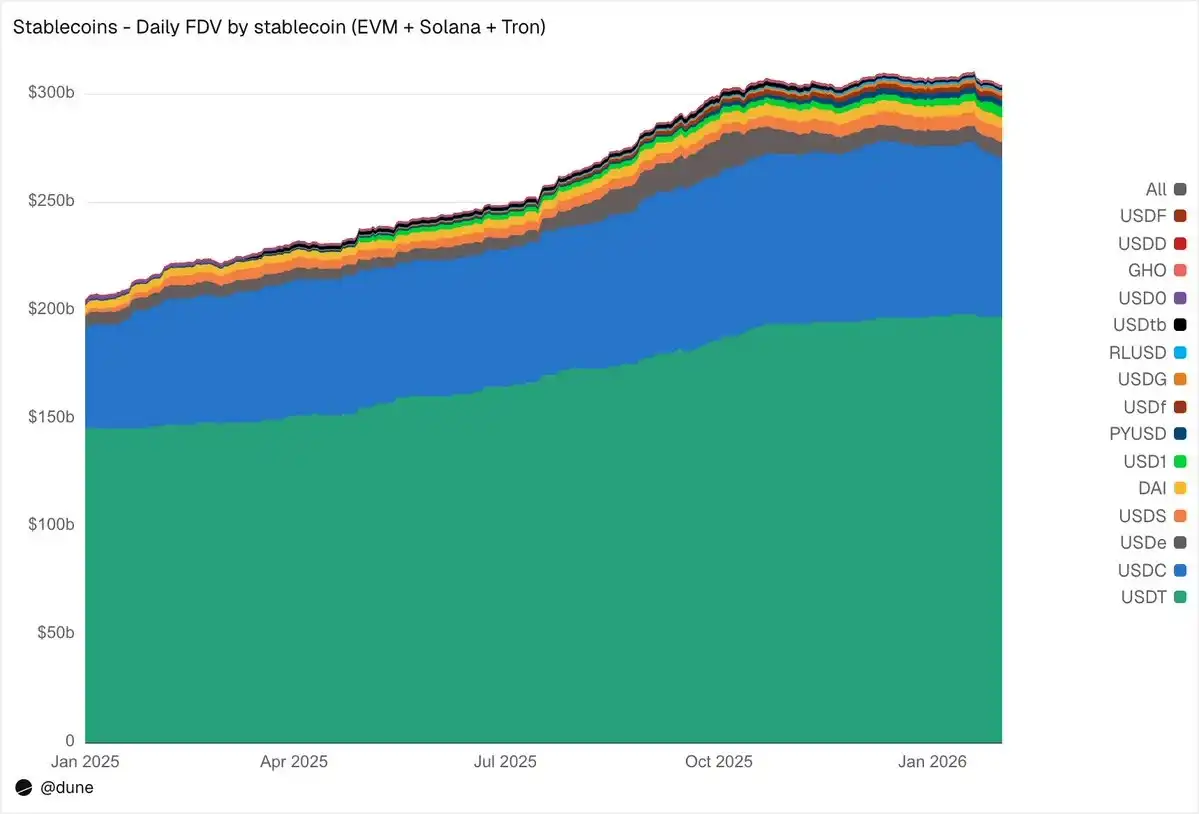
But beneath the top two stablecoins, 2025 was a year of challenger rise. USDS (Sky/MakerDAO) grew 376% to $6.3 billion; PYUSD (PayPal) grew 753% to $2.8 billion; RLUSD (Ripple) jumped from $58 million to $1.1 billion, a staggering increase of 1803%; USDG expanded 52 times; USD1 grew from zero to $5.1 billion.

Of course, not all challengers moved in the same direction. USD0 fell 66%; Ethena's USDe nearly tripled at its October peak, ending the year up 23%. Even so, the competitive layer beneath USDT and USDC has seen a significant increase in the number of competitors.

Who Holds Them?

Most stablecoin datasets can only tell you the total supply. Because our dataset tracks balances at the wallet level and incorporates address labels, we can answer a more critical question: Who is holding these stablecoins?
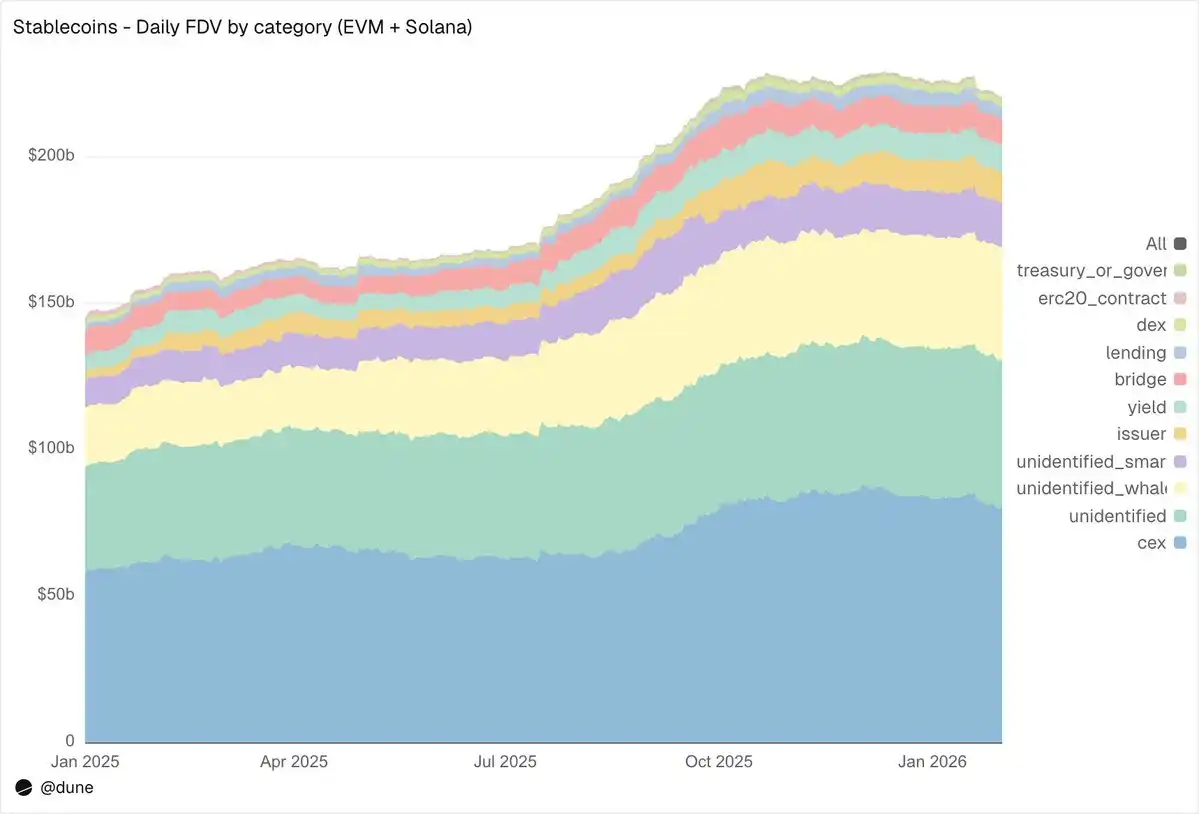
In the EVM and Solana ecosystems, centralized exchanges are currently the largest identified category, holding $80 billion, up from $58 billion a year ago. Stablecoins are, first and foremost, the infrastructure for exchange trading and settlement.

Whale wallets hold $39 billion; holdings in yield protocols almost doubled to $9.3 billion, reflecting the growth of on-chain yield strategies; issuer addresses—including treasuries and minting/burning contracts—jumped from $2.2 billion to $10.2 billion, a 4.6x increase, directly reflecting the scale of new supply entering the market.

Regarding label quality: Only 23% of the supply is in completely unidentified addresses. For on-chain data, this is a fairly high identification rate—and it is crucial for understanding where stablecoin risk is actually distributed.

172 Million Holders, But Extremely Concentrated

As of February 2026, a total of 172 million unique addresses held at least one of these 15 stablecoins. USDT accounts for 136 million, USDC for 36 million, and DAI for 4.7 million. The distribution of these three stablecoins is very wide: The top 10 wallets hold only 23%–26% of the supply, with an HHI (Herfindahl-Hirschman Index, where 0 represents perfect dispersion and 1 represents a single holder) below 0.03.
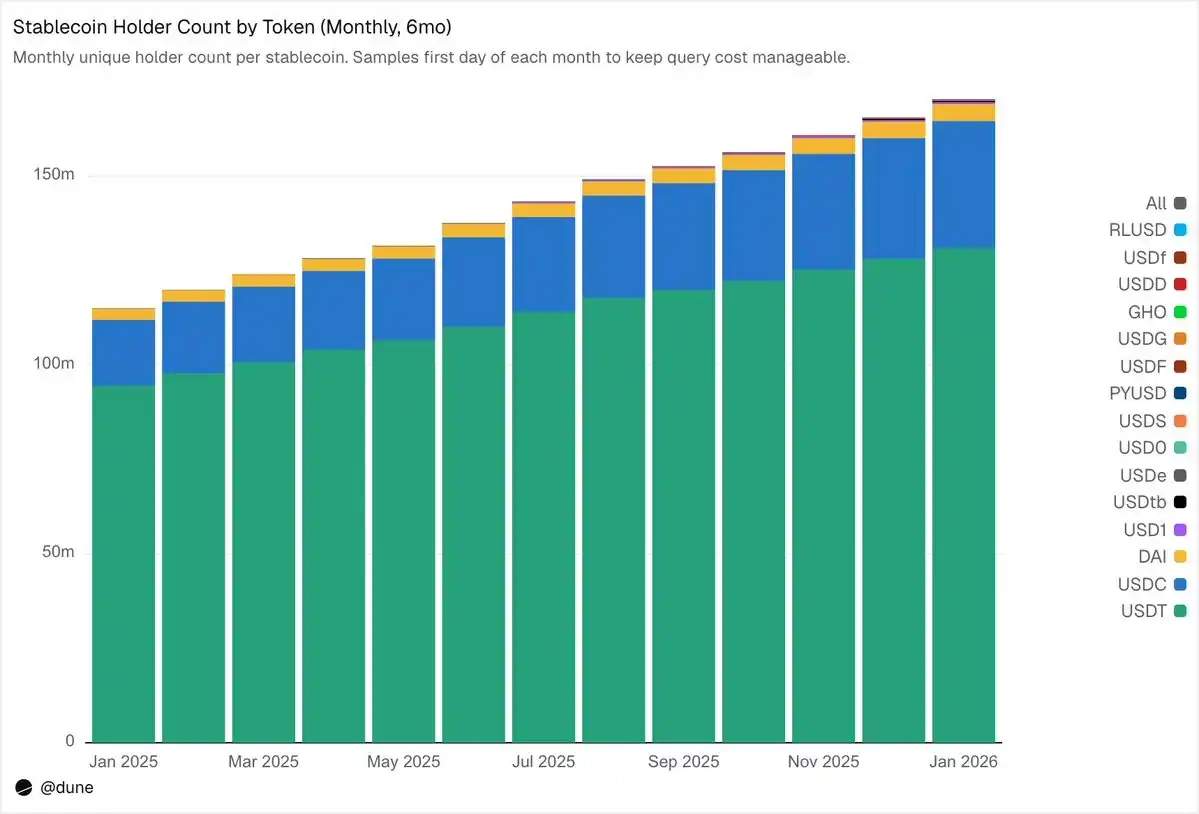
Other stablecoins present a completely different picture. The top 10 wallets often control 60% to 99% of the supply. Taking USDS as an example, although its circulating scale is $6.9 billion, 90% of it is concentrated in 10 wallets (HHI 0.48). USDF's concentration is even higher, with the top 10 addresses holding 99% of the supply (HHI 0.54). As for USD0, it almost reaches an extreme: again, 99% is concentrated in the top 10 wallets, but the HHI is as high as 0.84, meaning even within these top ten, the supply is dominated by one or two addresses.

This does not mean these stablecoins are inherently flawed—some projects are relatively new, and some are designed for institutional clients from the start. But it does mean their "supply" numbers cannot be interpreted in the same way as USDT or USDC. Holding concentration directly impacts de-pegging risk, liquidity depth, and whether the so-called "supply scale" represents real organic demand or merely reflects the allocation behavior of a few large holders. This kind of analysis is only possible when you have the balance data of every holder, not just the aggregate supply derived from minting/burning events.

January 2026: Transfer Volume $10.3 Trillion

In January 2026, the total transfer volume of stablecoins within the EVM, Solana, and TRON ecosystems reached $10.3 trillion, more than double that of January 2025.

The on-chain distribution contrasts sharply with the supply structure: Base led with $5.9 trillion, despite having a supply of only $4.4 billion; Ethereum had $2.4 trillion; Tron had $682 billion; Solana had $544 billion; BNB Chain had $406 billion.
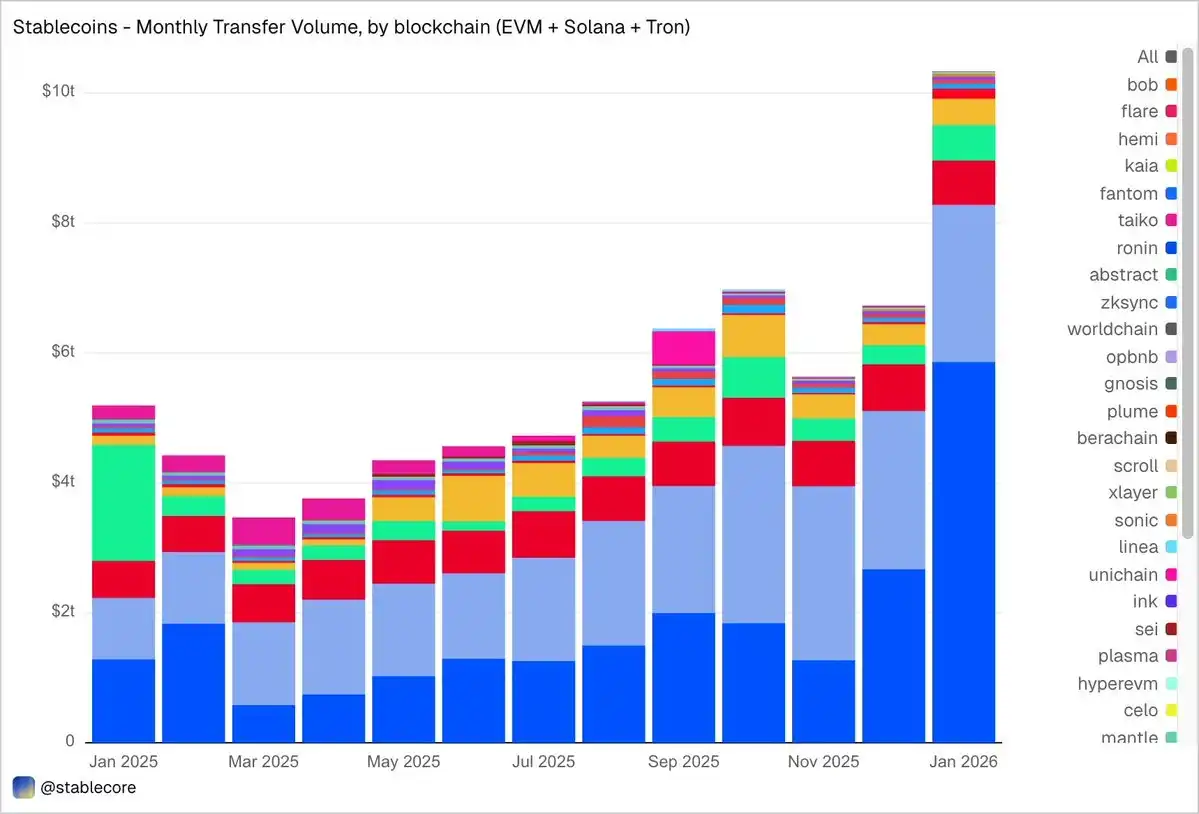
By token, USDC dominated with $8.3 trillion—almost 5 times that of USDT ($1.7 trillion)—even though its supply is only about 1/2.7 of the latter. USDC clearly circulates faster and more frequently. DAI had $138 billion, USDS had $92 billion, and USD1 had $43 billion.

It's important to emphasize that this data is deliberately objective and neutral. The dataset does not pre-filter "real" economic activity based on a fixed standard, so the total volume may include flows generated by automated behaviors like arbitrage, bots, and internal routing. We don't hardcode judgment into the data but provide an objective perspective, allowing users to choose their own filtering methods—whether to exclude bot transactions, identify organic usage, or define transaction activity metrics that better reflect the actual situation.

What Are Stablecoins Actually Doing?

This is where the granularity advantage of this dataset truly shines. Transfers are not simply labeled as "amount" but are categorized into different activity types based on the on-chain triggering mechanism. This means we not only know "$10 trillion flowed" but also "why it flowed."
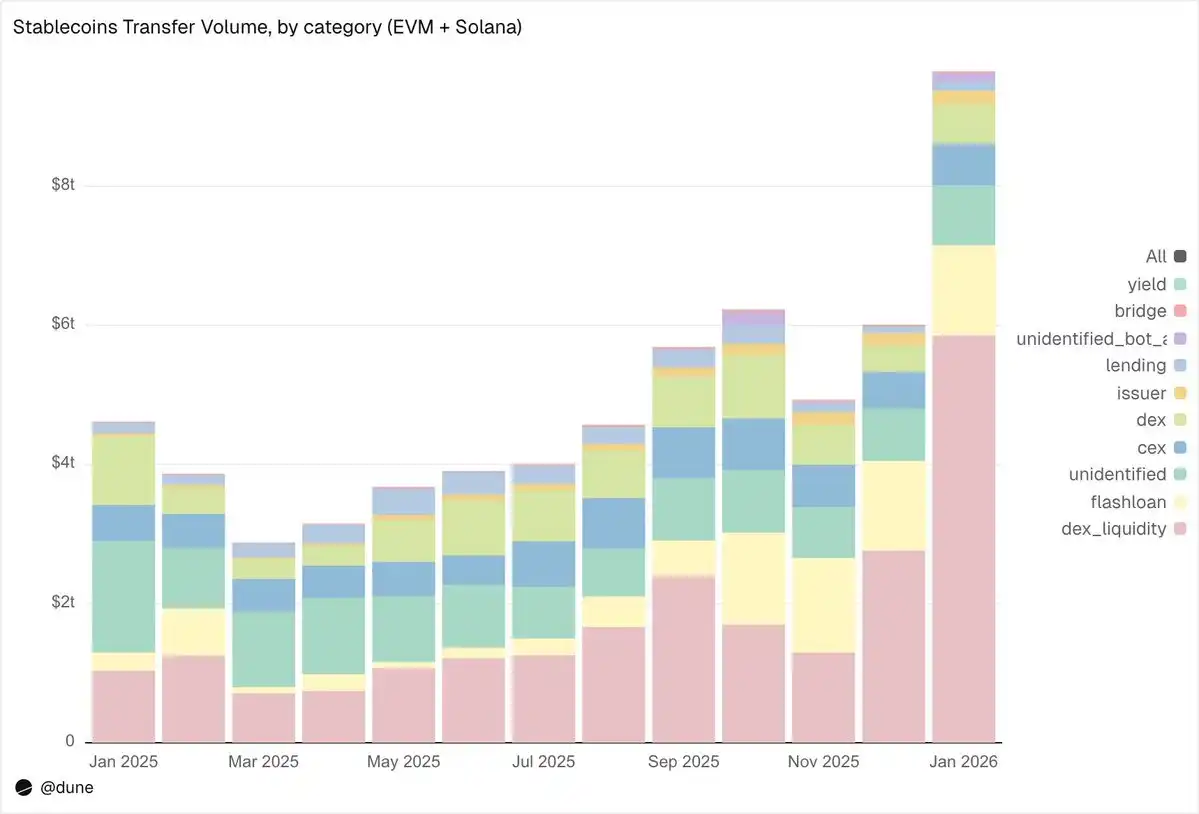
1. Market Infrastructure (DEX Trading & Liquidity)

  • DEX Liquidity Supply & Withdrawal: $5.9 trillion—The largest application, reflecting the role of stablecoins as base assets for on-chain market making.
  • DEX Swaps: $376 billion—Direct trading activity on automated market makers.

Together, they indicate that stablecoins are primarily trading collateral and liquidity infrastructure. Interestingly, the volume is more concentrated in incentive-driven liquidity mining and active capital optimization activities rather than pure trading demand.

2. Leverage & Capital Efficiency (Lending + Flash Loans)

  • Flash Loans (Borrow and Repay): $1.3 trillion—Automated arbitrage and liquidation loops.
  • Lending Activities (Deposit, Lend, Repay, Withdraw): $137 billion—Represents the on-chain short-term capital efficiency and structured credit layer.

3. On/Off Ramps (CEX & Bridges)

  • CEX Flows—Deposits ($224 billion), Withdrawals ($224 billion), Internal Transfers ($151 billion): Total $599 billion.
  • Bridge Deposits/Withdrawals: $28 billion—Shows the function of stablecoins as settlement channels between cross-chain and centralized platforms.

4. Issuance Layer (Monetary Operations)

  • Issuer Operations—Minting ($28 billion), Burning ($20 billion), Peg Rebalancing ($23 billion), and other operations: Total $106 billion, nearly 5 times the $42 billion a year ago.

5. Yield Protocols

  • Yield Protocol Activity: $2.7 billion—Small in scale but significant in structured strategies and on-chain asset management.

Overall, 90% of the transfer volume flows through identified activity categories, providing us with a fine-grained view across all layers of the entire on-chain stack.

Velocity of Circulation: Same Coin, Different Worlds

Daily Velocity of Circulation (Volume divided by Supply) is perhaps the most overlooked metric in stablecoin analysis. It reveals whether a stablecoin is actively used as a medium of exchange or merely held.

Among the tokens we analyzed, USDC and USDT stand out again, but exhibit different characteristics.
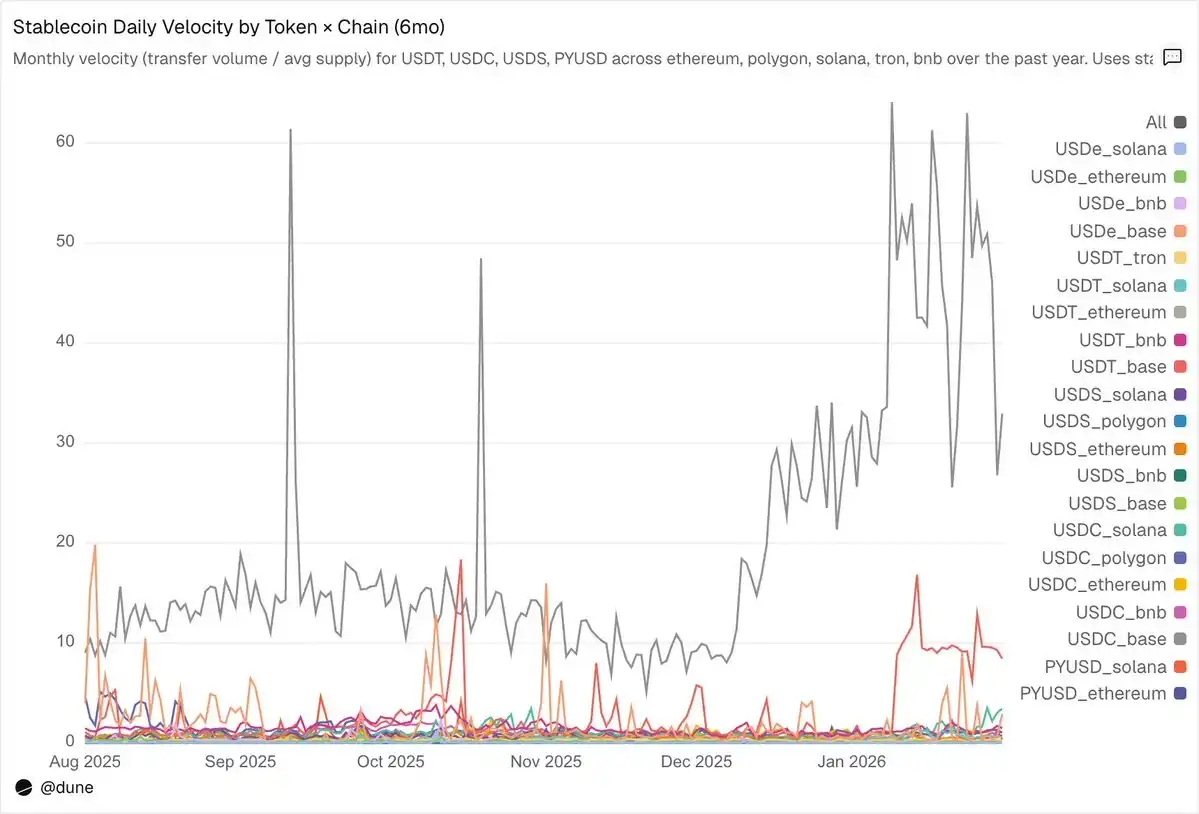
USDC circulates fastest on L2 and Solana. On Base, USDC's average daily velocity reaches 14x—an astonishing figure driven by high-frequency DeFi activity; on Solana and Polygon, it's about 1x; on Ethereum, it also reaches 0.9x, meaning almost the entire supply turns over daily.

USDT is fastest on BNB Chain and Tron. It reaches 1.4x on BNB Chain, reflecting active trading; on Tron, it's 0.3x, the volume is lower but exceptionally stable, consistent with its role as a main channel for cross-border payments. On Ethereum, however, USDT is only 0.2x, with over $100 billion of supply mostly sitting idle.

USDe and USDS are slower, but by design. USDe's average daily velocity on Ethereum is only 0.09x; USDS is 0.5x. Both are yield-bearing stablecoins: USDe is often staked as sUSDe to capture收益 from Ethena's delta-neutral strategy; USDS is deposited into Sky's savings rate mechanism to obtain protocol-subsidized yields. Therefore, a large portion of the supply remains in savings contracts, lending markets like Aave, or structured yield loops. Low velocity here is not a flaw but a feature—these assets are designed to accumulate yield, not to circulate frequently.

Chain differences are often more important than the token itself. The same PYUSD has a daily velocity of 0.6x on Solana, four times its velocity on Ethereum (0.1x). The same token exhibits completely different usage patterns in different ecosystems.

Supply and transfer volume each tell part of the story, while velocity connects the two—it reveals whether the stablecoin on a given chain is active infrastructure or sleeping capital.


Preguntas relacionadas

QWhat is the total fully diluted supply of the top 15 stablecoins as of January 2026, and which two dominate the market?

AThe total fully diluted supply of the top 15 stablecoins is $304 billion. Tether's USDT ($197 billion) and Circle's USDC ($73 billion) dominate the market with an 89% combined share.

QAccording to the data, which blockchain hosts the largest portion of stablecoin supply and what is its share?

AEthereum hosts the largest portion of stablecoin supply at $176 billion, representing 58% of the total.

QWhat does the data reveal about the concentration of holdings for stablecoins other than USDT and USDC?

AFor stablecoins other than USDT and USDC, holdings are extremely concentrated. The top 10 wallets often hold 60% to 99% of the supply, with some like USDF and USD0 having 99% concentration and a very high HHI index, indicating dominance by just one or two addresses.

QWhat was the total stablecoin transfer volume in January 2026, and which stablecoin accounted for the majority of this volume despite having a smaller supply?

AThe total stablecoin transfer volume in January 2026 was $10.3 trillion. USDC accounted for the majority of this volume at $8.3 trillion, which is nearly 5 times that of USDT ($1.7 trillion), even though its supply is only about 1/2.7 that of USDT.

QWhat is the significance of the velocity metric in stablecoin usage, and how does USDC's velocity on Base compare to USDT's on Ethereum?

AThe velocity metric (transfer volume divided by supply) reveals whether a stablecoin is actively used as a medium of exchange or simply held. USDC on Base has an extremely high daily velocity of 14x, driven by high-frequency DeFi activity. In contrast, USDT on Ethereum has a much lower velocity of 0.2x, indicating that over $100 billion of its supply is largely idle.

Lecturas Relacionadas

BTC Pulso de Mercado: Semana 24

El mercado de Bitcoin continúa bajo presión, con los vendedores dominando la actividad. El volumen en mercados spot ha aumentado, pero esto refleja una reducción de exposición por parte de los participantes más que una nueva demanda, indicando un tono defensivo. En los derivados, el interés abierto en futuros ha disminuido y el posicionamiento en perpetuas muestra una agresión persistente de la venta. En opciones, ha crecido la demanda de protección a la baja, señalando una mayor cautela entre los inversores en un período de incertidumbre. El comportamiento institucional, observado a través de los ETF spot en EE.UU., corrobora esta cautela. Aunque los volúmenes de negociación han aumentado, los flujos netos de capital siguen siendo negativos y la rentabilidad agregada se acerca a los niveles de coste, lo que sugiere una reevaluación de la exposición. No obstante, las métricas fundamentales de la red muestran una base de participación en expansión, con direcciones activas y volúmenes de transferencia en aumento. Los tenedores a largo plazo siguen dominando la distribución de la oferta, manteniendo una estructura de mercado resiliente. La transición hacia pérdidas realizadas y la contracción de la rentabilidad no realizada señalan una fase de capitulación, donde el mercado equilibra la presión de liquidación a corto plazo con una base estable de tenedores a largo plazo.

insights.glassnodeHace 14 min(s)

BTC Pulso de Mercado: Semana 24

insights.glassnodeHace 14 min(s)

De MSTR a STRC+: ¿Dónde está el límite del universo Strategy?

De MSTR a STRC+: ¿Cuál es el fin del universo de Strategy? Strategy, anteriormente MicroStrategy, ha evolucionado de ser una simple "compañía que compra Bitcoin" a un complejo sistema financiero construido alrededor de sus reservas de BTC. Su núcleo es el bucle de retroalimentación: el precio de BTC sube, la acción MSTR sube, la empresa emite más capital (acciones, bonos convertibles) y compra más BTC, lo que refuerza la narrativa. El artículo analiza cómo Strategy segmenta su exposición al BTC en diferentes productos de riesgo y rendimiento. MSTR es la capa de capital accionario volátil. Luego, productos como STRC (acciones preferentes perpetuas) ofrecen un "crédito de alto rendimiento a corto plazo" con dividendos (actualmente ~11.5%) dirigidos a inversores de renta fija. Esto convierte el apetito por los ingresos fijos en capital para comprar más BTC. El siguiente paso es STRC+: protocolos como Saturn y Apyx llevan los flujos de efectivo de estos productos de crédito (como STRC) a la cadena de bloques (DeFi), empaquetándolos como rendimiento para stablecoins (por ejemplo, sUSDat, apyUSD). Así, los dividendos de las acciones preferentes de una empresa con respaldo en BTC se convierten en una nueva fuente de rendimiento en DeFi. Sin embargo, los riesgos son significativos. El rendimiento de STRC+ depende de la salud crediticia de Strategy, que a su vez depende del precio del BTC, su relación mNAV (valoración de mercado frente al valor neto de sus BTC) y su capacidad para pagar dividendos. En un escenario bajista, la presión sobre los dividendos y la contracción del mNAV podrían romper el bucle de financiación, haciendo que productos como STRC sean repreciados como activos de crédito de alto riesgo en lugar de productos estables similares a fondos del mercado monetario. La conclusión es que el "fin del universo" de Strategy no es comprar BTC infinitamente, sino que el mercado acepte un nuevo sistema crediticio donde el BTC, a través de la estructura de capital de una empresa que cotiza en bolsa, pueda emitir crédito, pagar dividendos y respaldar aplicaciones financieras en cadena. Su límite final es si el BTC puede ser aceptado continuamente como base colateral para este sistema.

marsbitHace 21 min(s)

De MSTR a STRC+: ¿Dónde está el límite del universo Strategy?

marsbitHace 21 min(s)

Fundador de Baixing.com: Mis 14 experiencias usando Claude Code

Experiencias del Fundador de BaiXing Wang: Mis 14 Consejos de Uso para Claude Code (Autor: Wang Jianshuo). Aquí resumo mi experiencia personal con Claude Code hasta ahora. El enfoque clave es especializarse en una herramienta, en mi caso Claude Code, y dominar sus atajos esenciales. Para entrada de texto larga, usar Control+G; Control+A, E, U para navegación rápida. La entrada por voz (HoldSpeak) es muy útil. Al iniciar un proyecto, primero escribe un PROJECT.md estructurado. Usa Claude agents por defecto. Claude Code combina perfectamente con GitHub y Cloudflare para automatizar procesos de compilación, publicación y gestión de dominios. Separa claramente lo escrito por humanos y por máquinas: mantén manualmente un CLAUDE.md central; no leas código o .md generados por Claude, pregunta a la IA sobre ellos. Para clarificar ideas, arrastra archivos (audio, video, documentos, capturas de pantalla con Cmd+Shift+5) a la ventana. Reorganiza el sistema de memoria: usa ~/.claude/CLAUDE.md como núcleo, vinculando múltiples archivos de memoria. Guárdalos en un repositorio Git privado en GitHub para que sean permanentes y acumulativos, no dispersos por proyecto. Desarrolla Skills; al finalizar una tarea, pide a Claude que "consolide lo aprendido en un Skill". Para tareas complejas, considera usar ultracode para activar flujos de trabajo dinámicos, a pesar de su costo y lentitud, por su efectividad. Acumula y refactoriza Skills continuamente, también almacenados en Git. Usa la documentación de Git como salida de una tarea y entrada para la siguiente, facilitando la transferencia entre agents sin depender del contexto. Finalmente, trata a Claude Code como un caballo (o persona) con iniciativa propia, no como un coche que solo obedece órdenes. Su capacidad de "encontrar su propio camino" dentro de los objetivos y límites establecidos es una característica clave, no un error.

链捕手Hace 34 min(s)

Fundador de Baixing.com: Mis 14 experiencias usando Claude Code

链捕手Hace 34 min(s)

Yang Ge Gary: Economía de los Agentes y Microeconomía Subyacente de la IA

Después de la explosión de la singularidad de la IA, la evolución de la IA se ha acelerado, creando nuevas brechas generacionales de civilización a nivel global. A lo largo de mis participaciones en más de 20 eventos sobre IA en una docena de ciudades durante los últimos dos meses, quedó claro que la discusión sobre la "Economía Agent" y el ecosistema A2A (Agent-to-Agent) en Silicon Valley y San Francisco está una generación por delante del resto del mundo. Mientras muchos aún enfrentan los cuellos de botella de los agentes individuales, estas regiones ya están avanzando en la gestión cognitiva y la economía de los agentes hacia la siguiente dimensión. El artículo aborda seis puntos clave: 1) La competencia en AI Payment y los límites de la economía H2A (Human-to-Agent). 2) La tendencia inevitable hacia la Economía Agent y el ecosistema A2A, donde agentes autónomos de IA participan directamente en la creación e intercambio de valor. 3) La relación, brechas y factores político-económicos entre los protocolos de IA y los protocolos cripto. Los primeros se centran en facilitar la comunicación y colaboración, mientras que los segundos en la definición de derechos y valor. Su convergencia futura es probable. 4) Las características de la "microeconomía subagente" de la IA, que difiere de la economía humana al ser más frecuente, de bajo valor por transacción, orientada a tareas, impulsada por la eficiencia y basada en protocolos. Se establece una analogía con la biología celular. 5) La inevitabilidad de AIFi (Finanzas de IA), donde el valor reside nativamente en la IA y las finanzas son su forma de expresión. Se introduce el concepto de "chip financiero" (FinChip) como infraestructura clave. 6) Que ser "AI-Native" representa una actualización de paradigma diferente a la simple adición de internet ("internet+"). Requiere un pensamiento basado en principios primeros, la ruta más corta del valor energético y la máxima eficiencia, desafiando las estructuras comerciales y legales existentes. La presión competitiva para finales de 2026 sigue siendo intensa y la curva de adopción, empinada.

链捕手Hace 57 min(s)

Yang Ge Gary: Economía de los Agentes y Microeconomía Subyacente de la IA

链捕手Hace 57 min(s)

De 'The Big Short' a San Francisco: La euforia y el vértigo en la burbuja de la IA

Disfruta del resumen a continuación: Desde "La Gran Apuesta" hasta San Francisco: Fiesta y vértigo en la burbuja de la IA El artículo explora la frenética energía de San Francisco, epicentro actual de la revolución tecnológica y la especulación financiera en torno a la inteligencia artificial. El autor, tras mudarse desde Nueva York, describe una ciudad impregnada por el "olor del dinero", donde la densidad tecnológica, la creación de riqueza y las redes de información privilegiada son tan reales como la ansiedad y la competencia. La observación se estructura en cuatro puntos clave: primero, la palpable agitación o "temblor" colectivo, impulsado por la urgencia de no perderse la oportunidad, ejemplificada como un "comportamiento de gran burbuja". Segundo, San Francisco se reduce a un único juego de estatus: la tecnología y, específicamente, la IA, lo que fomenta una constante y exhaustiva comparación social basada en métricas vanidosas como rondas de financiación y valoraciones. Tercero, la ciudad vive sumida en un discurso apocalíptico, donde el temor a un futuro moldeado (o destruido) por la IA convive con un optimismo práctico sobre su despliegue. Finalmente, el autor señala la fascinación por los "genios matemáticos", cuyos talentos de infancia son vistos por algunos inversores como el boleto hacia rendimientos excepcionales, dibujando un paralelismo con los cazatalentos deportivos. Concluye con un sabio consejo recibido: en la vida se vivirán tres burbujas; la tercera es la oportunidad para crear riqueza generacional. Mientras la música de esta fiesta tecnológica suene a todo volumen, la recomendación es clara: "Puedes bailar, pero no te emborraches". Es un recordatorio para mantener los pies en la tierra y no dejar que el comportamiento irracional de la burbuja nuble el juicio.

marsbitHace 1 hora(s)

De 'The Big Short' a San Francisco: La euforia y el vértigo en la burbuja de la IA

marsbitHace 1 hora(s)

Trading

Spot
Futuros

Artículos destacados

Cómo comprar FLOW

¡Bienvenido a HTX.com! Hemos hecho que comprar Flow (FLOW) sea simple y conveniente. Sigue nuestra guía paso a paso para iniciar tu viaje de criptos.Paso 1: crea tu cuenta HTXUtiliza tu correo electrónico o número de teléfono para registrarte y obtener una cuenta gratuita en HTX. Experimenta un proceso de registro sin complicaciones y desbloquea todas las funciones.Obtener mi cuentaPaso 2: ve a Comprar cripto y elige tu método de pagoTarjeta de crédito/débito: usa tu Visa o Mastercard para comprar Flow (FLOW) al instante.Saldo: utiliza fondos del saldo de tu cuenta HTX para tradear sin problemas.Terceros: hemos agregado métodos de pago populares como Google Pay y Apple Pay para mejorar la comodidad.P2P: tradear directamente con otros usuarios en HTX.Over-the-Counter (OTC): ofrecemos servicios personalizados y tipos de cambio competitivos para los traders.Paso 3: guarda tu Flow (FLOW)Después de comprar tu Flow (FLOW), guárdalo en tu cuenta HTX. Alternativamente, puedes enviarlo a otro lugar mediante transferencia blockchain o utilizarlo para tradear otras criptomonedas.Paso 4: tradear Flow (FLOW)Tradear fácilmente con Flow (FLOW) en HTX's mercado spot. Simplemente accede a tu cuenta, selecciona tu par de trading, ejecuta tus trades y monitorea en tiempo real. Ofrecemos una experiencia fácil de usar tanto para principiantes como para traders experimentados.

324 Vistas totalesPublicado en 2024.12.10Actualizado en 2026.06.02

Cómo comprar FLOW

Discusiones

Bienvenido a la comunidad de HTX. Aquí puedes mantenerte informado sobre los últimos desarrollos de la plataforma y acceder a análisis profesionales del mercado. A continuación se presentan las opiniones de los usuarios sobre el precio de FLOW (FLOW).

活动图片