ETC Olympia Development Part 1: Implementing ECIP-1111 and ECIP-1112

金色财经Publicado a 2025-12-12Actualizado a 2025-12-12

Resumen

ETC Olympia Development Series Part 1: Implementing ECIP-1111 and ECIP-1112 This article introduces the first part of the Ethereum Classic Olympia development series, focusing on the implementation of ECIP-1111 and ECIP-1112. These two proposals are the only components within the broader Olympia framework that modify consensus behavior. ECIP-1111 modernizes the fee market by introducing an EIP-1559-style mechanism with a base fee and optional priority tip (miner tip). A key difference from Ethereum is that the base fee is not burned but is instead redirected to a treasury address defined by ECIP-1112. It also adds support for Type-2 transactions and the BASEFEE opcode (0x48), ensuring compatibility with modern EVM tooling and wallets. Crucially, it does not change miner rewards, monetary policy, or existing transaction types. ECIP-1112 defines an immutable, deterministic treasury smart contract that will receive the redirected base fees. This vault is designed to be receive-only upon activation, meaning it can accumulate value but cannot distribute funds until a separate, subsequent governance layer (defined in other ECIPs) is deployed and activated on the contract layer. The article emphasizes the modular architecture of Olympia. While the suite includes five ECIPs (1111-1115), only these two affect consensus. This separation ensures that the core protocol remains minimal and auditable, while future governance and funding mechanisms can evolve independently at the contra...

Ethereum Classic Core Developers - Olympia Development Series (Part 1)

Implementing ECIP-1111 and ECIP-1112: Base Fee Redirection and the Immutable Treasury

1. Introduction - From Concept to Code

This section provides an overview of the overall architecture of Olympia: its purpose, development history, and how ECIPs 1111-1115 fit into the modular, multi-layer upgrade path. This article will delve into the current engineering practices for two ECIPs, which together define the consensus boundaries of Olympia:

  • ECIP-1111 — EVM and Protocol Upgrades

  • ECIP-1112 — Immutable Treasury Contract

These two proposals are the only components in Olympia that modify consensus behavior. Other parts of the framework—governance (ECIP-1113), funding proposals (ECIP-1114), and the optional smoothing mechanism (ECIP-1115)—all operate at the contract layer and do not affect block validity or fork choice. On November 11, 2025, Ethereum Classic core developers initiated the implementation phase, preparing consensus logic and reference client infrastructure for a potential Mordor testnet deployment.

This article outlines:

  • What ECIP-1111 introduces

  • How ECIP-1112 defines the treasury target address

  • How these components work together

  • What is currently being prototyped in reference client development

This article only describes design proposals and implementation work and does not indicate that they will necessarily be activated or adopted in the future through the ECIP-1000 process. Before deploying the consensus layer changes of ECIP-1111 or ECIP-1112 to Mordor or the mainnet, ETC clients must first verify their stability and compatibility under baseline conditions.

2. ECIP-1111 — Modernizing the Fee Mechanism, Minimizing Network Disruption

ECIP-1111 integrates two widely adopted EVM improvements:

  • EIP-1559-style fee mechanism (Base Fee + optional tip) This mechanism introduces:

  • A dynamically adjusting base fee (BASEFEE),

  • An optional high-priority fee (tip) still paid directly to miners

  • And a more predictable fee market for modern tools.

2. Support for Type-2 (1559-style) transactions: This functionality has become standard for most wallets and infrastructure.

3. BASEFEE opcode (0x48): This exposes the current block's BASEFEE to contract logic (gas estimators, DEX routers, toolchains, etc.).

What changes for Ethereum Classic (ETC)?

Only one behavior differs from the Ethereum mainnet:

  • Ethereum Foundation (ETH): BASEFEE is burned.

  • Ethereum Classic (ETC): BASEFEE is redirected to the treasury defined by ECIP-1112. All other EIP-1559 semantics remain unchanged.

What remains the same?

  • Miner tips remain unchanged.

  • Block rewards remain unchanged.

  • Monetary policy (ECIP-1017) remains unchanged.

  • Traditional transaction types (Type-0 and Type-1) remain fully valid.

  • Existing contracts will not break; existing applications require no modifications.

  • No additional trust assumptions or permission mechanisms are introduced.

ECIP-1111 is additive, minimal, and strictly limited to modernizing the fee mechanism and enabling the BASEFEE redirection function.

3. ECIP-1112 — The Immutable Deterministic Treasury

ECIP-1112 defines the receiving address for the redirected base fees: a minimal, immutable smart contract deployed at a deterministic address. These definitions remain theoretical until client software demonstrates consistent behavior in a multi-client environment, a milestone requiring comprehensive testing to safely assess the Olympia components.

Core Features

  • Immutability: No upgrade key, no admin, no proxy pattern.

  • Deterministic address (e.g., via CREATE2): All clients agree on the same treasury destination.

  • Receive-only upon activation: The treasury can accumulate value but cannot release funds until subsequent governance is activated.

  • No internal governance logic: Purely a custody layer, not a decision-making layer.

Upon activation (testnet or mainnet):

  • The treasury can only receive funds.

  • No withdrawal mechanism is enabled until ECIP-1113 and ECIP-1114 are deployed, audited, and intentionally activated. This separation ensures predictability for consensus upgrades and makes them independent of the implementation of any governance scheme.

4. Clear Consensus Boundaries

Although Olympia comprises five ECIP proposals, only ECIP-1111 and ECIP-1112 change consensus behavior.

Consensus Boundary Summary

  • ECIP-1111 — Protocol layer. Introduces consensus changes: new base fee mechanism, Type-2 transactions, and the BASEFEE opcode.

  • ECIP-1112 — Protocol/Contract layer. Introduces consensus changes: defines the deterministic treasury receiving address for redirected base fees.

  • ECIP-1113 — Contract/Application layer. No consensus changes.
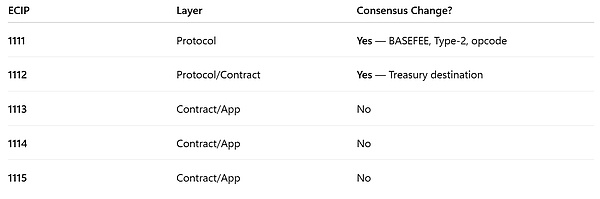
  • ECIP-1114 — Contract/Application layer. No consensus changes.

  • ECIP-1115 — Contract/Application layer. No consensus changes.

This modular structure ensures:

  • Consensus-critical logic remains lean and auditable,

  • Governance and funding mechanisms can evolve at the contract layer,

  • Improvements to ECIP-1113 to 1115 require no additional consensus changes.

If adopted, clients implementing ECIP-1111 and ECIP-1112 will maintain consensus compatibility, unaffected by subsequent governance layer deployments. Reference implementations can begin prototyping consensus logic during the draft stage, but these changes must undergo comprehensive testing (including baseline client validation such as the Gorgoroth verification described in Part II) before being merged into production clients.

5. Why Governance Activation is Delayed

If ECIP-1111 and ECIP-1112 are activated, base fees will begin flowing into the treasury—but treasury spending will remain disabled.

This phased deployment enables:

  • Independent testing of base fees

  • Comprehensive auditing of ECIP-1113 and ECIP-1114

  • Precise coordination among client implementers and infrastructure providers

  • Predictable behavior for node operators

If governance contracts are subsequently deployed and activated, the treasury will connect with authorized executors entirely at the contract layer (not the consensus layer).

6. Type-2 Transactions and Long-term EVM Interoperability

Type-2 transaction support is crucial for Ethereum Classic to maintain compatibility with:

  • Modern wallets

  • Exchanges and custody services

  • RPC infrastructure

  • Tooling frameworks (Hardhat, Foundry, etc.)

  • Block explorers

  • Cross-chain interoperability

Type-2 transactions do not alter user requirements or introduce permission mechanisms. Traditional transaction types will remain fully supported.

Type-2, as an incremental feature, ensures ETC maintains interoperability with the mainstream transaction format of the EVM ecosystem.

7. The Broader Context — Maintaining a Programmable Proof-of-Work Base Layer

Together, ECIP-1111 and ECIP-1112 constitute a foundational step for Ethereum Classic towards a sustainably funded, operational model for programmable proof-of-work—provided the community chooses to adopt these proposals.

These proposals achieve their goals without:

  • Modifying miner incentives

  • Introducing inflation

  • Changing monetary policy

  • Adding a governance layer to consensus

  • Altering Ethereum Classic's security assumptions

Their purpose is limited to:

  • Modernizing the fee market

  • Establishing a transparent protocol-level value accrual mechanism

If adopted, these changes will pave the way for the contract-layer governance and funding systems in subsequent Olympia proposals, without requiring new consensus rules.

8. Conclusion — Minimal, Secure, and Forward-Compatible

ECIP-1111 and ECIP-1112 define the consensus layer components proposed within the Olympia framework. They:

  • Add Type-2 and base fee mechanisms

  • Redirect the base fee to a deterministic treasury

  • Keep all existing user and miner behavior unchanged

  • Prepare ETC for future contract-layer components

These proposals do not introduce governance logic into the consensus mechanism, nor do they add trust assumptions on top of the existing EIP-1559/EIP-3198 semantics. Their aim is to preserve the conservatism of ETC's core protocol and EVM ecosystem compatibility, while enabling sustainable value flows at the contract layer.

9. ECIP Process Clarity

The Olympia ECIP specifications (1111–1115) are currently in the draft stage and under active discussion. Reference clients have initiated early implementation work on ECIP-1111 and ECIP-1112, which is fully consistent with the provisions of the ECIP-1000 draft stage. Reference implementations will only be considered for mainnet activation after testing on the Mordor testnet is completed. After testnet results are qualified, ECIP proposers may submit specification update proposals. Any decision to advance to "Accepted" status or schedule mainnet activation must undergo community review and the full ECIP-1000 evaluation process. This article outlines the design and implementation work being advanced during the draft stage.

10. What's Next in the Series

With the consensus design framework established, the next installment will focus on the client layer—the Fukuii alpha testing plan is about to launch, aiming to validate ETC client interoperability before Olympia integrations.

Disclaimer: The content of this article does not constitute any investment or financial advice. The content is reproduced from EthereumClassic and is for industry information reference only. If you have questions or copyright issues, please contact us for removal.

Criptos en tendencia

Preguntas relacionadas

QWhat are the two ECIPs that modify consensus behavior in the Olympia upgrade series?

AECIP-1111 (EVM and Protocol Upgrades) and ECIP-1112 (Immutable Vault Contract) are the two proposals that modify consensus behavior.

QHow does the handling of the BASEFEE differ between Ethereum (ETH) and Ethereum Classic (ETC) under ECIP-1111?

AOn Ethereum (ETH), the BASEFEE is burned. On Ethereum Classic (ETC), the BASEFEE is redirected to the treasury defined by ECIP-1112.

QWhat is the core purpose of the vault defined in ECIP-1112 at the time of its initial activation?

AAt activation, the vault is receive-only; it can accumulate value but has no mechanism to withdraw or release funds until governance proposals (ECIP-1113 and ECIP-1114) are deployed, audited, and intentionally activated.

QWhich components of the Olympia series operate purely at the contract/application layer without changing consensus rules?

AECIP-1113 (Governance), ECIP-1114 (Funding Proposals), and ECIP-1115 (Optional Smoothing Mechanism) operate at the contract/application layer and do not change consensus behavior.

QWhat is the stated goal of implementing Type-2 (EIP-1559-style) transactions on Ethereum Classic?

AThe goal is to ensure interoperability with the broader EVM ecosystem, including modern wallets, exchanges, RPC infrastructure, development frameworks, and block explorers, by supporting a mainstream transaction format.

Lecturas Relacionadas

Momento del Trading en BIT: La compra de BTC se recupera, pero el sentimiento bajista sigue siendo fuerte; la EMA de 50 meses es difícil de superar; SK Hynix intenta estabilizar el almacenamiento

**Resumen del artículo de BIT Trading Hours:** **Cripto (Bitcoin):** El BTC se recuperó por encima de los 65.000 USD, mostrando una desvinculación temporal de los activos de riesgo tradicionales, que siguen bajo presión por el alza de los rendimientos de los bonos. La demanda de spot en cadena muestra signos de mejora, acercándose a territorio positivo, lo que históricamente ha sido un indicador alcista. Sin embargo, el sentimiento en el mercado de opciones sigue siendo pesimista y el análisis de BIT advierte que, basándose en patrones anteriores, aún existe un riesgo de caída hacia los 45.500 USD. Los próximos catalizadores clave son las actas de la Fed y la subasta de bonos del Tesoro a 20 años. **Mercados Globales (Acciones & Bonos):** Una tormenta en el mercado de bonos, con el rendimiento del bono estadounidense a 30 años alcanzando máximos desde 2007, está dominando la narrativa y ejerciendo presión sobre las acciones, especialmente los sectores de alta valuación como la IA. Los inversores están preocupados por la sostenibilidad de los altos gastos de capital en IA en un entorno de tasas de interés más elevadas. El sector de los semiconductores y las acciones vinculadas a la IA fueron las más afectadas. SK Hynix intentó estabilizar el sector de la memoria anunciando una importante recompra de acciones. En Asia, los mercados de Seúl y Tokio cayeron bruscamente, liderados por la venta de acciones de chips. **Robótica/IA en China:** La IPO de Unitree Robotics (宇树科技) fue un punto destacado, con las acciones disparándose en su debut y convirtiendo a su fundador en el multimillonario más joven de China. Sin embargo, este entusiasmo por el líder no se trasladó al sector en general, ya que muchas otras acciones de robótica cayeron significativamente, mostrando una clara divergencia. **Próximos eventos a observar (Resumen):** * **19 ago:** Cumbre de IA en Seúl; Conferencia Mundial de Robótica en Beijing; Resultados de empresas como Kuaishou. * **20 ago:** Subasta de bonos del Tesoro de EE.UU. a 20 años (prueba clave para el mercado); Actas de la reunión de la Fed; Resultados de Alibaba y Walmart. * **21 ago:** Datos de inflación de Japón; datos de exportación de Corea; resultados de empresas como ZTE y Zijin Mining.

marsbitHace 17 min(s)

Momento del Trading en BIT: La compra de BTC se recupera, pero el sentimiento bajista sigue siendo fuerte; la EMA de 50 meses es difícil de superar; SK Hynix intenta estabilizar el almacenamiento

marsbitHace 17 min(s)

CEO de Robinhood: La ola de tokenización de acciones estadounidenses está aquí, EE. UU. no debe quedarse atrás

Estamos en las primeras etapas de un superciclo de tokenización de activos a nivel global, una ola que transformará el sistema financiero. Aunque fuera de EE. UU., como en la plataforma Robinhood Chain, los usuarios de más de 120 países ya pueden operar con tokens de acciones estadounidenses respaldados 1:1, estos productos aún no están disponibles en el mercado doméstico estadounidense. La tokenización va más allá de mover acciones a la cadena de bloques; se trata de reimaginar la infraestructura de propiedad de activos para que sean tan fluidos como la información en internet. Para los inversores en EE. UU., esto ofrecería tres ventajas clave: 1) Liquidación y compensación en tiempo real, reduciendo riesgos sistémicos como se vio en el evento GameStop. 2) Capacidad nativa para operar 24/7, permitiendo gestionar riesgos y oportunidades fuera del horario de mercado. 3) Mayor control y portabilidad de los activos, fomentando la competencia entre plataformas y permitiendo su uso en ecosistemas DeFi. Sin embargo, para liberar estos beneficios en EE. UU., es crucial modernizar el marco regulatorio centenario actual, diseñado para una infraestructura tecnológica obsoleta. Los responsables políticos deben actuar con rapidez para adaptar las normas, manteniendo la protección al inversor pero permitiendo la adopción de esta nueva infraestructura. La tokenización de acciones cotizadas es solo el comienzo. Sentará las bases para incluir otros activos, como capital privado, ampliando el acceso y la liquidez. Es fundamental que los inversores estadounidenses no se queden atrás en esta innovación impulsada, en gran parte, por activos y empresas de su propio país.

marsbitHace 17 min(s)

CEO de Robinhood: La ola de tokenización de acciones estadounidenses está aquí, EE. UU. no debe quedarse atrás

marsbitHace 17 min(s)

ASIC detecta 3.106 casos de fraude con criptomonedas, ya que las redes de inteligencia artificial apuntan a los ahorros de los australianos

El regulador corporativo australiano ha emitido una severa advertencia a los inversores, ya que redes de fraude sofisticadas, creadas con IA y que a menudo giran en torno a plataformas falsas de criptomonedas y "recomendaciones" con deepfakes, continúan apuntando a los ahorros de los australianos. En el año fiscal 2026, la Comisión Australiana de Valores e Inversiones (ASIC) eliminó 3,106 esquemas fraudulentos relacionados con inversiones en criptomonedas, un aumento de casi el 30% respecto al período anterior. En total, ASIC eliminó más de 19,400 esquemas fraudulentos en línea, incluyendo miles de plataformas de inversión falsas y esquemas de phishing. Los estafadores combinan cada vez más herramientas de IA generativa con la suplantación de figuras públicas como el Primer Ministro Anthony Albanese para promocionar instrumentos de inversión en criptomonedas. Estas redes crean ecosistemas en línea falsos con artículos de noticias, sitios web de medios y reseñas en redes sociales generadas por IA para crear una "prueba social" artificial. La presidenta de ASIC, Sarah Court, advirtió que la IA hace que los fraudes sean más convincentes y difíciles de detectar. Los estafadores también falsifican ilegalmente los números de licencia de servicios financieros australianos para dar una apariencia de legitimidad. ASIC y Scamwatch instan a los consumidores a verificar rigurosamente las licencias en los registros públicos oficiales antes de invertir, y a consultar recursos como la "Lista de advertencias para inversores" de Moneysmart. La prevención sigue siendo la principal defensa contra estos fraudes, que a menudo operan desde jurisdicciones extranjeras.

cryptonews.ruHace 20 min(s)

ASIC detecta 3.106 casos de fraude con criptomonedas, ya que las redes de inteligencia artificial apuntan a los ahorros de los australianos

cryptonews.ruHace 20 min(s)

Trading

Spot

Artículos destacados

Cómo comprar ETC

¡Bienvenido a HTX.com! Hemos hecho que comprar Ethereum Classic (ETC) sea simple y conveniente. Sigue nuestra guía paso a paso para iniciar tu viaje de criptos.Paso 1: crea tu cuenta HTXUtiliza tu correo electrónico o número de teléfono para registrarte y obtener una cuenta gratuita en HTX. Experimenta un proceso de registro sin complicaciones y desbloquea todas las funciones.Obtener mi cuentaPaso 2: ve a Comprar cripto y elige tu método de pagoTarjeta de crédito/débito: usa tu Visa o Mastercard para comprar Ethereum Classic (ETC) al instante.Saldo: utiliza fondos del saldo de tu cuenta HTX para tradear sin problemas.Terceros: hemos agregado métodos de pago populares como Google Pay y Apple Pay para mejorar la comodidad.P2P: tradear directamente con otros usuarios en HTX.Over-the-Counter (OTC): ofrecemos servicios personalizados y tipos de cambio competitivos para los traders.Paso 3: guarda tu Ethereum Classic (ETC)Después de comprar tu Ethereum Classic (ETC), guárdalo en tu cuenta HTX. Alternativamente, puedes enviarlo a otro lugar mediante transferencia blockchain o utilizarlo para tradear otras criptomonedas.Paso 4: tradear Ethereum Classic (ETC)Tradear fácilmente con Ethereum Classic (ETC) en HTX's mercado spot. Simplemente accede a tu cuenta, selecciona tu par de trading, ejecuta tus trades y monitorea en tiempo real. Ofrecemos una experiencia fácil de usar tanto para principiantes como para traders experimentados.

181 Vistas totalesPublicado en 2024.12.10Actualizado en 2026.06.02

Cómo comprar ETC

Discusiones

Bienvenido a la comunidad de HTX. Aquí puedes mantenerte informado sobre los últimos desarrollos de la plataforma y acceder a análisis profesionales del mercado. A continuación se presentan las opiniones de los usuarios sobre el precio de ETC (ETC).

活动图片