Author | Huang Yida
Editor | Zhang Fan
South Korea's stock market, which had been soaring this year, recently entered a sharp decline mode. Two super-heavyweight stocks, Samsung Electronics and SK Hynix, suffered sustained selling, frequently triggering circuit breakers for the broader market. Financial products heavily invested in these Korean market leaders also incurred significant losses recently. A typical example is the 2x Long Samsung Electronics/SK Hynix ETF, with many such products experiencing drawdowns of over 60% recently.
The QDII fund managed by Zhang Kun, E Fund Asia Select (hereinafter referred to as Asia Select), was also heavily invested in Samsung Electronics and SK Hynix. Boosted by the previous AI chain bull market, the fund's net asset value performance was impressive. By the end of the second quarter, as Korean stocks began to plummet, the fund's quarterly report showed that Asia Select significantly reduced its holdings in Samsung Electronics and SK Hynix during Q2. The market highly praised Zhang Kun's timely exit this time, bringing this former star fund manager back into investors' spotlight.
Currently, Zhang Kun manages four public funds. Besides Asia Select mentioned above, the two flagship products, E Fund Blue Chip Select and E Fund Quality Select (hereinafter referred to as Blue Chip Select and Quality Select), were once top-tier funds in the public offering industry. At their peak, Blue Chip Select's management scale approached 100 billion yuan, and Quality Select also exceeded 20 billion yuan.
On July 21st, Blue Chip Select and Quality Select released their Q2 2026 quarterly reports. As benchmark products in the industry, the holdings changes of these two funds in the second quarter not only reflect changes in the market environment but also present the latest pricing of held assets and predictions on future investment themes by leading public offering institutions, making them highly valuable references for the entire market.
So, what major changes occurred in Zhang Kun's investment strategy in the past second quarter? And what is the core logic behind it?
01 Significant Reduction in Major Consumer Stocks
The latest disclosed fund quarterly reports show that under the dual pressure of fundholder redemptions and declines in heavily held stocks, the management scale of Blue Chip Select and Quality Select suffered significant shrinkage in Q2 this year, with the asset allocation structure undergoing notable changes simultaneously. Reflected in specific data, both funds showed a decline in both shares outstanding and scale, with the scale reduction being particularly pronounced:
Blue Chip Select: Shares outstanding and scale at the end of Q2 were 13.4 billion units and 20.4 billion yuan respectively, decreasing by 1.8 billion units and 6.4 billion yuan quarter-on-quarter, especially the scale reduction was quite substantial;
Quality Select: Shares outstanding and scale at the end of Q2 recorded 1.7 billion units and 6.8 billion yuan respectively, decreasing by 240 million units and 2.8 billion yuan quarter-on-quarter.
Looking over a longer period, since Q1 2023, affected by continuous fundholder redemptions, the shares outstanding of both Blue Chip Select and Quality Select have declined quarter-on-quarter for 14 consecutive quarters. The current shares outstanding of Blue Chip Select are less than half of its historical peak, and the current shares outstanding of Quality Select are about 55% of its historical peak.
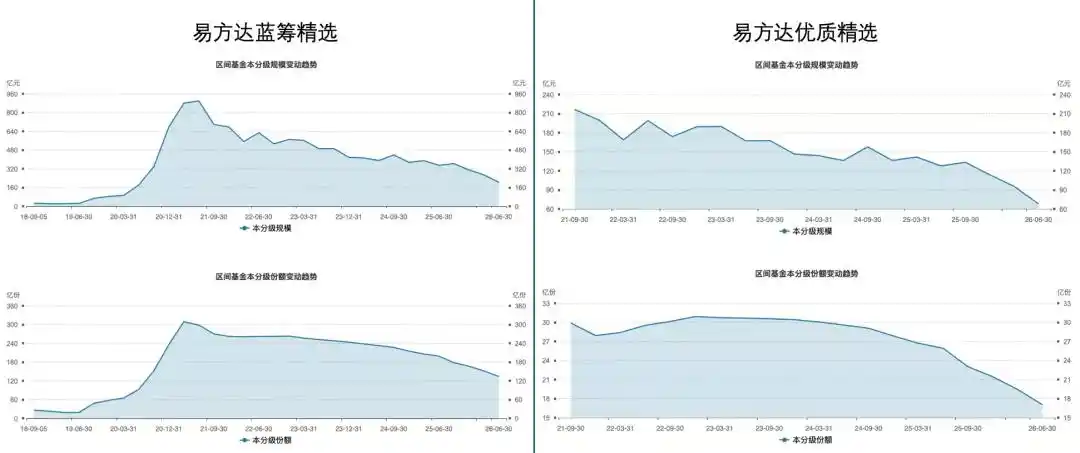
Chart: Shares Outstanding and Scale of Blue Chip Select and Quality Select; Source: wind, 36Kr
While the scale shrank, changes in the asset allocation structure of the two funds are mainly reflected in the following two aspects:
1. Significant reduction in equity position, with a synchronous substantial increase in the allocation proportion of cash assets;
2. Continued reduction in heavily held consumer stocks, with the scale proportion of consumer stocks persistently declining.
At the major asset allocation level, data shows that as of the end of June this year, the equity position of Blue Chip Select dropped from 93% last quarter to 75%, while the cash allocation proportion increased by 19 percentage points quarter-on-quarter to 25%; the situation for Quality Select was similar, with its equity position dropping to 80% during the same period, and the combined allocation proportion of cash and other assets being about 20%. The significant increase in cash proportion is partly expected to be for handling subsequent redemptions.
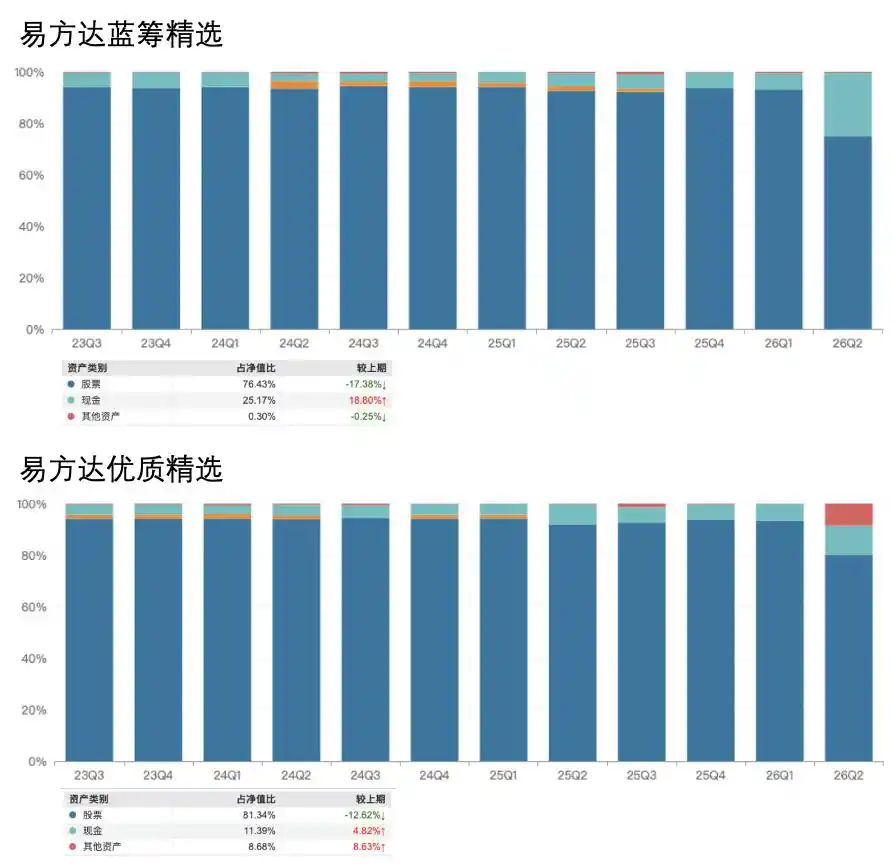
Chart: Major Asset Allocation Proportions of Blue Chip Select and Quality Select; Source: wind, 36Kr
From an investment style perspective, Zhang Kun is a representative figure among veteran star fund managers for investing in major consumer sectors. According to wind statistics, the industry allocation proportion of major consumer sectors (Consumer Staples + Consumer Discretionary) in Blue Chip Select has long been above 50% in recent years, once reaching as high as 80%; since its inception, the industry allocation proportion of major consumer sectors in Quality Select has never fallen below 60%, with the median in recent years being around 70%.
However, since the end of 2024, both funds have been continuously reducing their holdings of consumer stocks. According to the wind primary industry classification, the industry allocation proportion of major consumer sectors in Blue Chip Select was about 72% at the end of 2025, a reduction of about 8 percentage points compared to its historical peak (end of 2024). Looking at Quality Select, data from the Q2 2026 report shows the industry allocation proportion of the major consumer sector was about 64%, a reduction of about 18 percentage points compared to the historical peak of 82% (end of 2024).
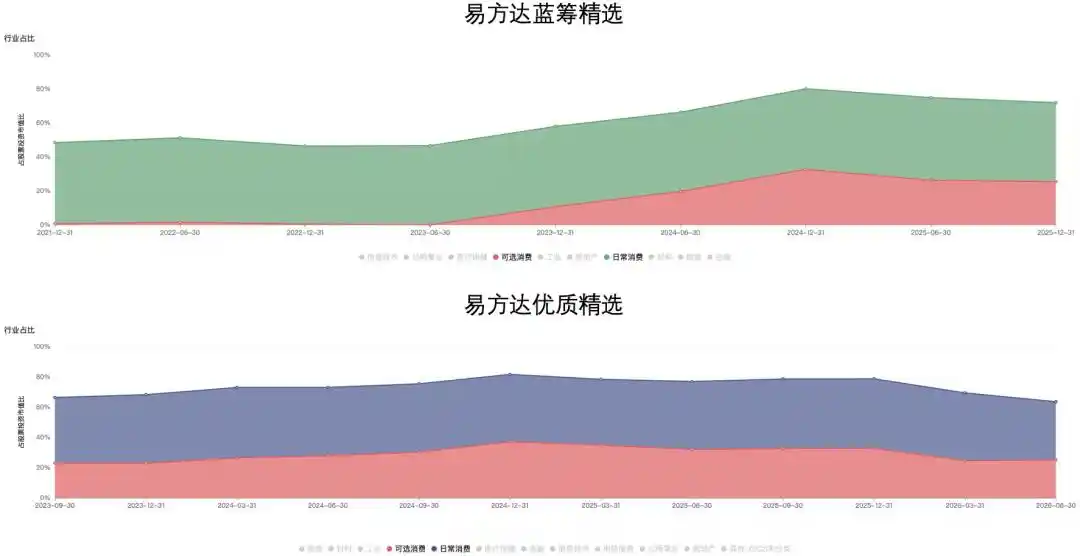
Chart: Major Consumer Sector Allocation Proportions of Blue Chip Select and Quality Select; Source: wind, 36Kr
The distribution of the top ten heavy holdings in Blue Chip Select and Quality Select is also highly similar, both centered on baijiu (Chinese liquor) leaders such as Moutai, Wuliangye, Luzhou Laojiao, and Fenjiu, while also heavily invested in Alibaba and Tencent. Looking at holdings changes over the past year, the portfolio adjustment direction of the two funds is basically consistent, namely a significant reduction in consumer stocks, mainly baijiu.
During the consumer bull market before 2021, baijiu leaders were the "core assets" pursued by the market, with Moutai being the core of the "core assets," naturally a key holding for top-tier funds like Blue Chip Select. Now, the baijiu industry's prosperity has entered a downward cycle, especially with leading liquor companies' performance slowing down continuously in recent years, which is an important factor driving fund managers to reduce baijiu holdings.
Looking at Zhang Kun's reduction in Moutai holdings, E Fund Blue Chip Select held 969,000 shares of Moutai in Q2 this year, representing year-on-year and quarter-on-quarter reductions of 59% and 47%, respectively; the situation for E Fund Quality Select was similar, holding 528,000 shares of Moutai during the same period, representing year-on-year and quarter-on-quarter reductions of 39% and 19%, respectively.
Looking at holdings changes in other heavy holdings, Blue Chip Select was more noticeably affected by large-scale fundholder redemptions. Among its top ten heavy holdings, only the holdings of SMIC and Dongshan Precision remained unchanged from the previous quarter, while holdings of other heavy holdings were significantly reduced compared to the previous quarter.
After this portfolio adjustment, the proportion of baijiu leaders in Blue Chip Select's portfolio plummeted from a long-term stable level above 40% to 20%; the proportion of the top ten heavy holdings also dropped quarter-on-quarter from 91% to 51%. The trend of changes in heavy holdings for Quality Select is similar, but because the redemption pressure is relatively smaller, the overall reduction in heavy holdings was also relatively less.
Zhang Kun's move to reduce baijiu holdings is a microcosm of public funds' continuous reduction in major consumer sectors in recent years. Public information shows that as of the end of Q2 this year, the food and beverage sector (mainly baijiu) accounted for only 1.5% of active equity funds' holdings, a quarter-on-quarter decrease of 2.4 percentage points. This is not only significantly lower than the historical median of 11% between 2018 and 2022 but also far below the contemporaneous largest sector holding, the electronics sector (holding proportion 43%).
Apart from food and beverage, the fund holding proportions of other sub-sectors within the major consumer sector have all dropped to low single digits. Among them, household appliances and commercial retail saw larger declines in fund holding proportions, dropping to 1.1% and 0.4% respectively by the end of Q2 this year, quarter-on-quarter decreases of 0.7 and 1.0 percentage points respectively. Other sub-sectors were also reduced, but as their current position proportions are too low, they are almost at a point where there's little left to reduce.
Looking at heavily held individual stocks by public funds, the trend of public funds continuously reducing major consumer sectors is also evident. Among the top ten individual stocks heavily held by all active equity public funds in Q2 this year, there were no consumer stocks; the top ten individual stocks with heavy increases in holdings during the same period were mainly from the electronics and communications sectors, with the electronics sector occupying 8 spots. Among the top ten individual stocks with heavy decreases in holdings during the same period were Moutai, Wuliangye, and Alibaba from the major consumer sector.
02 Why Are Public Funds Reducing Major Consumer Holdings?
In recent years, the collective and continuous reduction of major consumer holdings (including sectors like baijiu, food & beverage, home appliances, and social services) by public funds is the result of the combined effect of multiple factors including macroeconomic conditions, industry cycles, and style shifts.
Looking back, 2017-2021 can be called the golden age of the major consumer sector. At that time, benefiting from the core logic of consumption upgrading and high earnings certainty, the major consumer sector was regarded by investors as a high-quality, long-term growth track; the baijiu sector within food & beverage was even more a core target for public fund clustering, with both earnings and valuations rising simultaneously, experiencing a round of Davis Double play.
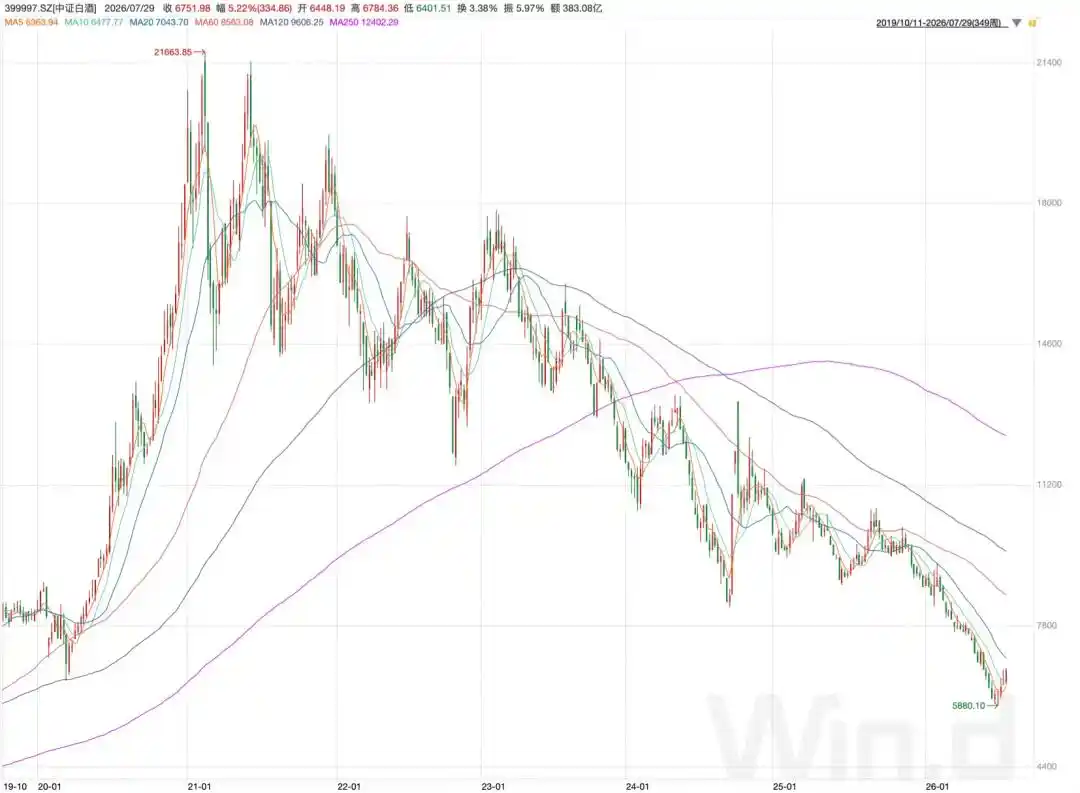
Chart: CSI Baijiu Index Trend; Source: wind, 36Kr
With changes in the macroeconomic environment, especially the long-term weak recovery post-pandemic, the corresponding reshaping of consumption concepts directly led to a noticeable slowdown in the earnings growth of the major consumer sector. The past core logic of consumption upgrading gradually shifted to consumption stratification. Consumers no longer blindly pursue premium brands and price premiums; consumption behavior has become more rational and focused on cost-effectiveness. Traditional high-end and sub-high-end consumption thus suffered impacts, the most typical being premium baijiu. The earnings growth of leading liquor companies like Moutai and Wuliangye significantly slowed in recent years, making the previous valuation expansion logic unsustainable.
At the same time, penetration rates in many sub-sectors of major consumer goods have neared saturation. Under存量 (stock) competition, the industries face long-term low growth, typical examples being white goods, black goods, condiments, dairy products, etc. Although related leading companies enjoyed certain valuation premiums during the previous golden age due to their stable performance, with the shift in the macroeconomic environment, especially the adjustment in market expectations, the accumulated valuation premiums have instead become a burden.
Therefore, the major consumer sector has undergone a prolonged period of valuation compression. To ensure portfolio safety, fund managers actively reduced positions to digest valuation risks. As some funds率先 (took the lead) in reducing holdings of consumer leaders, stock price declines led to fund net value declines, which in turn triggered fundholder redemptions; to cope with redemptions, funds were forced to passively sell the most liquid consumer core assets, forming a negative feedback loop of "reduction - stock price drop - redemption - further reduction."
Looking from the perspective of industry inventory cycles, channel destocking pressure is also an important factor for public funds to reduce major consumer sector holdings. Taking baijiu as an example, currently many liquor companies face high channel inventories leading to declining wholesale prices, even出现 price倒挂 (inverted pricing) phenomena; meanwhile, competition intensity in the存量 market has intensified, with severe industry内卷 (involution), pressure on gross margins, and performance being dragged down. Faced with continuous deterioration of financial indicators, public funds reducing holdings of related targets is also reasonable.
The impact of market style shifts is equally huge. Against the backdrop of long-term weak recovery in the macroeconomy, the attractiveness of the consumer sector has declined significantly in recent years. Meanwhile, the technology sector represented by the AI chain is in a super景气 (boom) cycle, with热门题材 (hot themes) like AI large models, computing infrastructure, AI Agent, and storage hardware continuously emerging. Driven by叠加 (overlapping) market赚钱效应 (money-making effect), capital mainly flows into industries related to "new quality productive forces" represented by the AI chain, while major consumer sectors have俨然 become "old登股" (old stocks, a term implying outdated or underperforming) in investors' minds.
Driven by the current AI chain bull market, public funds significantly increased their holdings in the electronics sector in Q2 this year. The holding proportion of active equity public funds rose by 23 percentage points quarter-on-quarter to 43%, continuing to稳居 (firmly occupy) the position of the largest heavily held industry; communications, as the second largest heavily held industry, recorded a holding proportion of 16% during the same period, a quarter-on-quarter increase of 3.8 percentage points.
After a long period of valuation digestion, the valuation level of the major consumer sector has fallen back to a historically low区间 (range), with relatively good安全边际 (margin of safety). The continuous reduction of consumer holdings by E Fund's招牌 (flagship) public fund products is both a集中体现 (concentrated reflection) of the current downturn in the consumer sector's prosperity and market style shifts, and also marks the consumer sector彻底告别 (completely bidding farewell to) the previous fund clustering行情 (trend).
Currently, the AI chain has entered a high-volatility stage. South Korea's stock market experienced frequent "circuit breakers" within the past month; domestic semiconductor indices, electronics indices, and Sci-Tech Innovation/ChiNext series indices all experienced relatively large adjustments during the same period. Meanwhile, after experiencing large-scale fund portfolio shifts, the major consumer sector is at a valuation bottom. Although it possesses certain valuation advantages—especially with consumer stocks like baijiu experiencing a minor rebound recently—it still难言 (is hard to speak of having) long-term配置价值 (allocation value).
Looking from a macro fundamental perspective, domestic weak consumption recovery is expected to persist, and the internal存量博弈 (stock competition)格局 (pattern) within the major consumer sector has not fundamentally changed. Therefore, it lacks the core catalyst for driving a trend性上涨 (trend rise). Short-term rebounds are更多 driven by sector轮动 (rotation), "market小作文" (market rumors/speculative news), and structural improvements in the fundamentals of some sectors. Meanwhile, although the AI chain bull market experienced a sharp adjustment recently, its core growth logic remains intact, with依然积极 (still positive) medium-to-long-term expectations.
Therefore, the overall subsequent trend of the major consumer sector will大概率 (most likely) maintain low-level震荡 (volatility), with certain structural修复机会 (recovery opportunities). However, for public fund products heavily invested in consumer sectors, the continued weakness of the major consumer sector will continue to拖累 (drag down) the performance of fund net asset values.
*Disclaimer:
The content of this article仅代表 (only represents) the author's views.
The market involves risks, and investment requires caution. Under any circumstances, the information or opinions expressed in this article do not constitute investment advice for anyone. Before making investment decisions, investors务必 (must) consult professionals and make prudent decisions if needed. We do not intend to provide underwriting services or any services that require specific qualifications or licenses for any交易各方 (parties to a transaction).