Crypto Morning Brief: Coinbase Launches Stock Trading and Prediction Market Services, Binance Explores Relaunch of Binance.US

深潮Publicado a 2025-12-18Actualizado a 2025-12-18

Resumen

**Crypto Morning Brief** Key market movements include BTC dropping below $86,000 and ETH falling under $2,800. Federal Reserve Governor Waller signaled that the weak job market supports the case for continued interest rate cuts. Major exchange developments are a central theme. **Coinbase** significantly expanded its services, launching stock trading with zero commissions, 24/5 availability, and a partnership with prediction market provider Kalshi. It also introduced AI-driven wealth management and business services. Meanwhile, **Binance** is reportedly exploring options to restart its US operations, Binance.US, which could involve a capital restructuring to reduce founder CZ's ownership stake. In other news, **Tether** launched a peer-to-peer password manager called PearPass, emphasizing enhanced security by avoiding cloud storage. **SBI Ripple Asia** announced plans to launch an XRP-based yield product and explore real-world asset tokenization on the XRP Ledger. Binance Wallet introduced a new on-chain lending feature, and Bitcoin treasury company Metaplanet received support for its management proposals from Norway's sovereign wealth fund. On the regulatory and corporate front, crypto VC firm **Shima Capital** is shutting down following SEC fraud charges against its founder, who has agreed to a settlement. Bitcoin miner **Hut 8** signed a $7 billion data center lease agreement.

Author: Deep Tide TechFlow

Yesterday's Market Dynamics

BTC Drops Below $86,000 This Morning, ETH Falls Below $2,800

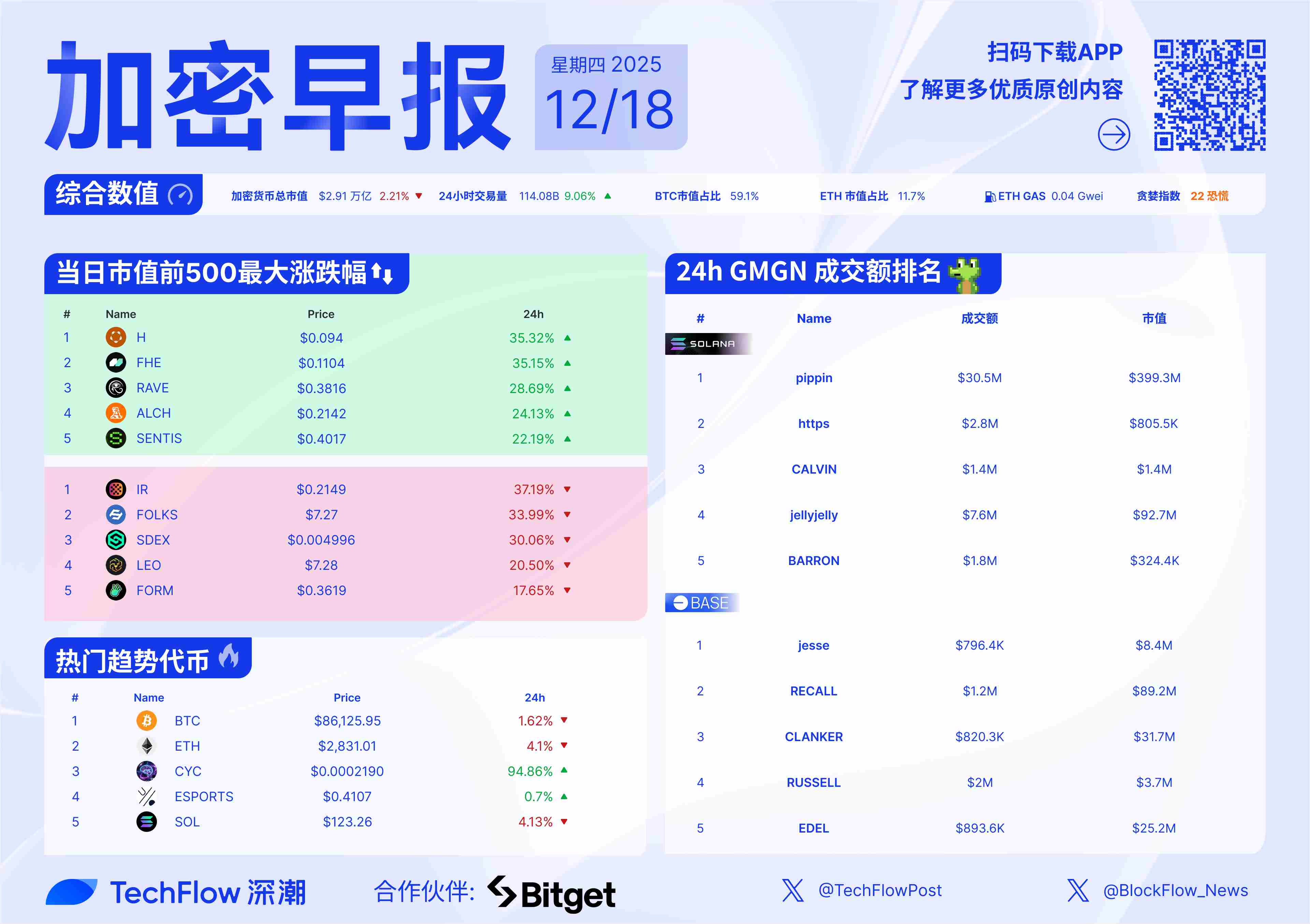
HTX market data shows that BTC dropped below $86,000 this morning and is currently trading at $86,132; ETH fell below $2,800 and is now at $2,831.

Waller: Job Market Indicates Fed Should Continue Cutting Rates

According to a report by Jinshi, Federal Reserve Governor Waller stated that inflation is above target but should decline in the coming months, and inflation expectations are well anchored. The current job market is very weak, and the existing job growth is not ideal; the job market indicates that the Fed should continue to cut interest rates.

Waller also mentioned that 2026 could be a better year for economic performance.

Coinbase Launches Stock Trading and Prediction Market Services

According to a report by CoinDesk, U.S.-listed cryptocurrency exchange Coinbase announced a major expansion of its platform's asset range during its System Update event on December 18th. The new services include stock trading, prediction markets, new cryptocurrencies, and perpetual futures, among others, aiming to solidify its market position as an "all-in-one exchange."

Coinbase will initially launch stock trading services for hundreds of stocks based on market capitalization and trading volume, with plans to add thousands more stocks and ETFs in the coming months. Users can enjoy zero-commission trading without the constraints of traditional market hours, trading 24 hours a day, five days a week. Additionally, Coinbase has partnered with prediction market provider Kalshi, valued at $11 billion, allowing users to trade on the outcomes of real-world events such as elections, sports, collectibles, and economic indicators.

Simultaneously, Coinbase also launched the AI-driven wealth management tool Coinbase Advisor and the business service Coinbase Business for startups, further expanding its business scope. Company executives stated that these new features will be supported by the Coinbase Tokenize platform, an end-to-end institutional-grade platform designed for tokenizing real-world assets.

Bloomberg: Binance Exploring Relaunch of Binance.US

According to a report by Bloomberg, Binance founder CZ is reasserting his influence in the crypto industry. As U.S. President Trump's stance on crypto assets becomes more friendly, CZ has frequently publicly affirmed related policies and signaled a positive outlook for the U.S. market.

Informed sources indicated that Binance has been exploring plans to relaunch Binance.US, including a possible recapitalization that would reduce CZ's controlling stake. The sources also mentioned that if Binance acquires part or all of CZ's shares, it could appoint new leadership, implement growth-oriented business strategies, and leverage its political connections in Washington.

Separately, informed sources revealed that Binance has been seeking closer cooperation with the world's largest asset management company, BlackRock.

Tether Launches Peer-to-Peer Password Manager PearPass

According to an official announcement, stable币 giant Tether has officially launched PearPass, a peer-to-peer (P2P) password manager designed to eliminate the risk of users' encrypted information being leaked via the cloud.

Tether stated that existing password management tools generally rely on cloud storage, and once cloud services are breached, users' sensitive data could be exposed. PearPass adopts a decentralized peer-to-peer architecture, not storing passwords in the cloud, thereby enhancing security and privacy. The official announcement noted that the product will first support mainstream browsers, with plans to expand to mobile and more platforms. This move reflects the crypto industry's continued focus on innovating user security tools.

SBI Ripple Asia to Launch XRP-Based Yield Product

According to a report by CoinDesk, Ripple's Asian venture SBI Ripple Asia announced the signing of a memorandum of understanding with Doppler Finance to launch an XRP-based yield product and explore real-world asset tokenization on the XRP Ledger. It is reported that SBI Digital Markets, regulated by the Monetary Authority of Singapore, has been designated as the institutional custodian for related products and will provide segregated custody services for client assets.

Hyper Foundation Proposes Permanent Burn of HYPE Tokens in Assistance Fund

Hyper Foundation has formally proposed a validator vote to confirm that the HYPE tokens in the Assistance Fund are considered burned, permanently removing these tokens from circulation and the total supply. The Assistance Fund, as part of the L1 execution, automatically converts transaction fees into HYPE through the system address 0xfefefefefefefefefefefefefefefefefefefefe. This address is similar to a zero address and has never had a private key; the funds within it cannot be retrieved without a hard fork.

A "Yes" vote means validators agree to treat the HYPE in the Assistance Fund as burned and commit to never authorizing any protocol upgrade that could access this address. Voting will take place on the governance forum before 04:00 UTC on December 21st. Users can stake to support validators aligned with their views before 04:00 UTC on December 24th. The final result will be based on the staking-weighted consensus as of that time.

Binance Wallet Introduces Web3 Loan On-Chain Lending Feature

According to an official announcement, Binance Wallet has launched a new Web3 Loan on-chain lending feature, allowing users to directly use existing assets as collateral within the Binance Wallet to borrow crypto assets, expanding the on-chain lending experience. This feature is implemented by integrating with the Venus protocol on the BNB Chain, enabling multi-asset collateral and borrowing. It currently supports collateral in mainstream assets including BTCB, ETH, USDT, USDC, FDUSD, WETH, and allows borrowing of USDT, USDC, and BNB. Binance Wallet stated that it will launch an exclusive Venus reward activity based on this lending feature. Users borrowing eligible assets can share a 400,000 USDT reward pool and enjoy preferential interest rates, aiming to enhance liquidity and yield potential for on-chain wealth management and lending services within the wallet.

He Yi: Offering Reward for Criminal Evidence Related to 'Listing Agent' Fraudsters

Binance Co-CEO He Yi posted a message offering a reward for criminal evidence related to fraudsters involved in 'listing agent' schemes.

Norwegian Sovereign Wealth Fund Supports All Management Proposals at Metaplanet Shareholder Meeting

According to Bitcoin Magazine citing a Bloomberg Automation summary, the Norwegian sovereign wealth fund management agency Norges Bank Investment Management (NBIM) has expressed support for several management proposals from Bitcoin treasury company Metaplanet and will exercise its voting rights at the shareholder meeting on December 22nd. Data shows that as of the end of June 2025, NBIM holds approximately 0.3% of Metaplanet's shares. The Norwegian sovereign fund's series of moves to increase its Bitcoin exposure through public market asset allocation reflects sovereign-level long-term capital's recognition of the company's strategic direction.

Informed Sources: Crypto VC Firm Shima Capital Quietly Winding Down Operations

According to informed sources disclosed by Kate Irwin, cryptocurrency venture capital firm Shima Capital is quietly winding down its business operations. Three weeks ago, the U.S. Securities and Exchange Commission (SEC) filed a lawsuit against the company and its founder, Yida Gao, accusing them of "participating in a fraudulent scheme" to deceive investors. According to an email sent to portfolio company founders, Yida Gao is resigning and closing the fund. In the email, he stated: "I deeply regret my poor decisions and apologize for letting everyone down."

Shima Capital was founded in 2021 with $200 million in capital and had invested in several crypto projects including Berachain, Monad, and Pudgy Penguins. The SEC accused Yida Gao of exaggerating investment returns in promotional materials, claiming a 90x return on an investment that actually only yielded 2.8x. Furthermore, Fortune magazine reported that Yida Gao transferred investment funds to offshore entities wholly owned by himself without disclosing this to investors.

The day after the SEC filed the lawsuit, Yida Gao agreed to pay a settlement of approximately $4 million.

Miner Hut 8 Signs $7 Billion Data Center Lease Agreement

Bitcoin miner Hut 8 announced on platform X that it has signed a 15-year data center lease agreement worth $7 billion with Fluidstack for its 245-megawatt data center at the River Bend campus. Additionally, Fluidstack can add up to an additional 1,000 megawatts of capacity in future expansion phases of the campus, with specific terms dependent on the campus's installed capacity.

Market Dynamics
Recommended Reading

On the Eve of the Bank of Japan's Rate Hike, Why Did Bitcoin Fall First?

This article analyzes the reasons behind Bitcoin's recent price drop, pointing out that expectations of a Bank of Japan rate hike have triggered a global liquidity tightening, leading to the prioritization of selling high-volatility assets like Bitcoin. The article also explores whether the narrative of Bitcoin as "digital gold" still holds and how its pricing logic has changed due to institutionalization.

Can Pump.fun Tell a New Story Next Year?

This article focuses on the current state and future development of Pump.fun as a consumer application, analyzing its creator token model, market performance, challenges faced, and potential future strategic directions. Despite uncertainties, Pump.fun has shown some resilience in the current cycle and maintains a certain dominance in the crypto space.

Crypto is Dead, Long Live Crypto

This article describes the transformation the crypto industry is undergoing, moving from a closed, self-centered ecosystem towards a more universal, mainstream-integrated technological infrastructure. The article explores the future of crypto technology, emphasizing the need to shift from serving "crypto natives" to providing value for a broader user base, while also pointing out the industry's current limitations and possible future directions.

Roundup: 11 Intersection Scenarios of Artificial Intelligence and Cryptocurrency

This article delves into the intersection points of Artificial Intelligence (AI) and crypto technology, listing 11 specific application scenarios that showcase the potential and challenges of both in the future internet. The article emphasizes the role of blockchain technology in enhancing the openness, decentralization, and credible neutrality of AI systems, providing an in-depth analysis of the potential technological changes, business model innovations, and social impacts resulting from the combination of AI and blockchain.

I Dropped Out of High School, Learned with AI, and Made a Comeback to Become an OpenAI Researcher

This article tells the comeback story of Gabriel Petersson from high school dropout to OpenAI research scientist, focusing on his unique method of self-learning through AI—recursive knowledge filling. It analyzes strategies for efficiently utilizing AI for learning while cautioning against treating AI merely as a tool, but rather as a learning aid and thinking trainer.


Preguntas relacionadas

QWhat new services did Coinbase announce during its System Update event on December 18th?

ACoinbase announced the expansion of its platform to include stock trading, prediction markets, new cryptocurrencies, and perpetual futures. It will first offer hundreds of stocks for trading with zero commissions and 24/5 availability, and it partnered with prediction market provider Kalshi.

QAccording to Bloomberg, what is Binance exploring regarding its US operations?

ABinance is exploring options to restart Binance.US, which could involve a recapitalization that would reduce founder CZ's controlling stake. The company is also reportedly seeking a closer partnership with asset management giant BlackRock.

QWhat is the main security feature of Tether's new password manager, PearPass?

APearPass is a peer-to-peer (P2P) password manager that enhances security and privacy by not storing passwords in the cloud, eliminating the risk of data exposure from a breach of cloud services.

QWhat did the Hyper Foundation propose regarding the HYPE tokens in its Assistance Fund?

AThe Hyper Foundation proposed a validator vote to confirm that the HYPE tokens in the Assistance Fund should be considered permanently burned, thus removing them from circulation and the total supply forever.

QWhat significant deal did bitcoin miner Hut 8 sign, as announced on their X platform?

AHut 8 signed a 15-year, $7 billion data center leasing agreement with Fluidstack for a 245-megawatt facility, with the potential for an additional 1,000 megawatts in future expansion phases.

Lecturas Relacionadas

Tras la aprobación de la Ley GENIUS y la Ley CLARITY, ¿cuál es realmente la arquitectura correcta para los rendimientos en cadena?

El artículo analiza la evolución del crédito en blockchain, destacando tres categorías: préstamos cripto con sobrecolateralización, préstamos sin garantía y **crédito respaldado por activos (ABC)**. Este último es el de mayor crecimiento y la única solución creíble al problema de **selección adversa** en el ecosistema. Actualmente, el ABC en blockchain se implementa principalmente a través de fondos tokenizados, lo que no resuelve el problema de fondo, sino que traslada el riesgo del gestor del fondo. La propuesta clave es resolverlo a nivel de protocolo, codificando la evaluación, estructura y recuperación en la **bóveda (vault)** inteligente misma. El marco regulatorio estadounidense, con las leyes **GENIUS** y **CLARITY**, prohíbe que las stablecoins paguen rendimientos directamente. Esto convierte a las bóvedas (como las estándar ERC-4626) en el vehículo fundamental para ofrecer rendimientos de forma regulada y transparente. Por lo tanto, el diseño de estas bóvedas —su permisividad, contabilidad, divulgación y cumplimiento— se vuelve crítico. El futuro, en un plazo de 12 a 18 meses, dependerá de construir productos de ABC conformes, centrados en Estados Unidos y diseñados desde su base para la nueva era regulatoria, aprovechando la enorme base de capital existente en stablecoins.

Foresight NewsHace 24 min(s)

Tras la aprobación de la Ley GENIUS y la Ley CLARITY, ¿cuál es realmente la arquitectura correcta para los rendimientos en cadena?

Foresight NewsHace 24 min(s)

TechFlow 情报局:Nuevo modelo Fable de Anthropic genera polémica por limitar la investigación en bioseguridad, el IPC de EE.UU. sube a 4.2%, máximo en tres años

**Resumen:** La compañía de IA Anthropic enfrenta críticas por limitaciones "silenciosas" en sus modelos Fable y Mythos para investigación en ciencias biológicas, alegando motivos de seguridad. Tras el escándalo, anunciaron que informarán a los usuarios sobre ajustes futuros. En otro episodio de la pugna entre gigantes de IA, Dario Amodei, cofundador de Anthropic, reveló que su salida de OpenAI se debió a la deshonestidad de Sam Altman, no a desacuerdos sobre seguridad. Mientras tanto, OpenAI planea recortes de precios agresivos para competir. En cripto, BlackRock avanza con su ETF de Bitcoin con generación de rendimientos, mientras el CEO de Bank of America advierte que las stablecoins podrían drenar billones de dólares en depósitos bancarios. A pesar de una inflación estadounidense (IPC) en 4.2% (máximo en 3 años) y el cierre del estratégico Estrecho de Ormuz por Irán, el Bitcoin cayó, cuestionando su narrativa como "activo refugio". En hardware, Nvidia y AMD intensifican su rivalidad con nuevos modelos de IA y arquitecturas para desafiar el dominio de CUDA. Un fallo judicial alemán marcó un hito al declarar a Google legalmente responsable por las respuestas incorrectas de su AI Overviews. La tensión geopolítica escaló con Irán cerrando el Estrecho de Ormuz, amenazando el 20% del transporte global de petróleo y provocando ataques de represalia de EE.UU. Los mercados reaccionaron con caídas en acciones y oro, mientras el petróleo subía. Tres desarrollos subrayan los dilemas de nuestro tiempo: las restricciones de Anthropic a la investigación, la responsabilidad legal de Google por su IA y el primer caso reportado de un dron autónomo que mata a un soldado, delinean la urgente necesidad de definir los límites éticos y legales de la IA. La tecnología avanza, pero debe navegar un mundo real de inflación, conflicto e incertidumbre económica.

marsbitHace 38 min(s)

TechFlow 情报局:Nuevo modelo Fable de Anthropic genera polémica por limitar la investigación en bioseguridad, el IPC de EE.UU. sube a 4.2%, máximo en tres años

marsbitHace 38 min(s)

Otra nueva división empresarial de Alibaba, ¿qué señal es?

En junio, Alibaba anunció su tercera reorganización de IA en 2026, fusionando sus dos principales equipos de IA, el Departamento de Modelo Grande Tongyi y el Laboratorio de Vida Futura, para formar el nuevo Departamento de Token Foundry. Este departamento, dirigido personalmente por el CEO del grupo, Wu Yongming, tiene como objetivo centralizar recursos y acelerar la comercialización de la IA. La reorganización también incluye el nombramiento de Zhou Jingren, fundador del sistema Qwen, como Científico Jefe del grupo para liderar el nuevo Instituto de Investigación del Futuro de la IA de Alibaba. El departamento Token Foundry ("Fábrica de Tokens") refleja la estrategia de Alibaba de actuar como proveedor fundamental en la era de la IA, enfocándose en la creación y aplicación de "tokens" de IA. Esta movida sigue a la creación previa del grupo de negocio ATH (Alibaba Token Hub) y el Comité de Tecnología del grupo, señalando una transición desde la fase de "integración de recursos" hacia la de "aceleración de la implementación". La nueva estructura organizativa de cuatro niveles (investigación, modelo base, plataforma de servicios, productos de aplicación) busca equilibrar la innovación a largo plazo con las necesidades comerciales a corto plazo. El cambio de rol de Zhou Jingren hacia la investigación de vanguardia, liberado de la gestión operativa, junto con el enfoque comercial del Token Foundry dirigido por el CEO, muestra la estrategia dual de Alibaba: competir en el presente mientras invierte en el futuro. Este ajuste se produce cuando Alibaba declara que su negocio de IA ha entrado en una fase de retorno comercial, con ingresos recurrentes anuales (ARR) relacionados con la IA proyectados para superar los 30.000 millones de yuanes a fin de año. La reorganización de Alibaba refleja una tendencia global entre los grandes jugadores tecnológicos (Google, Microsoft, Meta, Amazon) de consolidar sus equipos de IA bajo un mando unificado y directo del CEO para reducir la fricción interna y acelerar el desarrollo. Esto ocurre en un contexto de creciente competencia en el campo de MaaS (Modelo como Servicio) y de reducción de la ventana de oportunidad en la industria de la IA, donde la carrera ha pasado de ser solo sobre parámetros de modelos a incluir capacidades de ingeniería, comercialización y ecosistema.

marsbitHace 1 hora(s)

Otra nueva división empresarial de Alibaba, ¿qué señal es?

marsbitHace 1 hora(s)

Del regreso a la dimisión: Los 437 días de Chen Hang en DingTalk

Durante 437 días, Chen Hang, fundador de DingTalk, regresó como CEO con la misión de transformar la plataforma de trabajo en la principal aplicación de IA para empresas de Alibaba. Su gestión se caracterizó por una disciplina férrea, con medidas controvertidas como horarios estrictos y auditorías de productividad, que generaron malestar interno y críticas públicas. Bajo su liderazgo, DingTalk lanzó AI DingTalk 1.0, presentando el proyecto "ONE" como nueva entrada interactiva basada en IA, y posteriormente la versión 2.0 con la plataforma empresarial nativa de IA "Wukong". Este último implicó una reescritura completa del código base para permitir que la IA ejecute tareas automáticamente, cambiando el enfoque de la herramienta. Sin embargo, la presión por resultados rápidos, combinada con los intensos métodos de gestión, culminó en dos artículos virales escritos por empleados que exponían una cultura laboral tóxica. Esto llevó a una inusual reprimenda pública del Comité de Socios de Alibaba. Como consecuencia, Chen Hang fue reemplazado el 11 de junio por Chen Yusen, un técnico de 32 años conocido por su estilo más colaborativo. Aunque Chen Hang sentó las bases tecnológicas para la estrategia de IA de Alibaba, su partida marca un cambio hacia una cultura corporativa más abierta e inclusiva, mientras DingTalk busca reinventarse en la nueva era de la inteligencia artificial.

marsbitHace 1 hora(s)

Del regreso a la dimisión: Los 437 días de Chen Hang en DingTalk

marsbitHace 1 hora(s)

Trading

Spot
Futuros

Artículos destacados

Cómo comprar US

¡Bienvenido a HTX.com! Hemos hecho que comprar Talus Network (US) sea simple y conveniente. Sigue nuestra guía paso a paso para iniciar tu viaje de criptos.Paso 1: crea tu cuenta HTXUtiliza tu correo electrónico o número de teléfono para registrarte y obtener una cuenta gratuita en HTX. Experimenta un proceso de registro sin complicaciones y desbloquea todas las funciones.Obtener mi cuentaPaso 2: ve a Comprar cripto y elige tu método de pagoTarjeta de crédito/débito: usa tu Visa o Mastercard para comprar Talus Network (US) al instante.Saldo: utiliza fondos del saldo de tu cuenta HTX para tradear sin problemas.Terceros: hemos agregado métodos de pago populares como Google Pay y Apple Pay para mejorar la comodidad.P2P: tradear directamente con otros usuarios en HTX.Over-the-Counter (OTC): ofrecemos servicios personalizados y tipos de cambio competitivos para los traders.Paso 3: guarda tu Talus Network (US)Después de comprar tu Talus Network (US), guárdalo en tu cuenta HTX. Alternativamente, puedes enviarlo a otro lugar mediante transferencia blockchain o utilizarlo para tradear otras criptomonedas.Paso 4: tradear Talus Network (US)Tradear fácilmente con Talus Network (US) en HTX's mercado spot. Simplemente accede a tu cuenta, selecciona tu par de trading, ejecuta tus trades y monitorea en tiempo real. Ofrecemos una experiencia fácil de usar tanto para principiantes como para traders experimentados.

853 Vistas totalesPublicado en 2025.12.11Actualizado en 2026.06.02

Cómo comprar US

Discusiones

Bienvenido a la comunidad de HTX. Aquí puedes mantenerte informado sobre los últimos desarrollos de la plataforma y acceder a análisis profesionales del mercado. A continuación se presentan las opiniones de los usuarios sobre el precio de US (US).

活动图片












