Written by: Prathik Desai
Compiled by: Chopper, Foresight News
Throughout the long history of banking, depositors have always been in a disadvantaged position. People deposit their money in banks, which then lend out these funds, earning profits many times greater than the interest paid to depositors. Depositors accept this model because there has been no better alternative: holding cash in hand only leads to its value shrinking over time.
Currently, the average interest rate for a regular savings account in the U.S. is only 0.6%, but investing in U.S. Treasury bonds and money market funds can yield at least 4%. The core reason this traditional model has operated for so long is that depositors have consistently lacked convenient alternatives. However, new choices emerge in the market every few decades.
Stablecoins, built on blockchain technology, enable 24/7 circulation, transaction settlement in seconds, and transfer costs of less than one cent. Although relevant laws prohibit stablecoin issuers from directly distributing interest to holders, the composable nature of decentralized finance allows users to deposit stablecoins into lending protocols, earning 5% to 8% annualized returns. This provides depositors with a new destination for their funds without compromising on convenience.
In this article, we will analyze the various measures banks are taking to prevent deposit outflows and how this transformation will reshape the global banking industry and the flow of funds.
Depositor Behavior
In 1977, Merrill Lynch, a wealth management and investment firm, launched the Cash Management Account (CMA). At that time, the U.S. Regulation Q stipulated that bank deposit interest rates could not exceed 5.25%, while U.S. Treasury yields exceeded 7%. Merrill Lynch identified a regulatory loophole, using the CMA feature to automatically transfer clients' idle funds from their securities accounts into money market funds daily. Simultaneously, Merrill Lynch also provided clients with checking account and debit card services.
Combining these multiple functions, clients could enjoy market-level high yields while having the flexibility to withdraw funds as needed, just like a regular demand account. As a result, the scale of money market funds exploded, soaring from approximately $4 billion in 1977 to $220 billion in 1982—a 55-fold increase—driven by massive outflows of bank deposits.
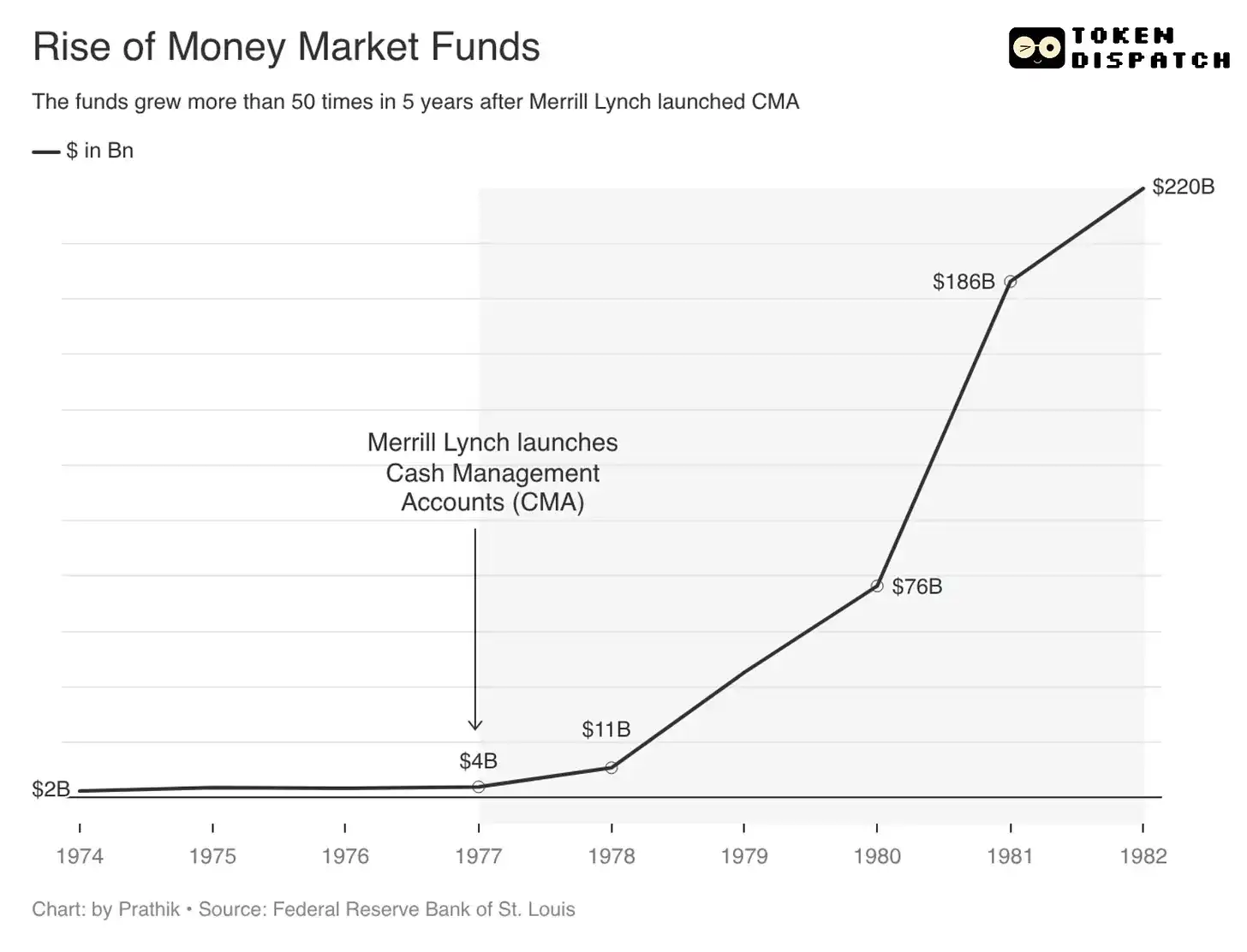
The banking industry immediately protested collectively. Ultimately, the U.S. Congress repealed the interest rate cap under Regulation Q, and major banks promptly introduced money market deposit accounts, attracting deposits back with higher yields. The entire process, from the introduction of the CMA to the removal of deposit interest rate restrictions, took nine years.
Today, technological advancements have shortened fund transfers to minutes or even less, and depositors are no longer willing to wait for extended periods.
On March 8, 2023, during the Silicon Valley Bank crisis, depositors initiated withdrawal requests totaling $42 billion in under eight hours, averaging about $1.5 million per second. Over 85% of the bank's deposits were uninsured, which was the core reason for the concentrated bank run.
Prudent depositors always move their funds to safer places where the money can at least preserve its value, or even appreciate.
Two Forms of Digital Dollars
To address this issue, two competing forms of digital dollars have emerged in the market, each with distinctly different trajectories: one leads funds out of the banking system, while the other keeps them within the system, albeit in a transformed form.
The First: Stablecoins
Taking USDC issued by Circle as an example, when users exchange dollars for USDC, the corresponding fiat funds are used to purchase U.S. Treasuries, thereby leaving the bank's balance sheet. This reduces the principal banks have available for lending and earning interest spreads. Simultaneously, such funds no longer enjoy insurance from the U.S. Federal Deposit Insurance Corporation (FDIC). If the stablecoin issuer ceases operations, holders may struggle to recover their principal.
The GENIUS Act, which took full effect in July 2025, establishes regulatory rules specifically for the issuance and use of stablecoins. The Act explicitly prohibits stablecoin issuers from paying interest to users, a control approach reminiscent of Regulation Q's deposit interest rate restrictions. However, just as Merrill Lynch circumvented Regulation Q by using money market funds to achieve high yields, stablecoin issuers now provide returns in disguise through reward distributions, with related disputes still under legislative discussion in the CLARITY Act. Additionally, users can deposit stablecoins into various lending protocols to earn returns independently.
For the banking industry, this is undoubtedly an existential threat. During the Silicon Valley Bank collapse, massive deposits left the banking system within hours. Standard Chartered predicts that by 2028, up to $500 billion in bank deposits could gradually shift to stablecoins, with U.S. regional banks being the most severely impacted, as their revenue heavily relies on net interest margin business.
Even if these predictions do not fully materialize, the trend of deposit outflow is already clear. It is precisely for this reason that America's four largest banks have joined forces for the first time in decades to explore new countermeasures.
The Second: Tokenized Deposits
The core advantages of stablecoins are low transfer costs and sub-second settlement. In response to this pain point, the banking industry has introduced tokenized deposits.
Banks can convert a user's deposit into a tokenized form on-chain. These tokens can circulate on blockchain networks with low cost and high efficiency. Meanwhile, the original dollar deposit remains on the bank's balance sheet, allowing the bank to continue normal lending operations and earn interest, with the tokenized deposit still insured by the FDIC.
Currently, two major banking consortia have formed to advance the implementation of tokenized deposits.
The first is a clearinghouse network. Over a dozen institutions, including JPMorgan Chase, Citibank, Bank of America, and Wells Fargo, are jointly building a unified tokenized deposit platform scheduled for launch in the first half of 2027. This platform primarily targets institutional clients, aiming to provide 24/7 settlement, programmable fund clearing, and cross-border payment functionalities, directly competing with stablecoins.
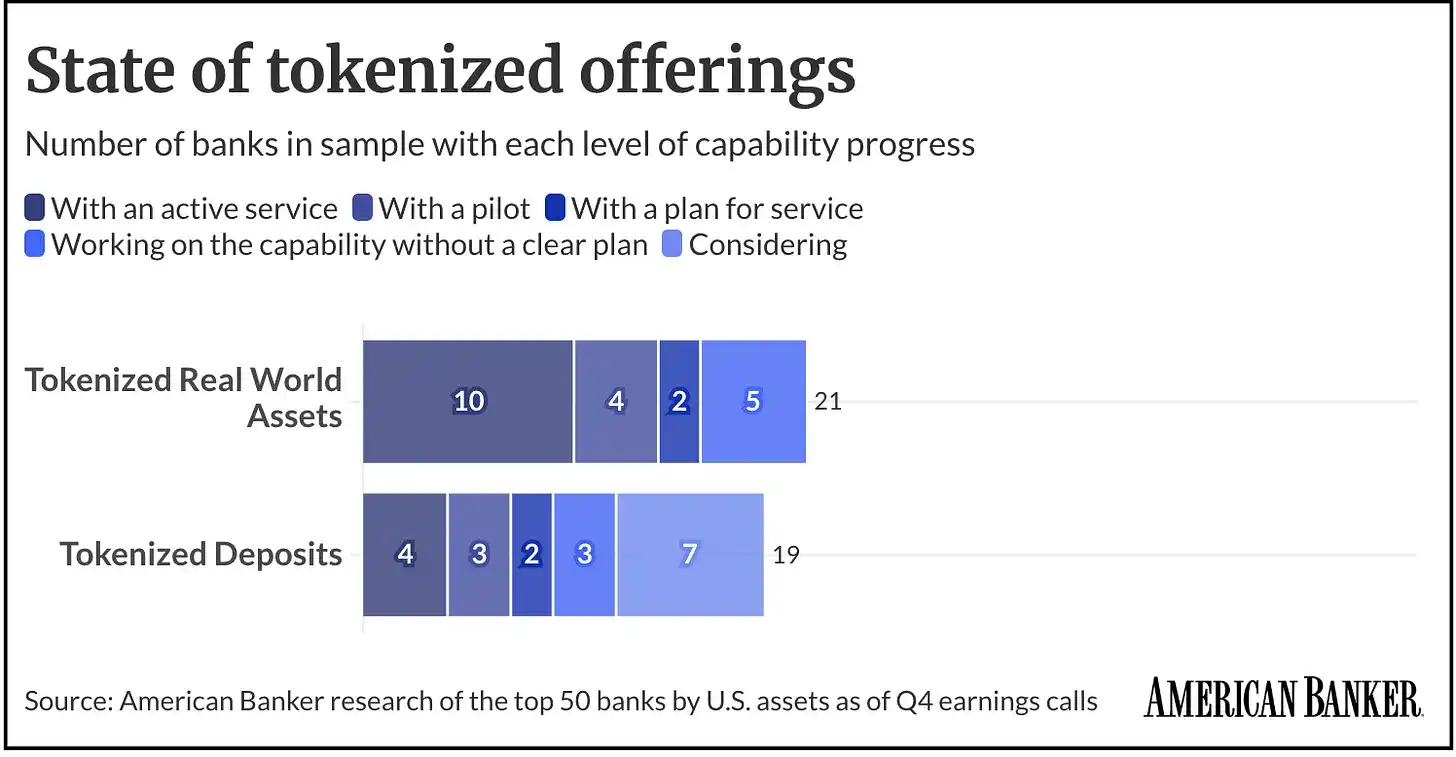
The second is the Cari Network, composed of five regional banks including Huntington, M&T, KeyCorp, First Horizon, and Old National, with combined assets under management of approximately $780 billion. The network leverages the Prividium technology stack of the zero-knowledge proof public chain ZKsync to build a tokenized deposit platform for retail users, expected to launch in Q4 2026. The proactive efforts of regional banks highlight the severity of the deposit outflow risk posed by stablecoins, as these banks' survival heavily depends on net interest margin income.
So, which product will depositors ultimately favor?
Historical experience suggests that when choosing products, depositors often do not simply evaluate the product's merits in isolation but prioritize the option that most easily alleviates their current pain points regarding fund usage.
In the late 1970s, depositors' core demand was to increase returns. Constrained by Regulation Q, while bank deposits were safe, they lost competitiveness when market interest rates rose. Merrill Lynch's innovation was to deconstruct the bank account into two core needs: yields matching market levels and the convenience of daily flexible access. Once regulations lifted interest rate restrictions, major banks also introduced money market deposit accounts, integrating similar functionalities.
Today, stablecoins possess advantages similar to Merrill Lynch's product back then: they operate independently of the traditional deposit system, support global circulation, can connect to various crypto platforms, and enable programmable use of idle funds. However, they also share the same weaknesses as the money market funds of that era: they are not insured bank liabilities, and asset security depends entirely on the issuer, reserve asset structure, redemption channels, and the overall regulatory environment.
Tokenized deposits replicate the advantages of traditional banks from the 1980s: funds remain within the regulated banking system, preserving banks' lending profit model while continuing the familiar deposit insurance mechanism. However, precisely because they adhere to the regulatory rules of the banking system, tokenized deposits lack the openness, circulation, and composability of stablecoins. Bank deposits can be accelerated and made programmable, but once they fully possess the open attributes of stablecoins, banks lose their core control over deposits.
Thus, the core of the competition between the two sides is gradually evolving into a struggle over the authority to convert funds.
Against this backdrop, a third development path has emerged, offering a glimpse into the future shape of banking and currency forms.
The Bridge of Integration
On May 27 of this year, SoFi Bank officially launched SoFiUSD, the first stablecoin issued by a U.S. national bank. The token is already live on the Ethereum and Solana public chains, and the platform's 15 million users can exchange and use it via the mobile App. SoFiUSD possesses all the characteristics of a stablecoin: 24/7 circulation, cross-border transfers settled in seconds, and per-transfer fees of just a few cents.
Simultaneously, users can convert SoFiUSD into tokenized deposits within the same App. These deposits can generate interest and are insured by the FDIC. Users gain the flexibility to switch forms: using stablecoins for convenient fund circulation and converting to tokenized deposits when seeking interest earnings and security. If dissatisfied with the bank's yield, they can convert back to stablecoins and deposit them into various lending protocols to pursue higher returns.
SoFi may never become more decentralized than Circle, nor may its overall scale surpass JPMorgan Chase, but it has created a unique advantage: integrating bank accounts, stablecoin wallets, and tokenized deposits into a single application interface.
This model more closely resembles Merrill Lynch's innovative approach from back then, distinct from pure stablecoin issuers or traditional banking consortia. SoFi aims to eliminate the user's dilemma of choosing between the convenience of blockchain technology and the earning power of bank deposits.
The evolution of various products confirms a truth: in the context of fund storage and circulation, the form of the product itself is not the key; the core lies in the ability to freely convert between forms.
Faced with the impact of stablecoins, the banking industry's initial response was to lobby regulators to prohibit stablecoins from distributing earnings and rewards. However, relying solely on regulatory pressure is unlikely to win this competition. The only way for the banking industry to break through is to proactively evolve, matching or even surpassing the capabilities of crypto products: combining interest earnings and deposit insurance with the foundation of instant transfers and programmability. Interestingly, the enabler for this upgrade is precisely blockchain technology.
This is the charm of the market: it forces traditional industries to continuously evolve until the entire ecosystem maximizes benefits for participants. Back then, Merrill Lynch's CMA forced the U.S. to repeal Regulation Q and prompted banks to introduce money market deposit accounts; today, the rise of stablecoins is pushing banks to develop tokenized deposits and build 24/7 settlement systems. In both transformations, the traditional industry was not completely eliminated but absorbed the advantages of innovative products to complete self-iteration and maintain industry position.
In this round of transformation, regional banks face the most severe impact. These banks are more dependent on net interest margins and have far less room to withstand deposit outflows compared to large banks. If they only optimize traditional bank accounts, they will lose users pursuing high liquidity; if they blindly match the transfer speed of crypto products, they will sacrifice their core advantages of deposit insurance and lending profitability. The Cari Network is an attempt at self-rescue by regional banks, the clearinghouse consortium represents the defensive strategy of large banks, while SoFi has chosen a more radical path: proactively building an integrated service bridge to avoid being preempted by external entities.
Looking back at the patterns of financial development, emerging sectors often break through by identifying inefficiencies in traditional systems; once the related pain points become impossible to ignore, traditional giants absorb the new functionalities to complete upgrades and stabilize their market position. In the past, Merrill Lynch pointed out the disconnect between deposit interest rate caps and market yields; banks later addressed this shortcoming with money market deposit accounts. Today, stablecoins expose the drawbacks of traditional banks settling only on business days and restricted fund circulation; banks are now starting to address these shortcomings with tokenized deposits and 24/7 settlement functionalities.
The ownership of industry advantages has gradually shifted from the innovative product that initially identified the problem to the institutions capable of integrating functionalities, operating compliantly, and scaling the implementation of solutions.
We have been discussing a viewpoint lately: the crypto industry, or more precisely, blockchain technology, is becoming the underlying infrastructure for fintech.
This judgment holds true in this transformation as well. Blockchain is not meant to completely replace bank deposits but to force the industry to deconstruct the value dimensions of various services: yield is one layer of value, settlement efficiency is another, deposit insurance is yet another, and the ability to freely convert between forms might be the highest-value layer among them.
Regardless of how the industry evolves, bank deposits will not disappear entirely; they will only be deconstructed and reconfigured. The ultimate winners will inevitably be those institutions that enable frictionless switching of funds between security, yield, and high liquidity.







