Airwallex Invests in Metal: How Stablecoins Reconnect with the Real Financial System?

Foresight NewsPublicado a 2026-07-03Actualizado a 2026-07-03

Resumen

Airwallex Invests in Metal: How Stablecoins Connect Back to the Real Financial System? Airwallex, a global financial platform for businesses, has completed a $3.2 billion Series H funding round at an $11 billion valuation. Concurrently, it co-led the seed round for Metal, a "tokenized financial products infrastructure" project, becoming its first design partner. This move signals Airwallex's strategic shift beyond traditional cross-border payments. It aims to leverage its decade of experience in licenses, local payment networks, and API infrastructure to address a new challenge: facilitating the entry of stablecoins, tokenized assets, and AI agents into enterprise financial systems. This involves handling critical functions like authorization, compliance, currency exchange, fiat on/off-ramps, and final settlement. Metal positions itself not merely as another stablecoin payment solution but as a compliant settlement layer (Layer 1 blockchain) designed for regulated financial institutions. It targets a broader scope of tokenized financial products, including stablecoins, tokenized deposits, and securities. The core challenge it addresses is connecting efficient on-chain assets with the complex realities of corporate finance, such as multi-currency bank accounts, securities, compliance checks, and local regulations. Airwallex's investment, alongside its founder-backed fund Capital49, provides Metal with crucial real-world infrastructure: access to local payment networks cove...


Written by: KarenZ, Foresight News


Moving money from New York to Singapore, the hardest part might not be 'moving fast.' It also needs to know who can move this money, which currency to convert it into, what compliance rules to follow, and finally, which bank account it should land in. As AI Agents start placing orders, making payments, and managing accounts for businesses, these problems will only be magnified.


On June 25th, Airwallex (Airwallex) completed a $320 million Series H financing round, reaching a valuation of $11 billion, and announced that the funds would be directed towards financial intelligence, agent commerce, global infrastructure, and compliance expansion.


On the same day, Metal announced that Airwallex and Capital49 (an independent venture capital fund founded by the Airwallex founding team) jointly led its seed round, with Airwallex becoming Metal's first design partner.


From a Web3 perspective, putting these two pieces of news together, the focus is not just on a strategic investment by Airwallex in Metal. More noteworthy is that Airwallex is placing the licenses, local payment networks, and API infrastructure it has accumulated over the past decade into a new proposition: when stablecoins, tokenized assets, and AI Agents are all to enter the enterprise financial system, who will be responsible for authorization, compliance, currency exchange, on/off-ramping, and final settlement?


From Cross-Border Payments to Agent Finance, Airwallex Aims to Get Closer to the Foundation


Airwallex's story has always been related to cross-border finance. In 2015, Jack Zhang and several entrepreneurs encountered the inefficiency, delays, and high costs of traditional banks and foreign exchange systems firsthand while running a cafe in Melbourne, leading to the founding of Airwallex.


Today, Airwallex positions itself as a modern financial platform for global businesses, connecting banks, payments, software, and AI.


This company has evolved from 'helping businesses receive and send cross-border payments cheaper and faster' to a more complex position. According to Airwallex's website, it currently supports over 200 countries, covers over 120 countries for local transfers, has processed over $287 billion in global payments cumulatively, with 92% of transfers settled on the same day and 50% processed instantly. The company also holds over 85 licenses and registrations, has over 2,300 employees, and 27 international offices.


The Series H financing round on June 25th made this direction even clearer. Airwallex officially announced that this round was led by existing shareholder Addition, with participation from existing and new investors including Baillie Gifford, Hummingbird, QED Investors, T. Rowe Price, Hedosophia, Haun Ventures, Washington University in St. Louis, and Amex Ventures.


The funds will be used to accelerate the research and development of financial intelligence and agent commerce products, expand global infrastructure and compliance in new markets, and grow the team to build next-generation AI-native financial software.


Jack Zhang's statement in the announcement is key. He said we are at a crucial juncture in the history of global financial development; ten years ago, the company could not clearly foresee the shape of the agent economy, but the financial licenses, local network integrations, and API-first financial infrastructure built over the past decade happen to fit the needs of today's agent economy.


This statement also explains why Airwallex is interested in Metal. Agent commerce is not as simple as getting AI to click a few more buttons. Once AI Agents start handling procurement, payments, reimbursements, foreign exchange, subscriptions, and revenue management for businesses, they require financial infrastructure that can be authorized, have limits set, settle across currencies, and undergo compliance reviews. Airwallex's licenses, local payment networks, and API capabilities are the entry point for this system in the real world.


What Metal Aims to Do Is Not 'Just Another Stablecoin Payment'


Six months ago, Loong Wang (co-founder of Metal) met Jack Zhang through a mutual friend and investor. Loong wrote in Metal's official blog that the two quickly began discussing a new type of financial infrastructure: it needed to be global, neutral, and institution-ready, capable of serving the next phase of finance represented by AI Agents, stablecoins, and tokenized financial products.


Metal defines itself as 'tokenized financial products infrastructure.' It is betting not on a single stablecoin payment scenario, but on a broader range of tokenized financial products, including stablecoins, tokenized bank deposits, money market products, US short-term treasuries, stocks, and securities. The application directions listed on Metal's website also include: tokenized financial products, stablecoin payments, inter-institutional settlement, micropayments, AI Agents, and embedded finance.


Stablecoins have already proven the efficiency of on-chain US dollars. They can make dollars cheaper, faster, and liquid 24/7. The judgment cited in Metal's official blog is that stablecoins have been growing at about 100% annually in recent years and are expected to reach a circulation of about $500 billion and a transaction volume of about $17.5 trillion by the end of 2026.


But corporate finance is far more complex than 'transfers.' Real-world settlement also involves bank deposits, securities, money market funds, foreign exchange conversion, accounts receivable, anti-money laundering reviews, regional rules, internal institutional risk control, and local on/off-ramps. Stablecoins are like a highway, but businesses need the highway, toll booths, customs, warehouses, and city roads to operate together.


This is also why Metal chose to build a compliant settlement network. Jack Zhang, when reposting Metal's announcement on June 25th, stated that Metal is a Layer 1 blockchain designed for 'large-scale compliant global settlement,' filling the infrastructure gap for licensed financial institutions to move and settle stablecoins securely, efficiently, and within a regulatory framework.


Catherine Porter, another co-founder and president of Metal, previously led partnerships for the Libra project and served as an advisor to Mysten Labs and Aptos.


The Position of Airwallex, Capital49, and Jack Zhang


The combination of Airwallex and Capital49 in Metal's seed round is very informative.


Metal stated that through the partnership with Airwallex, the Metal infrastructure will gain support from a local payment network covering 200 countries and 90 currencies.


This means Airwallex brings Metal not just brand endorsement, but a crucial piece of the puzzle for 'how on-chain assets enter the real world.' If tokenized financial products cannot enter bank accounts, local currencies, and corporate financial systems, it's difficult for them to evolve from on-chain narratives to institution-grade settlement tools. Airwallex's strengths lie exactly here: local payment networks, foreign exchange capabilities, licenses, APIs, and corporate finance scenarios.


The role of Capital49 is more like an early-stage capital extension of the Airwallex founders' network. Capital49 is a new venture capital fund backed by Airwallex founders, investing in fintech, e-commerce, artificial intelligence, and B2B software. One of its advantages is enabling portfolio companies to access potential clients, service providers, and advisory resources within Airwallex's global network.


Interpreting Airwallex and Capital49 jointly leading the investment in Metal simply as 'a payment company investing in a Web3 project' would be inaccurate. More precisely, it's a company with existing global financial infrastructure, together with the founder capital network behind it, betting on the next-generation settlement layer. This settlement layer must handle stablecoins, but also AI Agents, tokenized assets, compliance authorization, and local on/off-ramping.


Jack's change in attitude can also be viewed within this framework. On June 7, 2025, Jack publicly questioned the claim that 'stablecoins can reduce foreign exchange fees.' His core point at the time was that if a user sends money from USD to EUR, and the recipient ultimately needs to receive euros in their bank account, the cost of off-ramping stablecoins to local currency might be higher than the interbank forex market.
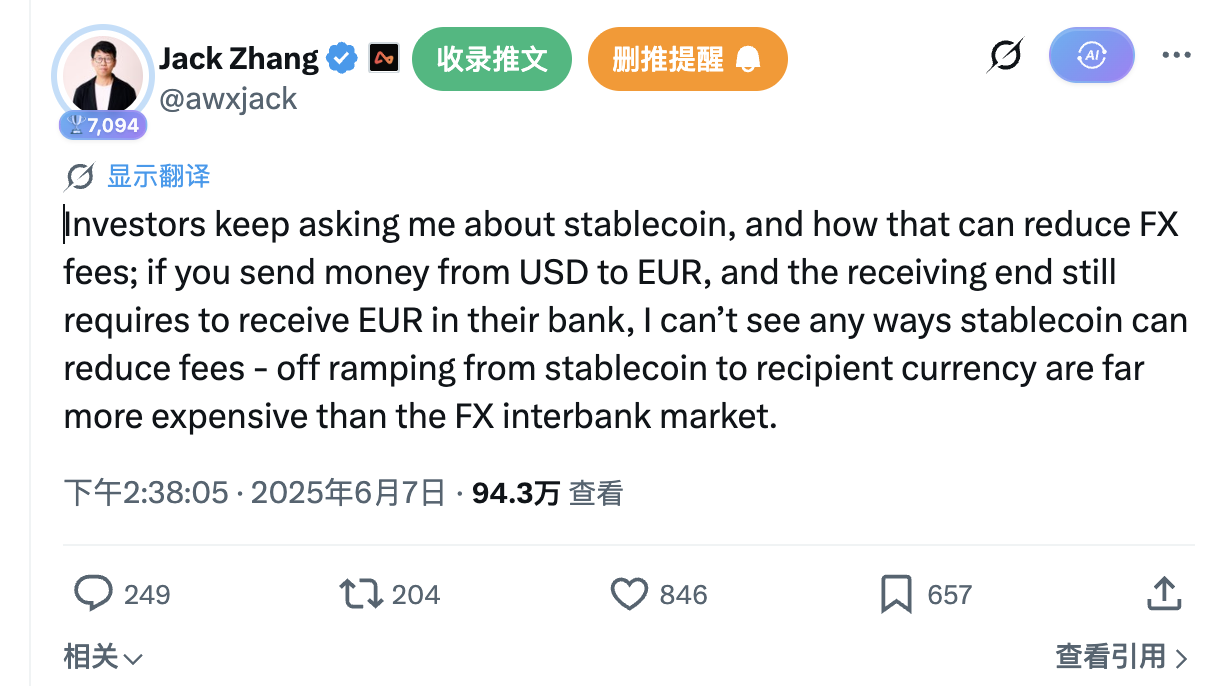


A year later, he publicly supports Metal, emphasizing its capabilities for compliant global settlement for licensed financial institutions. The change here is not simply 'from doubting stablecoins to being optimistic about stablecoins.' What he supports now is an infrastructure solution that integrates stablecoins, compliance, on/off-ramping, local currencies, institutional settlement, and agent commerce.


In addition, Airwallex's same-day announcements of T:0 and Airi can also be observed together. T:0 is an AI-native financial platform aiming to handle financial functions like bookkeeping, financial forecasting, tax processing, compliance control, and financial report generation from a company's first day. Airi is positioned as the wallet infrastructure for agent commerce. Early test data provided by Airwallex shows its one-click settlement feature can help merchants increase conversion rates by up to 14%. In the future, it will also cover capabilities like smart agent authorized payments, spending limit controls, permission management, and multi-currency balance management.


This indicates that Airwallex is not just observing AI Agents and on-chain finance from the sidelines. It is actively incorporating corporate finance and agent commerce into its product roadmap. Metal may become another piece of the puzzle: when agents need to complete payments and settlements cross-border, cross-currency, and cross-institution, the underlying network must simultaneously handle speed, fees, authorization, privacy, compliance, and on/off-ramping.


The Real Test is Reconnecting On-Chain Assets to the Real World


Metal's public materials have not yet disclosed its fundraising amount, mainnet launch timeline, full technical whitepaper, or actual customer list. Therefore, judging Metal's potential success now cannot rely solely on vision.


What it truly needs to prove are three things: Can compliance and privacy coexist within the same system? Are institutions willing to connect their real settlement processes? Can a reusable product loop be formed between Airwallex's payment network and the flow of on-chain assets?


Whoever can integrate licenses, local payments, APIs, compliance, AI Agents, and tokenized assets into the same infrastructure will have the opportunity to evolve on-chain finance from 'faster dollars' towards a truly usable global settlement system.

Preguntas relacionadas

QWhat are the key directions for Airwallex's $320 million Series H funding?

AThe funding will be used to accelerate the development of financial intelligence and intelligent agent commerce products, expand global infrastructure and compliance layouts into new markets, and expand the team to build next-generation AI-native financial software.

QWhat is Metal building, and what problem does it aim to solve for enterprise finance?

AMetal is building a compliant settlement network, specifically a Layer 1 blockchain designed for 'large-scale compliant global settlement'. It aims to fill the infrastructure gap for licensed financial institutions to move and settle stablecoins safely, efficiently, and within regulatory frameworks, addressing the complexities of real-world enterprise settlements beyond simple transfers.

QWhat key infrastructure does Airwallex bring to its partnership with Metal?

AAirwallex brings its global network covering 200 countries and 90 currencies, including local payment networks, foreign exchange capabilities, numerous licenses and registrations (over 85), API infrastructure, and enterprise financial scenarios. This provides a crucial bridge for how on-chain assets can enter the real-world banking and corporate finance systems.

QAccording to the article, what is the significance of the combined investment from Airwallex and Capital49 in Metal?

AIt represents more than just a payment company investing in a Web3 project. It signifies that a company with established global financial infrastructure (Airwallex) and its founders' capital network (Capital49) are jointly investing in the next-generation settlement layer designed to handle not just stablecoins, but also AI Agents, tokenized assets, compliance authorization, and local on/off-ramping.

QWhat three things does Metal ultimately need to prove, according to the article's conclusion?

AMetal needs to prove: 1) Whether compliance and privacy can co-exist within its system. 2) Whether institutions are willing to connect their real settlement processes to it. 3) Whether Airwallex's payment network and the flow of on-chain assets can form a reusable, closed-loop product.

Lecturas Relacionadas

¿Cuánto falta para que termine el mercado bajista de las criptomonedas?

Según datos de Coinglass, el Índice de Prima de Bitcoin de Coinbase ha estado en "valores negativos" durante 46 días consecutivos desde el 19 de mayo hasta el 3 de julio, estableciendo un récord. Esto, combinado con la caída de BTC por debajo de los $58,000 y ETH por debajo de los $1,600, mantiene incierto el momento final del mercado bajista. El evento desencadenante clave fue la venta de bitcoins por parte de MicroStrategy a finales de mayo, lo que provocó pánico y caídas en BTC, ETH y SOL. La primera semana de junio, Bitcoin registró su peor semana desde 2022, cayendo un 16% y rompiendo el soporte clave de la media móvil de 200 semanas, lo que muchos analistas consideran una señal de confirmación del mercado bajista. A pesar de algunas predicciones optimistas a mediados de junio que sugerían un posible fondo cercano a los $53,600 o un final del mercado bajista durante la Copa del Mundo de la FIFA 2026, la continua caída de los precios ha invalidado estas perspectivas. Indicadores como la fuerte devaluación de las acciones preferentes STRC de MicroStrategy y la expansión de pérdidas entre los tenedores a largo plazo de BTC y ETH confirman la profundidad del mercado bajista. Datos recientes muestran que un número récord de 1083 millones de BTC está en pérdidas. En cuanto al posible final del mercado bajista, existen opiniones divergentes. Algunos, como el fundador de TrendResearch, Yi Lihua, sugieren que julio-agosto podría ser el último tramo de la caída y una oportunidad clave para comprar. Por otro lado, Jiang Zhu'oer, fundador de BTC.TOP, predice que el fondo del mercado se alcanzará entre octubre y diciembre, con un rango de precios de $42,000 a $44,000. Indicadores técnicos como el precio promedio de 4 años de BTC y el mapa de calor de la media móvil de 200 semanas sugieren que el precio podría estar cerca de un fondo. Sin embargo, el Índice de Prima de Bitcoin de Coinbase sigue negativo, indicando que se necesita una recuperación significativa del precio para recuperar la confianza del mercado. En resumen, en ausencia de estímulos externos fuertes, se espera que este mercado bajista continúe durante al menos 2 o 3 meses más, siendo finales de septiembre o principios de octubre un período crucial para determinar una posible recuperación.

Odaily星球日报Hace 1 min(s)

¿Cuánto falta para que termine el mercado bajista de las criptomonedas?

Odaily星球日报Hace 1 min(s)

Acciones de semiconductores se desploman, pero Anthropic quiere fabricar un chip de 2 nm

**Anthropic planea su propio chip de IA de 2nm con Samsung** La startup de inteligencia artificial Anthropic, creadora del modelo Claude, ha iniciado los primeros trabajos para diseñar su propio chip de IA, según fuentes citadas por The Information. Las conversaciones exploratorias con Samsung apuntan a utilizar el avanzado proceso de fabricación de 2 nanómetros y tecnologías de empaquetado de la empresa coreana. Esta iniciativa, aún en fase inicial y sujeta a posibles cancelaciones, tiene como objetivo principal desarrollar un chip optimizado para **inferencia**, el proceso de ejecución de modelos ya entrenados. Esto permitiría a Anthropic ejecutar sus modelos de manera más rápida, eficiente y con menor coste operativo, reduciendo su dependencia de proveedores externos como NVIDIA, AWS o Google. La elección de Samsung no es casual. El gigante tecnológico coreano participó como inversor estratégico en la última ronda de financiación de Anthropic. Para Samsung, fabricar un chip de vanguardia para una empresa líder en IA supone una oportunidad clave para competir contra TSMC en el lucrativo negocio de la **fabricación por contrato (foundry)**. Anthropic enfatiza que, a corto plazo, su expansión en capacidad de cálculo seguirá dependiendo de los chips de sus socios actuales (Trainium de AWS, TPU de Google y GPUs de NVIDIA). La compañía mantiene una estrategia de múltiples proveedores para mitigar riesgos, incluyendo acuerdos a largo plazo por valor de cientos de miles de millones con AWS y Google, y el alquiler de un enorme clúster de GPUs de NVIDIA a través de xAI. Este movimiento se enmarca en una tendencia más amplia: las principales empresas de IA (OpenAI, Google, Amazon, Meta) buscan desarrollar **chips propios personalizados** para ganar eficiencia y control en su infraestructura crítica. Sin embargo, analistas señalan que esta búsqueda de independencia crea interdependencias más complejas, ya que todas dependen de los mismos fabricantes de chips asiáticos para su producción. Pese a estos esfuerzos, NVIDIA mantiene una posición dominante, con una cuota de mercado en inferencia que roza el 75%.

链捕手Hace 24 min(s)

Acciones de semiconductores se desploman, pero Anthropic quiere fabricar un chip de 2 nm

链捕手Hace 24 min(s)

Señales de recuperación en el ecosistema de Solana: actualización de gobernanza on-chain, acciones tokenizadas y memes ganan calor

En un contexto general de frío en el mercado cripto, Solana muestra una tendencia al alza independiente, con un aumento del ~14.9% en una semana. Este repunte está impulsado por señales de recuperación en su ecosistema y una actualización en su gobernanza. En el ámbito de los Activos del Mundo Real (RWA), Solana lidera en número de carteras (más de 293k) y activos (2119), con una entrada neta de más de $10 mil millones en 30 días. El crecimiento es notable en acciones tokenizadas, cuya participación en el volumen semanal de Solana pasó del 1% a ~10% desde principios de año, alcanzando un récord de $1.42 mil millones. Backpack es la principal plataforma, concentrando la mayor parte del volumen. Paralelamente, el mercado de memecoins se reactiva, impulsado por el éxito de ANSEM, respaldado por un KOL, cuyo valor de mercado superó brevemente los $180 millones. Esto aumentó la actividad en plataformas como Pump.fun. En cuanto a gobernanza, Solana lanzó el mecanismo Solana Governance Proposals (SGP), que permite a los validadores con al menos 100k SOL delegados proponer y votar decisiones en cadena. Este sistema complementa, pero no reemplaza, el proceso técnico SIMD, buscando mayor descentralización y participación comunitaria. Una propuesta requiere el apoyo del 15% del stake activo (~6.42 millones de SOL) para pasar a votación. Además, se proponen cambios en la tokenómica (SIMD-550/553) para reducir la inflación anual de SOL del 15% al 30% a partir de 2026. En resumen, aunque la recuperación de Solana es prometedora en sectores específicos como RWA y memecoins, y su gobernanza da un paso hacia la descentralización, la actividad general del ecosistema aún no alcanza los máximos anteriores, indicando una reactivación parcial.

marsbitHace 25 min(s)

Señales de recuperación en el ecosistema de Solana: actualización de gobernanza on-chain, acciones tokenizadas y memes ganan calor

marsbitHace 25 min(s)

¿De la bull market a la salida de bolsa? Las empresas coreanas que imitaron la estrategia de acumular criptomonedas

**Resumen en español (español de España):** Mientras el índice KOSPI surcoreano casi se ha duplicado este año, varias empresas cotizadas en el KOSDAQ que siguieron la estrategia "DAT" (adquirir Bitcoin como reserva principal, similar a Strategy o Metaplanet) enfrentan ahora un alto riesgo de salida del mercado. La aplicación el 1 de julio de normas más estrictas de permanencia en bolsa por parte de Corea del Sur es el principal detonante. Los nuevos requisitos elevan el umbral de capitalización bursátil mínima para mantenerse en el KOSDAQ de 150.000 a 200.000 millones de wones (aprox. 1,3 millones de dólares), y a 300.000 millones en enero de 2027. Las empresas que no cumplan de forma sostenida estos criterios de precio y valor de mercado serán designadas "acciones bajo precaución" y, si no se recuperan, iniciarán el proceso de salida. Las maniobras habituales para inflar artificialmente el precio, como las consolidaciones de acciones, están ahora severamente restringidas. Esta presión regulatoria coincide con una tormenta perfecta para estas empresas: la debilidad del mercado de criptoactivos (con Bitcoin cayendo desde máximos de 120.000$ a alrededor de 50.000$) provoca grandes pérdidas contables en sus tenencias, y el propio mercado KOSDAQ se encuentra en una fase de debilidad, con una caída del 10% anual mientras el capital fluye hacia los grandes valores del KOSPI. Empresas como BitPlanet o Parataxis Ethereum se encuentran actualmente cerca o por debajo de los nuevos umbrales. Aunque la bolsa coreana prevé un período de gracia y no anticipa una oleada inmediata de deslistados, analistas son pesimistas. Señalan que, a diferencia del precio de la acción, aumentar la capitalización de mercado de forma real es mucho más difícil en el actual entorno de flujos desfavorables y precios de cripto a la baja. Para estas "empresas DAT" surcoreanas, el ciclo virtuoso de "emitir acciones, comprar Bitcoin, subir el precio" se ha roto, y ahora luchan por su mera supervivencia en bolsa.

marsbitHace 35 min(s)

¿De la bull market a la salida de bolsa? Las empresas coreanas que imitaron la estrategia de acumular criptomonedas

marsbitHace 35 min(s)

¿Empresas coreanas que siguieron la estrategia de acumulación de criptomonedas, del bull market al deslistamiento?

Autores: Chloe, ChainCatcher Las empresas cotizadas en el KOSDAQ de Corea del Sur que siguieron la estrategia de acumular criptomonedas, inspiradas en Metaplanet y MicroStrategy, enfrentan ahora un alto riesgo de salida del mercado. Desde el 1 de julio, nuevas regulaciones más estrictas para mantener la cotización elevan el umbral de capitalización de mercado de 150 a 200 mil millones de wones (actualmente 1,300 millones USD), que aumentará a 300 mil millones en enero próximo. El modelo de estas compañías, denominadas DAT, dependía del aumento del precio de las criptomonedas. Sin embargo, la caída del bitcoin desde máximos de 120,000 USD en 2025 a alrededor de 50,000 USD en julio de 2026, combinada con una debilidad general del índice KOSDAQ (que cayó un 10% este año frente al alza del 95% del KOSPI), ha erosionado su valor. Empresas como BitPlanet y Parataxis Ethereum están cerca o por debajo de los nuevos límites. Las nuevas reglas dificultan maniobras artificiales para elevar el precio de las acciones, como la consolidación de acciones, y acortan los períodos de gracia para corregir deficiencias. Aunque la bolsa coreana señala que no habrá una oleada inmediata de exclusiones, analistas son pesimistas. Con la presión tripartita de la caída de las criptomonedas, la fuga de capitales del KOSDAQ y las regulaciones más duras, estas "empresas DAT" se encuentran en una encrucijada para su supervivencia en el mercado.

链捕手Hace 39 min(s)

¿Empresas coreanas que siguieron la estrategia de acumulación de criptomonedas, del bull market al deslistamiento?

链捕手Hace 39 min(s)

Trading

Spot
活动图片