a16z Crypto: 9 Charts to Understand the Evolution of Stablecoins

marsbitPublicado a 2026-04-25Actualizado a 2026-04-25

Resumen

Stablecoins are evolving from trading instruments to core financial infrastructure, driven by regulatory clarity and increased adoption. Key trends include accelerated growth following the U.S. GENIUS Act and the EU’s MiCA framework, which spurred non-USD stablecoin activity. Consumer-to-business transactions are growing fastest, doubling in 2025, while stablecoin card usage has surged. Velocity has nearly doubled since 2024, indicating active use rather than passive holding. Geographically, Asia dominates volume, led by Singapore, Hong Kong, and Japan. Notably, domestic transactions now account for nearly three-quarters of payments, highlighting stablecoins' role as local payment mediums on global infrastructure. Non-USD stablecoins, like Brazil’s BRLA, are also gaining traction. The data suggests stablecoins are becoming ubiquitous payment tools—global in design but increasingly local in practice.

Author: a16z crypto

Compiled by: Jiahuan, ChainCatcher

Stablecoins have been finding their footing for years.

Initially, they were just a trading tool, a means to transfer dollars across exchanges. Then they evolved into a savings instrument, held rather than spent. Today, the data points in a new direction: stablecoins are increasingly becoming core financial infrastructure.

The following nine charts reveal the factors driving this trend.

Regulation Accelerates Market Growth

For most of their history, regulatory uncertainty limited institutional participation. Later, the GENIUS Act brought regulatory clarity. It didn't create this trend, but it amplified and accelerated it.
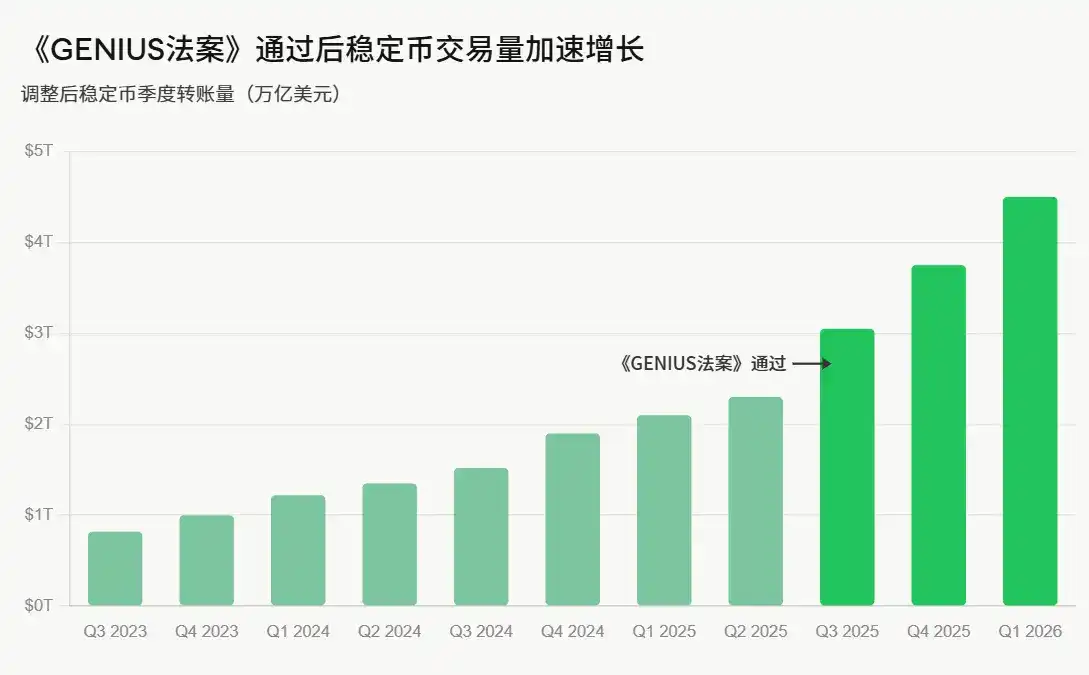
In the United States, the GENIUS Act established the first federal-level framework for stablecoin issuance. This shift is clearly visible in the data: adjusted trading volume had been rising for several quarters before the bill's passage, and growth accelerated further after its passage, reaching approximately $4.5 trillion in Q1 2026.

European regulation—the Markets in Crypto-Assets (MiCA) framework—tells a more complex story. When the法案 fully came into effect at the end of 2024, several major exchanges delisted USDT to comply, leading to a surge in activity for non-dollar stablecoins, which一度 exceeded $40 billion.
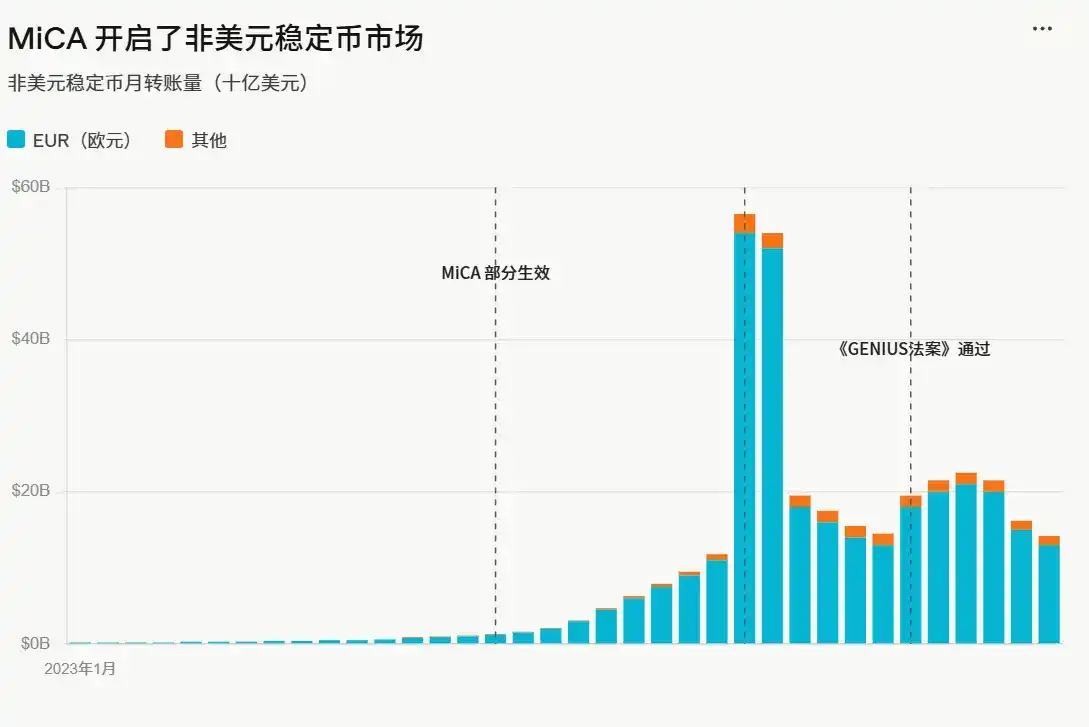
Since then, trading volume has stabilized at levels higher than the pre-MiCA baseline, around $15 billion to $25 billion per month. Regulation created a lasting market for non-dollar stablecoins that previously barely existed.

Stablecoin Commercial Activity is Growing

Perhaps the most noteworthy structural change lies in how people are actually using stablecoins.
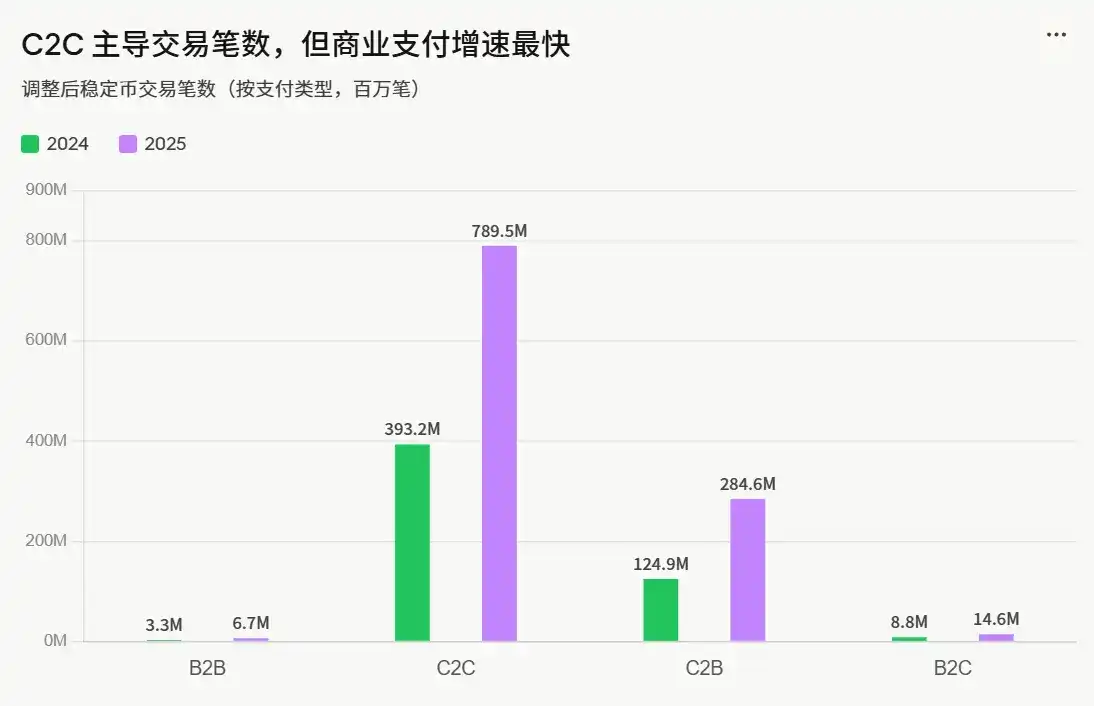
In terms of raw transaction count, the C2C category far surpasses all others: reaching 789.5 million in 2025. But Consumer-to-Business (C2B) stablecoin transactions grew the fastest, reaching 284.6 million in 2025 compared to 124.9 million in 2024, more than doubling year-over-year (+128%).

Data from stablecoin card infrastructure highlights this trend.
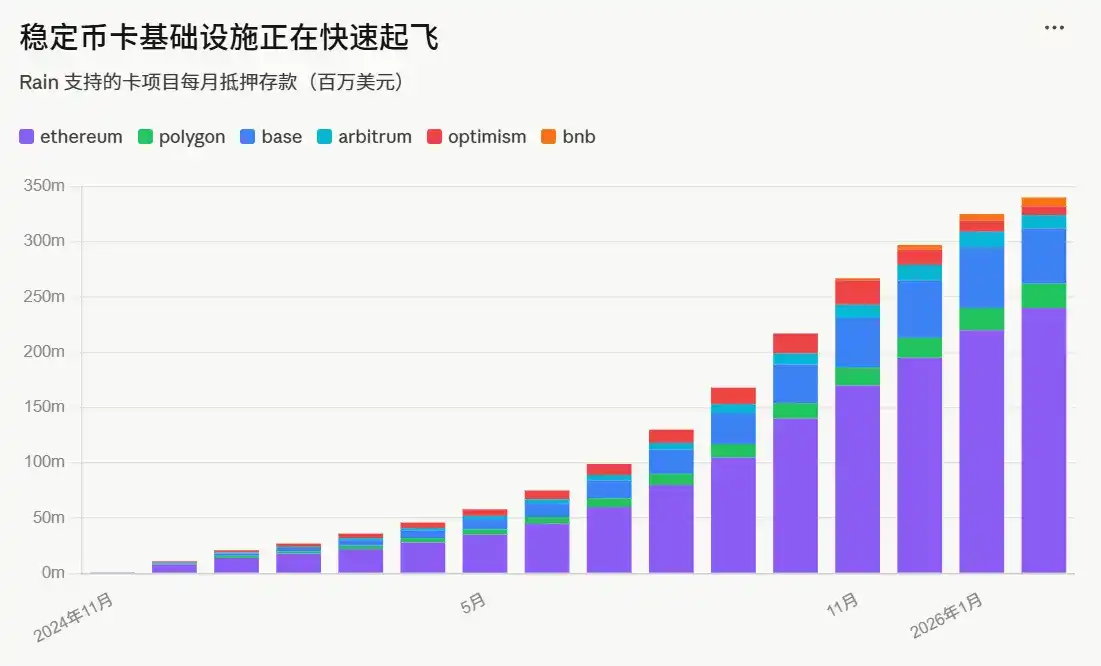
Monthly collateral deposits for stablecoin card programs supported by Rain (including Etherfi Cash, Kast, Wallbit, etc.) grew from nearly zero in November 2024 to over $300 million per month by early 2026. While this is collateral supporting spending, not direct spending of stablecoins, the trajectory is striking: stablecoin commercial activity is on the rise.

Stablecoin Velocity is Increasing

Every dollar of stablecoin supply is turning over more frequently.

Since early 2024, the velocity of stablecoins (the ratio of adjusted monthly transfer volume to circulating supply) has almost doubled, rising from 2.6x to 6x. An increase in velocity means demand for stablecoin transactions is outpacing new issuance, and the existing supply is working harder.
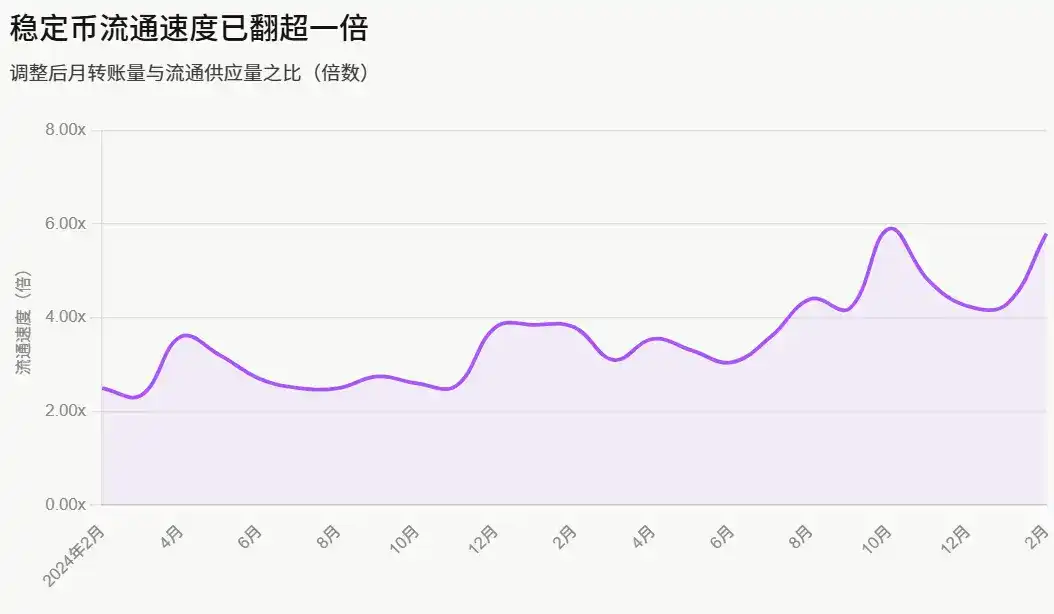
This is a hallmark of a true payment network—the base currency is being actively used, not just held.

Stablecoin Volume Reflects More Payments

If trading, fund flows, and exchange mechanisms—which make up the bulk of stablecoin transactions—are excluded, the estimated total for payments between different entities last year was still between $350 billion and $550 billion.

By volume, the Business-to-Business (B2B) sector dominates stablecoin payments (unsurprising given its scale). But other sectors, such as direct Consumer-to-Consumer (C2C) payments and interactions with merchants, are also expanding rapidly.

Stablecoin Payments are Currently Concentrated in Specific Regions

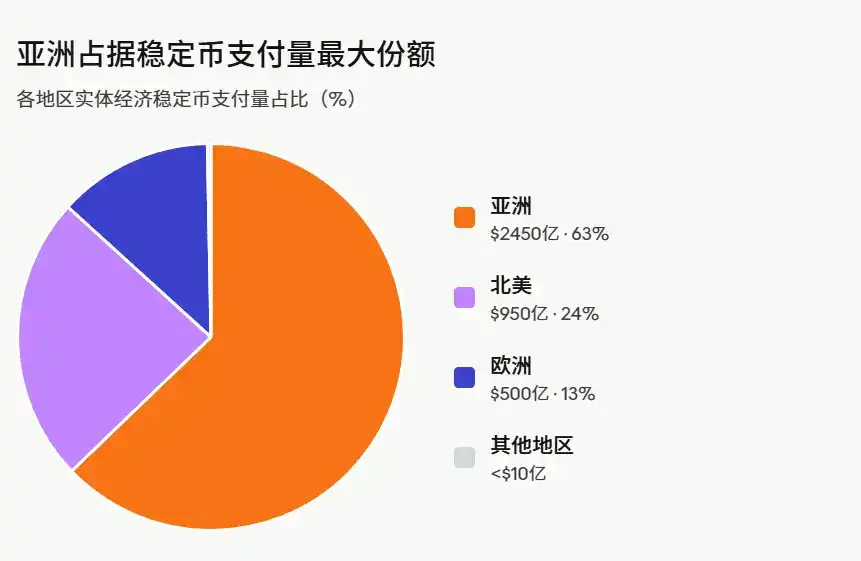
Geographically, stablecoin payment activity is not evenly distributed.

Nearly two-thirds of the transaction volume comes from Asia, primarily concentrated in Singapore, Hong Kong, and Japan.

North America accounts for about a quarter. Europe's share is around 13%. Latin America and Africa together make up only a very small portion, less than $1 billion.
Not Just Cross-Border Payments, But Local Currencies on Global Rails

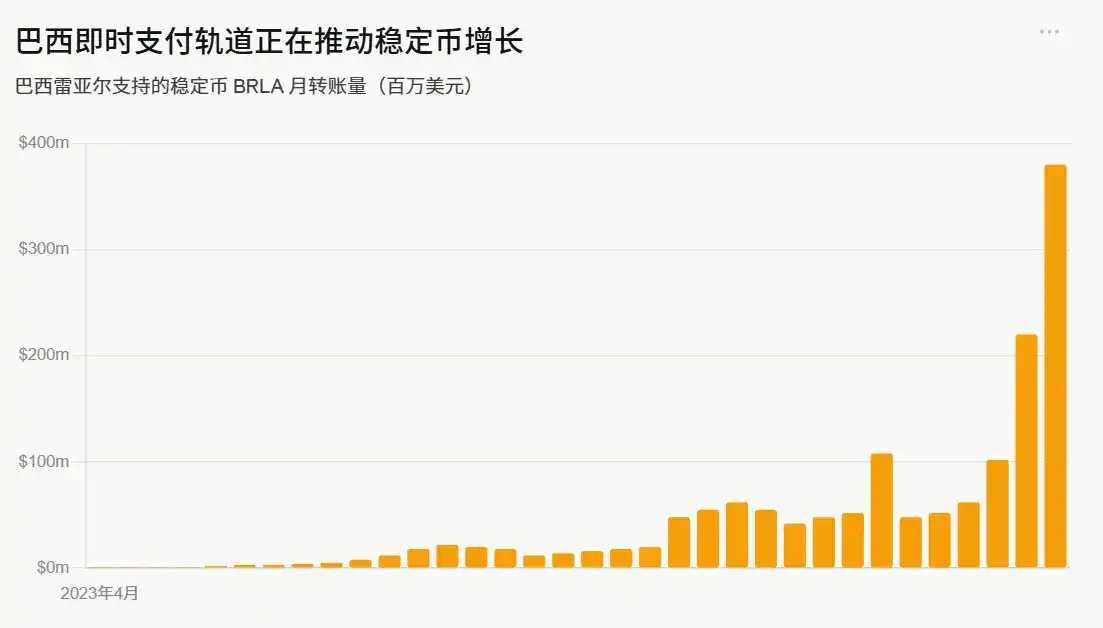
The development of non-dollar stablecoins is not limited to Europe; it is also evident in emerging markets, driven by various factors.

Brazil is a prime example. The monthly transfer volume of BRLA (a stablecoin backed by the Brazilian Real) has grown from nearly zero in early 2023 to about $400 million per month by early 2026. Access to the PIX instant payment network has driven its adoption.
Although stablecoins are often described as cross-border tools, the proportion of cross-border activity has actually been declining, not rising.

Domestic transactions (stablecoin transfers occurring within the same country/region) have grown from about half of the payment volume in early 2024 to nearly three-quarters by early 2026. What does this mean? Stablecoins are not only establishing themselves as remittance or forex tools but also becoming a local payment medium running on global infrastructure.
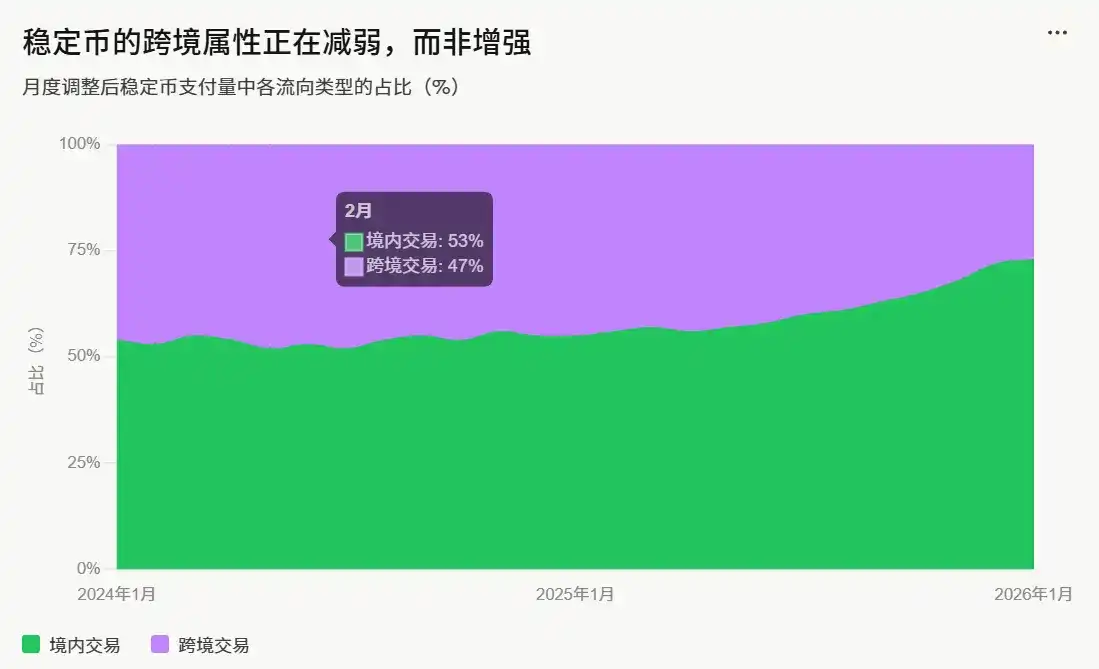
Putting all these factors together, a clear picture emerges, though it's not the one most people expected: many thought stablecoins would be purely focused on cross-border transactions. Instead, they are becoming increasingly localized.

While the US dollar remains the core f币锚定 for the vast majority of stablecoins, stablecoins are by no means simply an export of the dollar. Non-dollar variants, such as euro-backed and Brazilian real-backed local currency stablecoins, are gaining popularity.

Although peer-to-peer (C2C) stablecoin transfers far exceed other types of payment flows in quantity, increasingly usage is flowing towards everyday consumption (C2B).

Each quarter's data provides more evidence that stablecoins are developing into general-purpose payment infrastructure. They are global by design but increasingly local in practice.

It's still early days. But the shape of this system is becoming clearer.

Preguntas relacionadas

QWhat was the impact of the GENIUS Act on stablecoin trading volume in the US?

AThe GENIUS Act established the first federal-level framework for stablecoin issuance in the US. Before its passage, adjusted trading volume had been increasing for several consecutive quarters. After its enactment, growth accelerated further, reaching approximately $4.5 trillion in Q1 2026.

QWhich region accounts for the largest share of stablecoin payment volume, and which specific areas are the main contributors?

AAsia accounts for nearly two-thirds of the stablecoin payment volume. The main contributors are Singapore, Hong Kong, and Japan.

QWhat is the most significant structural change in how people use stablecoins, as indicated by transaction growth?

AThe most significant structural change is the growth in Consumer-to-Business (C2B) stablecoin transactions. This category saw the fastest growth, more than doubling (+128%) from 124.9 million transactions in 2024 to 284.6 million in 2025.

QWhat does the increasing velocity of stablecoins indicate about their use?

AThe increasing velocity of stablecoins, which nearly doubled from 2.6x to 6x since early 2024, indicates that the demand for stablecoin transactions is outpacing new issuance. It means the existing supply is circulating more frequently, which is a hallmark of a genuine payment network where the base currency is being actively used, not just held.

QContrary to common belief, what trend is observed in the proportion of cross-border stablecoin activity?

AContrary to the common belief that stablecoins are primarily for cross-border transactions, the proportion of cross-border activity has actually been decreasing. Domestic transactions (stablecoin transfers within the same country/region) grew from about half of the payment volume in early 2024 to nearly three-quarters by early 2026.

Lecturas Relacionadas

Atención obligatoria para la próxima semana|Se espera una votación en el Senado sobre el proyecto de ley CLARITY; SpaceX y Circle publicarán resultados financieros (3-9 de agosto)

**Resumen: Próximos eventos clave en cripto y tecnología (3-9 de agosto de 2026)** La semana del 3 al 9 de agosto trae eventos importantes. En política estadounidense, el **CLARITY Act**, un proyecto de ley bipartidista que busca establecer un marco regulatorio federal para las criptomonedas, podría someterse a votación en el Senado. Los negociadores tienen hasta el **7 de agosto** para conseguir los 60 votos necesarios. En resultados corporativos, **SpaceX** publicará sus resultados del Q2 el **4 de agosto**, seguido de un importante desbloqueo del 8% de sus acciones para accionistas internos el **6 de agosto**. **Circle**, la empresa detrás de USDC, informará el **5 de agosto**. Otras empresas como la minera de Bitcoin **Hut 8** y **American Bitcoin**, vinculada a la familia Trump, también presentarán resultados. En otros anuncios, **Zapper** y **Ctrl Wallet** cerrarán sus servicios el **3 de agosto**. **LayerZero** descontinuará sus relés para la versión v1 ese mismo día. **Upbit** dejará de cotizar los tokens AQT y AERGO. Además, **Elon Musk** anunció que **Grok 4.6** se lanzará alrededor del **7 de agosto**. Finalmente, los mercados estarán atentos al **informe de nóminas no agrícolas de EE.UU. de julio**, que se publicará el **7 de agosto**, y al inicio de la señalización obligatoria para **BIP-110** en la red Bitcoin alrededor del **8 de agosto**.

marsbitHace 1 hora(s)

Atención obligatoria para la próxima semana|Se espera una votación en el Senado sobre el proyecto de ley CLARITY; SpaceX y Circle publicarán resultados financieros (3-9 de agosto)

marsbitHace 1 hora(s)

Las acciones caen más que las criptomonedas, ¿a dónde se fue el dinero?

Los días 28 y 29 de julio, el índice Kospi de Corea del Sur activó el mecanismo de suspensión de contratación ("circuit breaker") de forma consecutiva, algo sin precedentes. Acciones clave como SK Hynix cayeron bruscamente, y ETF apalancados vinculados a ellas sufrieron pérdidas devastadoras, con caídas superiores al 80% en un mes. La narrativa global de desapalancamiento forzado golpeó con mayor dureza a las operaciones más concurridas, como las acciones tecnológicas y semiconductores. Paradójicamente, Bitcoin, conocido por su alta volatilidad, mostró una relativa estabilidad durante este período, recuperándose cerca de un 15% desde mínimos de julio. El artículo argumenta que esto no se debió a una entrada de capital desde el mercado bursátil, sino a que Bitcoin ya había sufrido su propia corrección significativa entre mayo y junio, con salidas récord de los ETF estadounidenses. El dinero que salió del mercado de valores buscó principalmente refugio en efectivo, bonos del Tesoro estadounidense y, sobre todo, en oro. Los datos muestran una correlación negativa récord entre Bitcoin y el oro, desafiando la narrativa del "oro digital". En esta crisis, el oro cumplió el rol de activo refugio, mientras que Bitcoin permaneció en el extremo más riesgoso de la curva. Para que llegue una entrada de capital sostenida a Bitcoin, el artículo identifica tres condiciones clave: alivio en la presión de liquidez global, recortes de tasas por la Fed sin recesión, y la aprobación de una legislación clara (como el CLARITY Act en EE.UU.) que elimine las incertidumbres regulatorias. Aunque Bitcoin actualmente no es un refugio, su baja correlación con los mercados tradicionales lo posiciona favorablemente para cuando el capital global vuelva a buscar diversificación una vez que pase la tormenta.

marsbitHace 1 hora(s)

Las acciones caen más que las criptomonedas, ¿a dónde se fue el dinero?

marsbitHace 1 hora(s)

Diálogo con Ray Dalio: Nos encontramos en una burbuja de IA actualmente, el 1% de mi cartera de inversiones está en Bitcoin

**Fuente: The Diary Of A CEO** **Resumen: Felix, PANews** Ray Dalio, fundador de Bridgewater Associates, advierte sobre una burbuja en la inteligencia artificial actual, comparable a burbujas históricas como la de Internet en 2000. Según Dalio, los signos clásicos están presentes: precios inflados, endeudamiento basado en ganancias especulativas y una posible corrección brusca si suben las tasas de interés o cambian las condiciones económicas. Dalio explica que esta burbuja se enmarca en un "gran ciclo" más amplio —de unos 80 años— caracterizado por tres dinámicas: creciente desigualdad interna, déficits fiscales gubernamentales y cambios en el orden geopolítico mundial. Estados Unidos y otros países occidentales se encuentran en una fase de declive relativo dentro de este ciclo. Para proteger la riqueza personal, Dalio recomienda diversificar las inversiones más allá del efectivo, incluyendo activos como oro, acciones y bonos. Aunque revela que alrededor del 1% de su cartera está en Bitcoin —considerándolo un activo escaso—, prefiere el oro físico por su seguridad histórica y su rol como reserva de los bancos centrales. Sobre el impacto laboral de la IA, Dalio prevé que aumentará la desigualdad, beneficiando sobre todo a los dueños de capital. Sin embargo, destaca que las habilidades humanas —como la intuición y la emoción— seguirán siendo valiosas y complementarias a la IA. En el ámbito geopolítico, Dalio anticipa un mundo más regionalizado, con EE.UU. y China como potencias líderes en sus respectivas esferas, y advierte que conflictos como el de Irán han expuesto debilidades estratégicas de Estados Unidos, acelerando un cambio en el equilibrio global de poder.

marsbitHace 5 hora(s)

Diálogo con Ray Dalio: Nos encontramos en una burbuja de IA actualmente, el 1% de mi cartera de inversiones está en Bitcoin

marsbitHace 5 hora(s)

Trading

Spot
活动图片





