Bitcoin Mining Companies Flee for the Nth Time

marsbitPublicado a 2026-04-03Actualizado a 2026-04-03

Resumen

Since late last year, major publicly traded Bitcoin mining companies have initiated a significant wave of Bitcoin (BTC) sell-offs. Cango sold about 60% of its holdings (4,451 BTC) in February, Bitdeer liquidated its entire Bitcoin inventory in January, Riot Platforms sold 3,778 BTC in the first quarter, and Core Scientific planned to sell approximately 2,500 BTC. Notably, Marathon Digital (MARA) sold 15,133 BTC in just three weeks in March, cashing out over $1 billion, while also cutting 15% of its workforce as part of a strategic shift toward becoming an energy and digital infrastructure company. This collective divestment is driven by three primary motives. First, mining has become unprofitable for many; the average cash cost to mine one BTC is approximately $79,995, while BTC trades around $68,000–70,000, resulting in an average loss of about $19,000 per coin. Second, AI data centers offer a more stable and lucrative alternative, with tech giants like Google, Microsoft, and financial institutions like Morgan Stanley providing substantial backing and contracts. Mining companies are repurposing their existing infrastructure—cheap power contracts, data centers, and cooling systems—toward AI, which promises higher, predictable margins. Third, some firms are using BTC sales to optimize their balance sheets, such as repurchasing convertible debt at a discount to reduce liabilities and avoid equity dilution. The industry is diverging into three paths: some, like CleanSpark and ...

Author: Zhou, ChainCatcher

Since the end of last year, listed mining companies have set off a wave of collective sell-offs.

Cango sold 4,451 bitcoins in February, about 60% of its holdings; Bitdeer liquidated its entire bitcoin inventory in January; Riot Platforms sold multiple times in December and sold 3,778 BTC in the first quarter; Core Scientific also previously planned to sell about 2,500 bitcoins in the first quarter.

Recently, the leading mining company MARA disclosed in an announcement that in just three weeks from March 4 to 25, the company sold 15,133 bitcoins, cashing out over $1 billion. Simultaneously, the company announced a reduction of approximately 15% of its workforce as part of its strategic transformation into an energy and digital infrastructure company.

In fact, miners selling bitcoin is not new. In the bear markets of 2018 and 2022, mining companies also experienced large-scale liquidation and capitulation, and those that remained were the more efficient players. But this time, the trigger for the sell-off is not just the falling coin price; they also have a new destination—AI data centers.

I. The Triple Motives Behind the Sell-Off

On the surface, it appears to be a collective sell-off by mining companies, but upon closer inspection, their underlying motives are not uniform and can be roughly divided into three distinct types of selling logic.

Mining Itself Has Fallen into Loss

The first, and most direct, motive: cost pressure.

The latest mining report from CoinShares shows that the weighted average cash cost for listed mining companies to mine one BTC is currently about $79,995, while the BTC market price hovers between $68,000 and $70,000, resulting in an average loss of nearly $19,000 per coin, putting the industry in a state of approximately 21% loss overall.
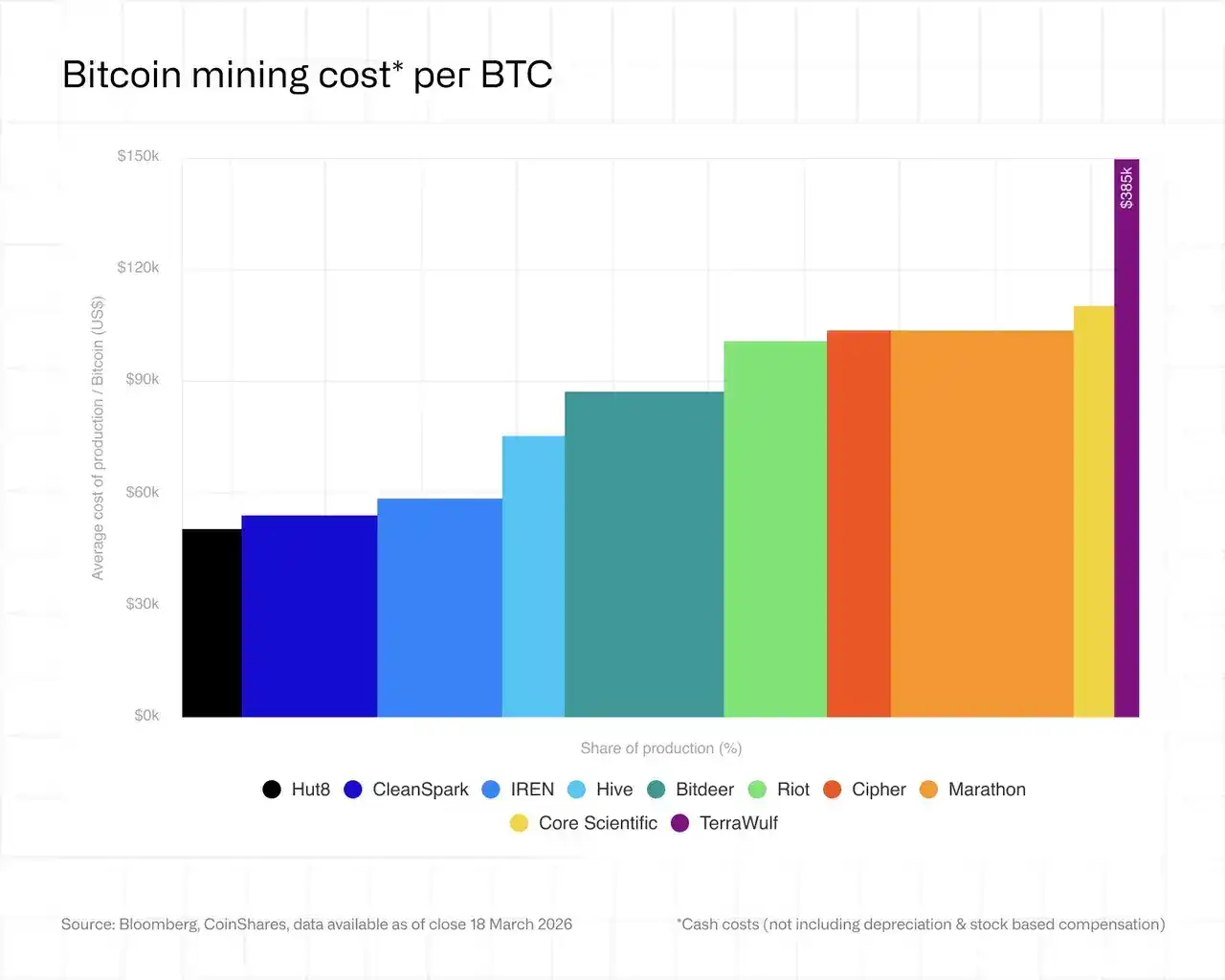
This is no longer just a matter of narrowing profit margins, but a question of whether cash flow can sustain continued mining.

The report also shows that the hash price fell to a historical post-halving low of $28 to $30/PH/day in early March. At this level, most active mining rigs need electricity prices to be压到 below $0.05/kWh to maintain cash profitability. Currently, about 15% to 20% of the network's mining rigs are on the edge of breakeven.

Meanwhile, tensions in the Middle East are pushing up energy prices, putting continuous pressure on electricity costs, an external variable that mining companies themselves have little control over.

QCP Group pointed out in a report that with the bitcoin price significantly below the average mining cost, mining companies are under obvious pressure, and liquidity priority has surpassed the HODL strategy.

Against this background, for some mining companies, selling bitcoin is a practical necessity to maintain operations.

AI Offers a More Stable Revenue Logic

The second motive is more strategic and the most值得深究 part of this sell-off.

Bloomberg analysis pointed out that unlike previous sell-offs to cover costs, the funds from this round are being reallocated to the artificial intelligence sector.

The business logic behind this is clear: mining revenue is highly dependent on coin price, hash rate difficulty, and electricity price, making it extremely volatile. In contrast, AI infrastructure is closer to long-term leases, with CoinShares' report指出其利润率可达 80% to 90%, and revenue is predictably long-term.

More crucially, mining companies already hold ready-made resources—cheap power contracts, built data centers,完善的散热系统, and mature operations teams.

Some analysts point out that the construction cost of Bitcoin mining infrastructure is about $700,000 to $1 million per megawatt, while AI infrastructure costs as much as $8 million to $15 million per megawatt. This huge cost gap is being monetized on a large scale by mining companies.

Notably, behind this transformation stands a group of unexpected drivers—tech giants and traditional financial institutions.

Previously, Google provided credit support for the lease obligations of the AI cloud platform Fluidstack, with disclosed credit support累计 exceeding $5 billion,先后为 TeraWulf, Cipher Mining, Hut 8 and other mining companies' AI transformation提供担保并换取相应股权; Microsoft signed a five-year, $9.7 billion AI cloud services contract with mining company IREN; Morgan Stanley provided a $500 million loan to Core Scientific, with a potential total credit line of $1 billion.

Their entry provides far more solid capital endorsement for this transformation than imagined.

Meanwhile, mining companies like Core Scientific, TeraWulf, Hut 8, and Cipher have successively signed large AI/HPC contracts, with cumulative amounts exceeding $70 billion. The CoinShares report mentioned that mining companies with AI/HPC contracts have valuation multiples approximately twice those of pure mining companies, and the market is rewarding those who complete the transformation first with valuation premiums.

Even the most financially sound mining companies with the lowest leverage, like HIVE, have actively scaled back mining operations and turned to expanding AI data centers. This indicates that the pressure to transform is no longer exclusive to highly indebted mining companies but is a directional choice facing the entire industry.

Actively Using BTC as a Financial Tool

The third logic is relatively精明 and the most proactive.

Some mining companies choose to sell BTC not due to operational pressure but to use it as a tool to optimize their balance sheets, like MARA. The specific operation is: use the proceeds from the sale to repurchase previously issued convertible bonds at a discount below par value, thereby compressing the scale of liabilities and reducing potential equity dilution risks.

For these mining companies, the role of BTC on the balance sheet has quietly changed from a long-term holding象征信仰 to a strategic asset that can be flexibly allocated.

Additionally, a relatively rare type of seller has emerged in this round of sell-offs: sovereign nations.

On-chain data shows that the BTC holdings of the Royal Government of Bhutan have decreased by about 66% from the peak at the end of 2024, with the single transfer size in March rising to $35 million to $45 million, and the pace of selling持续加快.

Unlike most countries that accumulate BTC through market purchases, Bhutan's holdings come from its domestic hydroelectric mining operations. This large-scale reduction may be related to the funding needs of its national development projects. This is also one of the largest government bitcoin reduction actions on record.

The叠加 of three logics—mining losses, AI transformation, debt optimization—plus selling pressure at the sovereign level—means the market is承受 structural supply pressure from multiple directions and of varying nature. The Bitcoin faith of mining companies is being reshaped by more realistic business logic.

II. After Leaving, Each Goes Its Own Way

Of course, selling off does not mean completely liquidating positions. The remaining holdings and subsequent strategies of various mining companies are showing截然不同的分化.

Three Paths, Three Choices

The first path:坚守挖矿.

Represented by CleanSpark and HIVE. They do not chase the AI transformation narrative, do not叠加 debt, and rely on a combination of low electricity prices, new-generation矿机, and low leverage to seek victory in the industry's liquidation process. Their logic is that as high-cost capacity gradually withdraws, the per-unit hash rate收益 for remaining mining companies will increase accordingly.

CleanSpark has publicly stated that继续大规模投入比特币挖矿"在经济上已不太合理" at the current hash price level, but the company still chooses to stick to its main business, betting that the cycle will eventually reverse.

Well-known crypto KOL蓝狐 pointed out that historically, almost every halving has been followed by miner capitulation, and those who remain are often the more efficient players, securing a larger share in the next rebound.

For these companies,坚守挖矿 is not stubbornness but trust in the laws of the cycle.

The second path:两条腿走路.

Represented by MARA, IREN, and Riot. They retain a considerable规模 of BTC holdings while simultaneously布局 AI/HPC, using the relatively stable income from AI business to hedge against the cyclical fluctuations of mining income.

These companies are essentially solving an asset allocation problem. The answers vary by company, but the core logic is that the two business lines support each other,分散单一风险.

The third path:全面转向 AI.

Represented by Core Scientific, TeraWulf, and Cipher. BTC holdings have exited the position of core assets, and mining is gradually becoming an附属部分 of the data center business.

CoinShares predicts that by the end of 2026, the AI revenue share of some mining companies could be as high as 70%, while the mining revenue share may drop from about 85% in early 2025 to less than 20%. These companies are nominally still mining companies, but in essence, they are becoming AI infrastructure operators that started with mining.

The potential risk of this path is that a heavy-asset transformation意味着巨额债务负担. Once AI demand cools down, both businesses will be under pressure.

也有观点指出, the credit guarantee structure provided by Google through Fluidstack actually creates highly concentrated counterparty risk—the entire cash flow chain relies on Fluidstack as an intermediary. Once the AI lease market experiences major changes, this structure could become a single point of failure.

BTC Price Determines Their Fate

No matter which path is chosen, it ultimately points to the same variable: the direction of the BTC price.

CoinShares gives three scenarios:

If BTC recovers to $100,000 by the end of 2026, the hash price will rebound to about $37/PH/day, mining profits will be repaired, and overall industry pressure will ease;

If it remains below $80,000, high-cost miners will accelerate their exit, and the traditional model of mining and HODLing等待牛市 will become increasingly difficult to sustain;

If it breaks through the historical high, the hash price could soar to $59/PH/day, and the industry will enter a new expansion cycle.

Conclusion

Overall, mining companies face two ultimate outcomes: either the coin price recovers, they return to their main business, and everything now is just a cyclical historical footnote; or the price remains low for an extended period, more and more mining companies complete their transformation into AI data centers, and the company model of mining and HODLing等待牛市 becomes increasingly rare in this industry.

However, there is another question worth asking beyond the business logic of this transformation. Mining companies are not ordinary listed companies; the continuous investment in hash rate is itself the security budget of the Bitcoin network.

Sazmining CEO Kent Halliburton once直言, these companies "hold power contracts, land, and infrastructure, yet hand these resources over to Microsoft and Google in exchange for rent checks, transforming from protecting the Bitcoin network to保管机架空间 for hyperscale cloud providers."

When mining no longer generates sufficient economic returns, the rational business decision is naturally to转移资源; but if this trend continues to spread, who will bear the long-term cost of maintaining the security of the Bitcoin network will become a problem that cannot be ignored.

History may have given an answer to this question.

The Bitcoin network has experienced several large-scale miner liquidations, and each time之后, it has operated with higher efficiency.

But this time, the miners who are leaving are not just turning off their machines.

The times have changed.

Preguntas relacionadas

QWhat are the three main motivations behind the recent large-scale Bitcoin sales by mining companies?

AThe three main motivations are: 1) Mining operations are unprofitable due to high costs and low Bitcoin prices, creating cash flow pressure. 2) A strategic pivot towards the more stable and lucrative AI data center business, backed by major tech firms. 3) Using Bitcoin as a financial tool to optimize balance sheets, such as repurchasing debt.

QWhich major technology companies are backing the mining companies' transition to AI infrastructure, and how?

AGoogle has provided over $5 billion in credit support for AI platform Fluidstack, taking equity in companies like TeraWulf, Cipher Mining, and Hut 8. Microsoft signed a $9.7 billion AI cloud services contract with IREN. Morgan Stanley provided a $500 million loan to Core Scientific, with a potential total of $1 billion.

QAccording to the CoinShares report, what is the current weighted average cash cost for a public miner to produce one Bitcoin, and how does it compare to the market price?

AThe weighted average cash cost for a public miner to produce one Bitcoin is approximately $79,995. With Bitcoin market price fluctuating between $68,000 and $70,000, this results in an average loss of nearly $19,000 per Bitcoin, representing an overall loss-making state of about 21%.

QWhat are the three potential future paths for mining companies as outlined in the article?

AThe three paths are: 1) Staying in mining (e.g., CleanSpark, HIVE), relying on low costs to survive the cycle. 2) A dual-track approach (e.g., MARA, IREN, Riot), maintaining Bitcoin holdings while expanding into AI to hedge risk. 3) A full pivot to AI (e.g., Core Scientific, TeraWulf, Cipher), where Bitcoin mining becomes ancillary to their new core data center business.

QWhat broader concern does the article raise about the long-term health of the Bitcoin network as miners pivot to AI?

AThe article raises the concern that if the economic incentive to mine Bitcoin continues to diminish, the security budget for the Bitcoin network—funded by mining—could be at risk. As miners reallocate their resources (power contracts, land, infrastructure) to rent-seeking AI deals with tech giants, the question of who will bear the long-term cost of securing the Bitcoin network becomes critical.

Lecturas Relacionadas

Resumen Semanal de RWA: HSBC y Standard Chartered obtienen licencias de stablecoin en Hong Kong; FDIC de EE.UU. publica borrador de guía para la emisión de stablecoins por instituciones

Resumen Semanal RWA: HSBC y Standard Chartered obtienen licencias de stablecoin en Hong Kong; FDIC de EE.UU. publica borrador de guía para emisores institucionales El mercado de RWA en cadena alcanzó un valor total de 29.06 mil millones de dólares, mientras que la capitalización de stablecoins se situó en 3.006,5 mil millones. La transferencia mensual alcanzó un récord de 10,21 billones de dólares, con un aumento del 15,24% en direcciones activas mensuales, lo que indica una mayor participación de usuarios minoristas. En materia regulatoria, Hong Kong emitió las primeras licencias de emisión de stablecoins a HSBC y Anchorpoint (consorcio de Standard Chartered, HKT y Animoca Brands), marcando el inicio de una era de stablecoins reguladas. En EE.UU., el FDIC publicó un borrador de guía para bancos y fintechs que emitan stablecoins, cubriendo requisitos de reservas, reembolsos y capital. FinCEN y OFAC también propusieron normas antilavado de dinero y sanciones para emisores. Corea del Sur, Dubái y Rusia avanzaron en marcos legales para stablecoins y RWA. En proyectos destacados, seis bancos suizos, incluido UBS, probarán el franco suizo digital en 2026. Securitize tokenizó acciones de Currenc Group en Nasdaq. SBI Ripple Asia completó una plataforma de emisión de tokens en XRP Ledger. Circle lanzó CPN Managed Payments para expandir servicios de pago con stablecoins. En financiación, Pharos recaudó 44 millones de dólares para su cadena de RWA, GSR lideró la inversión en Libeara, y Gobi Partners invirtió en Transak para infraestructura de pagos en Asia. Informes de Chainalysis proyectan que el volumen de transacciones de stablecoins podría alcanzar 1.500 billones de dólares para 2035, impulsado por cambios demográficos y adopción comercial.

marsbitHace 7 min(s)

Resumen Semanal de RWA: HSBC y Standard Chartered obtienen licencias de stablecoin en Hong Kong; FDIC de EE.UU. publica borrador de guía para la emisión de stablecoins por instituciones

marsbitHace 7 min(s)

Trading

Spot
Futuros

Artículos destacados

Qué es BITCOIN

Comprendiendo HarryPotterObamaSonic10Inu (ERC-20) y Su Posición en el Espacio Cripto En los últimos años, el mercado de criptomonedas ha sido testigo de un aumento en la popularidad de las monedas meme, capturando el interés no solo de los traders, sino también de aquellos que buscan participación comunitaria y valor de entretenimiento. Entre estos tokens únicos se encuentra HarryPotterObamaSonic10Inu (ERC-20), un proyecto intrigante que fusiona referencias culturales en el tejido de las criptomonedas. Este artículo ahonda en los aspectos clave de HarryPotterObamaSonic10Inu, explorando sus mecanismos, su ética impulsada por la comunidad y su compromiso con el panorama cripto más amplio. ¿Qué es HarryPotterObamaSonic10Inu (ERC-20)? Como su nombre indica, HarryPotterObamaSonic10Inu es una moneda meme construida sobre la blockchain de Ethereum, clasificada bajo el estándar ERC-20. A diferencia de las criptomonedas tradicionales que pueden enfatizar la utilidad práctica o el potencial de inversión, este token prospera en el valor de entretenimiento y la fuerza de su comunidad. El proyecto tiene como objetivo fomentar un entorno donde los usuarios comprometidos puedan reunirse, compartir ideas y participar en actividades inspiradas por diversos fenómenos culturales. Una característica notable de HarryPotterObamaSonic10Inu es su cero impuesto sobre las transacciones. Este elemento atractivo busca incentivar el comercio y la participación comunitaria, sin cargos adicionales que puedan disuadir a los traders de pequeña escala. El suministro total de la moneda se establece en mil millones de tokens, cifra que marca su intención de mantener una circulación sustancial dentro de la comunidad. Creador de HarryPotterObamaSonic10Inu (ERC-20) Los orígenes de HarryPotterObamaSonic10Inu están algo envueltos en misterio; los detalles sobre el creador siguen siendo desconocidos. El desarrollo de este token carece de un equipo identificable o un plan explícito, lo cual no es raro dentro del sector de las monedas meme. En su lugar, el proyecto ha surgido de forma orgánica, con su progreso fuertemente dependiente del entusiasmo y la participación de su comunidad. Inversores de HarryPotterObamaSonic10Inu (ERC-20) En cuanto a inversiones externas y respaldo, HarryPotterObamaSonic10Inu también se mantiene ambiguo. El token no enumera ninguna fundación de inversión conocida o apoyo organizacional significativo. Más bien, la savia del proyecto es su comunidad de base, que informa su crecimiento y sostenibilidad a través de la acción colectiva y la participación en el espacio cripto. ¿Cómo Funciona HarryPotterObamaSonic10Inu (ERC-20)? Como una moneda meme, HarryPotterObamaSonic10Inu opera principalmente fuera de los marcos tradicionales que a menudo rigen el valor de los activos. Hay varios aspectos distintivos que definen cómo funciona el proyecto: Transacciones Sin Impuestos: Sin comisiones fiscales en las transacciones, los usuarios pueden comprar y vender el token libremente sin preocuparse por costos ocultos. Compromiso de la Comunidad: El proyecto prospera en la interacción comunitaria, aprovechando plataformas de redes sociales para crear expectación y facilitar la participación. Las discusiones, el intercambio de contenido y el compromiso son elementos cruciales que ayudan a expandir su alcance y fomentar la lealtad entre los seguidores. Sin Utilidad Práctica: Cabe señalar que HarryPotterObamaSonic10Inu no ofrece una utilidad concreta dentro del ecosistema financiero. Más bien, se clasifica como un token principalmente para actividades de entretenimiento y comunitarias. Referencia Cultural: El token incorpora hábilmente elementos de la cultura popular para atraer interés, conectando con entusiastas de los memes y seguidores de criptomonedas por igual. HarryPotterObamaSonic10Inu ejemplifica cómo las monedas meme operan de manera diferente a los proyectos de criptomonedas más tradicionales, ingresando al mercado como constructos sociales innovadores en lugar de activos utilitarios. Cronología de HarryPotterObamaSonic10Inu (ERC-20) La historia de HarryPotterObamaSonic10Inu se caracteriza por varios hitos notables: Creación: El token surgió de un meme viral, capturando la imaginación de muchos entusiastas de las criptomonedas. No se disponen de fechas específicas de creación, lo que subraya su ascenso orgánico. Listado en Exchanges: HarryPotterObamaSonic10Inu ha logrado estar presente en varios exchanges, facilitando el acceso y el comercio por parte de la comunidad. Iniciativas de Compromiso Comunitario: Actividades en curso destinadas a mejorar la interacción comunitaria, incluidos concursos, campañas en redes sociales y generación de contenido por parte de fans y defensores. Planes de Expansión Futura: La hoja de ruta del proyecto incluye el lanzamiento de una colección de NFT, mercancía y un sitio de comercio electrónico relacionado con sus temas culturales, involucrando aún más a la comunidad e intentando añadir más dimensiones a su ecosistema. Puntos Clave Sobre HarryPotterObamaSonic10Inu (ERC-20) Naturaleza Impulsada por la Comunidad: El proyecto prioriza la aportación y creatividad colectiva, asegurando que la participación de los usuarios esté en el centro de su desarrollo. Clasificación como Moneda Meme: Representa la epítome de la criptomoneda basada en el entretenimiento, diferenciándose de los vehículos de inversión tradicionales. Sin Afiliación Directa con Bitcoin: A pesar de la similitud en el nombre del ticker, HarryPotterObamaSonic10Inu es distinto y no mantiene ninguna relación con Bitcoin u otras criptomonedas establecidas. Enfoque en la Colaboración: HarryPotterObamaSonic10Inu está diseñado para crear un espacio para la colaboración y el intercambio de historias entre sus poseedores, proporcionando una vía para la creatividad y la unión comunitaria. Perspectivas Futuras: La ambición de expandirse más allá de su premisa inicial en NFTs y mercancía delinean un camino para que el proyecto potencialmente ingrese en avenidas más convencionales dentro de la cultura digital. A medida que las monedas meme continúan capturando la imaginación de la comunidad de criptomonedas, HarryPotterObamaSonic10Inu (ERC-20) destaca por sus lazos culturales y su enfoque centrado en la comunidad. Aunque puede no encajar en el molde típico de un token impulsado por la utilidad, su esencia radica en la alegría y la camaradería fomentadas entre sus simpatizantes, destacando la naturaleza evolutiva de las criptomonedas en una era cada vez más digital. A medida que el proyecto sigue desarrollándose, será importante observar cómo las dinámicas comunitarias influyen en su trayectoria en el panorama en constante cambio de la tecnología blockchain.

1.7k Vistas totalesPublicado en 2024.04.01Actualizado en 2024.12.03

Qué es BITCOIN

Cómo comprar BTC

¡Bienvenido a HTX.com! Hemos hecho que comprar Bitcoin (BTC) sea simple y conveniente. Sigue nuestra guía paso a paso para iniciar tu viaje de criptos.Paso 1: crea tu cuenta HTXUtiliza tu correo electrónico o número de teléfono para registrarte y obtener una cuenta gratuita en HTX. Experimenta un proceso de registro sin complicaciones y desbloquea todas las funciones.Obtener mi cuentaPaso 2: ve a Comprar cripto y elige tu método de pagoTarjeta de crédito/débito: usa tu Visa o Mastercard para comprar Bitcoin (BTC) al instante.Saldo: utiliza fondos del saldo de tu cuenta HTX para tradear sin problemas.Terceros: hemos agregado métodos de pago populares como Google Pay y Apple Pay para mejorar la comodidad.P2P: tradear directamente con otros usuarios en HTX.Over-the-Counter (OTC): ofrecemos servicios personalizados y tipos de cambio competitivos para los traders.Paso 3: guarda tu Bitcoin (BTC)Después de comprar tu Bitcoin (BTC), guárdalo en tu cuenta HTX. Alternativamente, puedes enviarlo a otro lugar mediante transferencia blockchain o utilizarlo para tradear otras criptomonedas.Paso 4: tradear Bitcoin (BTC)Tradear fácilmente con Bitcoin (BTC) en HTX's mercado spot. Simplemente accede a tu cuenta, selecciona tu par de trading, ejecuta tus trades y monitorea en tiempo real. Ofrecemos una experiencia fácil de usar tanto para principiantes como para traders experimentados.

5.9k Vistas totalesPublicado en 2024.12.12Actualizado en 2025.03.21

Cómo comprar BTC

Qué es $BITCOIN

ORO DIGITAL ($BITCOIN): Un Análisis Exhaustivo Introducción al ORO DIGITAL ($BITCOIN) ORO DIGITAL ($BITCOIN) es un proyecto basado en blockchain que opera en la red Solana, cuyo objetivo es combinar las características de los metales preciosos tradicionales con la innovación de las tecnologías descentralizadas. Aunque comparte un nombre con Bitcoin, a menudo denominado “oro digital” debido a su percepción como un almacén de valor, ORO DIGITAL es un token separado diseñado para crear un ecosistema único dentro del paisaje Web3. Su meta es posicionarse como un activo digital alternativo viable, aunque los detalles sobre sus aplicaciones y funcionalidades aún están en desarrollo. ¿Qué es ORO DIGITAL ($BITCOIN)? ORO DIGITAL ($BITCOIN) es un token de criptomoneda diseñado explícitamente para su uso en la blockchain de Solana. A diferencia de Bitcoin, que proporciona un papel de almacenamiento de valor ampliamente reconocido, este token parece centrarse en aplicaciones y características más amplias. Aspectos notables incluyen: Infraestructura Blockchain: El token está construido sobre la blockchain de Solana, conocida por su capacidad para manejar transacciones de alta velocidad y bajo costo. Dinámicas de Suministro: ORO DIGITAL tiene un suministro máximo limitado a 100 cuatrillones de tokens (100P $BITCOIN), aunque los detalles sobre su suministro circulante no se han divulgado actualmente. Utilidad: Aunque las funcionalidades precisas no están delineadas explícitamente, hay indicios de que el token podría ser utilizado para diversas aplicaciones, potencialmente involucrando aplicaciones descentralizadas (dApps) o estrategias de tokenización de activos. ¿Quién es el Creador de ORO DIGITAL ($BITCOIN)? En la actualidad, la identidad de los creadores y el equipo de desarrollo detrás de ORO DIGITAL ($BITCOIN) sigue siendo desconocida. Esta situación es típica entre muchos proyectos innovadores dentro del espacio blockchain, particularmente aquellos alineados con las finanzas descentralizadas y los fenómenos de monedas meme. Si bien tal anonimato puede fomentar una cultura impulsada por la comunidad, intensifica las preocupaciones sobre la gobernanza y la responsabilidad. ¿Quiénes son los Inversores de ORO DIGITAL ($BITCOIN)? La información disponible indica que ORO DIGITAL ($BITCOIN) no tiene patrocinadores institucionales conocidos ni inversiones destacadas de capital de riesgo. El proyecto parece operar bajo un modelo de peer-to-peer centrado en el apoyo y la adopción de la comunidad en lugar de rutas de financiación tradicionales. Su actividad y liquidez se sitúan principalmente en intercambios descentralizados (DEX), como PumpSwap, en lugar de plataformas de trading centralizadas establecidas, lo que resalta aún más su enfoque de base. Cómo Funciona ORO DIGITAL ($BITCOIN) Los mecanismos operativos de ORO DIGITAL ($BITCOIN) se pueden elaborar en función de su diseño blockchain y atributos de red: Mecanismo de Consenso: Al aprovechar el único mecanismo de prueba de historia (PoH) de Solana combinado con un modelo de prueba de participación (PoS), el proyecto asegura una validación eficiente de transacciones que contribuye al alto rendimiento de la red. Tokenómica: Aunque los mecanismos deflacionarios específicos no se han detallado extensamente, el vasto suministro máximo de tokens implica que podría atender microtransacciones o casos de uso nicho que aún están por definirse. Interoperabilidad: Existe el potencial de integración con el ecosistema más amplio de Solana, incluyendo varias plataformas de finanzas descentralizadas (DeFi). Sin embargo, los detalles sobre integraciones específicas siguen sin especificarse. Cronología de Eventos Clave Aquí hay una cronología que destaca hitos significativos relacionados con ORO DIGITAL ($BITCOIN): 2023: El despliegue inicial del token ocurre en la blockchain de Solana, marcado por su dirección de contrato. 2024: ORO DIGITAL gana visibilidad al estar disponible para el comercio en intercambios descentralizados como PumpSwap, permitiendo a los usuarios comerciar contra SOL. 2025: El proyecto presencia actividad de comercio esporádica y un posible interés en compromisos liderados por la comunidad, aunque no se han documentado asociaciones notables o avances técnicos hasta la fecha. Análisis Crítico Fortalezas Escalabilidad: La infraestructura subyacente de Solana soporta altos volúmenes de transacciones, lo que podría mejorar la utilidad de $BITCOIN en varios escenarios de transacción. Accesibilidad: El potencial bajo precio de negociación por token podría atraer a inversores minoristas, facilitando una participación más amplia debido a oportunidades de propiedad fraccionada. Riesgos Falta de Transparencia: La ausencia de patrocinadores, desarrolladores o un proceso de auditoría públicamente conocidos puede generar escepticismo sobre la sostenibilidad y confiabilidad del proyecto. Volatilidad del Mercado: La actividad comercial depende en gran medida del comportamiento especulativo, lo que puede resultar en una volatilidad de precios significativa e incertidumbre para los inversores. Conclusión ORO DIGITAL ($BITCOIN) surge como un proyecto intrigante pero ambiguo dentro del ecosistema de Solana en rápida evolución. Si bien intenta aprovechar la narrativa del “oro digital”, su alejamiento del papel establecido de Bitcoin como almacén de valor subraya la necesidad de una diferenciación más clara de su utilidad y estructura de gobernanza previstas. La futura aceptación y adopción dependerán probablemente de abordar la actual opacidad y definir sus estrategias operativas y económicas de manera más explícita. Nota: Este informe abarca información sintetizada disponible hasta octubre de 2023, y pueden haber ocurrido desarrollos más allá del período de investigación.

75 Vistas totalesPublicado en 2025.05.13Actualizado en 2025.05.13

Qué es $BITCOIN

Discusiones

Bienvenido a la comunidad de HTX. Aquí puedes mantenerte informado sobre los últimos desarrollos de la plataforma y acceder a análisis profesionales del mercado. A continuación se presentan las opiniones de los usuarios sobre el precio de BTC (BTC).

活动图片