Bitcoin accumulation and distribution: which cohort is taking part in what

BitcoinistPublicado a 2023-01-26Actualizado a 2023-01-26

Resumen

On-chain analytic firm Glassnode has broken down which Bitcoin cohorts have been accumulating and which have been distributed during the...

On-chain analytic firm Glassnode has broken down which Bitcoin cohorts have been accumulating and which have been distributed during the past year.


Bitcoin Whales Distributed Coins Equivalent To 60% Of Mined Supply In The Last 12 Months
“”

As per data from Glassnode, whales, miners, and exchange outflows were the primary distribution sources in the past year. The relevant indicator here is the “yearly absorption rates,” which measures the yearly Bitcoin balance changes of the different cohorts in the market and compares them with the number of coins issued over this period.

The “coins issued” refer to the total amount BTC miners receive as block rewards for mining a block. These new coins produced have to go somewhere, and that’s what the yearly absorption rates metric tries to paint a picture of the BTC supply flow.


The cohorts that Glassnode has considered are the shrimps (investors holding less than 1 BTC), crabs (between 1 to 10 BTC), whales (more than 1,000 BTC), and miners. Additionally, the firm has also included data for the “exchange outflows,” which measure the total number of coins withdrawn from the wallets of all centralized exchanges.


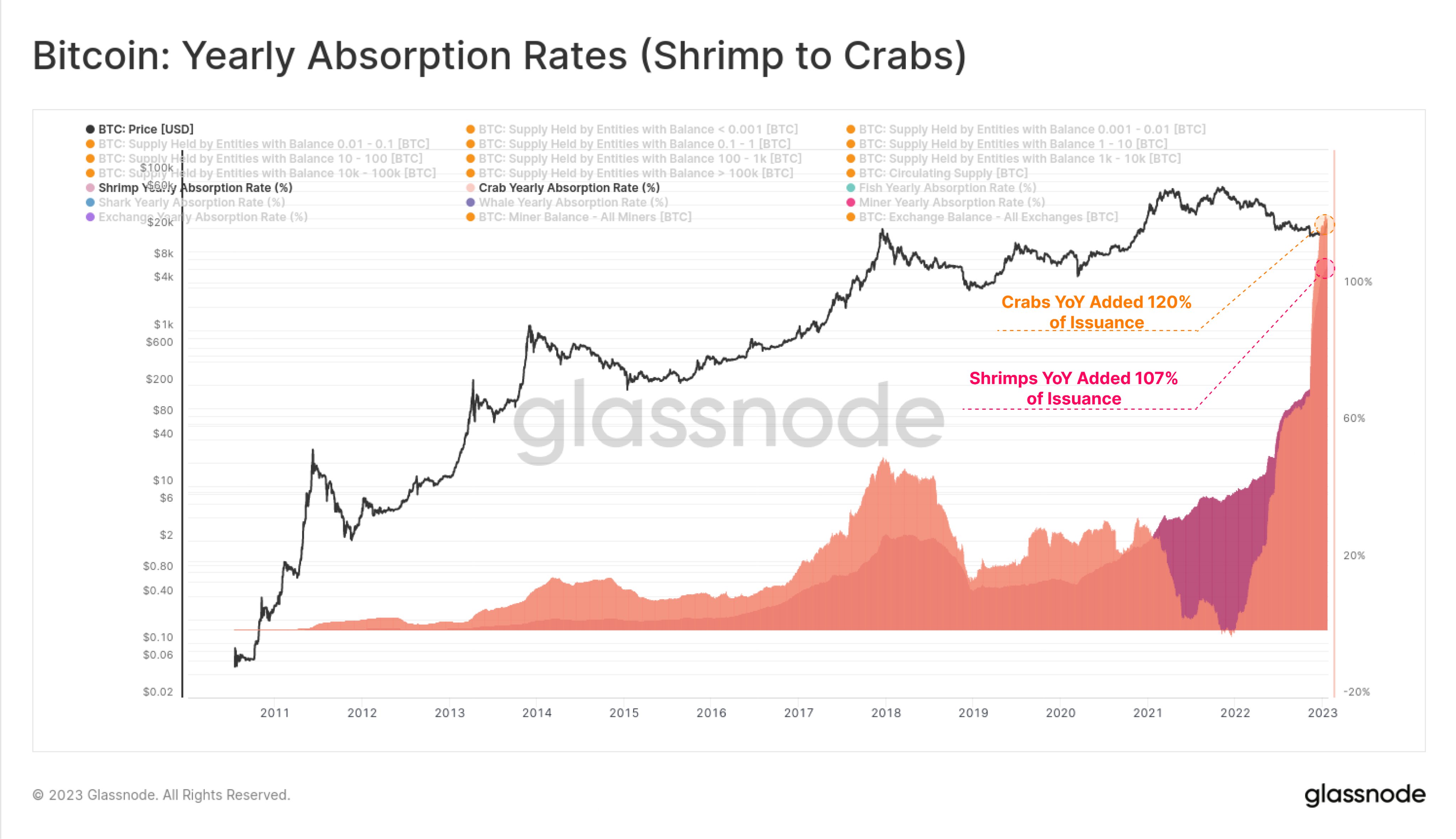
Now, first, below there is a chart that shows which of these investor groups were absorbing a positive amount of the yearly coin issuance:
Bitcoin Accumulation

The value of the metrics seem to have been quite high in recent weeks | Source: Glassnode on Twitter


As shown in the above graph, the Bitcoin yearly absorption rate of the shrimps is 107% right now, meaning that this investor group added 107% of the total number of coins issued on the network to their holdings during the past year.

The indicator’s value has been even higher for the crabs at around 120%. From the chart, it’s apparent that the metric has observed a very rapid rise in the last few months, suggesting that a lot of accumulation took place at the lows following the FTX collapse.

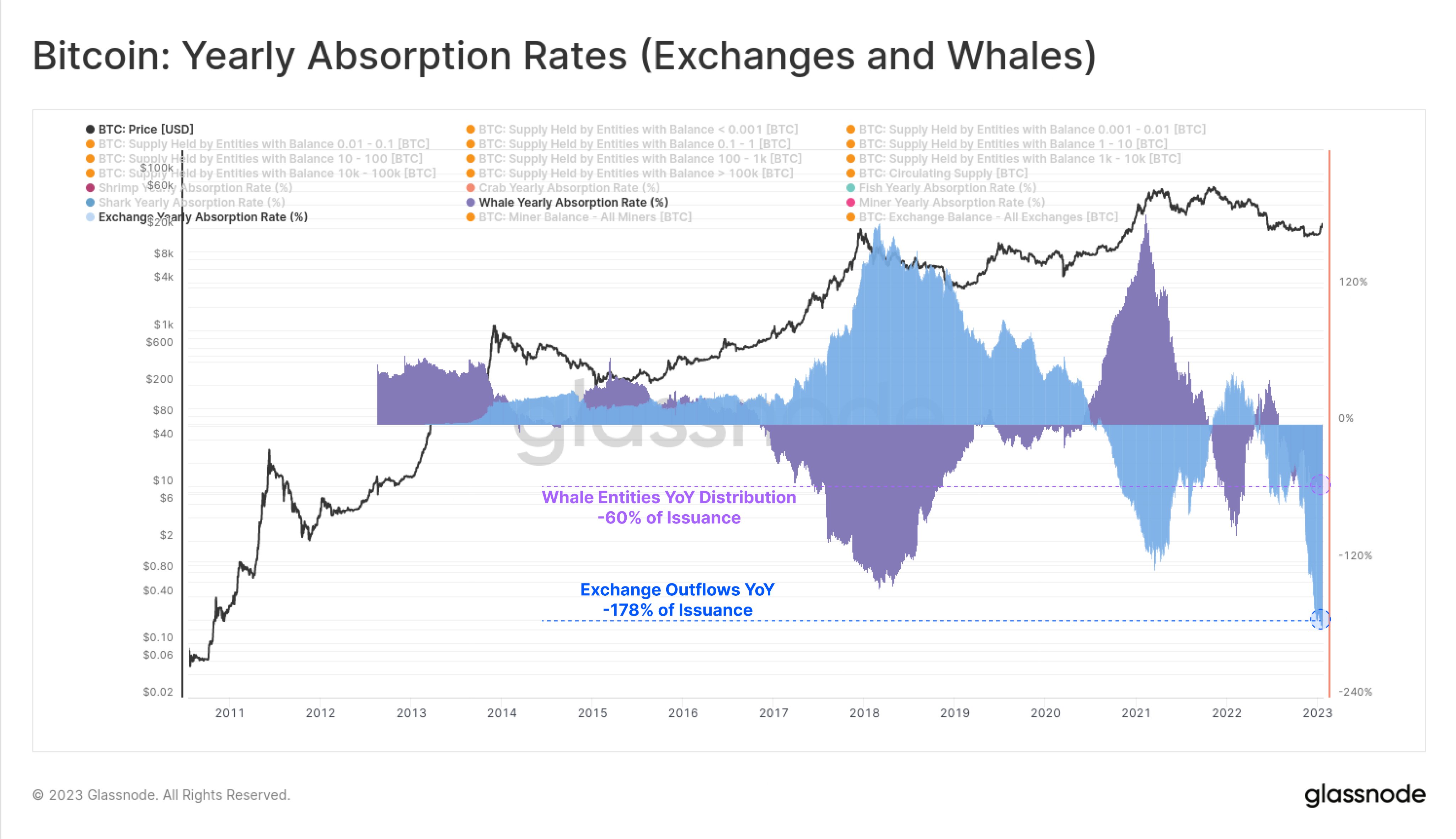
Since the amounts added by these cohorts are higher than what the network issued in the past year, it seems reasonable to assume that some groups must have distributed or sold their coins to make up for the difference. The below chart shows which cohorts displayed distribution behavior during the past year.
Bitcoin Distribution

Looks like these metrics have been deeply negative recently | Source: Glassnode on Twitter
“”

It seems that the yearly absorption rate of the whales is 60% underwater, which suggests that these humongous holders have shed coins equal to 60% of the issued supply from their wallets over the past year.

Exchanges also distributed a massive amount of Bitcoin as the metric’s value was negative 178% for exchange outflows. These platforms observed large withdrawals in this period partly because of the FTX collapse, which made BTC holders more aware of the risks of keeping their coins in centralized wallets. This led to a massive migration of the BTC kept on centralized entities.
“”

Users transfer large amounts of BTC from exchanges to keep their holdings in privately owned hardware wallets. Though not displayed in the chart, Glassnode also mentions in the tweet that miners distributed 100% of the coins they mined (which means 100% of the issuance), plus an additional 2% from their existing reserves.
“”

BTC Price
“”

At the time of writing, Bitcoin is trading around $22,600, up 8% in the last week.

Bitcoin Price Chart

BTC continues to move sideways | Source: BTCUSD on TradingView

Lecturas Relacionadas

La crónica del fraude grave que envuelve al unicornio cripto Blockstream

A lo largo de 2024, Blockstream, la empresa de cripto del pionero de Bitcoin Adam Back, se ha visto envuelta en varias controversias. Una investigación de NatInfoSec lanzó graves acusaciones sobre su producto de notas mineras, Blockstream Mining Note (BMN). Los principales señalamientos incluyen: una discrepancia entre el poder de cómputo mostrado (15 EH/s) y el necesario para cumplir con las obligaciones de los BMN (20-45 EH/s); una falta de evidencia verificable pública sobre las operaciones mineras a esa escala; rendimientos anuales fijos inusualmente altos, cercanos al 20%; y el descubrimiento de que Christopher William Cook, figura clave de la operación minera de Blockstream a través de Exacore, tiene antecedentes penales por fraude postal, información no revelada a los inversores. Aunque BitMEX Research y otros como Samson Mow han cuestionado algunos puntos por falta de pruebas o por implicar incorrectamente a BSTR, la compañía de tesorería de Bitcoin asociada a Back, las preguntas centrales sobre los BMN persisten. La comunidad y los analistas exigen mayor transparencia y capacidad de verificación sobre: el tamaño real y los límites de responsabilidad de los BMN; la fuente de los altos rendimientos prometidos; la procedencia verificable de los BTC pagados a los inversores; y el papel exacto de Cook. Hasta ahora, Blockstream no ha emitido una respuesta oficial integral a estas acusaciones.

marsbitHace 2 hora(s)

La crónica del fraude grave que envuelve al unicornio cripto Blockstream

marsbitHace 2 hora(s)

La Historia Completa del Fraude Severo en el que está Inmerso el Unicornio Cripto Blockstream

El artículo aborda las graves acusaciones de fraude contra Blockstream, la compañía cofundada por el pionero de Bitcoin, Adam Back. Un informe de investigación de la cuenta NatInfoSec señala múltiples irregularidades en su producto estrella, los Bitcoin Mining Notes (BMN). Las principales acusaciones incluyen: 1) Una discrepancia entre el hashrate necesario para cumplir con las obligaciones de los BMN (estimado en 20-45 EH/s) y el hashrate real reportado por Blockstream (15 EH/s), sin evidencia pública suficiente de infraestructura minera a esa escala. 2) La oferta de rendimientos fijos anormalmente altos (cercanos al 20%) en un sector volátil como la minería de Bitcoin. 3) El antecedente penal por fraude postal de Christopher William Cook, una figura clave en la división minera de Blockstream (Exacore), lo que no fue revelado en los documentos de los BMN. 4) Posibles riesgos de contagio para Bitcoin Standard Treasury Company (BSTR), una empresa relacionada con Back que planea salir a bolsa vía SPAC. BitMEX Research analizó las acusaciones, confirmando la probable veracidad del historial de Cook y la preocupación por los altos rendimientos, pero consideró insuficiente la evidencia sobre otros puntos, destacando la independencia legal entre BMN y BSTR. La comunidad debate intensamente, especialmente sobre la verificabilidad del hashrate y el origen de los pagos a los inversionistas. En conclusión, el artículo subraya que las acusaciones, aunque no son prueba definitiva de fraude, revelan importantes lagunas de transparencia en los BMN respecto al tamaño real de las obligaciones, el origen verificable de los rendimientos, la infraestructura minera subyacente y la divulgación de riesgos clave. Blockstream no había emitido una respuesta oficial sistemática al momento de la publicación.

链捕手Hace 3 hora(s)

La Historia Completa del Fraude Severo en el que está Inmerso el Unicornio Cripto Blockstream

链捕手Hace 3 hora(s)

Trading

Spot
Futuros
活动图片