Current State of NFT Royalties
The question of NFT royalty requirements has been top of mind in the crypto community lately. In short, NFT royalties are mechanisms to pay the original NFT creator a percentage of the purchase price from resales. As the digital art trades hands, royalties give the creator access to the upside and reward them for their piece reaching more people.
However, eliminated royalties and therefore lower prices for NFT buyers result in more sales for trading platforms, meaning that marketplaces are often conflicted on different policies to instate. On crypto Twitter especially, the debate has been raging – many have voiced opinions in favor of or against creator royalties.
One of the events that first set the debate in motion was the launch of Sudoswap, which uses a royalty-free trading model. The platform – essentially a decentralized NFT exchange with an AMM model – has seen incredible traction in the past few months, reaching a TVL of over $3.4M at peaks.
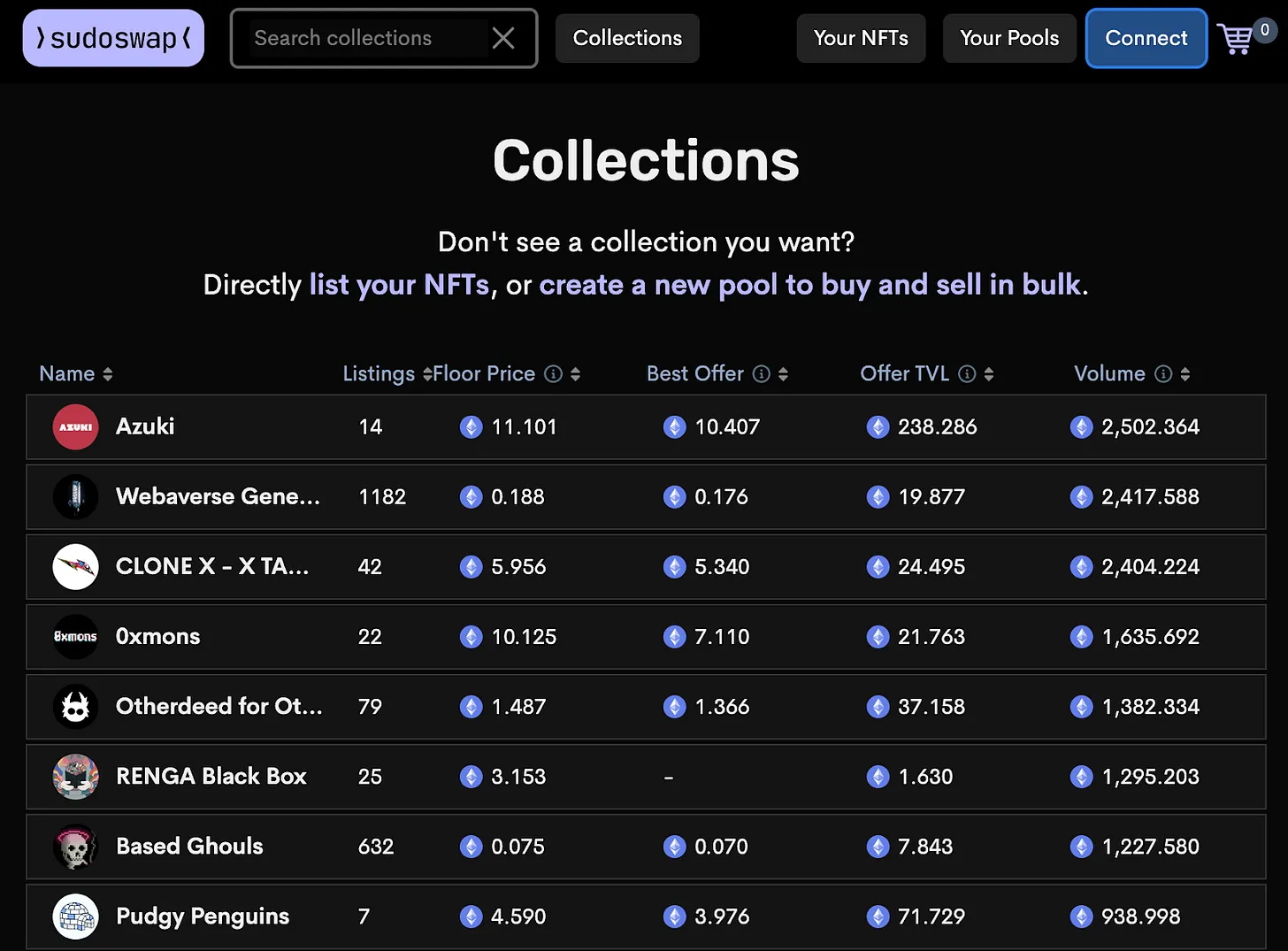
Collections on Sudoswap. Source: Sudoswap
Because of Sudoswap’s popularity and tx volume, their decision to forgo creator royalties drew a ton of attention in the NFT and crypto community. Users will most likely buy at the cheapest price point available to them, even if it means that the original creator of the art isn’t earning any fees.
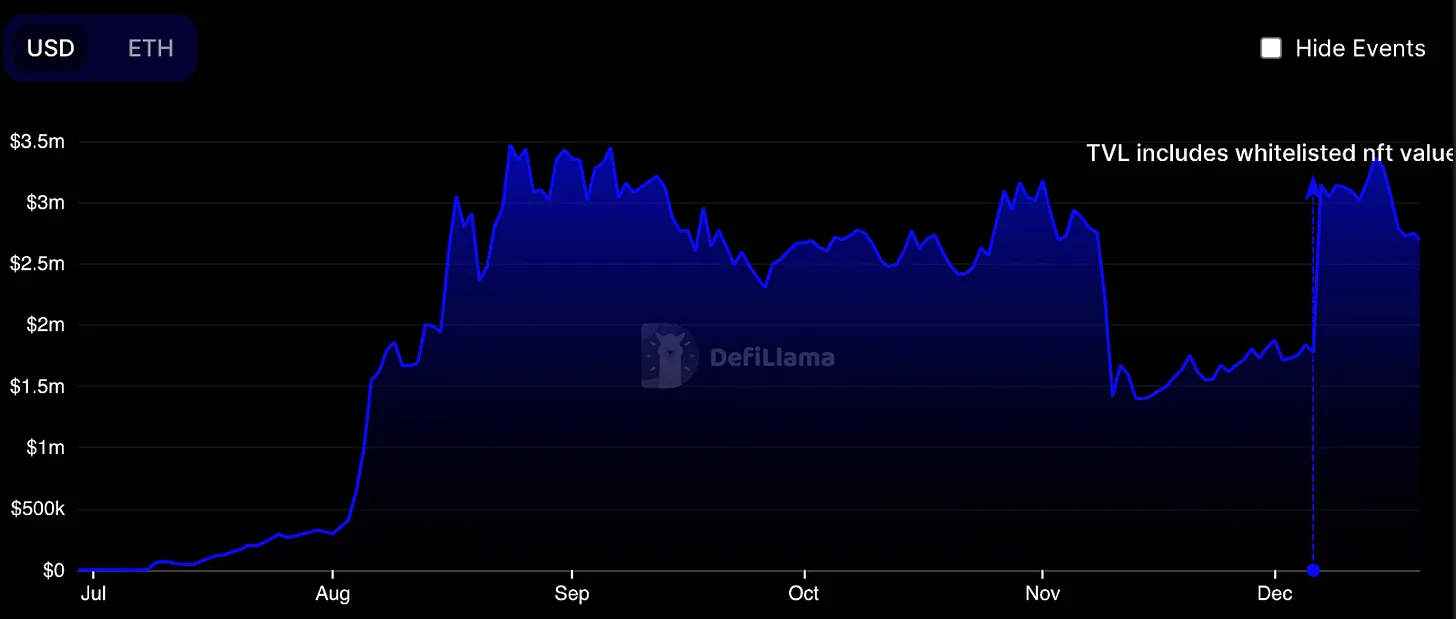
Sudoswap TVL. Source: Defi Llama
Many marketplaces have been increasingly eliminating royalties in an effort to bring more traders to their platform due to lower overall fees. Unlike Sudoswap, OpenSea has a history of paying on average 5% to creators via secondary sales. However, the dominant Ethereum marketplace stated on November 7 that they were creating a royalty enforcement tool that was only applicable to new NFT collections with no language on existing ones. However, after aggressive community pushback, OpenSea stated that it would continue to enforce royalties on existing projects just two days later on November 9. The OpenSea drama proved the power of community pushback influencing large business decisions almost immediately – something especially unique to the crypto environment. OpenSea’s decision also generated network effects: the following Friday, X2Y2, another popular marketplace, stated that they’d enforce creator royalties on all NFTs. Blur, an NFT collection platform for pro traders, recently also took to Twitter to affirm that they would “enforce a minimum royalty on immutable collections.” To start, Blur will enforce a minimum royalty of 0.5%, and plans to increase the minimum as they “observe the effects of each increase.”
Not all marketplaces have been as receptive to community feedback. In mid-October, Magic Eden stated on Twitter that “the market has been shifting towards optional creator royalties for awhile,” but that they’ve been “actively trying to avoid this outcome.” Noting that royalties aren’t enforceable on-chain, the platform instated optional royalties with the default set to full royalties. Magic Eden also cited evidence of wallet owners shifting their behavior towards using optional royalty marketplaces for trading.
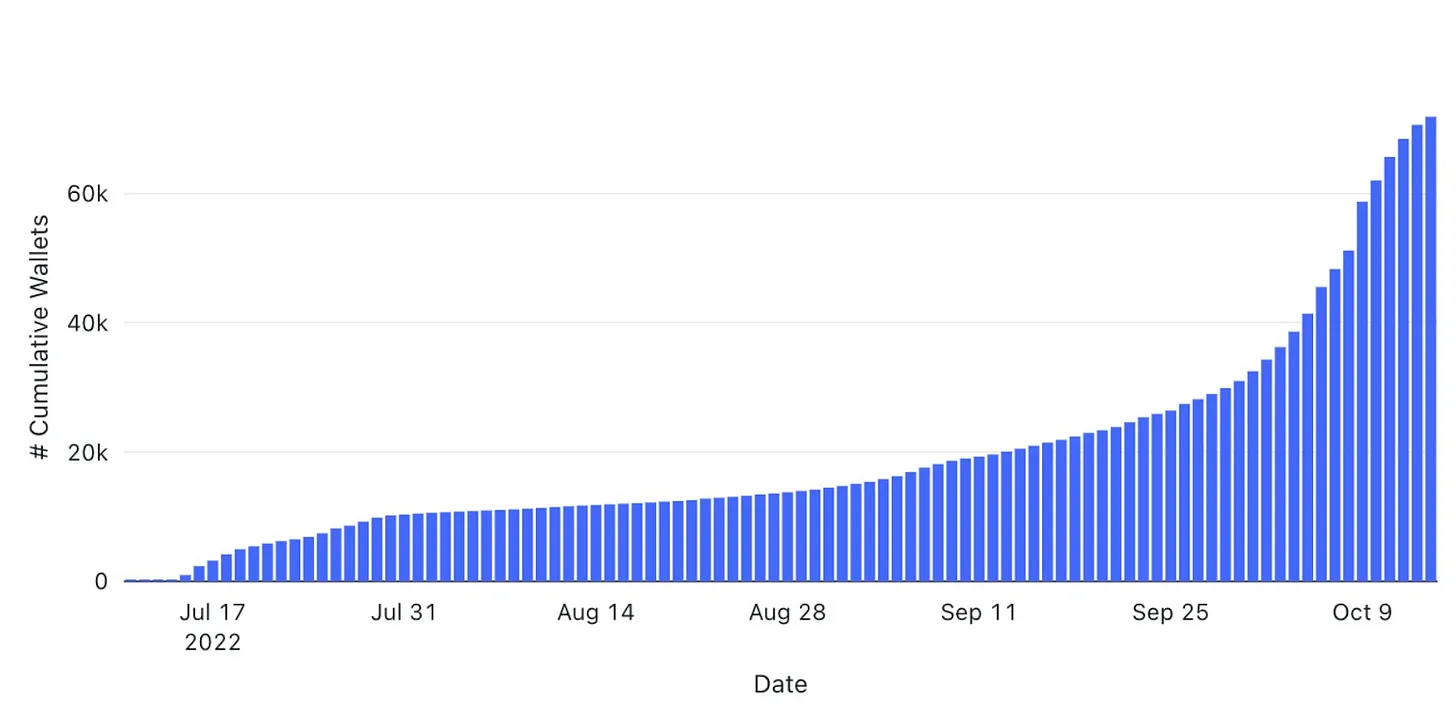
Cumulative wallets that have used optional royalty marketplaces to buy or sell NFTs. Source: Magic Eden on Twitter
Royalties have been a unique part of the NFT industry that have encouraged creators to further develop their projects. Wylie Aronow, co-founder of Yuga Labs, even claimed that “the NFT ecosystem would be a tiny fraction of what it is today if it weren’t for creator royalties.” For his collection, Bored Ape Yacht Club, the first mint was for only $220 per NFT, which pushed the team to get creative, popularize the collection, and really develop a brand around it that people were drawn to. If they did this, the NFTs would trade hands more often (at least initially), their prices would be bid up, and the project would generate more revenue for the core creators. According to Harry Liu on Twitter, royalties earned by top NFT collections in 2022 was around $340M, with Yuga Labs alone bringing in $110M.
There have also been some novel mechanisms involving royalties experimented with in practice, including with DigiDaigaku creator Limit Break’s “opt in, backwards compatible programmable royalties powered by staking.” As Limit Break specifies in an article detailing the mechanism, the royalties are enforceable at the individual token level and are compatible with any ERC-721 contract.
Royalties are a basic incentive design in industry. Without royalties, NFT creators aren’t as willing to promote and stick with their project. I’d even go so far as to say that a lack of royalties discourages creation in the first place. If artists aren’t given financial attribution as their work popularizes, they’re going to be disinclined to pursue creation. However, decentralization is at the heart of this industry and NFT royalties are nearly impossible to enforce on-chain. We need to take into account what’s feasible on-chain, what makes sense in a competitive business environment (and if businesses are responsible for enforcing royalties), and how to support creators in order to make decisions as a community for the future of royalties.