Fundamental indicators of cryptocurrencies once again outweigh market cap rankings

cryptonews.ruPublicado a 2026-08-16Actualizado a 2026-08-16

Resumen

Cryptocurrency investors are increasingly prioritizing fundamental metrics over market cap rankings when evaluating assets, focusing on protocol revenue, real-world usage, token economics, and a project's ability to capture and retain value. Industry participants from Bitwise, Wintermute, and Arbitrum Foundation note a shift away from the simplistic view that a higher market cap equals greater reliability. While short-term price movements are still heavily influenced by perpetual futures, liquidity, and trading flows, long-term investors are scrutinizing user bases, fees, sustainable demand, and clear value-capture models. Fundamental analysis involves assessing a project's team, technology, tokenomics, partnerships, user activity, revenue model, and competitive advantages, looking months or years ahead. Technical analysis remains relevant for short-term trading. Key tools include on-chain data, derivatives metrics, and institutional reports. Market cap is no longer the primary benchmark. Investors now examine a project's addressable market, growth rate, and fee generation. Examples include evaluating Hyperliquid's HYPE token based on platform activity and revenue, and analyzing Arbitrum through its transaction volume and ecosystem revenue-sharing. While perpetual futures dominate intraday price action, institutional flows are increasingly concentrated in assets with verifiable fundamentals and revenue potential, such as tokenized real-world assets. Metrics like fee reven...

Fundamental indicators of cryptocurrencies are increasingly becoming the main filter for investors: they look at protocol revenue, real-world usage, token economics, and a project's ability to retain created value, not just its position in the market capitalization table.

Market participants from Bitwise, Wintermute, and Arbitrum Foundation note that cryptocurrency is gradually moving out of the stage where tokens were evaluated on the principle of 'the higher in the ranking, the more reliable.' In the short term, prices are still largely driven by perpetual futures, liquidity, and trading flows. But over months and years, investors are paying closer attention to whether a network has users, fees, sustainable demand, and a clear model for capturing value.
Key takeaways:

  • Investors are increasingly evaluating tokens based on the size of the potential market, actual adoption, and the project's ability to convert activity into value.
  • Capital managers who are just entering the crypto industry are not limiting themselves to CoinMarketCap rankings and are delving deeper into individual networks and applications.
  • Hyperliquid became one of the early examples of this approach: the $HYPE token is evaluated through platform activity, its revenues, and economic parameters.

What is fundamental analysis of cryptocurrencies

Fundamental analysis of cryptocurrencies, in simple terms, is an attempt to understand what makes a project valuable in the first place. An investor looks not only at the token price, but at users, fees, revenues, technology, tokenomics, and the network's ability to retain created value.

Technical analysis answers a different question: how the price behaves on the chart right now. It helps assess levels, liquidity, perpetual futures, funding rates, and trader behavior. Fundamental analysis is more suitable for evaluating a project over months and years, while technical analysis is for finding entry points and short-term trades.

Fundamental and technical analysis: a brief comparison

  • Criterion: What is studied. Fundamental analysis looks at the protocol's business logic, users, fees, and token economics. Technical analysis looks at the price chart, volumes, liquidity, and derivatives.
  • Criterion: Horizon. Fundamental analysis is more useful over a horizon of months and years. Technical analysis is more often used intraday and for short-term trades.
  • Criterion: Main question. Fundamental analysis asks why an asset should have value. Technical analysis asks where the price might go in the near future.

What to check before evaluating a token

  • Developer team: Experience, public presence, ability to deliver on promises and develop the product.
  • Technology and innovation: What problem the network or application solves and whether the project has a noticeable advantage.
  • Tokenomics: Issuance, token distribution, incentives for participants, and value accumulation mechanism.
  • Partnerships and integrations: Whether they help attract users, capital, and real-world use cases.
  • User activity: Transactions, paying users, fees, and audience retention.
  • Economic model: Whether there are revenues, demand, and a clear link between protocol activity and token value.
  • Competitors: How the project differs from other networks, exchanges, applications, or infrastructure solutions.
  • Roadmap and development plans: How realistic the plans are and whether they support the long-term growth of the ecosystem.

Tools and metrics for fundamental analysis

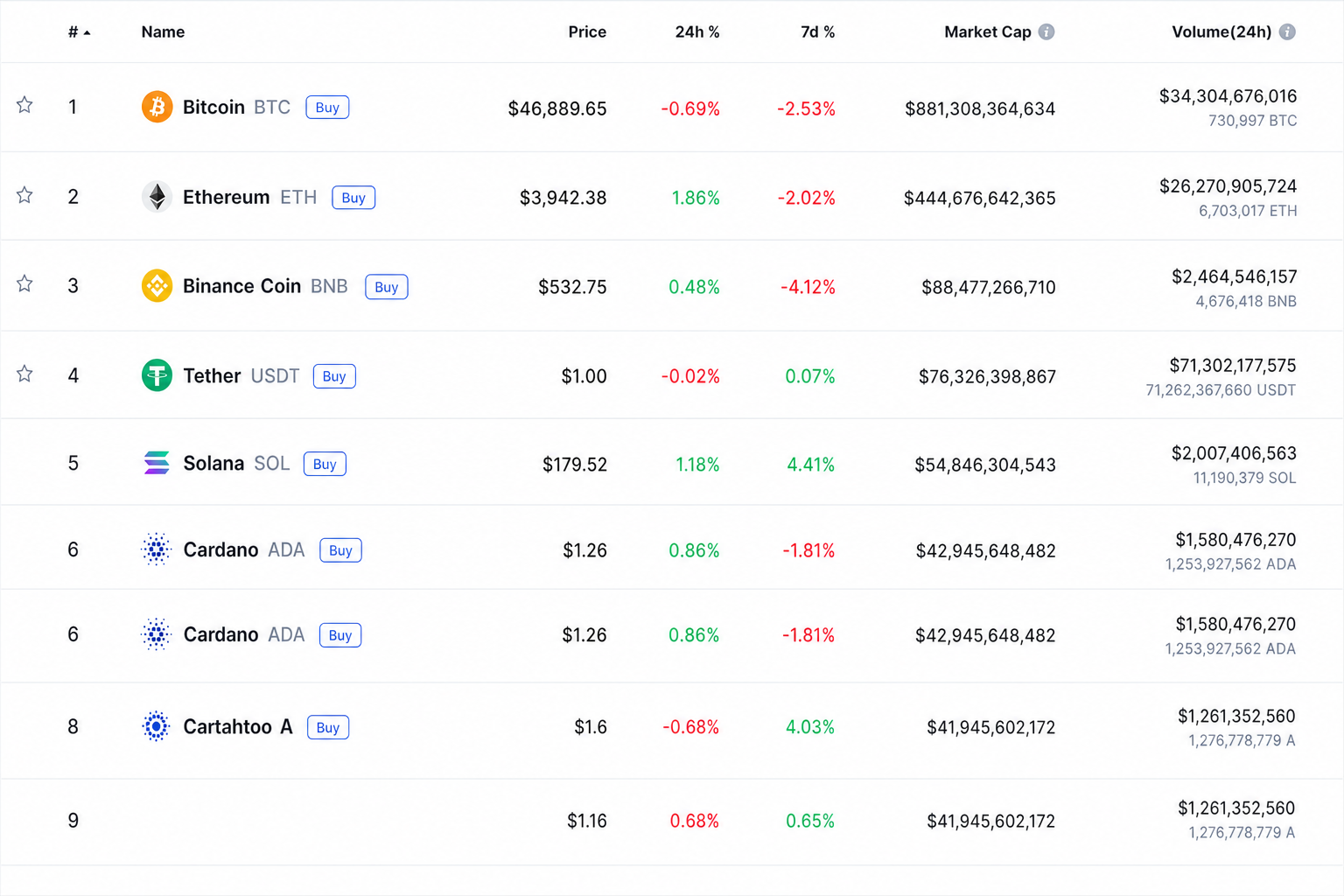
For fundamental analysis, investors use not one indicator, but a set of sources and metrics. The market capitalization ranking helps to quickly understand the scale of an asset, but by itself it no longer answers the question of how strong a project is.

  • Rankings and aggregators like CoinMarketCap help assess a token's place in the market and compare its capitalization with other assets.
  • On-chain data shows transactions, fees, user activity, and capital that remains within the network.
  • Reports and reviews from managers and market makers, including Bitwise and Wintermute, help to see institutional flows and changes in demand.
  • Data on derivatives, perpetual futures, funding rates, and liquidations help separate short-term price movements from the long-term value of a project.

Market capitalization is the token price multiplied by the number of tokens in circulation. This indicator is important because it helps compare the scale of projects, but it does not replace the analysis of revenues, users, tokenomics, and sustainability of demand.

When evaluating a team, it's worth looking at who develops the project, whether the participants have relevant experience, how they communicate with the community, and whether they fulfill stated plans. When evaluating tokenomics, token distribution, incentives, issuance, token demand, and whether part of the created value is returned to the ecosystem are important.

Government policy and regulation affect the market through rules for investor admission, requirements for exchanges and custodians, tax regime, as well as the approach to stablecoins, tokenized assets, and DeFi instruments. The clearer the rules, the easier it is for large allocators to work with digital assets; sharp uncertainty, on the contrary, increases risk and can put pressure on liquidity.

Why market cap ranking has ceased to be the main benchmark

Bitwise CEO Hunter Horsley describes what is happening as the end of the 'CoinMarketCap ranking' era. In previous market cycles, new layer-1 networks were often evaluated as a scaled-down version of the largest blockchains: if a project was lower on the list, a discount was automatically applied to it.

Now this template works less well. Fundamental analysis comes to the fore: what market a project can capture, how fast its user base is growing, what fees it collects, and how much of the created value remains within the ecosystem. Market capitalization remains a noticeable benchmark, but it no longer replaces a full-fledged evaluation of the protocol's business.

Horsley cites Hyperliquid as an example. When evaluating $HYPE, investors can look not at how similar it is to another blockchain network, but at the trading activity of the derivatives platform, its profitability, and internal economics. Over the past year, the token has risen by about 20%.

When we talk to capital managers at companies that have recently entered this sector, they often don't even know what position an asset occupies on CoinMarketCap. For them, it's just not the main thing, said Hunter Horsley.

Perpetual futures still move the price intraday

Wintermute OTC trader Jasper De Maer emphasizes: fundamental indicators and market flows are important, but they work on different timeframes. Intraday, the price is still often determined by perpetual futures, funding rates, trader positioning, and liquidations.

For most major tokens, the volume of perpetual futures remains several times higher than spot trading. Therefore, technical analysis, liquidity data, and the behavior of the derivatives market retain significance for short-term trades. But for longer-term investments, investors are increasingly returning to revenues, demand, and the quality of user activity.

According to De Maer, over the past 12-18 months, interest has noticeably shifted from pure infrastructure to applications and application-specific blockchains. Such projects are closer to the familiar logic of fintech and venture capital: they are easier to compare by clients, turnover, fees, and user retention.

Fundamental metrics become especially important in decentralized finance, on perpetual futures exchanges, and in decentralized physical infrastructure networks. Mining also falls into this category, where investors have long been accustomed to looking at the cost of production, revenue, and the sustainability of the model, not just the coin price.

Fundamental indicators form the lower boundary of valuation and help create a shortlist of assets, and then trading flows determine the specific price, noted Jasper De Maer.

He adds that revenues and real-world usage help understand which tokens will survive downturns and enter the portfolios of large allocators. But these indicators rarely determine where the price will go today.

Institutional flows are changing the market structure

Wintermute data shows that the main change is not so much a shift from spot to derivatives, but rather who exactly is trading. In the first half of 2026, institutional counterparties accounted for about 72% of the company's spot OTC flow. A year earlier, their share was approximately 59%.

These flows are concentrated in the largest cryptocurrencies and in a limited set of tokens that can generate income. De Maer calls tokenized real assets a separate new category. In this logic, a token is increasingly perceived not only as a speculative instrument, but also as an asset on the balance sheet, whose value must be based on verifiable cash flows or retained capital.

At the same time, De Maer warns: it is not always easy to understand where the market is truly rewarding strong fundamentals, and where it is simply following a fashionable narrative. Tokens with revenue attract attention precisely because the fundamental theme is currently in demand, and these two effects are difficult to separate.

The gap is also noticeable between the crypto assets themselves and public companies related to the industry. In the first half of the year, cryptocurrencies fell by 36%, while crypto company stocks rose by 23%, according to a Bitwise review. This does not mean that the stock as a financial instrument will continue to outperform tokens, but it shows that the securities market and the digital assets market can operate in different modes.

Which metrics do investors consider more reliable

Brendan Ma, Head of Investment Strategy at Arbitrum Foundation, says analysts have become better at understanding revenue structure, transactional activity, and value capture mechanisms compared to a year ago. In his opinion, the most convincing are metrics that require costs to create and are verifiable on the blockchain.

Ma includes fee revenue, users who actually pay fees, and capital remaining in the network as such indicators. These can be stablecoin balances and tokenized assets. Such data is harder to fake than a simple number of addresses or total value locked.

The number of addresses and the total value locked metric can be inflated by incentives or bots. Therefore, transaction growth becomes more important when accompanied by an increase in fees and user retention. In this sense, economics as a science helps to look at blockchain not as a price quote table, but as a system of incentives, demand, and value distribution.

Ma cites Arbitrum as an example of project-level analysis. Throughout its history, the network has processed over 2.7 billion transactions, of which more than 500 million occurred in 2026. According to the foundation, Robinhood Chain generates about $40 million in annual revenue. Under the expansion program, 10% of that network's net protocol revenue is returned to the Arbitrum ecosystem.

Which assets look stronger based on fundamentals

According to the logic of Hunter Horsley, Jasper De Maer, Brendan Ma, and Zach Pandl, assets that look stronger are not just the most prominent tokens, but those with real usage, revenues, capital within the network, and a clear model for capturing value.

  • Bitcoin remains a separate macro asset, demand for which is linked to the search for alternatives to fiat currencies.
  • Ethereum and projects beyond it will undergo stricter scrutiny of their economic model, users, and revenues.
  • $HYPE is evaluated through Hyperliquid's activity, platform profitability, and internal economics.
  • Arbitrum shows how investors can look at transactions, revenue of connected networks, and the return of part of the revenue to the ecosystem.

Bitcoin, Ethereum, and the new chapter of digital assets

Hunter Horsley believes that index products can give investors broad access to the crypto market without the need to pick individual winners. Such solutions are offered by Bitwise, as well as other asset managers, including 21Shares.

Grayscale's Head of Research, Zach Pandl, separates Bitcoin and the rest of the market. In his assessment, Bitcoin remains a macro asset, demand for which is linked to the search for alternatives to fiat currencies. Here, macroeconomics, inflation, and investor attitudes towards monetary policy are important.

Other cryptocurrencies, including Ethereum and projects beyond it, will undergo stricter scrutiny of their underlying economic model. Investors will look at whether the network has real users, sustainable revenues, and a clear logic for value accumulation. In traditional finance, financial reporting plays a similar role: it helps understand to what extent a security or business is backed by real results.

Pandl expects the sector's prospects to remain strong because stablecoins, tokenized assets, and decentralized finance instruments will support demand for digital assets beyond Bitcoin in the coming years.

A small number of tokens with a strong fundamental base will play a key role in the next stage of digital asset development. Weak projects with poor indicators will be left behind, said Zach Pandl.

The main conclusion for the market is simple: capital is increasingly less willing to pay just for a place in the ranking. As the industry matures, verifiable economics, real users, and a project's ability to convert activity into long-term value become more important for investors than a loud narrative.

end-content

Criptos en tendencia

Preguntas relacionadas

QAccording to the article, why are fundamental indicators becoming more important than market cap rankings for cryptocurrency investors?

AFundamental indicators are becoming more important because investors are increasingly looking at a project's actual business metrics, such as protocol revenue, real usage, tokenomics, and its ability to capture and retain value, rather than just its position in a market cap ranking. Market cap alone no longer answers how strong a project truly is.

QWhat is the main difference between fundamental analysis and technical analysis in crypto, according to the article?

AThe main difference lies in their focus and time horizon. Fundamental analysis looks at the business logic of a protocol, its users, fees, and token economics to understand why an asset should have value, typically over months and years. Technical analysis examines price charts, volume, liquidity, and derivatives to predict short-term price movements, often used for intraday and short-term trading.

QWhat key metrics, as mentioned by Brendan Ma from Arbitrum Foundation, are considered more reliable for fundamental analysis and why?

AMetrics that require cost to create and are verifiable on-chain are considered more reliable. These include fee revenue, users who actually pay fees, and capital that stays within the network (like stablecoin balances and tokenized assets). These metrics are harder to fake compared to easily inflated ones like the number of addresses or total value locked (TVL).

QAccording to Jasper De Maer from Wintermute, what still drives intraday price movements in the crypto market?

AIntraday price movements are still largely driven by perpetual futures, funding rates, trader positioning, and liquidations. For most major tokens, the volume of perpetual futures trading remains several times higher than spot trading, making technical analysis and derivative market behavior significant for short-term trades.

QWhat shift in investor focus does Jasper De Maer note has occurred over the last 12-18 months?

AHe notes a noticeable shift in investor interest away from pure infrastructure projects towards applications and application-specific blockchains. These projects are closer to traditional fintech and venture capital logic, making them easier to compare based on customers, turnover, fees, and user retention.

Lecturas Relacionadas

¿Tendría sentido RWA sin DeFi?

La discusión sobre RWA (Real World Assets) suele comenzar con una visión simple: tokenizar un activo como un bono del tesoro o una acción. Esto es útil, pero no transformador. Tokenizar es como poner un código de barras a un contenedor; es necesario, pero no crea toda la infraestructura comercial. Un token es un reclamo de propiedad direccionable; DeFi es el sistema operativo del mercado. La pregunta clave no es cuántos activos pueden tokenizarse, sino cuántos pueden valorarse, financiarse, cubrirse, comercializarse y liquidarse en condiciones de estrés sin coordinación fuera de cadena. La tokenización representa la propiedad; DeFi proporciona la utilidad real. Para que un RWA sea compatible con DeFi, necesita seis capas: derechos exigibles, fuentes de datos fiables, reglas claras de transferencia, liquidez secundaria ejecutable, parámetros de garantía realistas y vías creíbles de liquidación. Una contradicción técnica fundamental son los múltiples "relojes" bajo los que operan los RWA: la cadena de bloques se liquida en segundos, pero los mercados tradicionales cierran por la noche y los fines de semana, y los reembolsos pueden tardar días. Esta discrepancia crea un "vacío de liquidación" donde DeFi exige liquidez inmediata, pero el mundo real no puede proporcionarla. Por lo tanto, un RWA de baja volatilidad como un bono tokenizado puede ser una garantía más riesgosa que el ETH volátil pero líquido las 24 horas. La liquidez no es el TVL; es la capacidad de convertir una posición en el activo de liquidación necesario dentro de una ventana de tiempo aceptable. Un RWA tiene múltiples vías de salida (venta en el mercado, reembolso, préstamo garantizado), cada una con diferentes retrasos y riesgos. El apalancamiento es lo que libera la utilidad económica, pero también introduce fragilidad. Las tasas de garantía deben tener en cuenta la ejecutabilidad legal, la frescura de los datos del oráculo, los retrasos en el reembolso y la capacidad de los creadores de mercado. El riesgo en DeFi es el riesgo del activo multiplicado por el riesgo de la estructura del mercado. El riesgo de los RWA debe modelarse como un gráfico de relaciones entre nodos (flujos de efectivo subyacentes, custodios, oráculos, protocolos de préstamo, etc.), ya que las fallas rara vez están aisladas y se propagan a través de dependencias. Los bonos del tesoro tokenizados son solo el punto de entrada. Las fronteras más interesantes son los activos de potencia computacional y energía, que tienen perfiles de riesgo únicos y complejos. Las acciones tokenizadas y los contratos perpetuos presentarán la prueba más grande, conectando la propiedad de acciones globales con el apalancamiento nativo de las criptomonedas, pero también generarán riesgos interconectados que requerirán diseños arquitectónicos sólidos. Sin DeFi, los RWA tienen un valor limitado (mejor distribución, transparencia). La verdadera oportunidad surge cuando los activos ingresan a mercados de capital abiertos y programables, donde pueden ser utilizados como garantía. Un RWA es verdaderamente compatible con DeFi cuando todo el mercado que lo rodea puede sobrevivir a un fin de semana de estrés. La visión a largo plazo no es "tokenizar todo", sino que los activos productivos del mundo real sean direccionables por software, con el capital fluyendo sin problemas y los riesgos gestionados a la velocidad del mercado. El token es solo el código de barras. El mercado es la máquina que realmente funciona.

marsbitHace 18 min(s)

¿Tendría sentido RWA sin DeFi?

marsbitHace 18 min(s)

La intervención del gobierno en el mercado de bonos, ¿qué significa realmente?

El 19 de agosto de 2026, el Departamento del Tesoro de EE. UU. anunció que duplicaría al menos (hasta 40 mil millones de dólares) el tamaño máximo de sus operaciones de recompra de bonos del gobierno a largo plazo (10 a 30 años), vigente del 9 de septiembre al 4 de noviembre. La medida respondía a una fuerte presión vendedora que había llevado el rendimiento del bono a 30 años al 5.34%, su nivel más alto desde 2007. En una operación de recompra previa, los inversionistas ofrecieron vender cerca de 200 mil millones, pero el Tesoro solo compró 20 mil millones, lo que evidenció un severo desequilibrio. La reacción del mercado fue inmediata: los rendimientos de los bonos a largo plazo cayeron, las acciones subieron y el oro avanzó un 2.7%. Estas recompras, que retiran de circulación bonos antiguos y menos líquidos, buscan apoyar el funcionamiento del mercado, no reducir la deuda total. Expertos advierten que se trata de una solución táctica que no aborda las causas estructurales del alza de rendimientos: un déficit fiscal elevado, presiones inflacionarias y una menor demanda de compradores tradicionales como bancos centrales extranjeros. La intervención del Secretario del Tesoro, Scott Bessent, sugiere que las autoridades están vigilantes, pero el desafío fundamental de financiar una deuda pública que supera los 40 billones de dólares persiste. Se vigilarán los próximos datos económicos y subastas de bonos para evaluar la duración del alivio.

marsbitHace 20 min(s)

La intervención del gobierno en el mercado de bonos, ¿qué significa realmente?

marsbitHace 20 min(s)

¿Hasta cuánto le queda a EE.UU. para reiniciar el QE después del 'Bessent Put'?

El Tesoro de EE.UU. anunció el 19 de agosto un aumento de sus recompras de bonos a largo plazo, elevando la oferta por operación para bonos nominales a 10-20 y 20-30 años de un máximo de 2.000 a al menos 4.000 millones de dólares, con efecto desde el 9 de septiembre. Aunque la medida es pequeña en relación con el mercado total de deuda, su anuncio fuera del ciclo habitual de comunicaciones (QRA) hizo que los inversores la interpretaran como una señal de política: una posible creciente disposición del gobierno a intervenir para contener el aumento rápido de los rendimientos a largo plazo. El mercado comenzó a referirse a esta expectativa como el "Bessent Put", en referencia al subsecretario del Tesoro, Joshua Bessent. Analistas como Charlie McElligott de Nomura ven la acción como una declaración de intenciones para evitar que los costes de financiación a largo plazo restrinjan el gasto fiscal, la estrategia geopolítica o la financiación privada. Sin embargo, el Tesoro insiste en que se trata únicamente de una operación de apoyo a la liquidez. La presión sobre los bonos a largo plazo proviene de múltiples factores: grandes déficits fiscales y una elevada oferta de deuda del Tesoro, una prima por plazo en aumento, una fuerte emisión de deuda corporativa para financiar infraestructuras de IA (efecto expulsión) e incertidumbres relacionadas con Japón, un importante tenedor extranjero. En esencia, el "Bessent Put" refleja un cambio en la función de reacción política percibida por el mercado: la expectativa de que las autoridades podrían actuar de forma más proactiva si los rendimientos amenazan objetivos económicos o geopolíticos. No obstante, hay una gran distancia entre estas recompras limitadas y herramientas como el Control de la Curva de Rendimientos (YCC) o un nuevo Quantitative Easing (QE). La recompra del Tesoro es una operación de gestión de deuda, mientras que el QE implica la expansión del balance de la Fed. Para que se den pasos hacia políticas más intervencionistas, el entorno económico y de mercado tendría que deteriorarse significativamente. Por ahora, la medida abre el debate pero no marca el inicio de un nuevo QE. Su verdadero impacto será determinado por si el Tesoro y la Fed escalan su respuesta ante un posible nuevo repunte estructural de los tipos a largo plazo.

marsbitHace 23 min(s)

¿Hasta cuánto le queda a EE.UU. para reiniciar el QE después del 'Bessent Put'?

marsbitHace 23 min(s)

¡Ethereum finalmente "recupera sangre"! ETH regresa a la línea dorada, ¿en qué se diferencia este repunte?

Después de más de tres meses, el precio de Ethereum (ETH) ha superado los 2.300 dólares, alcanzando un nivel similar al de principios de mayo. Este repunte de aproximadamente el 25% en una semana ha sido más fuerte que el de Bitcoin, impulsando la relación ETH/BTC a 0,031. La capitalización de mercado de ETH ha vuelto a situarse entre los principales activos mundiales, en el puesto 72. La liquidación masiva de posiciones cortas (más de 13.300 millones de dólares, un 88,4% en cortos) ha amplificado la subida. Técnicamente, ETH ha superado una resistencia clave y ha vuelto a situarse por encima de su media móvil exponencial de 50 semanas (EMA50) por primera vez en este ciclo bajista, lo que se considera una señal alcista significativa. Los ETF de Ethereum muestran un fuerte flujo de entrada de capitales, superando recientemente a los de Bitcoin. En julio, los ETF de ETH registraron entradas netas equivalentes al 3,19% de sus activos, frente al 0,34% de los de BTC. Instituciones como Morgan Stanley y JPMorgan han aumentado significativamente su exposición a ETH. La participación en staking de ETH ha alcanzado un máximo histórico, con más de 41,1 millones de ETH (casi el 33,7% de la oferta) apostados. Sin embargo, el rendimiento por staking ha caído al 2,59%, lo que podría reducir su atractivo. Una próxima propuesta de mejora (EIP-8061) busca aumentar la eficiencia y flexibilidad para retirar fondos del staking. En resumen, el repunte de ETH cuenta con el apoyo de la mejora del sentimiento, los flujos de capital y los fundamentos, aunque su sostenibilidad a largo plazo dependerá de la evolución del mercado y la adopción de casos de uso como la tokenización y los agentes de IA.

marsbitHace 27 min(s)

¡Ethereum finalmente "recupera sangre"! ETH regresa a la línea dorada, ¿en qué se diferencia este repunte?

marsbitHace 27 min(s)

Trading

Spot

Artículos destacados

Cómo comprar CAP

¡Bienvenido a HTX.com! Hemos hecho que comprar Cap (CAP) sea simple y conveniente. Sigue nuestra guía paso a paso para iniciar tu viaje de criptos.Paso 1: crea tu cuenta HTXUtiliza tu correo electrónico o número de teléfono para registrarte y obtener una cuenta gratuita en HTX. Experimenta un proceso de registro sin complicaciones y desbloquea todas las funciones.Obtener mi cuentaPaso 2: ve a Comprar cripto y elige tu método de pagoTarjeta de crédito/débito: usa tu Visa o Mastercard para comprar Cap (CAP) al instante.Saldo: utiliza fondos del saldo de tu cuenta HTX para tradear sin problemas.Terceros: hemos agregado métodos de pago populares como Google Pay y Apple Pay para mejorar la comodidad.P2P: tradear directamente con otros usuarios en HTX.Over-the-Counter (OTC): ofrecemos servicios personalizados y tipos de cambio competitivos para los traders.Paso 3: guarda tu Cap (CAP)Después de comprar tu Cap (CAP), guárdalo en tu cuenta HTX. Alternativamente, puedes enviarlo a otro lugar mediante transferencia blockchain o utilizarlo para tradear otras criptomonedas.Paso 4: tradear Cap (CAP)Tradear fácilmente con Cap (CAP) en HTX's mercado spot. Simplemente accede a tu cuenta, selecciona tu par de trading, ejecuta tus trades y monitorea en tiempo real. Ofrecemos una experiencia fácil de usar tanto para principiantes como para traders experimentados.

498 Vistas totalesPublicado en 2026.06.26Actualizado en 2026.06.26

Cómo comprar CAP

Discusiones

Bienvenido a la comunidad de HTX. Aquí puedes mantenerte informado sobre los últimos desarrollos de la plataforma y acceder a análisis profesionales del mercado. A continuación se presentan las opiniones de los usuarios sobre el precio de CAP (CAP).

活动图片