Send a Message to Transfer Coins? Telegram to 'Stuff' a Crypto Wallet into 1 Billion Users This Summer

marsbitPublicado a 2026-07-22Actualizado a 2026-07-22

Resumen

Telegram founder Pavel Durov has announced that a native, non-custodial wallet called Gram wallet will be built into every Telegram app this summer. This move aims to provide instant, fee-free cryptocurrency transfers for the platform's over 1 billion monthly active users. Durov described it as the largest deployment of a non-custodial crypto wallet in history. The new wallet, developed by Telegram itself, differs fundamentally from the existing third-party @wallet bot. It will be non-custodial from the start, meaning users will control their private keys. Following the announcement, the GRAM token (formerly Toncoin) saw a price increase of approximately 8%. This initiative is part of Telegram's renewed control over the TON blockchain and its "Make TON Great Again" roadmap, marking a return to the project after a 2018 SEC lawsuit. The launch comes as other super-apps like X Money and Meta are also expanding into digital payments, with Telegram opting for a crypto-native approach. However, key details remain unclear, including the exact launch date beyond "this summer," how the promised zero fees will be implemented technically, and how asset support and private key management will work for mainstream users.

Author: Claude, Deep Tide TechFlow

Deep Tide's Guide: Telegram founder Pavel Durov announced that this summer, a native non-custodial Gram wallet will be built into all Telegram apps, offering zero-fee instant transfers to over 1 billion users. GRAM subsequently rose about 8% to $1.53. This wallet differs from the existing third-party-operated @wallet bot; it is developed by Telegram itself, with users directly controlling their private keys. Amid a competitive window where super apps like X Money and Meta's stablecoin payments are entering the fray, Durov is betting on a crypto-native route. However, the promise of the "largest deployment in human history" still lacks technical details and a definitive timeline.
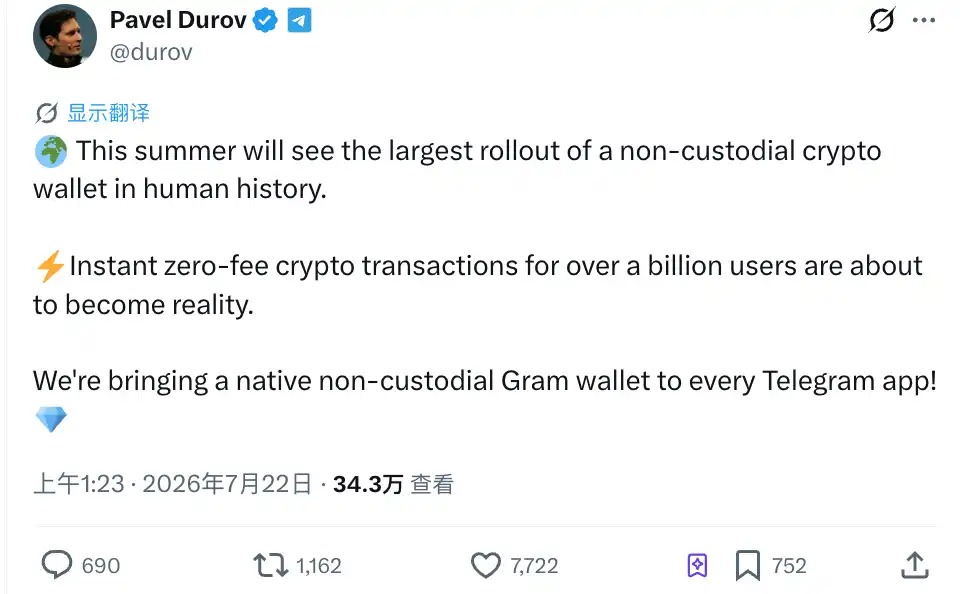
Telegram founder Pavel Durov announced in his Telegram channel on July 21 that this summer, a native non-custodial Gram wallet will be built into every Telegram application, providing instant, zero-fee cryptocurrency transfer services to over 1 billion monthly active users.

Durov characterized this launch as "the largest non-custodial crypto wallet deployment in human history." For comparison, the most widely used self-custody wallet in the crypto space, MetaMask, has tens of millions of users; no crypto wallet has ever started with a base of 1 billion users.

Completely Different from the Existing @wallet, Telegram Steps In Directly

This new wallet is fundamentally different from the existing @wallet bot within Telegram.

According to Decrypt, the existing @wallet is a mini-app developed and operated by the independent third-party company The Open Platform (TOP), and is not an official Telegram product. The service already boasts over 150 million registered users, with a default custodial model (meaning a third party holds user private keys), requiring users to actively switch to use its self-custody layer.

The new wallet announced by Durov is a feature natively embedded into the Telegram app, designed from the ground up as non-custodial, with users controlling their own private keys and assets. Non-custodial means there is no intermediary that can freeze, seize, or block transactions.

According to BeInCrypto, TOP founder Andrew Rogozov confirmed that the existing custodial @wallet service will continue to operate independently. However, key questions remain unanswered: whether the old and new wallets will ultimately coexist, which assets besides GRAM the new wallet will support, and how private key management will be handled for ordinary users who have never interacted with cryptocurrency.

GRAM Rises About 8%, But Still 88% Away from Previous High

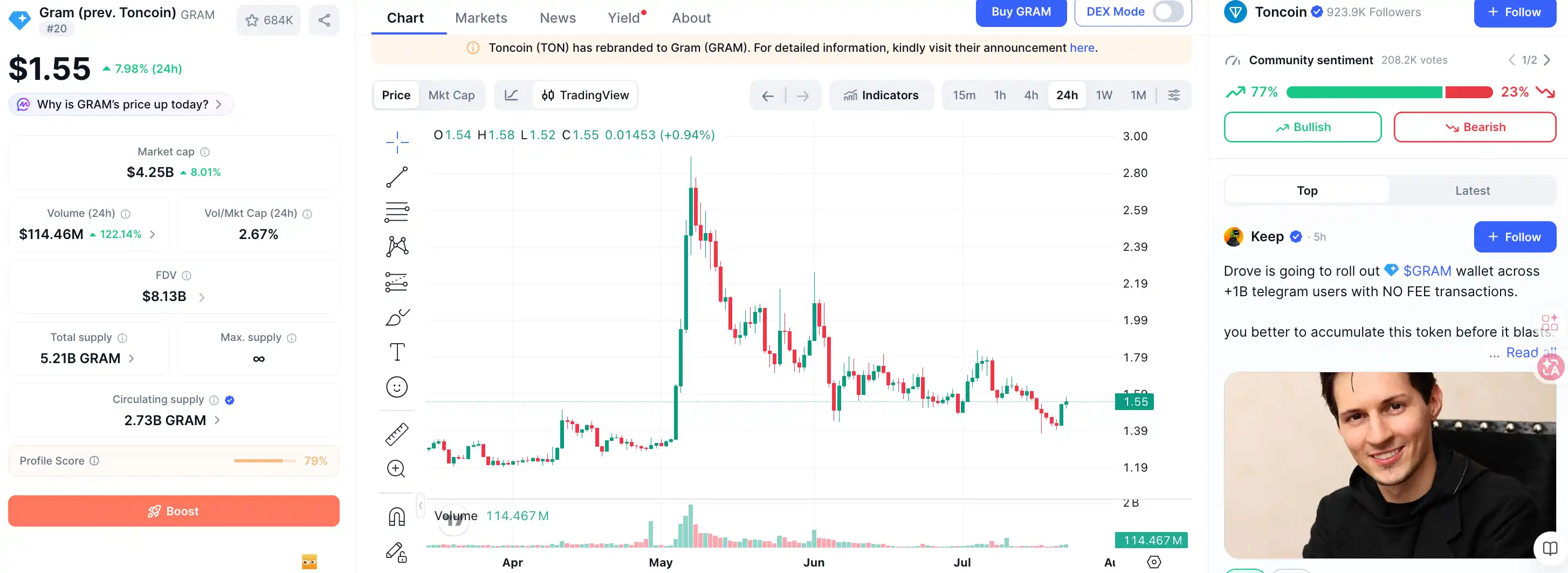
Following the announcement, GRAM (originally Toncoin, the native token of the TON blockchain) rose approximately 8.5% in 24 hours to around $1.53, with a market cap of about $4.18 billion. According to CoinMarketCap data, this partially offset a cumulative decline of about 25% since July, but significant reversal remains distant.

GRAM's 200-day exponential moving average is far above its current price, indicating a still bearish long-term trend. The token's all-time high was $8.25 (during the Telegram 'Tap-to-Earn' gaming frenzy in June 2024). It reached its yearly high of $2.89 in May 2026 when Telegram announced it was taking over the TON network. A return from the current price to the May high would require an increase of approximately 88%.
From SEC Lawsuit to 'Make TON Great Again', Durov's Seven-Year Comeback Battle

This wallet deployment is the latest chapter in a narrative that began in 2018.

In 2018, Telegram raised $1.7 billion for the TON blockchain project, planning to issue a token called Gram. The SEC subsequently sued, determining the token was an unregistered security. In 2020, Telegram settled with the SEC, refunding investors $1.2 billion and paying an $18.5 million fine, completely withdrawing from the project. Community developers took over, independently operating the token renamed as Toncoin for several years.

In 2026, Durov regained control of the TON network and launched a seven-step roadmap named "Make TON Great Again" (MTONGA). Publicly completed steps so far include: the Catchain 2.0 upgrade achieving a 10x speed increase and sub-second transaction confirmation; a 6x reduction in base transaction fees; Telegram becoming the network's largest validator; and the token name change (from Toncoin back to Gram) passed by 81% community vote on June 15. The built-in wallet is likely step five, with three remaining steps yet to be disclosed.

Super App Payments War Heats Up, Telegram Chooses Crypto-Native Route

Durov's wallet announcement comes during a dense window where multiple super apps are simultaneously deploying payment functions.

According to Glitchwire, Musk's X Money launched on June 26 for US Premium subscribers, offering 6% APY, Visa Direct peer-to-peer transfers, and 3% cashback, but currently only supports fiat currency. Crypto and stock trading features are on the roadmap but not yet live. Meta is also re-strategizing digital payments, reportedly sending partnership invitations to third-party stablecoin providers, planning to integrate stablecoin payments into WhatsApp, Instagram, and Facebook in the second half of 2026.

The route choices of the three super apps present a stark contrast: X Money takes a compliant fiat route (holding money transmitter licenses in over 40 states), Meta explores a stablecoin middle path, while Telegram directly bets on a crypto-native non-custodial wallet. Telegram's advantages lie in its user base (over 1 billion monthly active users) and natural affinity for the crypto community. The risks involve the user education costs associated with non-custodial models and regulatory uncertainty.

Zero-Fee Promise Still Lacks Key Details

Durov's promised "zero fees" is another issue requiring attention. Most crypto wallets still charge network fees, even if minimal. Telegram might bypass gas fees through internal subsidies or by using methods like off-chain settlement, but the specific technical solution has not been announced.

According to CryptoBriefing, in July 2025, Telegram launched a non-custodial TON Wallet to 87 million US users as a proof-of-concept. That deployment demonstrated that a messaging app could distribute wallet infrastructure at scale without the traditional friction of crypto onboarding, but a significant gap remained between the number of on-chain active wallets and the user base.

Beyond "this summer," Durov has not provided a more specific launch date.

Preguntas relacionadas

QWhat are the key differences between the new native Gram wallet announced by Telegram and the existing @wallet bot?

AThe new native Gram wallet is a core feature built directly into the Telegram app by Telegram itself, designed from the ground up as a self-custodial wallet where users control their private keys. In contrast, the existing @wallet bot is a third-party mini-app developed and operated by The Open Platform (TOP). It currently operates primarily as a custodial service (where TOP holds the keys), with a self-custodial layer available as an optional switch.

QWhat are some of the unanswered questions and uncertainties surrounding Telegram's planned Gram wallet deployment?

AKey unanswered questions include: a precise launch date beyond 'this summer'; technical details on how the promised 'zero-fee' transactions will be implemented; whether the new wallet will support assets beyond GRAM; how the wallet will manage the user experience and security for crypto-naive users among Telegram's billion-plus user base; and how the new official wallet will coexist with the existing third-party @wallet bot.

QHow has the announcement of the native Gram wallet affected the GRAM (TON) token's price and market position?

AFollowing the announcement, the GRAM token price rose approximately 8.5% to around $1.53. However, its overall market position remains challenging. The price is still about 88% below its year-to-date high of $2.89 from May 2026, and its 200-day exponential moving average is well above the current price, indicating a long-term bearish trend. It is also far from its all-time high of $8.25 set in June 2024.

QHow does Telegram's approach to payments compare with strategies from other 'super apps' like X (formerly Twitter) and Meta?

ATelegram, X, and Meta are taking distinct paths. X Money (on platform X) is pursuing a licensed, fiat-first approach in the US, offering features like yields and cashback, with crypto trading as a future roadmap item. Meta is reportedly exploring a partnership model with third-party stablecoin providers for integration into its apps. Telegram is taking a crypto-native route by directly building and integrating a self-custodial crypto wallet, leveraging its large user base and inherent appeal to the crypto community.

QWhat is the historical context of Telegram's involvement with the TON blockchain and the GRAM token?

ATelegram's history with TON and GRAM dates back to 2018 when it raised $1.7 billion for the TON blockchain project and planned to issue the Gram token. The SEC sued, alleging the token was an unregistered security. In 2020, Telegram settled, refunding investors and paying a fine, completely abandoning the project. Independent developers continued it as Toncoin. In 2026, under the 'Make TON Great Again' (MTONGA) roadmap, Durov and Telegram regained control, with key steps including network upgrades, fee reductions, Telegram becoming the top validator, and the community voting to rename Toncoin back to Gram.

Lecturas Relacionadas

Tras tres trimestres consecutivos de caída, ¿puede el mercado cripto encontrar una ventana de estabilización en el tercer trimestre?

El mercado cripto sufrió su peor trimestre desde 2022, con una caída del 12.6% en la capitalización total (ahora en $2.1 billones). El volumen de operaciones y el valor de las stablecoins también disminuyeron, señalando una salida generalizada de capitales. Bitcoin y Ethereum cayeron un 14.2% y 25.4% respectivamente, rompiendo su correlación con los mercados de riesgo tradicionales. Los ETFs de Bitcoin en EE.UU. registraron importantes salidas netas ($4.67 mil millones en Q2), aunque datos sugieren que el ciclo de ventas podría estar cerca de su fin. La atención del mercado se centra ahora en la reunión de la FED a finales de julio, cuya postura (halcón o paloma) podría definir el rango de trading de Bitcoin para el trimestre. El avance de la ley CLARITY en el Senado estadounidense se ha estancado, reduciendo la probabilidad de aprobación en 2026 y manteniendo una prima de riesgo regulatorio alta. Solo dos sectores mostraron crecimiento: los mercados de predicción (volumen +48.7%) y los coleccionables tokenizados (volumen +143% vs. Q1). El sentimiento general es de cautela. La lógica del mercado ha cambiado, priorizando fundamentos como la política monetaria y la regulación frente a los simples impulsos narrativos. Aunque las bases para una caída extrema parecen limitadas, la recuperación sostenida en Q3 depende críticamente de la FED y de un posible progreso regulatorio.

marsbitHace 13 hora(s)

Tras tres trimestres consecutivos de caída, ¿puede el mercado cripto encontrar una ventana de estabilización en el tercer trimestre?

marsbitHace 13 hora(s)

BIT Trading Moments: BTC aún presionado por la EMA 200 semanal, tras el rechazo podría reiniciar la caída, los valores de almacenamiento y semiconductores que subieron fuertemente anoche comenzaron a caer en la sesión nocturna

**BIT Trading Moments: BTC aún presionado por la EMA 200 semanal; almacenamiento y semiconductores caen en el after-hours** El mercado de cripto continúa su recuperación, con **Bitcoin** manteniéndose cerca de los $66,000. Enfrenta una fuerte resistencia en la zona de los $68,000, nivel que coincide con el costo promedio de los inversores en los últimos cinco meses y un punto de fallo anterior. Los analistas señalan que se encuentra atrapado entre la media móvil simple (MA) de 200 semanas (~$63,333) y la media exponencial (EMA) de 200 semanas (~$68,328). Se necesitaría un cierre semanal por debajo de $55,000 o por encima de $70,000 para confirmar una dirección de mayor alcance. Los ETF de Bitcoin registran entradas netas por sexto día consecutivo. En Wall Street, los **futuros de los principales índices** caen. Después de fuertes ganancias el martes, las acciones de **semiconductores y almacenamiento** retroceden en el after-hours: el ETF de semiconductores cae un 2.22%, Micron un 2.29% y SK Hynix casi un 5%. Sin embargo, **Super Micro Computer (SMCI)** se dispara más de un 20% tras el cierre, impulsada por sólidos pedidos. Otras noticias positivas incluyen un contrato de $266M de la Fuerza Aérea para **Rocket Lab**. A pesar del repunte bursátil, factores como el **crudo Brent por encima de $91** y el **rendimiento del bono estadounidense a 10 años subiendo a ~4.64%** generan preocupaciones inflacionarias y enfrían el optimismo. Las acciones relacionadas con cripto, como Coinbase y Robinhood, tuvieron un buen desempeño apoyadas por avances regulatorios. En Asia, los mercados siguieron la recuperación tecnológica. El **índice KOSPI de Corea del Sur** subió un 0.74%, con acciones de semiconductores mostrando volatilidad. El principal riesgo es el **yen japonés**, que tocó su nivel más bajo desde 1986, lo que genera temores a una intervención del gobierno. **Próximos eventos clave:** Este miércoles 22 de julio, el enfoque está en los eventos de **AMD AI** y los resultados financieros de **Alphabet (Google), Tesla e IBM** después del cierre. El jueves 23, la **decisión de tasas del BCE** y los resultados de **Intel** serán cruciales para el sentimiento del mercado.

marsbitHace 13 hora(s)

BIT Trading Moments: BTC aún presionado por la EMA 200 semanal, tras el rechazo podría reiniciar la caída, los valores de almacenamiento y semiconductores que subieron fuertemente anoche comenzaron a caer en la sesión nocturna

marsbitHace 13 hora(s)

Trading

Spot
活动图片





