Critical Game Week: BTC Retracement Confirmation vs. HYPE Support Battle | Guest Analysis

marsbitPublicado a 2026-06-22Actualizado a 2026-06-22

Resumen

This weekly analysis outlines a critical juncture for BTC and HYPE markets, focusing on key price level confirmations. **BTC Analysis:** BTC is at a pivotal point after a five-wave rally from the June 5th low of $59,100. The price has broken below a short-term rising channel's lower boundary, with the current move seen as a pullback to test this breakdown. Failure to reclaim this level could lead to a retest of the $59,000-$60,000 support zone. The core scenario hinges on this channel retest outcome. * **Key Levels:** Resistance at $64,500-$65,000 (channel boundary) and $69,500-$70,500. Support at $59,000-$60,000 and $55,000. * **Strategy:** A core bearish stance is maintained (20% short from last week), with short-term plans for tactical trades. Three detailed contingency plans (A/B/C) are provided for short positions on resistance tests or breakdowns, emphasizing strict stop-loss discipline. **HYPE Analysis:** HYPE shows strong momentum but is currently in a corrective phase after hitting a new high of $76.94. The price is retesting the crucial $64-$66 support area. * **Key Levels:** Resistance near $77 and $80-$82. Support at $64-$66 and $52-$54. * **Strategy:** The short-term approach is "buy on dips, avoid chasing rallies." A long position is considered only if clear stabilization signals appear at the $64-$66 or deeper $52-$54 support zones, with tight risk controls. **General Risk Management:** A standardized trailing stop-loss protocol is emphasized: set in...

This week, the market enters a critical phase of contention.

At the macro level, marginal changes in Federal Reserve policy expectations continue to dictate the pricing rhythm of risk assets. In the crypto market, after the previous period of consolidation, the divergence between bulls and bears is intensifying around key price levels.

This weekly review maintains the consistent framework: based on multi-timeframe structural analysis and combined with quantitative model signals, it assesses the market outlook for BTC and HYPE this week and formulates specific short- to medium-term trading plans.

It is crucial to note that all content herein represents personal technical analysis records, serving solely as a reference framework and review basis for my own trading decisions, and does not constitute any form of investment advice. The market is always more complex than predictions. Strict adherence to risk control and stop-loss discipline remains the top priority.

Summary of Core Trading Views for This Week:

  • BTC Hourly Timeframe Structure Analysis (Detailed in Part 1)
  • BTC Weekly Outlook & Medium/Short-Term Trading Strategies (Detailed in Part 2)
  • HYPE Hourly Timeframe Structure Analysis (Detailed in Part 3)
  • HYPE Weekly Outlook & Short-Term Trading Strategy (Detailed in Part 4)

Market Verification of Last Week's Trading Strategies & Core Views:

  • BTC Market Outlook Verification: Last week, strictly following trading discipline, we promptly established an approximately 20% short position when market entry opportunities emerged. The medium-term trading plan outlined in the weekly review article was executed.

I. In-depth Analysis of Bitcoin's Hourly Timeframe Structure

Bitcoin _4-Hour K-line Chart
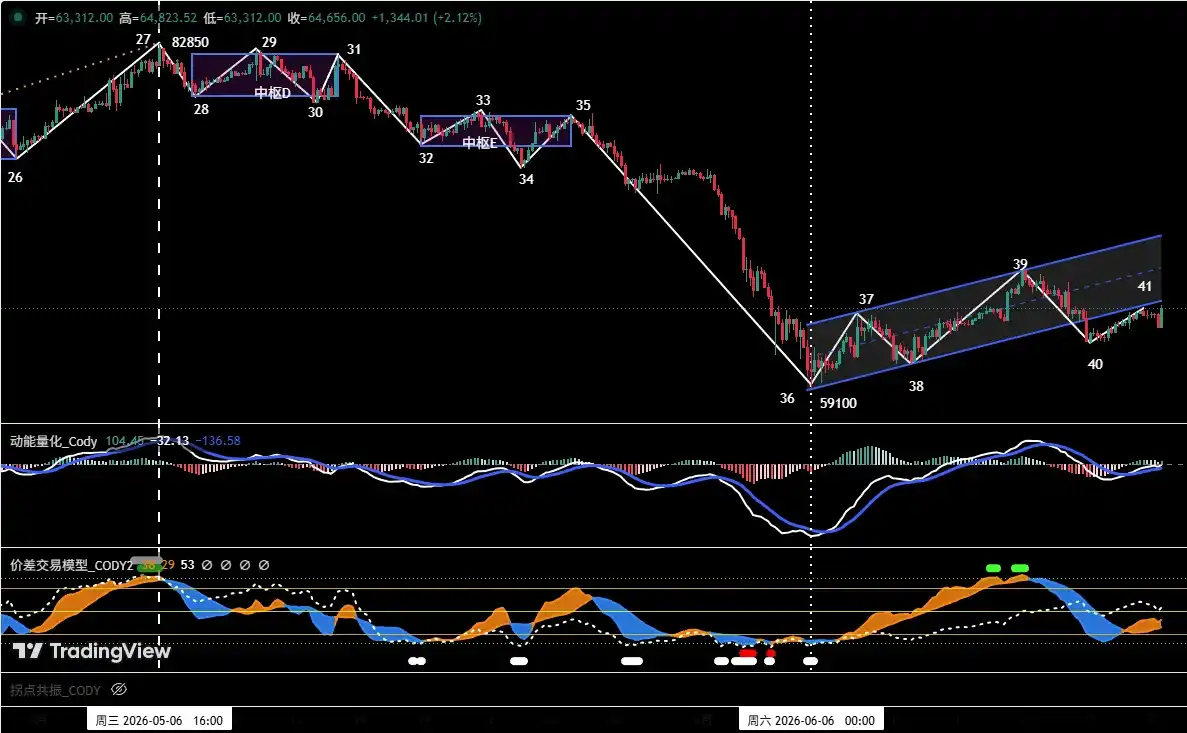
Figure 1

1 As shown in (Figure 1): From a 4-hour structural perspective, the price rebound initiated from the June 5th low of $59,100 can be subdivided into a five-wave structure, corresponding sequentially to segments 36-37, 37-38, 38-39, 39-40, and 40-41.

2 The overall trend presents a short-term rising channel pattern (blue channel in the chart): its upper bound is formed by connecting the two rebound highs at (point 37) and (point 39), while the lower bound is established by connecting the two correction lows at (point 36) and (point 38). The chart shows that the price has already breached the channel's lower bound at (point 40). The current (40-41) rebound segment can be viewed as a retracement confirmation phase for the breakdown below the channel's lower bound. If (point 41) fails to decisively reclaim a position above the channel's lower bound, the probability of the price revisiting the previous low support around $59,100 will significantly increase.

II. Bitcoin Weekly Outlook and Trading Strategies

1. BTC Weekly Market Outlook:

Core View for the Week: Focus on the outcome of the price's retracement confirmation of the short-term channel's lower bound.

  • If it holds firmly above, the price may continue its rebound along the short-term rising channel, potentially challenging the core resistance zone of $69,500~$70,500.
  • If it fails to hold, the market may retest the core support zone of $59,000~$60,000.

2. Core Resistance Levels:

  • First Resistance Zone: $64,500~$65,000 area (near the short-term rising channel's lower bound)
  • Second Resistance Zone: $69,500~$70,500 area (previous high-volume congestion zone)

3. Core Support Levels:

  • First Support Level: $59,000~$60,000 area (previous significant support level)
  • Second Support Level: Around $55,000 (previous significant support level)

4. Trading Strategies for This Week (Excluding Unexpected News Impact)

1 Medium-Term Strategy:

Bitcoin _ Daily K-line Chart (Position Monitoring Model)
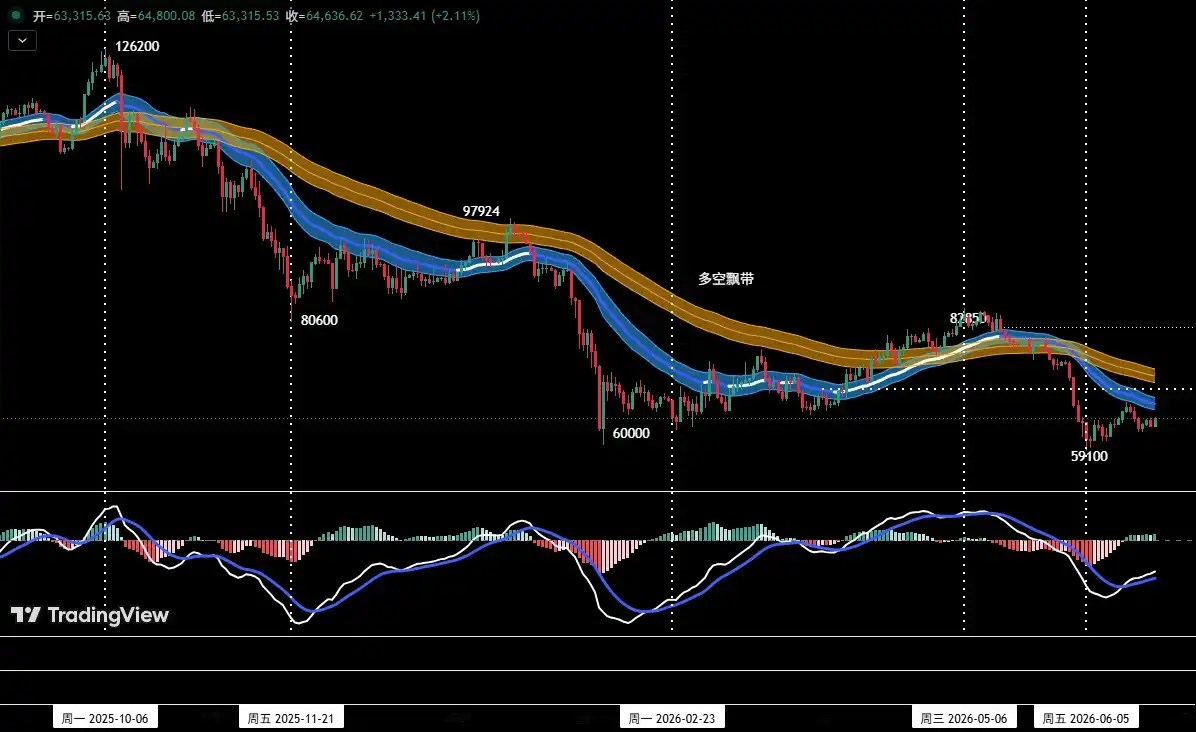
Figure 2

Position Monitoring Model: As shown in (Figure 2), the current price has decisively broken below the "Bull-Bear Channel," confirming a shift in market structure to a bear-dominated regime. Following the pre-set plan last week, we entered a short position around $64,500, with the initial medium-term position controlled at approximately 20% of total capital. Subsequent actions will adhere to stop-loss discipline, awaiting the next opportunity to add to the position.

2 Short-Term Strategy: Utilize 30% of capital, set stop-loss points, and seek "spread" trading opportunities based on support and resistance levels (using 30-minute/60-minute cycles).

3 To dynamically respond to the market's complex evolution in short-term operations, we have pre-formulated three specific contingency plans: A, B, and C.

Plan A: Tentative Positioning in Resistance Zone

  • Entry: If the price rallies to the $64,500~$65,000 zone showing signs of exhaustion, combined with a quantitative model top signal, an initial short position of around 15% can be established.
  • Risk Control: Set an initial stop-loss.
  • Exit: When the correction approaches significant support levels and aligns with model signals, gradually close positions to take profits.

Plan B: Adding to Position in Strong Resistance Zone

  • Addition: If the price breaks above the $65,000 resistance and continues to rally to the $69,500~$70,500 zone showing pressure signs, combined with a quantitative model top signal, increase the short position to within 30%.
  • Risk Control: Set an initial stop-loss.
  • Exit: When the correction approaches significant support levels and aligns with model signals, gradually close positions to take profits.

Plan C: Following the Break Below Support to Add Shorts

  • Addition: If the price decisively breaks below the $65,000 support, continues its decline, and loses the $59,000~$60,000 support zone, consider adding to the short position (within 30%) when price shows weakness during a retracement confirmation.
  • Risk Control: Set an initial stop-loss.
  • Exit: When the decline reaches significant support levels and aligns with model signals, gradually close positions to take profits.

III. HYPE Hourly Timeframe Structure Analysis

HYPE_4-Hour K-line Chart
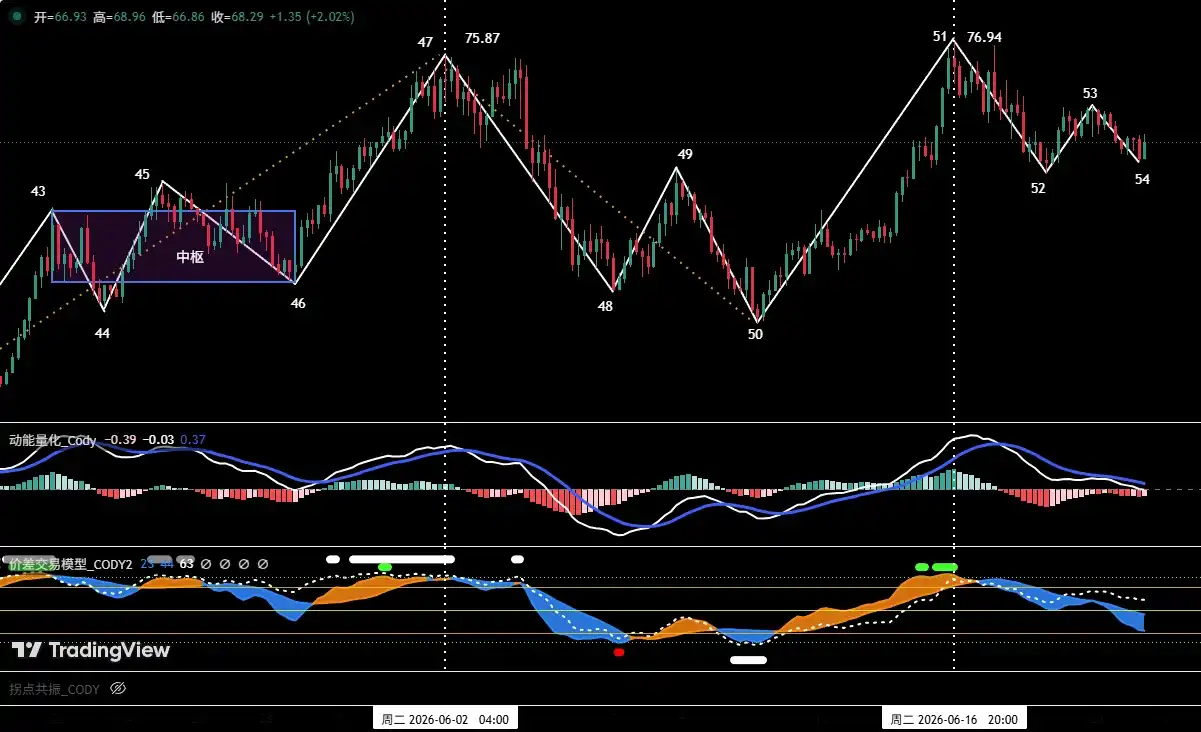
Figure 3

1 As shown in (Figure 3), on the 4-hour timeframe, HYPE initiated a correction from the June 2nd high of $75.87 (point 47), finding support near $52.62 (point 50) on June 10th, a correction lasting about 9 trading days. Subsequently, the market began a strong upward wave (segment 50-51), breaking the previous high within 6 trading days to reach a new high of $76.94 since the January rally, indicating that bullish momentum remains strong.

2 The decline from the new high presents a clear three-wave corrective structure (51-52, 52-53, 53-54). The price has currently retraced back to the critical support zone of $64~$66.

  • Bullish Scenario: If the price finds effective support in this zone, the uptrend from (point 50) is likely to continue, with subsequent prices challenging new highs.
  • Bearish Scenario: If this level is lost, the correction period will extend, and the price may retest the core support band of $52~$54, which marks the starting point of the previous uptrend.

IV. HYPE Weekly Outlook and Short-Term Trading Strategy

1. HYPE Weekly Market Outlook:

1 Core Resistance Levels:

  • First Resistance Level: Around $77
  • Second Resistance Zone: $80~$82 area

2 Core Support Levels:

  • First Support Level: $64~$66 area
  • Second Support Level: $52~$54 area

Core View for HYPE This Week:

  • Observe the outcome of the battle between bulls and bears over the $64~$66 zone.

2. HYPE Short-Term Trading Strategy for This Week (Long on Support)

This week's short-term HYPE trading should adhere to the strategy of "buying the dip, avoiding chasing rallies."

Short-Term Strategy: Testing Longs on Support Zone Stabilization

When the HYPE price retests and finds support, showing signs of stabilization in the $64~$66 key support zone or the deeper $52~$54 zone, and this aligns with bottom signals triggered by the two models, consider a light long position trial. Position size must be controlled below 30%, and strict stop-loss discipline must be maintained.

V. Special Notes:

  1. Upon Entry: Immediately set the initial stop-loss.
  2. Upon Reaching 1% Profit: Move the stop-loss to the entry price (break-even point), ensuring capital safety.
  3. Upon Reaching 2% Profit: Move the stop-loss to the position of 1% profit.
  4. Continuous Tracking: Thereafter, for every additional 1% profit gained, move the stop-loss up by 1%, dynamically protecting and locking in profits.

Financial markets change rapidly. All market analysis and trading strategies require dynamic adjustment. All views, analytical models, and operational strategies mentioned in this article are derived from personal technical analysis, intended solely for personal trading log purposes, and do not constitute any investment advice or operational basis. Markets involve risk, investment requires caution. Please do not make decisions based solely on this content.


Criptos en tendencia

Preguntas relacionadas

QWhat is the key technical situation for Bitcoin according to the analysis?

AThe key technical situation for Bitcoin is its current position in a short-term rising channel on the 4-hour chart. The price has already broken below the channel's lower rail at point 40. The current move (40-41) is seen as a retest to confirm this break. If point 41 fails to hold above the lower rail, the probability of a retest of the previous low at $59,100 increases significantly.

QWhat are the two main scenarios for HYPE this week based on its price action?

AFor HYPE, there are two main scenarios based on its price action around the key support zone of $64-$66. In the bullish scenario, if the price finds effective support in this zone, the uptrend from point 50 is expected to continue, potentially challenging new highs. In the bearish scenario, if this support is decisively broken, the correction will likely extend, and the price may test the more critical support band of $52-$54.

QWhat is the core medium-term trading strategy for Bitcoin, and what action was already taken?

AThe core medium-term strategy for Bitcoin is bearish, as the price has broken below the 'Bull-Bear Channel' on the daily chart, confirming a market structure shift to bearish dominance. Following the plan, a short position of approximately 20% of total capital was established near $64,500 last week. The strategy involves holding this initial position while waiting for potential opportunities to add to it.

QAccording to the analysis, what is the primary short-term trading approach recommended for HYPE?

AThe primary short-term trading approach for HYPE is to 'buy on dips and avoid chasing rallies.' The specific strategy is to attempt long positions on support levels. When the price retests and shows signs of stabilization in the key support zones of $64-$66 or $52-$54, and this is confirmed by bottom signals from the analysis models, a light long position (under 30% of capital) can be considered, with strict adherence to stop-loss discipline.

QWhat are the three contingency plans (A, B, C) outlined for Bitcoin's short-term trading?

AThe three contingency plans for Bitcoin's short-term trading are: Plan A (Resistance Zone Test): Initiate a ~15% short position if the price shows signs of stalling in the $64,500-$65,000 resistance zone with a model top signal. Plan B (Strong Resistance Zone): Increase the short position to under 30% if the price rallies further and faces pressure in the $69,500-$70,500 zone with a model top signal. Plan C (Breakdown Follow-through): Add to the short position (to under 30%) if the price decisively breaks below $65,000 and then $59,000-$60,000 support, showing weakness on any retest.

Lecturas Relacionadas

La IA arrasa en todo el mundo, ¿por qué Crypto + IA es tan desolador?

TL;DR: A pesar del auge de la IA, el sector blockchain + IA lucha por despegar. El análisis revela un desajuste entre la oferta tecnológica y la demanda del mercado. Cuatro subsegmentos clave enfrentan obstáculos específicos: 1. **Cómputo y Almacenamiento Descentralizados:** Ofrecen ventajas teóricas (soberanía de datos, costos) pero no superan claramente en rendimiento a proveedores de nube centralizados como AWS. Las empresas priorizan estabilidad y no asumirán el riesgo de migrar. 2. **Verificación de Modelos y Privacidad:** Tecnologías como el Aprendizaje Automático con Conocimiento Cero (ZKML) resuelven problemas futuros de transparencia y cumplimiento, pero la demanda actual de las empresas es baja. Es probable que crezcan impulsadas por regulaciones como la Ley de IA de la UE. 3. **Infraestructura para Agentes de IA:** Desarrolla soluciones para un futuro de agentes autónomos que interactúan entre sí. Sin embargo, el mercado actual se centra en la automatización de procesos internos, por lo que la demanda aún no está madura. 4. **Pagos para Agentes de IA:** Es el único subsegmento donde blockchain compite en igualdad de condiciones con las finanzas tradicionales, ya que ambos buscan resolver los retos de micropagos y liquidación en tiempo real para máquinas. **Conclusión:** El problema no es la lógica de combinar blockchain e IA, sino un grave **desajuste oferta-demanda**. La industria de IA prioriza ganancias de rendimiento y estabilidad a corto plazo, mientras que las soluciones blockchain se enfocan en beneficios a largo plazo (descentralización, transparencia). La falta de casos de uso exitosos a gran escala frena la adopción. El valor a largo plazo dependerá de si el sector logra alinearse con las necesidades inmediatas del mercado o si se mantiene como infraestructura preparada para la próxima fase de la economía de los agentes de IA.

Foresight NewsHace 7 min(s)

La IA arrasa en todo el mundo, ¿por qué Crypto + IA es tan desolador?

Foresight NewsHace 7 min(s)

Las ETF registran salidas netas continuas: ¿Están saliendo las instituciones?

Durante las últimas seis semanas, los ETF estadounidenses de Bitcoin han registrado salidas netas de aproximadamente 6.000 millones de dólares, la racha de pérdidas semanales más larga desde su lanzamiento en 2024. El fondo IBIT de BlackRock concentró gran parte de estas salidas. La venta proviene principalmente de inversores que accedieron a través de cuentas de corretaje de ETF, facilitando tanto la entrada como la salida, en lo que parece una "rendición colectiva" tras la aprobación regulatoria. Factores como el repunte de la inflación, un tono más agresivo de la Fed y la atracción de capital hacia sectores como la IA y nuevas OPVs han impulsado una reasignación de capital de riesgo. El Bitcoin, como activo de alta beta, ha sido de los primeros en sufrir. Las pérdidas realizadas aumentaron un 78%, con muchos vendiendo en el rango de 55.000 a 68.000 dólares. Aunque el ritmo de salidas se ha ralentizado notablemente, la presión estructural persiste, ya que el gran tamaño del IBIT convierte sus rescates en una fuente de presión de venta constante. El mercado se enfrenta ahora a la prueba de sostenerse sin el apoyo de los flujos de entrada de los ETF. Si las salidas del IBIT disminuyen y el precio se mantiene por encima de 60.000 dólares, la corrección podría considerarse un reajuste. Sin embargo, si las salidas continúan y el precio cae por debajo de 58.000 dólares, indicaría una salida más sostenida, obligando al mercado spot a absorber toda la presión de venta institucional por sí solo.

marsbitHace 51 min(s)

Las ETF registran salidas netas continuas: ¿Están saliendo las instituciones?

marsbitHace 51 min(s)

Concepto de Modelos del Mundo para Principiantes: Una Historia que va de la Psicología al Campo Principal de la IA

El concepto de "modelo mundial" (World Model) es actualmente una idea candente pero confusa en el campo de la IA. Su objetivo central es dotar a la máquina de un "simulador mental" o "tablero de arena interno" que le permita prever y ensayar posibles escenarios futuros antes de actuar en el mundo real. Esto es crucial para aplicaciones como la conducción autónoma (simular condiciones extremas), la robótica (entrenar en entornos virtuales) o la generación de contenidos. El concepto tiene raíces profundas. El psicólogo Kenneth Craik (1943) propuso que la mente humana construye "modelos a pequeña escala" de la realidad para predecir eventos. En IA, pioneros como Marvin Minsky y, más recientemente, investigadores como David Ha y Jürgen Schmidhuber (2018) con su trabajo "Recurrent World Models", sentaron las bases modernas. Los principales investigadores tienen visiones distintas pero complementarias: * **Yann LeCun** (Meta) critica los modelos de lenguaje grandes y aboga por un modelo mundial que comprenda la física subyacente, a través de arquitecturas como JEPA, que predicen en un espacio de representación abstracto, no en píxeles. * **Fei-Fei Li** (Stanford, World Labs) propone una clasificación basada en el ciclo de acción-observación: **Renderizadores** (generan píxeles, como Sora), **Simuladores** (generan estados 3D/físicos precisos) y **Planificadores** (generan acciones). * **El laboratorio FIB de la Universidad de Tsinghua** simplifica la división en modelos para **entender** el mundo (apoyo a la decisión) y para **predecir** el futuro (generación). Grandes empresas están impulsando el campo con diferentes enfoques: * **OpenAI** con **Sora** lo presenta como un "simulador del mundo" basado en generación de vídeo. * **Google DeepMind** con **Genie 3** crea mundos 3D interactivos en tiempo real a partir de texto. * **NVIDIA** con **Cosmos** ofrece una "plataforma de modelo base mundial" para IA física y simulación. Técnicamente, coexisten tres rutas principales: 1. **"Pintar"**: Modelos generativos de vídeo (Sora, Genie 3). Ventaja: realismo visual. Desventaja: coherencia física débil. 2. **"Calcular mentalmente"**: Predicción en espacio de representación abstracta (JEPA). Ventaja: eficiente, aprende estructura. Desventaja: menos interpretable. 3. **"Construir con bloques"**: Generación de entornos 3D con propiedades físicas explícitas (Omniverse). Ventaja: preciso y editable. Desventaja: costoso, menos generalizable. Un desarrollo reciente es el **World Action Model (WAM)**, que integra la predicción del estado futuro y la generación de acciones en un único sistema, acercándose a una capacidad "unificada de conocimiento y acción" para robots. A nivel industrial, se está formando una estructura en tres capas: **1) Soporte base** (datos, potencia de cálculo, sensores), **2) Plataformas tecnológicas** (genéricas o verticales) y **3) Aplicaciones** (conducción autónoma, robótica, juegos, etc.). La conducción autónoma es actualmente la aplicación más madura. La falta de una definición única no es necesariamente negativa. Refleja una fase temprana y dinámica donde diferentes enfoques (compresión del mundo en píxeles, geometría 3D, reglas de comportamiento) están explorando en paralelo. El objetivo final, sin embargo, es convergente: dotar a las máquinas de un modelo interno del mundo que sea **deducible, repasable y generalizable**, para actuar de forma más segura y eficiente. La unificación conceptual llegará, pero la confusión actual es señal de que el "modelo mundial" se ha convertido en un campo de batalla principal para el futuro de la IA.

marsbitHace 1 hora(s)

Concepto de Modelos del Mundo para Principiantes: Una Historia que va de la Psicología al Campo Principal de la IA

marsbitHace 1 hora(s)

"Reparando caminos a plena luz, cruzando en secreto por Chencang", ¿está Walsh preparando el camino para una "bajada de tipos" en septiembre?

El presidente de la Fed, Kevin Walsh, podría estar preparando el camino para una reducción de tasas en septiembre, según un análisis de Academy Securities. A pesar de su retórica "halcón" reciente, que ha logrado moderar las expectativas del mercado, la estrategia real podría ser allanar el camino para un recorte antes de las elecciones de mitad de mandato. El argumento señala que los objetivos políticos de la administración Trump favorecen tasas bajas, y que Walsh podría estar coordinando una narrativa de endurecimiento inicial para luego pivotar basándose en datos. Se cuestionan las métricas de inflación actuales, como el índice PCE, sugiriendo que podrían sustituirse por indicadores alternativos, como el índice de rentas para nuevos inquilinos, que muestran una inflación más baja. Datos en tiempo real de Truflation sitúan la inflación subyacente por debajo del 1.8%. Además, se argumenta que la inflación impulsada por la IA afecta principalmente a sectores específicos y es insensible a las subidas de tasas, que en cambio dañan a otros prestatarios. La recomendación de inversión es apostar por una bajada en el extremo corto de la curva de rendimientos, ser sobreponderado en energía (especialmente nuclear) y biotecnología, y ser cauteloso con las valoraciones de las megacap tecnológicas.

marsbitHace 1 hora(s)

"Reparando caminos a plena luz, cruzando en secreto por Chencang", ¿está Walsh preparando el camino para una "bajada de tipos" en septiembre?

marsbitHace 1 hora(s)

IBIT registra salidas por 1.300 millones en una semana: el mayor ETF de Bitcoin se convierte en un muro de presión vendedora que los alcistas deben superar

El ETF de Bitcoin de BlackRock, IBIT, experimentó una salida neta de 1.300 millones de dólares la semana pasada, representando aproximadamente el 73% de las salidas totales de los ETF spot de Bitcoin en EE.UU. Esta concentración de reembolsos en el fondo más grande convierte a este producto, antes principal canal de entrada institucional, en una fuente significativa de presión vendedora. Los datos de Farside Investors muestran que IBIT fue el único contribuyente negativo en las salidas del 26 de junio. Este cambio estructural plantea una prueba clave para el mercado: los compradores de Bitcoin fuera del ecosistema ETF ahora deben absorber la presión de venta cuando los titulares de ETF decidan reducir su exposición. El precio de Bitcoin se negociaba cerca de los 60.000 dólares, una zona de soporte crítica. La narrativa del "canal de entrada institucional" se ha invertido, mostrando que el mismo vehículo puede operar en ambas direcciones. Si bien los reembolsos del ETF no equivalen automáticamente a ventas directas en el mercado spot, representan un riesgo de transmisión. La escala de IBIT hace que sus flujos sean ineludibles para el sentimiento del mercado. El escenario futuro depende de si estas salidas se agotan rápidamente (un posible "capitulación") o si persisten, consolidando la narrativa del "muro de presión vendedora". Los próximos días determinarán si el mercado ha absorbido esta presión o si la recuperación debe ocurrir a pesar de la continua salida de fondos del principal ETF.

marsbitHace 2 hora(s)

IBIT registra salidas por 1.300 millones en una semana: el mayor ETF de Bitcoin se convierte en un muro de presión vendedora que los alcistas deben superar

marsbitHace 2 hora(s)

Trading

Spot

Artículos destacados

Cómo comprar HYPE

¡Bienvenido a HTX.com! Hemos hecho que comprar Hyperliquid (HYPE) sea simple y conveniente. Sigue nuestra guía paso a paso para iniciar tu viaje de criptos.Paso 1: crea tu cuenta HTXUtiliza tu correo electrónico o número de teléfono para registrarte y obtener una cuenta gratuita en HTX. Experimenta un proceso de registro sin complicaciones y desbloquea todas las funciones.Obtener mi cuentaPaso 2: ve a Comprar cripto y elige tu método de pagoTarjeta de crédito/débito: usa tu Visa o Mastercard para comprar Hyperliquid (HYPE) al instante.Saldo: utiliza fondos del saldo de tu cuenta HTX para tradear sin problemas.Terceros: hemos agregado métodos de pago populares como Google Pay y Apple Pay para mejorar la comodidad.P2P: tradear directamente con otros usuarios en HTX.Over-the-Counter (OTC): ofrecemos servicios personalizados y tipos de cambio competitivos para los traders.Paso 3: guarda tu Hyperliquid (HYPE)Después de comprar tu Hyperliquid (HYPE), guárdalo en tu cuenta HTX. Alternativamente, puedes enviarlo a otro lugar mediante transferencia blockchain o utilizarlo para tradear otras criptomonedas.Paso 4: tradear Hyperliquid (HYPE)Tradear fácilmente con Hyperliquid (HYPE) en HTX's mercado spot. Simplemente accede a tu cuenta, selecciona tu par de trading, ejecuta tus trades y monitorea en tiempo real. Ofrecemos una experiencia fácil de usar tanto para principiantes como para traders experimentados.

320 Vistas totalesPublicado en 2024.12.11Actualizado en 2026.06.02

Cómo comprar HYPE

Discusiones

Bienvenido a la comunidad de HTX. Aquí puedes mantenerte informado sobre los últimos desarrollos de la plataforma y acceder a análisis profesionales del mercado. A continuación se presentan las opiniones de los usuarios sobre el precio de HYPE (HYPE).

活动图片