Crypto Shockwave: Circle Sued As $280 Million Drift Hack Unravels

bitcoinistPublicado a 2026-04-17Actualizado a 2026-04-17

Resumen

A class action lawsuit has been filed in a Massachusetts federal court against Circle Internet Financial, alleging the stablecoin issuer was negligent and aided in the theft of $280 million from the Drift Protocol. The plaintiffs, representing over 100 investors, argue Circle had the means to stop the stolen USDC from being moved across blockchains using its Cross-Chain Transfer Protocol but failed to act. They point to Circle's prior action of freezing wallets in a separate civil case as proof it could have intervened. The April 1st hack is attributed to North Korean state-backed actors who moved the funds to Ethereum and laundered them through Tornado Cash. The case raises significant questions about the responsibility of centralized entities in the decentralized crypto ecosystem.

North Korean hackers likely pocketed hundreds of millions in stolen crypto — and now a US court is being asked to decide whether a stablecoin giant should have stopped them.

Circle’s Own Track Record Becomes A Key Weapon

A class action lawsuit filed in a Massachusetts federal court this week names Circle Internet Group as the defendant, with plaintiffs arguing the company had both the means and the opportunity to stop roughly $280 million in stolen USDC from moving across blockchains — and did nothing.

The case was brought by Drift Protocol investor Joshua McCollum, representing more than 100 affected members. Their attorneys put it plainly: Circle allowed criminal use of its own technology.
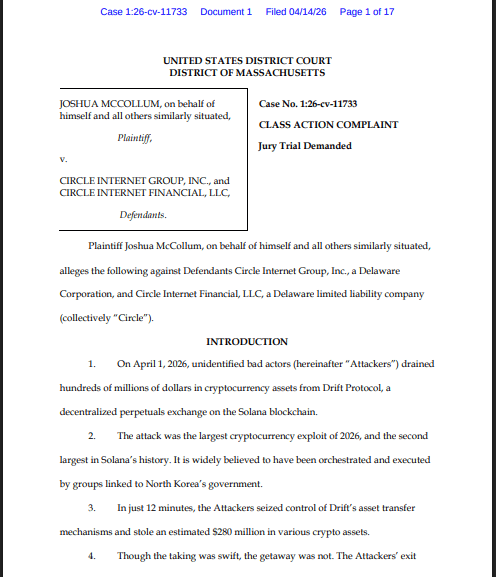
The complaint was filed Wednesday in a Massachusetts US district court by Drift investor Joshua McCollum, representing more than 100 members.

The April 1 attack on Drift Protocol saw attackers drain funds and route them from Solana to Ethereum using Circle’s Cross-Chain Transfer Protocol, a bridging tool the company operates. The transfers happened over several hours, according to reports. The window was wide open.

What makes the lawsuit particularly pointed is what happened just days before the hack. About a week prior, Circle froze 16 USDC wallets tied to a sealed US civil case. Plaintiffs seized on that detail. If Circle could move fast for a court-adjacent matter, they argue, it could have acted here too. That single fact sits at the center of the legal fight.

Accusations Range From Negligence To Aiding The Crime

The suit carries two main charges: negligence and aiding and abetting conversion — a legal term for helping someone unlawfully take another person’s property. The law firm Mira Gibb is handling the case for McCollum and the other Drift investors. Damages have not yet been set and will be determined at trial.

BTCUSD trading at $75,081 on the 24-hour chart: TradingView

Circle has not responded to requests for comment.

Crypto analytics firm Elliptic flagged the attack as the work of North Korean state-backed operatives. Based on Elliptic’s analysis, the hackers executed more than 100 transactions through Circle’s bridging infrastructure during regular US business hours. After moving the funds to Ethereum, the stolen assets were converted and pushed through Tornado Cash, a privacy protocol used to obscure transaction trails.
Image: SOPA Images/Getty Images

ARK Invest Defends Circle, But The Moral Stakes Remain High

Not everyone is pointing fingers at Circle. Lorenzo Valente, ARK Invest’s director of digital asset research, argued that Circle made the right call by not acting without a legal order.

His concern: give a company like Circle the power to freeze funds on judgment alone, and every decision becomes political. He questioned aloud where the line would be drawn — between a North Korean hacker and a suspicious wallet elsewhere in the world.

Featured image from B&G Lawyers, chart from TradingView

Criptos en tendencia

Preguntas relacionadas

QWhat is the main allegation against Circle Internet Group in the class action lawsuit?

AThe plaintiffs allege that Circle had both the means and the opportunity to stop roughly $280 million in stolen USDC from moving across blockchains but did nothing, thereby allowing criminal use of its technology.

QWhich hacking group is suspected to be behind the $280 million attack on Drift Protocol?

ACrypto analytics firm Elliptic flagged the attack as the work of North Korean state-backed operatives.

QWhat key precedent from just days before the hack do the plaintiffs use to strengthen their case against Circle?

AThe plaintiffs point out that about a week prior to the hack, Circle froze 16 USDC wallets tied to a sealed US civil case, arguing that if Circle could act quickly in that instance, it could have acted to stop the stolen funds.

QWhat are the two main legal charges brought against Circle in the lawsuit?

AThe two main charges are negligence and aiding and abetting conversion, which is a legal term for helping someone unlawfully take another person's property.

QWhat was the primary method the hackers used to obscure the trail of the stolen funds after the attack?

AAfter moving the funds to Ethereum, the stolen assets were converted and pushed through Tornado Cash, a privacy protocol used to obscure transaction trails.

Lecturas Relacionadas

¿Una transformación trascendental en la Fed? Informe: Warsh evalúa reducir la frecuencia de reuniones sobre tasas, rompiendo una práctica de 40 años

La presidenta de la Reserva Federal, Michelle Warsh, está considerando reducir la frecuencia de las reuniones periódicas del Comité Federal de Mercado Abierto (FOMC). Este cambio potencial, que rompería la práctica de "ocho reuniones al año, aproximadamente cada seis semanas" vigente desde 1981, representaría una de las transformaciones más significativas en las operaciones del banco central en décadas. Según el New York Times, la propuesta se discutió en una reunión esta semana, y un nuevo calendario podría acordarse antes de la próxima reunión de mediados de septiembre. La Ley Bancaria de 1935 exige al menos cuatro reuniones anuales del FOMC. El presidente Warsh ha solicitado comentarios a los funcionarios sobre la idea. La reducción del número de reuniones disminuiría las oportunidades de votar sobre las tasas de interés y podría afectar la capacidad de respuesta de la Fed a los cambios económicos, al tiempo que reduciría la transparencia al limitar las señales de política disponibles para el mercado. Esta iniciativa se enmarca en los esfuerzos de "reforma institucional" de Warsh, que ya han incluido declaraciones de política más breves y menos comentarios públicos sobre la economía. Históricamente, la frecuencia de las reuniones ha variado; en 1956 hubo 19 reuniones. Una evaluación interna de 1988 consideró que el esquema de ocho reuniones seguía siendo apropiado. La implementación de este cambio tendría un impacto profundo en los flujos de información del mercado, la flexibilidad de la política y la comunicación del banco central.

marsbitHace 2 hora(s)

¿Una transformación trascendental en la Fed? Informe: Warsh evalúa reducir la frecuencia de reuniones sobre tasas, rompiendo una práctica de 40 años

marsbitHace 2 hora(s)

Selecciones semanales del editor (Weekly Editor's Picks) (25-31 de julio)

**Resumen de la Selección del Editor Semanal (25-31 de julio)** La edición de esta semana destaca análisis profundos sobre incertidumbre financiera, tendencias tecnológicas y desarrollo regulatorio. La reunión de la Reserva Federal se perfila como una de las más inciertas en años, con el mercado dividido entre señales de desaceleración inflacionaria y posturas aún firmes contra la inflación persistente. En inversión y emprendimiento, se analiza la naturaleza de largo plazo del valor en criptomonedas, donde la persistencia supera al oportunismo. Se discute cómo los mercados globales de acciones, especialmente en tecnología, adoptan dinámicas similares a las de las criptomonedas, con narrativas y apalancamiento impulsando la volatilidad. Plataformas líderes como Hyperliquid y Polymarket enfrentan desafíos al expandirse más allá de sus mercados centrales, subrayando la importancia de la liquidez y los hábitos de usuario consolidados. En el ámbito de IA y almacenamiento, se examinan las crecientes preocupaciones sobre la deuda ligada a la expansión de infraestructura en la nube para IA y la reacción del mercado ante posibles excesos de oferta futuros en chips de memoria. El extraordinario rendimiento trimestral de SK Hynix no logró satisfacer las elevadas expectativas del mercado, reflejando la presión sobre los líderes del sector. Políticamente, la aprobación de la Ley CLARITY en EE.UU. se encuentra en una etapa crucial y políticamente compleja, con su destino aún incierto a pocos meses de las elecciones. Su posible fracaso podría tener un impacto limitado inmediato en el mercado pero complicaría futuros esfuerzos legislativos. Finalmente, en Ethereum, se anticipa un cambio estructural en el staking tras la actualización Pectra, que permitirá una gestión de capital más eficiente, aunque persiste una desconexión entre los fundamentos de la red y el precio de ETH. La semana también registró eventos de seguridad, como la compensación por liquidaciones anómalas en Trade.xyz, recordando los riesgos en la custodia de activos.

marsbitHace 2 hora(s)

Selecciones semanales del editor (Weekly Editor's Picks) (25-31 de julio)

marsbitHace 2 hora(s)

Trading

Spot

Artículos destacados

Cómo comprar DRIFT

¡Bienvenido a HTX.com! Hemos hecho que comprar Drift Protocol (DRIFT) sea simple y conveniente. Sigue nuestra guía paso a paso para iniciar tu viaje de criptos.Paso 1: crea tu cuenta HTXUtiliza tu correo electrónico o número de teléfono para registrarte y obtener una cuenta gratuita en HTX. Experimenta un proceso de registro sin complicaciones y desbloquea todas las funciones.Obtener mi cuentaPaso 2: ve a Comprar cripto y elige tu método de pagoTarjeta de crédito/débito: usa tu Visa o Mastercard para comprar Drift Protocol (DRIFT) al instante.Saldo: utiliza fondos del saldo de tu cuenta HTX para tradear sin problemas.Terceros: hemos agregado métodos de pago populares como Google Pay y Apple Pay para mejorar la comodidad.P2P: tradear directamente con otros usuarios en HTX.Over-the-Counter (OTC): ofrecemos servicios personalizados y tipos de cambio competitivos para los traders.Paso 3: guarda tu Drift Protocol (DRIFT)Después de comprar tu Drift Protocol (DRIFT), guárdalo en tu cuenta HTX. Alternativamente, puedes enviarlo a otro lugar mediante transferencia blockchain o utilizarlo para tradear otras criptomonedas.Paso 4: tradear Drift Protocol (DRIFT)Tradear fácilmente con Drift Protocol (DRIFT) en HTX's mercado spot. Simplemente accede a tu cuenta, selecciona tu par de trading, ejecuta tus trades y monitorea en tiempo real. Ofrecemos una experiencia fácil de usar tanto para principiantes como para traders experimentados.

494 Vistas totalesPublicado en 2024.12.11Actualizado en 2026.06.02

Cómo comprar DRIFT

Discusiones

Bienvenido a la comunidad de HTX. Aquí puedes mantenerte informado sobre los últimos desarrollos de la plataforma y acceder a análisis profesionales del mercado. A continuación se presentan las opiniones de los usuarios sobre el precio de DRIFT (DRIFT).

活动图片