Cardano Didn’t Fail On Scalability, Says Hoskinson — Leios Coming In 2026

bitcoinistPublicado a 2025-11-06Actualizado a 2025-11-06

Resumen

Charles Hoskinson used a Nov. 5 video address to rebut a renewed wave of criticism that Cardano has “failed on...

Trusted Editorial content, reviewed by leading industry experts and seasoned editors. Ad Disclosure

Charles Hoskinson used a Nov. 5 video address to rebut a renewed wave of criticism that Cardano has “failed on scalability,” centering his response on two pillars: Hydra, Cardano’s off-chain scaling stack, and Leios, a forthcoming Ouroboros upgrade that he says now has a complete design and a clear path to mainnet in 2026.

Hoskinson’s remarks were framed as a direct answer to a thread by Cyber Capital CEO Justin Bons alleging Cardano is capped at “23 transactions per second,” dismissing the impact of batching, fee markets, Hydra, and the Ouroboros Leios roadmap, and concluding that Input Output Global (IOG) has shifted focus to a new chain. “You’re entitled to an opinion, but you’re not entitled to your own facts,” Hoskinson said, calling the conclusion “blatantly wrong” and “pathetic” for ignoring public specifications and ongoing engineering work. He pushed back on claims that Leios had been abandoned: “There exists a CIP. We have the blueprint. We know how to do it.”

Cardano Has Not Failed On Scalability

Central to his argument is that Leios has moved from research to a fully specified implementation track. Hoskinson held up the CIP for Ouroboros Leios, emphasizing that the end-to-end design was completed only this year after “years of paper writing, prototyping, and simulation.”

In his telling, the protocol aims to thread the industry’s core dilemma of decentralization, security, and throughput without leaning on centralized shortcuts. “What do we care about in this industry? Do we care about decentralization or not?” he asked, warning that once systems optimize around cheap, high-throughput configurations with heavy hardware demands, “no one has any incentive to change the status quo.”

Hydra, he argued, is already live and delivering practical capacity gains that critics are “discounting.” As evidence, he cited the Glacier drop, saying “33.6 million accounts were loaded into that thing and we were able to operate no problem at all,” and that Hydra continues to “evolve and get more advanced.” While he did not present throughput figures beyond disputing the 23 TPS narrative, the thrust of his rebuttal was that Cardano’s scaling arc is cumulative: Hydra now, Leios next.

On Leios timelines, Hoskinson was unambiguous. “Yes, it will ship in 2026. No if, ands, or buts about it,” he said, adding that IOG has instituted “a 24/7 implementation, a follow-the-sun model to get Leios out in market faster.” He also previewed a dedicated Leios website “before the end of the month” to publish daily updates as the network “march[es] towards it,” and claimed “more than a dozen companies” are engaged in implementation work alongside multiple node clients. His message to the broader ecosystem was equally pointed: “In 2026, we’re going to find a path to get linear Leios on Cardano,” urging operators to “hold off on the adoption” of nodes that don’t support Leios so the feature can be activated network-wide.

Beyond scaling mechanics, the address veered into governance and industry structure. Hoskinson asserted Cardano targets “50% Byzantine resistance” while preserving decentralization, contending that no major chain—he named Bitcoin and Ethereum among others—has achieved at-scale decentralization without trade-offs. He linked scaling work to the project’s self-image as one of the few ecosystems “carrying on our backs the original dream of Satoshi,” warning that industry consolidation around ETFs, bank custody, and centralized stablecoins risks “put[ting] the chains on humanity for the rest of time.”

Marketing, Not The Technology

Hoskinson located Cardano’s bottleneck not in research or engineering but in go-to-market. “Our problem is not our technology… Our problem right now is marketing and adoption, deal making and partnerships,” he said, criticizing entities in the ecosystem that he claims received “hundreds and hundreds and hundreds of millions of ADA” or “over a billion” for adoption efforts that have been “pulling teeth.” He credited a new foundation-driven initiative—presented by critics as a “pivot” away from Cardano—as having already attracted listings, integrations, and a path to “tier one stables,” insisting such work ultimately routes back to Cardano usage.

The tone throughout was combative, reflecting frustration with narratives he sees as moving the goalposts. “Leios is going to ship. It’s a real thing. It exists. Look at CIP 164,” he said. “When we turn it on, they’ll move the goalpost and it will be something else.”

He portrayed the coming year as a campaign to close the engineering loop and reorient on adoption: “We have the technology. We have the ecosystem. We just have to invest heavily in [marketing and adoption]… and we will.” The message to skeptics was unvarnished—“You can’t discount Hydra… you can’t discount the progress made with Leios.”

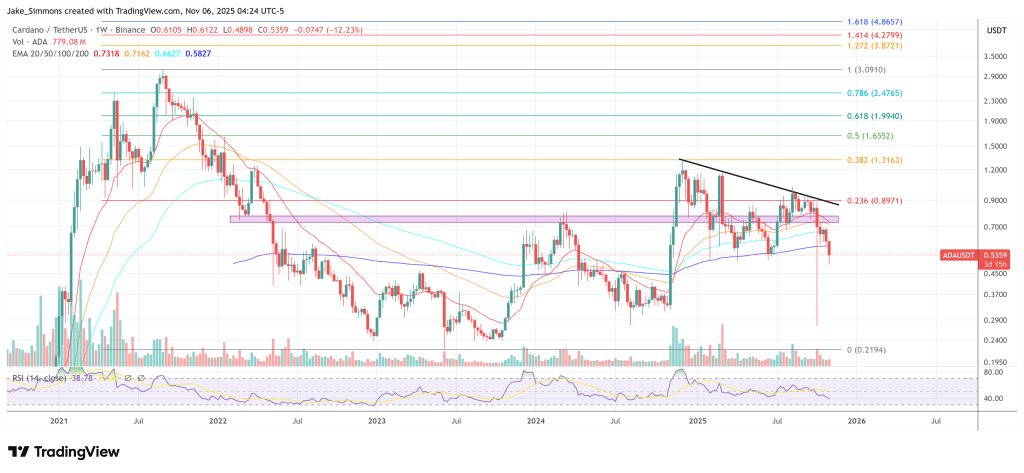
At press time, ADA traded at $.05359
Cardano price
ADA falls below the 200-week EMA, 1-week chart | Source: ADAUSDT on TradingView.com
Featured image created with DALL.E, chart from TradingView.com
Editorial Process for bitcoinist is centered on delivering thoroughly researched, accurate, and unbiased content. We uphold strict sourcing standards, and each page undergoes diligent review by our team of top technology experts and seasoned editors. This process ensures the integrity, relevance, and value of our content for our readers.

Jake Simmons has been a Bitcoin enthusiast since 2016. Ever since he heard about Bitcoin, he has been studying the topic every day and trying to share his knowledge with others. His goal is to contribute to Bitcoin's financial revolution, which will replace the fiat money system. Besides BTC and crypto, Jake studied Business Informatics at a university. After graduation in 2017, he has been working in the blockchain and crypto sector. You can follow Jake on Twitter at @realJakeSimmons.

Criptos en tendencia

Lecturas Relacionadas

Las acciones de las empresas de criptomonedas se disparan mientras Wall Street sufre bajo la presión de los riesgos relacionados con Irán

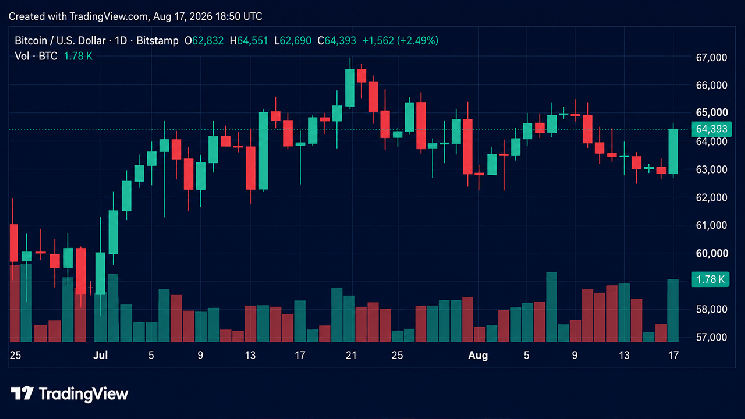
Las acciones de empresas relacionadas con criptomonedas, como Strategy y Strive, registraron fuertes ganancias de aproximadamente un 5%, impulsadas por un repunte del bitcoin de alrededor del 1-1,5% hasta los 64.000 dólares. Este desempeño contrastó marcadamente con la caída de los principales índices bursátiles estadounidenses (Nasdaq, Dow Jones, S&P 500) en la sesión del 17 de agosto. La divergencia se produjo en un contexto de creciente tensión geopolítica. El presidente Donald Trump amenazó con ataques aéreos contra Omán si este país obstaculiza un acuerdo de Estados Unidos con Irán sobre el estratégico Estrecho de Ormuz, una ruta crucial para el transporte global de petróleo y gas. Estas preocupaciones mantuvieron los precios del petróleo elevados y presionaron a los mercados tradicionales, mientras los inversores buscaban refugio en activos alternativos como el bitcoin. La prueba clave será si esta desconexión entre las acciones vinculadas a las criptomonedas y el mercado general persiste más allá de una sola sesión. Los inversores observarán la capacidad del bitcoin para mantenerse por encima de los 63.000 dólares, así como los informes corporativos y los desarrollos regulatorios, mientras la atención global sigue centrada en la situación en el Estrecho de Ormuz.

cryptonews.ruHace 2 hora(s)

Las acciones de las empresas de criptomonedas se disparan mientras Wall Street sufre bajo la presión de los riesgos relacionados con Irán

cryptonews.ruHace 2 hora(s)

El Bitcoin vuelve a superar la marca de 64.000 dólares, y los vendedores en corto pierden 57,4 millones de dólares en liquidaciones

Bitcóin ha vuelto a superar los 64,000 dólares, tras recuperarse de una caída por debajo de los 63,000 dólares. Este repunte, que se produjo en cuestión de horas, generó un aumento diario de casi un 2% y situó la capitalización de mercado por encima de 1,29 billones de dólares. La subida desencadenó liquidaciones significativas en los mercados de derivados, con posiciones cortas liquidadas por valor de 57,4 millones de dólares en 24 horas, superando ampliamente las liquidaciones de posiciones largas (13,3 millones). En total, las liquidaciones en el mercado de criptomonedas alcanzaron casi 220 millones de dólares. Mientras tanto, la empresa MicroStrategy, un importante tenedor institucional de bitcóin, anunció que no compró ni vendió bitcoines la semana pasada. En su lugar, aumentó sus reservas de efectivo a 4.800 millones de dólares, utilizando parte de los fondos para recomprar acciones y pagar dividendos preferentes. Los analistas señalan que esta estrategia prioriza la estabilidad financiera, ya que el precio actual del bitcóin sigue estando un 15% por debajo del costo promedio de adquisición de la empresa. Inicialmente, el bitcóin también pareció reaccionar con optimismo a los rumores de una extensión del alto el fuego entre Estados Unidos e Irán, pero esta reacción se desvaneció después de que las autoridades iraníes desmintieran dichos informes. Por lo tanto, la criptomoneda carece actualmente de un claro catalizador macroeconómico para impulsar una ruptura decisiva al alza.

cryptonews.ruHace 2 hora(s)

El Bitcoin vuelve a superar la marca de 64.000 dólares, y los vendedores en corto pierden 57,4 millones de dólares en liquidaciones

cryptonews.ruHace 2 hora(s)

Trading

Spot

Artículos destacados

Cómo comprar T

¡Bienvenido a HTX.com! Hemos hecho que comprar Threshold Network Token (T) sea simple y conveniente. Sigue nuestra guía paso a paso para iniciar tu viaje de criptos.Paso 1: crea tu cuenta HTXUtiliza tu correo electrónico o número de teléfono para registrarte y obtener una cuenta gratuita en HTX. Experimenta un proceso de registro sin complicaciones y desbloquea todas las funciones.Obtener mi cuentaPaso 2: ve a Comprar cripto y elige tu método de pagoTarjeta de crédito/débito: usa tu Visa o Mastercard para comprar Threshold Network Token (T) al instante.Saldo: utiliza fondos del saldo de tu cuenta HTX para tradear sin problemas.Terceros: hemos agregado métodos de pago populares como Google Pay y Apple Pay para mejorar la comodidad.P2P: tradear directamente con otros usuarios en HTX.Over-the-Counter (OTC): ofrecemos servicios personalizados y tipos de cambio competitivos para los traders.Paso 3: guarda tu Threshold Network Token (T)Después de comprar tu Threshold Network Token (T), guárdalo en tu cuenta HTX. Alternativamente, puedes enviarlo a otro lugar mediante transferencia blockchain o utilizarlo para tradear otras criptomonedas.Paso 4: tradear Threshold Network Token (T)Tradear fácilmente con Threshold Network Token (T) en HTX's mercado spot. Simplemente accede a tu cuenta, selecciona tu par de trading, ejecuta tus trades y monitorea en tiempo real. Ofrecemos una experiencia fácil de usar tanto para principiantes como para traders experimentados.

799 Vistas totalesPublicado en 2024.12.10Actualizado en 2026.06.02

Cómo comprar T

Discusiones

Bienvenido a la comunidad de HTX. Aquí puedes mantenerte informado sobre los últimos desarrollos de la plataforma y acceder a análisis profesionales del mercado. A continuación se presentan las opiniones de los usuarios sobre el precio de T (T).

活动图片