Ripple CTO Schwartz Revisits NSA Past And Satoshi Speculation

bitcoinistPublicado a 2025-10-24Actualizado a 2025-10-24

Resumen

Ripple chief technology officer David “JoelKatz” Schwartz has resurfaced a years-long thread of speculation around Bitcoin’s origins and his own...

Trusted Editorial content, reviewed by leading industry experts and seasoned editors. Ad Disclosure

Ripple chief technology officer David “JoelKatz” Schwartz has resurfaced a years-long thread of speculation around Bitcoin’s origins and his own pre-Ripple work with US government agencies, clarifying once again that he neither possessed “high level” intelligence nor claims special insight into Satoshi Nakamoto’s identity—while acknowledging that a US intelligence provenance for Bitcoin is “not a terrible theory.”

The renewed attention follows a fresh exchange on X on October 23, 2025, in which Schwartz responded to questions about prior employment and nondisclosure obligations—context that traces back to an October 24, 2022 thread where he weighed in on Satoshi debates and litigation risk tied to public claims about identity. “There is nothing defamatory about saying that Craig Wright is not Satoshi, just as there is nothing defamatory about saying that I am not Satoshi,” Schwartz wrote in 2022, adding, “There is nothing inherently wrong with not being Satoshi.”

In the same 2022 exchange, after community member @XRPcryptowolf joked “David Schwartz is Satoshi confirmed jk lol” and floated the notion that “Satoshi is really the CIA or NSA,” the Ripple CTO replied: “That’s not a terrible theory. If the NSA or the CIA happened to stumble on how to make bitcoin, it might make sense that they would implement and deploy it to eliminate the risk that someone hostile to the US would do it first and potentially made billions of dollars.”

Ripple CTO Shuts Down Satoshi Claims

The 2025 follow-ups drilled into Schwartz’s own past work and what, if anything, it implies. In response to a commenter’s claim—“Well, you’ve worked at the NSA, getting high level information, by your own words.” The Ripple CTO flatly rejected the characterization, indirectly doubling down that he isn’t (part of) Satoshi Nakamoto: “I never got anything even remotely resembling high level information. I had to certify that the thing I was working on would meet the NSA’s requirements without even being allowed to see most of them.”


He then shared vignettes about the compartmentalization he encountered. “One requirement that I was allowed to see was that you had to be able to stop it from processing classified data if you lost control over it. I was puzzled—if you lost control over it, by definition you can’t stop it, right? It was explained to me that that’s…” He also noted signage he wasn’t permitted to have explained: “They wouldn’t even tell me why there’s little signs all over the place (generally on entrances or containers) that can be set to ‘OPEN’ or ‘CLOSED’ and what ‘OPEN’ and ‘CLOSED’ mean on those signs.”

Schwartz further recounted how, at one point, he recognized the user interface of “one thing I worked on” not through briefings but “because late one night I happened to have the Discovery Channel on and saw our UI on a screen.” He clarified the lineage of that code: “To be precise, that was work I did (on the same core code) for NATO shortly before I adapted it for the NSA. I don’t remember how I found out what the NSA was using it for. I don’t think I should reveal the exact uses, but they’re pretty boring.”

Asked when his nondisclosure agreement would expire, he answered: “I have no idea. They didn’t let me keep a copy and I don’t remember—if I ever even knew. I just hope nobody really cares any more. Plus, I never really knew anything all that secret.”

The through-line between the 2022 and 2025 messages is clear: a willingness to treat state-origin hypotheses for Bitcoin as plausible without endorsing them. “There is nothing inherently wrong with not being Satoshi,” the Ripple CTO emphasized in 2022. By 2025, his clarifications around the nature of his NSA and NATO work add color but not conspiracy: process-driven engineering inside a tightly siloed environment, limited visibility into end use, and no privileged window into intelligence secrets.

At press time, XRP traded at $2.42.
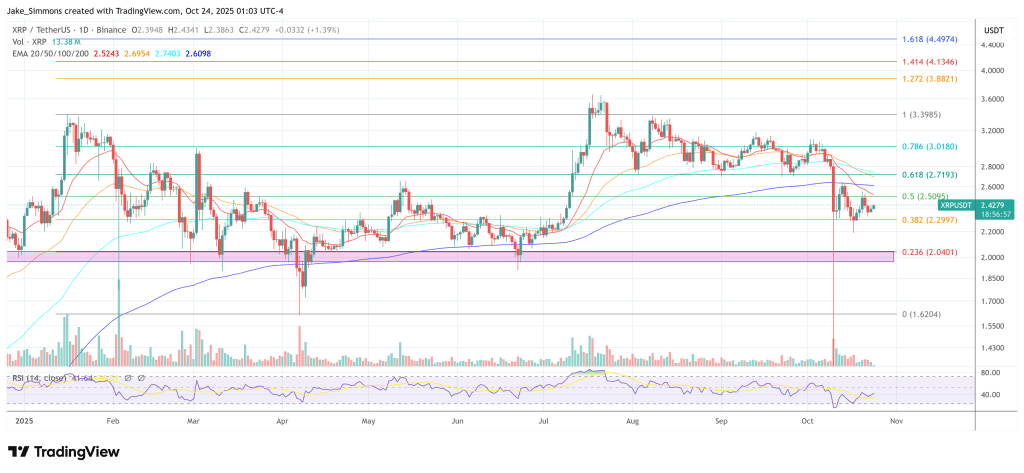
XRP price
XRP bulls face the 0.5 Fib, 1-day chart | Source: XRPUSDT on TradingView.com
Featured image created with DALL.E, chart from TradingView.com
Editorial Process for bitcoinist is centered on delivering thoroughly researched, accurate, and unbiased content. We uphold strict sourcing standards, and each page undergoes diligent review by our team of top technology experts and seasoned editors. This process ensures the integrity, relevance, and value of our content for our readers.

Jake Simmons has been a Bitcoin enthusiast since 2016. Ever since he heard about Bitcoin, he has been studying the topic every day and trying to share his knowledge with others. His goal is to contribute to Bitcoin's financial revolution, which will replace the fiat money system. Besides BTC and crypto, Jake studied Business Informatics at a university. After graduation in 2017, he has been working in the blockchain and crypto sector. You can follow Jake on Twitter at @realJakeSimmons.

Lecturas Relacionadas

De las piscinas mineras a Marte: ¿Por qué Wang Chun se sentará en la cabina de SpaceX?

**Del pool de minería a Marte: ¿Cómo Wang Chun llegó a la cabina de SpaceX?** Cuando SpaceX anunció que Wang Chun, cofundador de F2Pool, sería el comandante de la primera misión comercial interestelar tripulada, muchos se sorprendieron. ¿Por qué un fundador de un pool de minería de Bitcoin estaría en la lista para una misión a Marte? Sin embargo, un análisis más profundo revela que esto no es una coincidencia, sino un resultado lógico de las crecientes conexiones entre la industria cripto y SpaceX. El plan para Marte ha evolucionado más allá de un proyecto aeroespacial; ahora es un experimento de actualización civilizatoria impulsado por el capital tecnológico global, la IA, la potencia de cálculo, la energía y la economía cripto. Wang Chun se encuentra precisamente en la intersección de estas fuerzas. Wang Chun es una figura pionera en el mundo cripto, representante de una época de idealistas y constructores de infraestructura para Bitcoin. F2Pool ayudó a construir la red global de minería, una base fundamental para el mundo digital. Esta lógica de "infraestructura" conecta directamente con la exploración espacial y la visión de una civilización multiplanetaria, valores que resuenan con la filosofía de largo plazo de Elon Musk. La convergencia entre la esfera cripto y SpaceX se debe a que ambas son componentes clave de la próxima generación de infraestructura global. La reducción radical del costo de acceso al espacio por parte de SpaceX podría crear una nueva economía espacial, que necesitará sistemas de valor y financieros globales y sin confianza, donde las criptomonedas encajan naturalmente. Ambas comunidades comparten un núcleo de alto riesgo y visión a largo plazo. Este evento marca un cambio histórico: la exploración espacial está pasando de ser un dominio estatal a uno impulsado por la empresa comercial, el capital tecnológico global y nuevos ideólogos, similar a la transición de las flotas estatales a las compañías comerciales durante la Era de los Descubrimientos. La participación de Wang Chun simboliza que las fuerzas del capital, la tecnología y el idealismo cultivadas en el mundo cripto están entrando oficialmente en la era interestelar. Su viaje, de la red Bitcoin a las naves estelares, podría ser un preludio de la dirección evolutiva de la civilización tecnológica en las próximas décadas.

marsbitHace 9 hora(s)

De las piscinas mineras a Marte: ¿Por qué Wang Chun se sentará en la cabina de SpaceX?

marsbitHace 9 hora(s)

Las 3 Criptomonedas por Debajo de $0.05 que Ofrecen un Potencial Alcista del +1,000% si se Alcanzan los Objetivos de Adopción

A medida que los inversores buscan la próxima ola de crecimiento explosivo en criptomonedas, los tokens de bajo precio vuelven a estar en el punto de mira. Los activos que cotizan por debajo de **$0.05** a menudo atraen a inversores en etapas iniciales, ya que una adopción modesta puede traducirse en ganancias porcentuales enormes. El artículo destaca **tres proyectos criptográficos destacados por debajo de $0.05** que, según analistas, podrían ofrecer una **revalorización del 1,000% o más** si alcanzan sus objetivos de adopción. **Ozak AI ($OZ):** En la Fase 7 de su preventa a **$0.014**, este proyecto de IA ha recaudado unos **$7 millones**. Su plataforma de inteligencia de mercado impulsada por IA analiza datos en tiempo real utilizando una infraestructura física descentralizada (DePIN). Con un precio de listado en exchanges esperado de **$1**, los analistas proyectan un potencial alcista significativo. **Kaspa (KAS):** Una blockchain de prueba de trabajo de alta velocidad que utiliza una arquitectura **blockDAG** para confirmar múltiples bloques simultáneamente. Sus partidarios creen que una mayor adopción en pagos y aplicaciones escalables podría llevar a una importante revalorización. **VeChain (VET):** Un token establecido centrado en la **gestión de la cadena de suministro y la verificación de datos empresariales**. Considerado infravalorado dada su adopción real, podría ver una demanda renovada si aumenta el uso de blockchain empresarial. Estos tokens ofrecen un atractivo psicológico y matemático, donde una pequeña inversión puede adquirir miles de tokens. Sin embargo, con un mayor potencial de ganancias también viene un **riesgo más alto**, dependiendo de la ejecución del proyecto, la adopción y las condiciones del mercado.

TheNewsCryptoHace 9 hora(s)

Las 3 Criptomonedas por Debajo de $0.05 que Ofrecen un Potencial Alcista del +1,000% si se Alcanzan los Objetivos de Adopción

TheNewsCryptoHace 9 hora(s)

Trading

Spot
Futuros
活动图片