Shiba Inu Team Issues Explosive Update On Shibarium Bridge Exploit

bitcoinistPublicado a 2025-09-18Actualizado a 2025-09-18

Resumen

Shiba Inu’s core team has issued a sweeping post-mortem update on the Shibarium bridge breach, detailing a multi-step attack that...

Trusted Editorial content, reviewed by leading industry experts and seasoned editors. Ad Disclosure

Shiba Inu’s core team has issued a sweeping post-mortem update on the Shibarium bridge breach, detailing a multi-step attack that combined a flash-loan powered governance capture with compromised validator keys—followed by emergency protocol changes and a split bounty offer aimed at recovering user funds.

Shiba Inu Devs Speak Out On Shibarium Bridge Exploit

In an X post published on September 17, 2025, the official Shiba Inu account said the exploiter “executed a flash loan swap to acquire 4.6M BONE from ShibaSwap” and delegated them to “Ryoshi Validator 1,” which pushed their voting power “> 2/3 majority” across Shibarium validators. Using “compromised internal validators” to co-sign a malicious state, the attacker then drained assets from the L2’s canonical bridge. The team now pegs direct losses at $4.1 million.

The disclosure adds granular color on what left the bridge exposed and how responders moved. The Shiba Inu team says the “leading possibility for the root cause” was a compromise of internal validator keys—“either from the developer machine or the server’s KMS”—not a CCIP predicate path that “was unrelated.”

The team further says it suspended bridge operations, began forensic analysis, and initiated a hardening campaign: revoking root chain manager access on the PoS bridge, lengthening the half-exit time on the Plasma path, and removing a predicate burn-only entry from the Plasma registry to prevent withdrawals. “We have suspended bridge operations… there is a significant loss of user funds on Shibarium,” the update states.

According to the team’s accounting, 17 tokens were taken from the bridge, including roughly $1.0M in ETH, $1.3M in SHIB, $717K in KNINE, $680K in LEASH, and $260K in ROAR, alongside smaller balances of TREAT, USDC, USDT, BAD, SHIFU, FUND, DAI, LTD, xFUND, WBTC and OSCAR. The exploiter has so far sold only USDT and USDC into ETH; they attempted seven times to sell KNINE before the K9 Finance DAO blacklisted the attacker’s wallet. The rest of the assets remain under the attacker’s control and “at risk,” the team warned.

SHIB Team Ups Bounty To 50 ETH

The remediation push now includes two distinct bounty tracks. First, the bounty chronology began with K9 Finance DAO—the Shibarium-aligned liquid-staking project—publishing an on-chain 5 ETH offer to the attacker for the return of KNINE, structured to decay after seven days and expire after 30 days.

K9’s accompanying X posts stressed the “accept()” finality and “code-is-law” terms embedded in the escrow contract. The exploiter then replied publicly: “I can’t accept 5 ETH. The bounty I can accept is 50 ETH and I will not return KNINE for less.”

After that refusal did the Shiba Inu team transmit a separate, on-chain 50 ETH bounty message via its Deployer 2 address covering the non-KNINE assets, conditioned on full restitution and a whitehat disclosure, with a promise of a legal-action waiver upon verified return.

The Shiba Inu team’s on-chain message reads in part: “Offer: 50 ETH bounty via a new bounty smart contract escrow,” adding that the attacker must return WETH, SHIB, LEASH, ROAR, TREAT, USDC, USDT, BAD, SHIFU, FUND, DAI, LTD, xFUND, WBTC, and OSCAR, and submit a full technical disclosure; “upon complete restitution and accepted disclosure, we will issue a waiver of legal action (subject to applicable law).” Transaction records show the message was sent from shiba-swap.eth (Deployer 2) to the address labeled ShibaSwap Exploiter on September 17.

For now, bridge operations remain disabled, and users are cautioned that assets listed as “under attacker control” remain exposed until recovery or further containment.

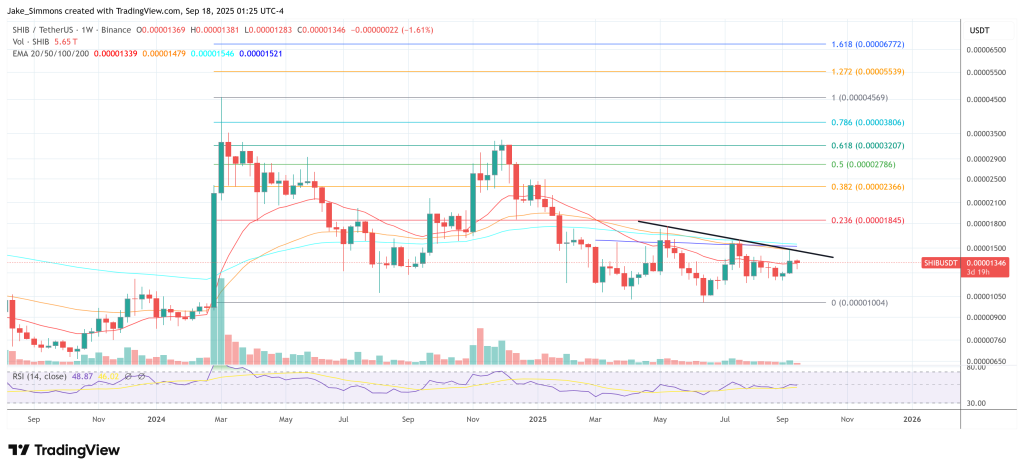
At press time, SHIB traded at $0.00001346.
Shiba Inu price
Shiba Inu continues its downtrend, 1-week chart | Source: SHIBUSDT on TradingView.com
Featured image created with DALL.E, chart from TradingView.com
Editorial Process for bitcoinist is centered on delivering thoroughly researched, accurate, and unbiased content. We uphold strict sourcing standards, and each page undergoes diligent review by our team of top technology experts and seasoned editors. This process ensures the integrity, relevance, and value of our content for our readers.

Jake Simmons has been a Bitcoin enthusiast since 2016. Ever since he heard about Bitcoin, he has been studying the topic every day and trying to share his knowledge with others. His goal is to contribute to Bitcoin's financial revolution, which will replace the fiat money system. Besides BTC and crypto, Jake studied Business Informatics at a university. After graduation in 2017, he has been working in the blockchain and crypto sector. You can follow Jake on Twitter at @realJakeSimmons.

Lecturas Relacionadas

Inversión en Mareas: Seguimos siendo optimistas respecto a la cadena de suministro de IA, pero las razones han cambiado

Inversiones Mareas: Sigue siendo optimista sobre la cadena industrial de IA, pero las razones han cambiado. A mediados de 2026, las principales empresas tecnológicas como Alphabet, Amazon, Meta, Microsoft y Oracle continúan aumentando agresivamente sus inversiones de capital (CAPEX), con cifras proyectadas entre 600 y 2000 mil millones de dólares para 2026. La fase actual de inversión, a diferencia de ciclos tecnológicos anteriores, se centra en infraestructura física a largo plazo (electricidad, redes, transformadores, refrigeración) donde los cuellos de botella son complejos y los plazos de ejecución son lentos. Aunque el mercado muestra preocupación ante el crecimiento del CAPEX por encima de los ingresos y posibles similitudes con la burbuja puntocom del año 2000, el análisis argumenta diferencias clave: la oferta de infraestructura crítica no puede expandirse rápidamente, lo que dificulta una sobrecapacidad masiva. El optimismo actual se basa en que las inversiones continúan, los pedidos a proveedores de infraestructura se mantienen fuertes y aún no hay señales de reducción en las proyecciones de gasto o cancelación de pedidos. Los riesgos de rentabilidad (ROI) existen, pero los datos actuales no justifican un cambio de postura. Por lo tanto, el ciclo de inversión en IA no ha terminado; ha entrado en una nueva fase más compleja y extensa.

marsbitHace 34 min(s)

Inversión en Mareas: Seguimos siendo optimistas respecto a la cadena de suministro de IA, pero las razones han cambiado

marsbitHace 34 min(s)

Inversiones Mareales: Seguimos siendo optimistas sobre la cadena industrial de IA, pero la razón ha cambiado

En "Inversiones Mareal", mantenemos una visión positiva de la cadena industrial de la IA, pero los motivos han cambiado. En 2026, el mercado ha pasado de preguntarse si la IA es viable a cuestionar cuánto tiempo puede sostenerse esta intensa inversión. Los gigantes tecnológicos como Alphabet, Amazon, Meta, Microsoft y Oracle han elevado drásticamente sus guías de gasto de capital (Capex) para 2026, lo que demuestra un compromiso continuo. Esta ronda de inversión es más compleja y difícil de detener que los ciclos anteriores de hardware. Los cuellos de botella se han trasladado de los chips a componentes físicos como la energía eléctrica, los transformadores y la refrigeración, cuyas cadenas de suministro tienen plazos de entrega muy largos. Datos de empresas como Eaton muestran un crecimiento explosivo en pedidos para centros de datos. El mercado tiene dos preocupaciones clave: que el Capex supere el crecimiento de los ingresos, poniendo en riesgo el ROI, y los paralelismos con la burbuja puntocom del año 2000. Sin embargo, a diferencia de aquella burbuja impulsada por un exceso de oferta fácil (como la fibra óptica), la infraestructura de IA actual enfrenta limitaciones de oferta reales y prolongadas. La electricidad no se puede "pre-instalar" como la fibra. Por lo tanto, aunque las recientes rondas de financiación masiva de las grandes tecnológicas puedan causar nerviosismo, no señalan el final del ciclo. Más bien, indican que la obra de la IA ha entrado en un nuevo acto, uno marcado por la superación de obstáculos de infraestructura a largo plazo. El ciclo de inversión sigue en marcha.

链捕手Hace 40 min(s)

Inversiones Mareales: Seguimos siendo optimistas sobre la cadena industrial de IA, pero la razón ha cambiado

链捕手Hace 40 min(s)

Grayscale: Estos 15 protocolos de criptomonedas generadores de ingresos están gravemente infravalorados

**Resumen: Un análisis de Grayscale sobre protocolos DeFi infravalorados** Grayscale Research identifica 15 protocolos criptográficos con ingresos sustanciales que, según su análisis, cotizan con múltiplos de valoración notablemente bajos. Muchos presentan un múltiplo de ingresos (capitalización de mercado/ingresos anuales) de un solo dígito, e incluso cercano a 1x, como Pump.fun (1x), PancakeSwap (1x) y Meteora (1x). Otros como Aave (9x), Jupiter (6x) y Lido (3x) también se consideran baratos según métricas fundamentales. El informe argumenta que la posible aprobación de la "CLARITY Act" (con una probabilidad del 67% según Polymarket), una ley estadounidense que clarificaría el marco regulatorio para los activos digitales, podría actuar como catalizador. Al reducir la incertidumbre para las instituciones, se esperaría un aumento de la actividad y los ingresos en estos protocolos, predominantemente financieros (DEXs, préstamos, staking). Grayscale aplica, de manera destacada, modelos de valoración tradicionales como el descuento de flujos de caja (DCF) a protocolos como Aave, fijando un precio objetivo de ~175 dólares. No obstante, se advierte que: 1) la aprobación de la ley no está garantizada, y 2) Grayscale, como gestor de activos cripto con productos relacionados (ej. ETF de Hyperliquid), tiene un interés comercial inherente en esta tesis de inversión. La conclusión subraya la anomalía de valoración, pero deja al inversor la valoración final del riesgo.

marsbitHace 1 hora(s)

Grayscale: Estos 15 protocolos de criptomonedas generadores de ingresos están gravemente infravalorados

marsbitHace 1 hora(s)

Trading

Spot
Futuros
活动图片