First US Spot XRP ETF Set To Debut This Week: All You Need To Know

bitcoinistPublicado a 2025-09-16Actualizado a 2025-09-16

Resumen

REX Shares says it will list the first US exchange-traded fund offering spot exposure to XRP this week, trading under...

Trusted Editorial content, reviewed by leading industry experts and seasoned editors. Ad Disclosure

REX Shares says it will list the first US exchange-traded fund offering spot exposure to XRP this week, trading under the ticker XRPR. “The REX-Osprey™ XRP ETF is coming this week!” the issuer posted on X, adding that the product will be the first US ETF to deliver investors spot exposure, currently the third-largest cryptoasset by market value.

XRP Makes Wall Street History

Unlike the SEC-approved spot bitcoin and ether products—structured as ’33 Act commodity trusts—the REX-Osprey fund is being launched as a ’40 Act open-end ETF. That structure permits an ETF to operate as a registered investment company and can mix exposures, rather than holding only a single commodity in a trust format. The SEC itself emphasizes that spot bitcoin and ether “ETPs” are not ’40 Act ETFs, underscoring the distinct regulatory regimes at play here.

In its latest Form N-1A filing, the fund is presented alongside sister products and described as seeking results that correspond to the performance of the token. The principal strategy commits to investing at least 80% of net assets in XRP and/or other assets that provide exposure to the token, either directly or via a wholly-owned Cayman subsidiary.

The filing also caps investment in that subsidiary at 25% of total assets. Creation and redemption are available to authorized participants, with the fund reserving the right to settle redemptions in cash and noting a standard T+2 payout timeline, extendable to seven days under stress.

The prospectus further allows the ETF to invest in other investment companies (including ETFs) subject to Section 12(d)(1) limits and contemplates the use of derivatives as permitted under the ’40 Act—language that provides flexibility, but does not make derivatives the primary exposure.

Bloomberg’s James Seyffart, who tracks crypto ETPs, cautioned that the product is not “pure” spot, explaining “it will hold spot directly and other spot XRP ETFs from around the world to get its exposure.” He added: “The fund documents also have language that would allow derivatives usage for exposure if needed but that definitely isn’t the primary exposure method.”

ETF Store president Nate Geraci framed the launch as a regulatory maneuver enabled by the ’40 Act: “First ETF offering spot XRP exposure set to launch this week…REX-Osprey using clever regulatory end-around via ‘40 Act structure to bring this to market. Will be another good litmus test for ‘33 Act spot XRP ETF demand. Futures-based XRP ETFs already nearing $1bil in assets.”

Market Backdrop And Futures Momentum

The debut comes as derivatives set records. In late August, CME XRP futures surpassed $1 billion in open interest, the fastest pace for any new contract on the venue, and industry commentators now peg US futures-based ETFs as nearing $1 billion in assets—a relevant yardstick for gauging initial demand for spot exposure in an ETF wrapper.

A broader wave of ’33 Act spot proposals is also in the queue. Any eventual approvals of ’33 Act spot trusts would add a second, more direct structural path to US spot exposure, alongside the REX-Osprey ’40 Act route.

Notably, REX-Osprey previously introduced the Solana + Staking ETF (SSK) via a comparable framework—context for how the firm is threading the regulatory needle. Separately, the issuer has guided that a Dogecoin ETF (DOJE) is also on deck this week, highlighting how alternative structures are opening US markets to non-BTC/ETH assets.

At press time, XRP traded at $3.00.
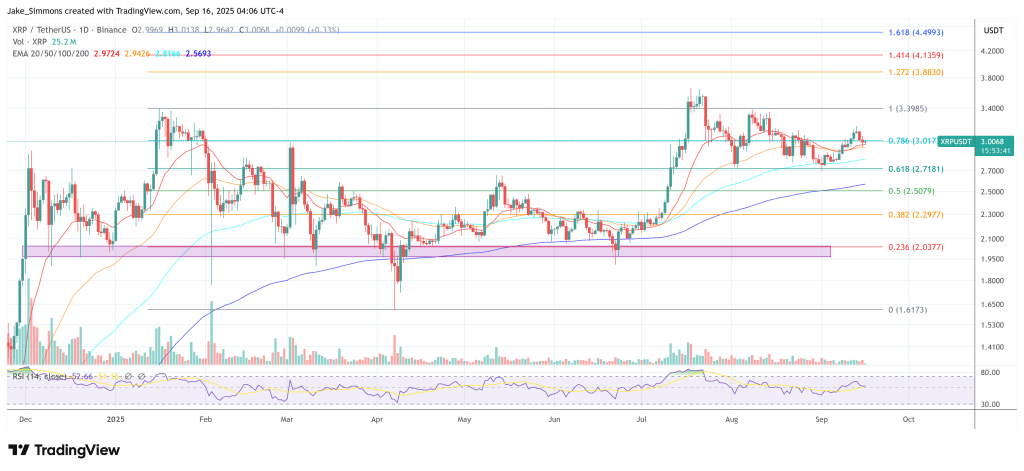
XRP price
XRP price, 1-day chart | Source: XRPUSDT on TradingView.com
Featured image created with DALL.E, chart from TradingView.com
Editorial Process for bitcoinist is centered on delivering thoroughly researched, accurate, and unbiased content. We uphold strict sourcing standards, and each page undergoes diligent review by our team of top technology experts and seasoned editors. This process ensures the integrity, relevance, and value of our content for our readers.

Jake Simmons has been a Bitcoin enthusiast since 2016. Ever since he heard about Bitcoin, he has been studying the topic every day and trying to share his knowledge with others. His goal is to contribute to Bitcoin's financial revolution, which will replace the fiat money system. Besides BTC and crypto, Jake studied Business Informatics at a university. After graduation in 2017, he has been working in the blockchain and crypto sector. You can follow Jake on Twitter at @realJakeSimmons.

Lecturas Relacionadas

La mayor cuestión político-económica de la era de la IA: si los robots son cada vez más capaces, ¿cómo comparte la humanidad el valor?

El título del artículo plantea la pregunta crucial de la era de la IA: ¿cómo compartirán los humanos el valor creado por máquinas cada vez más capaces? El artículo critica un análisis de *The Economist* sobre China, que sugiere que su enfoque en la tecnología podría distorsionar la asignación de recursos y no abordar la débil demanda interna. Sin embargo, el autor argumenta que el problema central es más profundo y global: la IA está reescribiendo la lógica fundamental de la creación y distribución de la riqueza. A diferencia de revoluciones industriales anteriores, donde los humanos seguían siendo el núcleo del proceso productivo, la IA (especialmente en forma de AGI) amenaza con reemplazar masivamente el trabajo cognitivo. Esto plantea un desafío existencial: la economía podría seguir creciendo, pero con menos personas participando directamente en la creación de valor. El mayor problema no es solo el desempleo, sino la distribución: si el poder adquisitivo de los consumidores no crece, surgirá una contradicción de "demanda insuficiente". Aunque China necesita desesperadamente impulsar sectores como la IA y la robótica como nuevos motores de crecimiento, el verdadero reto es cerrar la brecha entre la innovación tecnológica, los beneficios empresariales, los ingresos de los hogares y el consumo. Este "punto de ruptura" en la transmisión de los beneficios de la productividad es un fenómeno global, como lo demuestra la concentración de riqueza en las grandes tecnológicas estadounidenses frente al estancamiento de los ingresos laborales. El artículo esboza tres posibles caminos futuros: el capitalismo tradicional (los beneficios van a los accionistas), el capitalismo de estado (participación del gobierno) o modelos más innovadores como fondos soberanos digitales, propiedad accionarial ciudadana o rentas básicas universales adaptadas a la era de la IA. Para China, la oportunidad estratégica reside en utilizar su capacidad de coordinación política para no solo convertirse en una potencia de IA, sino también en construir un sistema que permita a la mayoría compartir sus beneficios. Esto requerirá reformas en la distribución del ingreso, el sistema de seguridad social y la formación profesional. La competencia futura no se tratará solo de quién tiene la mejor tecnología, sino de quién construye el mejor sistema de distribución para la era de la inteligencia artificial. Resolver cómo los humanos obtienen ingresos y comparten el valor cuando las máquinas realizan gran parte del trabajo es el principal problema de economía política de nuestro tiempo.

marsbitHace 46 min(s)

La mayor cuestión político-económica de la era de la IA: si los robots son cada vez más capaces, ¿cómo comparte la humanidad el valor?

marsbitHace 46 min(s)

Trading

Spot
活动图片