Ripple Flamed By Caitlin Long: ‘XRP Is Doomed, Banks Don’t Trust It’

bitcoinistPublicado a 2025-08-06Actualizado a 2025-08-07

Resumen

Caitlin Long, founder and CEO of Custodia Bank, delivered one of the harshest assessments yet of Ripple and the XRP...

Trusted Editorial content, reviewed by leading industry experts and seasoned editors. Ad Disclosure

Caitlin Long, founder and CEO of Custodia Bank, delivered one of the harshest assessments yet of Ripple and the XRP ecosystem in a recent episode of the Gold Goats ‘n Guns podcast, calling into question the project’s credibility, tokenomics, and long-term viability in institutional finance. In a sweeping critique, Long stated bluntly: “It’s not going to take over. If it were going to take over, it would have taken over a long time ago.”

Caitlin Long Slams Ripple And XRP

The conversation began with a reference to growing speculation that Ripple might be among the blockchain networks “blessed” by regulators to handle tokenized financial infrastructure. But Long pushed back hard on that narrative, saying the idea “overstates how important that network is.”

According to Long, the core issue lies in Ripple’s structural legacy. “The banks have always been suspicious of it,” she said, citing what she described as the project’s centralized architecture and flawed tokenomics. “It is a centralized network and the tokenomics are backwards.” She argued that the XRP supply model — rooted in a massive pre-mine and upfront fundraising — has permanently damaged institutional trust. “The people who extracted money up front are never going to be trusted because everybody is going to look and think that anything they do is an exit scam to try to dump on retail.”

For Long, the contrast with Bitcoin and Ethereum is stark. “The most effective tokenization platforms are the ones where there was no money up front or very little money up front,” she explained. “That’s Bitcoin and Ethereum.”

Long also interpreted Ripple’s recent pivot — with the company now launching its own regulated stablecoin — as a tacit admission of failure. “Instead of trying to sell that into the banking industry, they’re getting their own regulated financial institutions and trying to issue a stablecoin,” she said. “That’s kind of, in some ways, an admission that the base layer blockchain didn’t get the adoption they were looking for.”

Her comments come amid Ripple’s continued push into institutional markets, including efforts to obtain a US bank charter and launch a US dollar stablecoin. While these moves have been celebrated in some circles as signs of maturity and strategic adaptation, Long framed them as a fallback, noting that the original promise — to become a foundational layer for interbank settlement — had clearly not materialized. “The base layer network is not going to become the base layer of replacing SWIFT,” she said.

She also pointed to the legal and regulatory drag Ripple faced over the past several years, including the SEC’s long-running lawsuit against the company for allegedly conducting an unregistered securities offering. “That hamstrung them,” she said, while acknowledging that Ripple wasn’t alone in suffering under the Biden administration’s broader crackdown on crypto: “It didn’t hurt Ripple as much as the Fed hurt us… Everybody who was targeted by the Biden administration was hurt to varying degrees.”

When asked what network the US Treasury is most likely to choose for tokenizing US Treasuries, Long was unequivocal: “They’re not going to use Ripple. They’re going to use Ethereum. They may use Bitcoin, but the Bitcoin layer twos are not mature enough for something like that.” She cited Ethereum’s technical maturity and infrastructure readiness as the decisive factors.

XRP Community Reacts

The backlash from the XRP community was swift and furious. Prominent community figure Crypto Eri called the remarks “ugly tribalism,” accusing Long of conflating Ripple with the XRP Ledger, and failing to distinguish between a centralized company and a decentralized protocol. “The entire blockchain community should be deeply disappointed,” she wrote.

Digital Asset Investor, another well-known XRP supporter, tagged Ripple executives directly, suggesting the company was still on track to achieve regulatory breakthroughs. Ashley Prosper went even further, alleging that Long’s criticism may stem from frustration over Custodia Bank’s lack of a Federal Reserve master account: “Sounds like Caitlin Long is mad that Ripple will get their Fed master account before Custodia Bank.”

But Long’s criticism was not offhanded nor casual — it was pointed and rooted in her long-standing perspective on what makes blockchain infrastructure bank-grade. For her, trust, decentralization, and long-term neutrality are prerequisites — and XRP, in her view, fails on all three.

“Ripple’s been at this longer than almost anybody else and they haven’t made a lot of progress,” Long concluded. “It’s really that simple.”

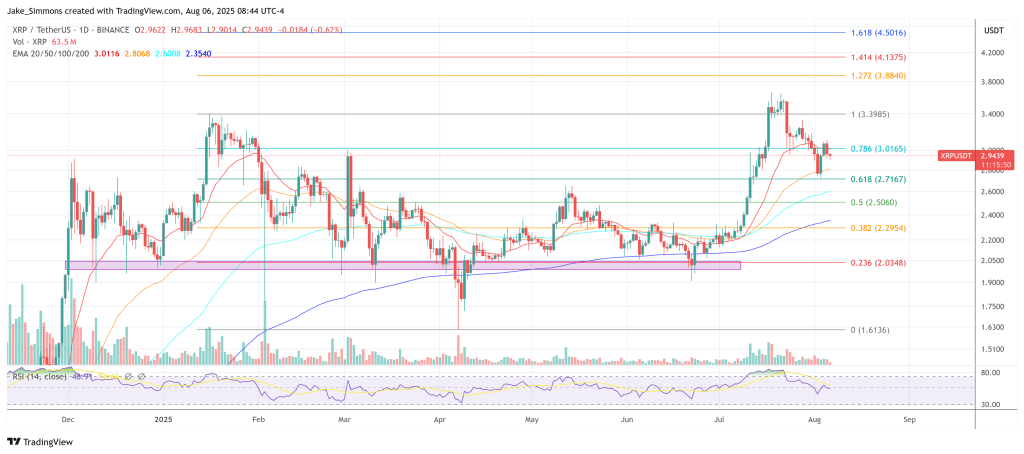
At press time, XRP traded at $2.94.
XRP price
XRP price, 1-day chart | Source: XRPUSDT on TradingView.com
Featured image created with DALL.E, chart from TradingView.com
Editorial Process for bitcoinist is centered on delivering thoroughly researched, accurate, and unbiased content. We uphold strict sourcing standards, and each page undergoes diligent review by our team of top technology experts and seasoned editors. This process ensures the integrity, relevance, and value of our content for our readers.

Jake Simmons has been a Bitcoin enthusiast since 2016. Ever since he heard about Bitcoin, he has been studying the topic every day and trying to share his knowledge with others. His goal is to contribute to Bitcoin's financial revolution, which will replace the fiat money system. Besides BTC and crypto, Jake studied Business Informatics at a university. After graduation in 2017, he has been working in the blockchain and crypto sector. You can follow Jake on Twitter at @realJakeSimmons.

Criptos en tendencia

Lecturas Relacionadas

Última charla de Dan Bin: No se pierdan una gran era

Discurso reciente de Dan Bin: No pierdas una gran era (Resumen en español europeo) El 29 de junio, Dan Bin, presidente de Oriental Harbor, pronunció un discurso titulado "No perder una gran era" en la Cumbre de Estrategias de Gelonghui. Abordando las preocupaciones sobre una posible burbuja de la IA, Dan Bin argumentó desde una perspectiva de ciclo industrial que el riesgo de perder una era tecnológica es mayor que el riesgo de las burbujas a corto plazo. Subrayó que la humanidad está en el comienzo de la era de la inteligencia artificial, que considera más disruptiva que las eras electrónica, de internet y móvil. Basándose en el historial del Nasdaq, afirmó que el progreso tecnológico, no factores macroeconómicos a corto plazo como los tipos de interés, es el principal motor del crecimiento del mercado a largo plazo. Dan Bin predice que la ola de IA probablemente tendrá un ciclo industrial largo, similar al de la era de internet (unos 10 años). Tomando el lanzamiento de ChatGPT a finales de 2022 como punto de partida, sugirió que la ventana de riesgo relevante podría estar alrededor de 2033, por lo que es poco probable que el impulso se agote en tres o cuatro años. Ampliando la perspectiva, compartió una visión a largo plazo sobre la posibilidad de que la vida basada en silicio (IA) complemente o incluso sustituya a la basada en carbono, viéndola como un posible paso para la continuidad de la civilización a escalas cósmicas. También destacó la intensa competencia en IA entre EE.UU. y China, impulsada en parte por su aplicación en defensa, afirmando que ninguno de los dos países puede permitirse perder esta carrera. Reflexionando sobre lecciones de inversión, mencionó el "arrepentimiento" de figuras como Charlie Mungger por no invertir más en grandes éxitos tecnológicos como Microsoft, enfatizando la necesidad de evolucionar el conocimiento. Concluyó instando a los inversores a mantener la perspectiva, evitar el cortoplacismo y participar activamente en esta "gran era" transformadora impulsada por la IA.

marsbitHace 8 min(s)

Última charla de Dan Bin: No se pierdan una gran era

marsbitHace 8 min(s)

Trading

Spot

Artículos destacados

Cómo comprar T

¡Bienvenido a HTX.com! Hemos hecho que comprar Threshold Network Token (T) sea simple y conveniente. Sigue nuestra guía paso a paso para iniciar tu viaje de criptos.Paso 1: crea tu cuenta HTXUtiliza tu correo electrónico o número de teléfono para registrarte y obtener una cuenta gratuita en HTX. Experimenta un proceso de registro sin complicaciones y desbloquea todas las funciones.Obtener mi cuentaPaso 2: ve a Comprar cripto y elige tu método de pagoTarjeta de crédito/débito: usa tu Visa o Mastercard para comprar Threshold Network Token (T) al instante.Saldo: utiliza fondos del saldo de tu cuenta HTX para tradear sin problemas.Terceros: hemos agregado métodos de pago populares como Google Pay y Apple Pay para mejorar la comodidad.P2P: tradear directamente con otros usuarios en HTX.Over-the-Counter (OTC): ofrecemos servicios personalizados y tipos de cambio competitivos para los traders.Paso 3: guarda tu Threshold Network Token (T)Después de comprar tu Threshold Network Token (T), guárdalo en tu cuenta HTX. Alternativamente, puedes enviarlo a otro lugar mediante transferencia blockchain o utilizarlo para tradear otras criptomonedas.Paso 4: tradear Threshold Network Token (T)Tradear fácilmente con Threshold Network Token (T) en HTX's mercado spot. Simplemente accede a tu cuenta, selecciona tu par de trading, ejecuta tus trades y monitorea en tiempo real. Ofrecemos una experiencia fácil de usar tanto para principiantes como para traders experimentados.

593 Vistas totalesPublicado en 2024.12.10Actualizado en 2026.06.02

Cómo comprar T

Discusiones

Bienvenido a la comunidad de HTX. Aquí puedes mantenerte informado sobre los últimos desarrollos de la plataforma y acceder a análisis profesionales del mercado. A continuación se presentan las opiniones de los usuarios sobre el precio de T (T).

活动图片