Best Altcoins to Watch as Banks Enter Crypto and DeFi Surges

bitcoinistPublicado a 2025-05-24Actualizado a 2025-05-24

Resumen

The crypto space has never been more exciting, especially with news circulating about traditional financial giants like JPMorgan, Bank of...

Trusted Editorial content, reviewed by leading industry experts and seasoned editors. Ad Disclosure

The crypto space has never been more exciting, especially with news circulating about traditional financial giants like JPMorgan, Bank of America, Citi, and Wells Fargo possibly launching a joint stablecoin.

This could be a game-changer, but it’s not just stablecoins that deserve your attention.

Altcoins continue to be the driving force behind innovation in the blockchain and cryptocurrency world.
In fact, many of the best altcoins of 2025 are looking to capitalize on the growing interest in decentralized finance (DeFi), tokenized assets, and new technologies.

As big banks consider entering the crypto space, it’s important to look beyond the headlines and focus on the smaller, yet powerful projects making waves.

In this article, we’ll highlight three exciting new crypto projects that have the potential to change the game in the world of altcoins.

The Big Picture: Traditional Banks Eye Crypto, But Altcoins Lead the Way

The world of cryptocurrency is undergoing a major shift, with some of the biggest traditional financial institutions – JPMorgan, Bank of America, Citi, and Wells Fargo – reportedly considering a joint stablecoin launch.

This is a significant development, as these major players in banking have largely stayed on the sidelines, hesitant to fully embrace crypto.

Stablecoins, which are pegged to fiat currencies like the US dollar, offer a sense of stability in the otherwise volatile crypto market.
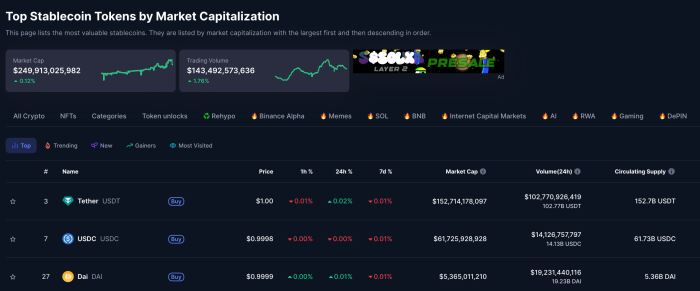
Top 3 stablecoins on CoinMarketCap.
Source: CoinMarketCap.

With these financial giants moving into the space, they may appeal to both retail and institutional investors seeking safer, less volatile options.

However, while stablecoins may offer short-term stability, the true innovation in blockchain lies within altcoins. These projects are pushing the boundaries of what decentralized finance can achieve, from tokenizing real-world assets to enabling decentralized exchanges.

Investors are flocking to protocols that offer speed, transparency, and liquidity, which are solving long-standing issues in traditional finance.

As financial institutions look to enter the crypto space, altcoins are already leading the charge, proving that the future of digital finance is decentralized.

1. Best Wallet Token ($BEST) – Unlocking Future Growth with Innovation and Security

Best Wallet Token ($BEST) is revolutionizing digital wallet management with a user-friendly platform that supports multiple cryptocurrencies, cross-chain transfers, and top-tier security powered by Fireblocks MPC-CMP technology.

Unlike traditional wallets, Best Wallet is designed for both newcomers and experienced investors, making crypto management easy and secure.

Priced at $0.025075, $BEST raised over $12.6M during its presale, signaling strong investor confidence.
As major financial institutions like JPMorgan, Bank of America, and Wells Fargo explore stablecoin initiatives, the decentralized wallet and token space is gaining traction.

how to buy $BEST presale.

With a forecasted price of $0.62 by 2026, $BEST could see a significant 2,372% increase from its current value.

If you staked $1,000 worth of $BEST today, at a 15% annual percentage yield (APY), you could accumulate additional tokens throughout the year.

By 2026, with $BEST priced at $0.62, your total investment could be worth $3,174 – a potential profit of $2,174.

Token buyers also enjoy reduced transaction fees, early access to new projects, and benefits in Best Wallet’s iGaming partnerships.

As Best Wallet continues to disrupt the market with innovative features, $BEST offers significant long-term growth potential — making it one of the most promising altcoins to watch in 2025.

2. SUBBD Token ($SUBBD) – Tokenizing Real-World Assets for Blockchain Innovation

SUBBD Token ($SUBBD) is transforming the creator economy by tokenizing real-world assets such as real estate and commodities, allowing people to buy, sell, and trade them as digital assets.

This approach makes traditionally illiquid markets more accessible and efficient, bridging the gap between blockchain and traditional finance.

Beyond tokenization, $SUBBD leverages AI to empower creators, offering tools to automate chat, editing, and monetization, helping them scale content with ease.

People can also generate AI-driven photos and videos, which are approved by creators, creating new revenue streams. With over 250M combined followers across its ecosystem, $SUBBD is poised to onboard a large user base to its platform.

The project raised nearly $500K during its presale, and you can buy $SUBBD right now for $0.055475.

As financial institutions explore stablecoin initiatives, the decentralized content and asset tokenization space is gaining significant momentum.

SUBBD token benefits

With staking rewards offering 20% APY during the presale, $SUBBD provides an attractive opportunity for early investors.

As the platform grows and blockchain adoption accelerates, $SUBBD is set to become a key player in both the crypto and creator economies.

3. NEAR Protocol ($NEAR) – A Blockchain Built for the Future

NEAR Protocol ($NEAR) is a blockchain platform designed to make decentralized apps (dApps) easier to build and use. Think of it like a super-fast highway for blockchain, where developers can quickly deploy apps without getting stuck in traffic.

One of $NEAR’s coolest features is its sharding technology, called Nightshade. It splits the blockchain into smaller parts (called shards), allowing the network to process a lot more transactions at once.

This makes NEAR Protocol faster and cheaper to use than many other blockchains, which tend to slow down when too many people use them.

But $NEAR isn’t just about speed. It also makes it easy for newcomers.

Instead of dealing with complicated crypto addresses, users get simple, human-readable account names. And developers can easily connect to other blockchains, like Ethereum, thanks to tools like the Aurora EVM.

Currently priced at $2.81, $NEAR has been gaining momentum with over 1K projects already running on its network. It’s quickly becoming one of the most reliable platforms in decentralized space.
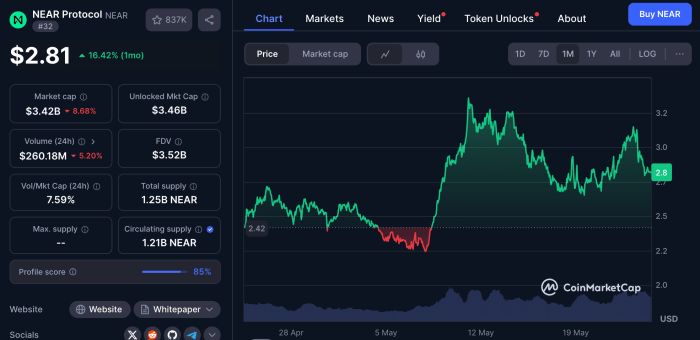
$NEAR pumping over the last month on CoinMarketCap.
Source: CoinMarketCap.

As traditional financial institutions like JPMorgan and Bank of America explore blockchain technology, $NEAR’s scalability and developer-friendly approach make it a key player in the future of decentralized finance.

The Next Generation of Altcoins

As traditional financial institutions start exploring the crypto space, innovative altcoins like Best Wallet Token, SUBBD Token, and NEAR Protocol are leading the charge in decentralized finance.

These projects are pushing the boundaries with secure wallets, tokenizing real-world assets, and bridging crypto with traditional markets. Keep an eye on them for future growth.

Before investing in crypto, always do your own research (DYOR). This article is for informational purposes only and shouldn’t be considered as financial advice.

Editorial Process for bitcoinist is centered on delivering thoroughly researched, accurate, and unbiased content. We uphold strict sourcing standards, and each page undergoes diligent review by our team of top technology experts and seasoned editors. This process ensures the integrity, relevance, and value of our content for our readers.

Lecturas Relacionadas

Por qué Uniswap apuesta más por la ejecución que por mayores incentivos a los proveedores de liquidez

Uniswap [UNI] ha propuesto reducir hasta un 33% los incentivos para proveedores de liquidez (LP) en su versión V4, apostando por una mejor ejecución en lugar de mayores recompensas. Esta estrategia busca reducir los costes de trading, estrechar los spreads y mejorar el uso de capital, con el objetivo de aumentar el volumen y compensar así los menores rendimientos para los LP. La propuesta supone un cambio significativo respecto al modelo anterior (V3), que dependía más de incentivos elevados. Aunque Uniswap mantiene un liderazgo con un TVL de 3.020 millones de dólares y un volumen mensual cercano a los 36.000 millones, este cambio conlleva riesgos. Los proveedores de liquidez podrían trasladar su capital a protocolos competidores que ofrezcan mejores rendimientos. Para fortalecer su posición, Uniswap ya está integrando herramientas como el módulo LitePSM de Sky, que permite operaciones sin deslizamiento entre stablecoins como USDS, DAI y USDC, mejorando la liquidez y reduciendo costes de ejecución. En definitiva, el éxito de esta nueva estrategia dependerá de si la mejora en la ejecución atrae suficiente volumen de trading para compensar la reducción de incentivos a los LP. Si los traders adoptan el modelo, Uniswap podría consolidar su liderazgo; de lo contrario, los DEX rivales podrían ganar terreno con incentivos más atractivos.

ambcryptoHace 55 min(s)

Por qué Uniswap apuesta más por la ejecución que por mayores incentivos a los proveedores de liquidez

ambcryptoHace 55 min(s)

La estratagema contable de Strategy: el límite de venta de monedas está muy por encima de los 12.500 millones de dólares

Strategy reveló la venta de 3588 BTC (unos 216 millones de dólares) para pagar dividendos y reponer su reserva en dólares. Aunque anunció previamente un límite de venta de 1250 millones de dólares para "construir" dicha reserva, esta venta no se contabiliza en ese cupo, ya que se clasifica como "reposición". El plan de monetización de BTC de la compañía contempla tres usos principales para los fondos de las ventas: 1) Construir la reserva en dólares (hasta 1250 millones), 2) Cubrir costos de dividendos e intereses de acciones preferentes y deuda, y 3) Financiar recompras de acciones (hasta 2000 millones). Solo los dos últimos puntos con límites explícitos suman potencialmente más de 3000 millones en ventas, sin contar las ventas para cubrir obligaciones, que no tienen tope definido. La distinción clave es contable: vender BTC para *añadir* efectivo a la reserva es "construir", mientras que usarla para pagar obligaciones y luego vender BTC para *volver a llenarla* es "reponer". Ambas acciones terminan inyectando dólares al mismo fondo para el mismo propósito. Este marco marca un cambio fundamental: Strategy ha pasado de ser un simple acumulador de Bitcoin a un gestor de capital activo que utiliza su BTC como una herramienta en el balance para mantener en funcionamiento su compleja estructura de capital, lo que genera nuevos conflictos de interés entre sus diferentes partes (acciones comunes, preferentes, reserva y BTC). Los inversores ahora deben analizar minuciosamente la terminología de sus comunicados para evaluar el impacto real en las futuras ventas de BTC.

Odaily星球日报Hace 1 hora(s)

La estratagema contable de Strategy: el límite de venta de monedas está muy por encima de los 12.500 millones de dólares

Odaily星球日报Hace 1 hora(s)

El juego de conexiones entre la élite de Silicon Valley: ¿Quién tiene contactos consigue 50 millones, y el que tiene talento real no encuentra financiación?

El ecosistema de Silicon Valley ha experimentado un cambio fundamental: la meritocracia está siendo desplazada por un sistema de favoritismos y conexiones personales. Los fundadores con antecedentes prestigiosos, como graduados de Stanford o ex-empleados de OpenAI, consiguen inversiones millonarias con facilidad, mientras que talentos externos y disruptivos luchan por obtener financiación. Este fenómeno se debe a tres factores principales: 1) las expectativas de crecimiento distorsionadas por la IA, 2) la concentración de capital en unos pocos fondos de capital de riesgo establecidos, y 3) la profesionalización de la industria de VC, que atrae a seguidores en lugar de pensadores independientes. Como consecuencia, los emprendedores se ven obligados a adaptarse a un molde predefinido, priorizando las relaciones con inversores sobre la construcción de su producto. Esto ha llevado a prácticas cuestionables, como la manipulación de métricas de ingresos y la venta temprana de participaciones secundarias por parte de los fundadores. A pesar de esta tendencia, el autor argumenta que la historia demuestra que las compañías más valiosas no suelen surgir de las modas del momento. Se muestra optimista ante un eventual regreso a la meritocracia, donde los talentos outsiders e infravalorados triunfarán, y aquellos que solo siguen la corriente terminarán perdiendo.

marsbitHace 1 hora(s)

El juego de conexiones entre la élite de Silicon Valley: ¿Quién tiene contactos consigue 50 millones, y el que tiene talento real no encuentra financiación?

marsbitHace 1 hora(s)

Trading

Spot
活动图片