The last few days have seen Bitcoin ignite an upward rally while jolting most cryptos. The world’s most popular crypto asset has hit a higher high since March 3rd and was trading at $46,499 at the time of writing, representing a 3.9% upward rally over the last 7 days. This Bullish stance has taken shape on crypto charts after the repercussions of Russia’s invasion of Ukraine which brought about a bearish outlook.
Bitcoin’s upward rally
Bitcoin has currently hit a three-week high. On the 1st of March, BTC was trading at around $43,000 with resistance pegged at the $45,000 mark and finally rested at its support (around the $39,000 region) on 6th March. This might be attributed to the strife between Russia and Ukraine. Since then, the largest coin by market capitalization has been on an upward rally as shown below:
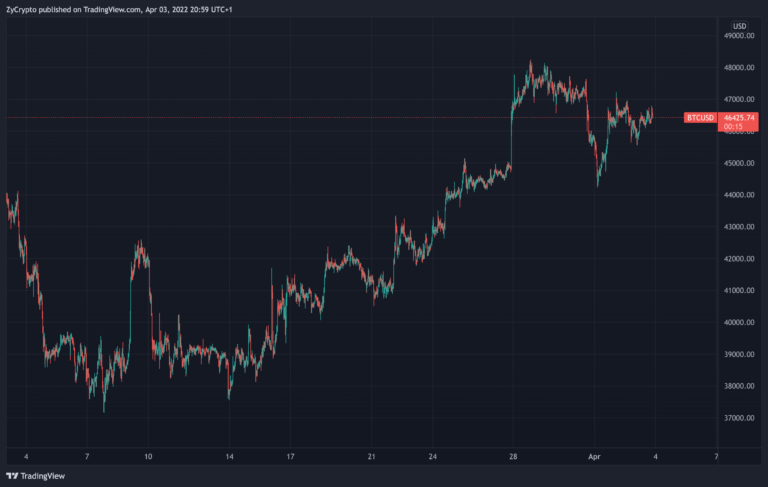
Bitcoin’s upward momentum over the last few days might be attributed to a few happenings in the digital currency markets’ sphere including last week’s Wall Street shakeup. It was announced that Goldman Sachs, a U.S.-based bank, made a revolutionary over-the-counter (OTC) transaction in Bitcoin where they purchased a non-deliverable option (NDO) from Galaxy Digital. The latter is a crypto-investment firm that acts as a liquidity partner for the bank’s Bitcoin futures trading desk. Market analysts partly attributed bitcoin’s resurgence to the announcement which echoed across most coins.
The effect of Bitcoin’s kickoff has reverberated across several coins including Ethereum (ETH), Cardano (ADA), Solana (SOL), and most other coins which have painted crypto charts green.
Ethereum’s stellar run
Ether’s stellar performance has even transcended bitcoin’s trajectory. ETH hit a high of slightly above the $3,500 mark and has now consolidated at $3,490 as illustrated in the below chart.
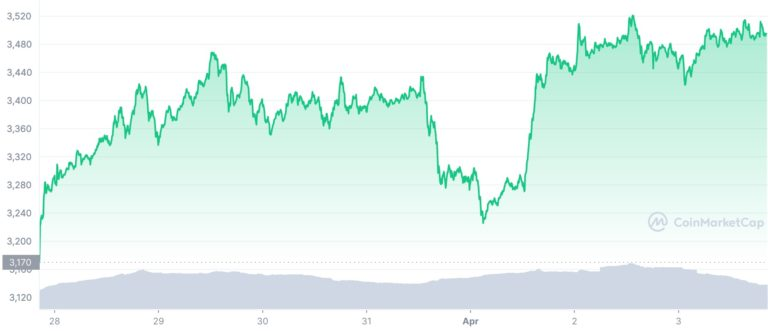
This momentum has resulted from the buzz around Ethereum’s network migration from Proof-of-Work to Proof-of-Stake. This merger has been tried out and proven to be effective on the ‘Kiln’ testnet and is widely regarded as a game-changer for the Ethereum ecosystem.
These developments on the Ethereum network have seen investor sentiments rise positively over the coin’s potential and are now looking to key in to supply the imminent demand of Ethereum.
Cardano follows suit
ADA’s charts have followed the same trajectory, rallying upwards to trade at $1.18 at the time of writing and designating a 5.9% increase in 7 days. The 7-day and 21-day moving averages intersected at the $1.2 mark signifying a continued upward rally in the coming days.
Cardano continues to build upon its gains with imminent network upgrades. Additionally, Cardano’s developers, IOG, formerly known as IOHK, recently announced a proposal to increase the memory of the network’s Plutus scripts. These and other factors appear to have swayed investor confidence positively.
As Bitcoin rallies upwards, other coins are following suit. Most moving averages are indicative of continued upward momentum. However, only time will tell how long the momentum will hold.