Claude Code's Father's Night Shift AI Army, Fable 5 Built with Two Commands

marsbitPublished on 2026-07-20Last updated on 2026-07-20

Abstract

For the past year, Boris Cherny, creator of Claude Code, hasn't written a single line of code himself. He manages hundreds, even thousands, of AI agents that run day and night, autonomously handling tasks from writing and submitting code to fixing CI tests and gathering user feedback. His secret lies in a "loop" system, where tasks are defined and set to run repeatedly, combined with a critical "/goal" command that provides a clear, verifiable objective and a "supervisor" model to check progress. This approach transforms the programmer's role from a coder to a system designer and reviewer. At Anthropic, AI agents even collaborate in Slack channels to divide work. The recently released Fable 5 model is built for such long-term autonomous operation, featuring self-verification and the ability to understand complex charts. Effective use requires the "/goal" command for targeted tasks and "/loop" for recurring ones. To maximize efficiency, a local context system can be set up in 20 minutes, providing the AI with persistent memory of your projects, preferences, and procedures. The key takeaway is that the future lies not in prompting AI for each step, but in building autonomous systems driven by clear, verifiable goals.

For the past year, he hasn't written a single line of code by hand.

He submits dozens of PRs every day, and one day hit 150, setting a personal record.

What's even more outrageous is that he has hundreds of AI agents running simultaneously on his side, and thousands more work the night shift for him.

This was personally stated by Boris Cherny, the father of Claude Code, during a recent public discussion with developers.
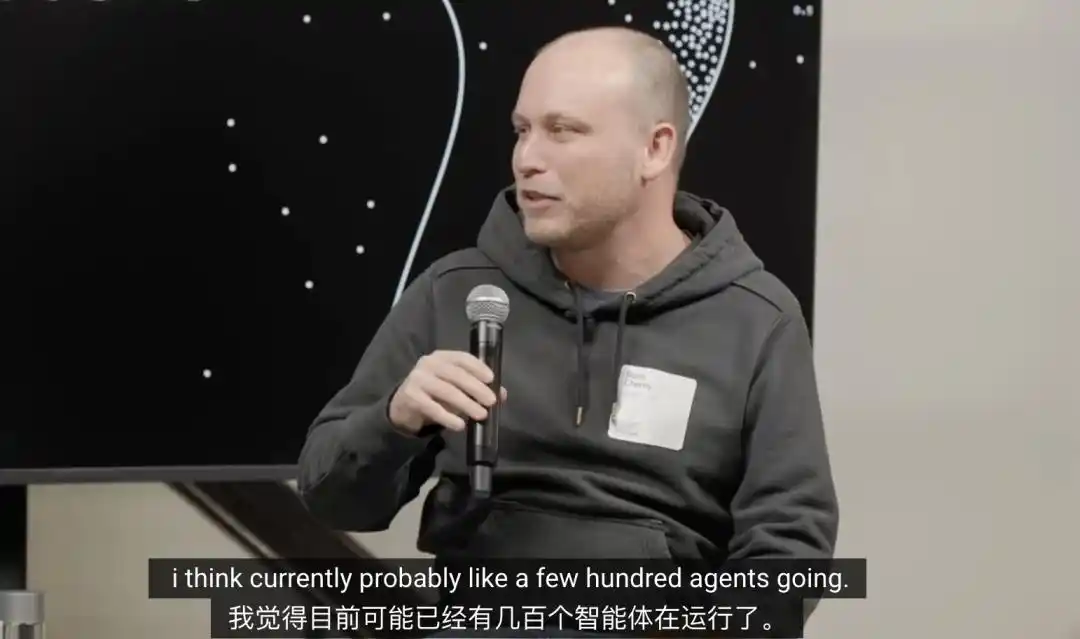

He has the Claude app open on his phone, with a small code tab on the left, containing 5 to 10 concurrent sessions.

Under each session is a cluster of agents, hundreds running during the day, and once night falls, thousands start doing deeper work.

The models write all the code, he doesn't touch a single line.

For him, the task of programming has been solved.

How Can One Person Manage Thousands of Agents?

One person manages thousands of agents, having them all modify code in the same repository simultaneously, without losing control, fighting each other, or creating piles of garbage.

Boris's secret lies behind one word: Loop.

He says a Loop is the simplest yet most useful thing he's seen; Loops are the future.

The essence of a Loop is letting Claude schedule a repeatable task using a cron job—every minute, every five minutes, daily, as you set it. Once it's running, it basically requires no management.

He has dozens of Loops running perpetually:

One specifically monitors his PRs, automatically fixing continuous integration (CI) and rebasing;

One is responsible for keeping CI healthy, fixing any unstable tests itself;

And another scrapes user feedback from X every 30 minutes, clusters and organizes it, then submits it to him.

More crucially, later on, even the step of initiating a Loop rarely requires Boris to speak up.

Once he just asked the model to run a data query, and the model replied: "I noticed this data keeps changing, so I'll start a Loop and give you a report every 30 minutes."

He said okay, just send it to my Slack. The model then handled the matter.

Not long ago, Boris also mentioned he no longer writes prompts, only loops.

Soon, he might not even need to write loops.

Agents

Are Redefining "Getting Work Done"

Behind this, "getting work done" itself is changing.

In the past, it was you writing a line, AI answering, you writing the next line; now, it's you building a small system that can find work, do it, and submit it on its own, then you walk away.

Anthropic recently launched Routines, moving the same mechanism to the server side. Close your laptop, and it still runs.

The role of "engineer" is also being rewritten in Boris's case:

The model writes the code, he's responsible for building the system and acceptance testing. Dozens to hundreds of PRs emerge daily from the agents. His real job is deciding which can be merged and which need to be sent back.

In his words, this is not "AI replacing engineers," but humans transitioning from operators and executors to designers of automated systems: the focus shifts from "writing this line of code correctly" to "building a system that can write code correctly on its own."

He even predicts that in another year, security steps like prompt injection protection, command validation, and manual approval will become less important because models will become increasingly conscientious about doing the right thing.

And this approach is no longer just his personal play.

According to Boris, there's hardly any manual coding left in the company; even SQL is written by models. It's hard to find a few lines of code still typed by a human in the entire company.

Even more surreal is another scene. When his Claude agents are writing code in a Loop, they'll go to Slack themselves, chat with colleagues' Claude agents, aligning on things no one has figured out yet.

A group of AIs holding meetings in a Slack channel, dividing up the work, and going back to do it—this is daily routine at Anthropic.

Even more intense is the team composition: engineering managers, product managers, designers, data scientists, finance, user researchers—everyone is writing code.

The functions remain, but everyone has gained an extra layer of general capability: "orchestrating AI to get work done," becoming cross-disciplinary generalists.

From Writing Prompts to Writing Loops

The Gap Lies in a Step Called Acceptance

How can an AI that works autonomously infinitely not be a machine producing bugs at high speed?

The answer lies in a step most people overlook: acceptance.

A Loop can run autonomously without going off the rails, relying on a "goal-driven" mechanism, corresponding to the /goal command in Claude Code.

You give it a goal, like "All unit tests under /tests/ pass, linting clean." After each step, a separate, smaller model judges: Is it done? If not, keep going; if yes, stop.

This "supervising model" responsible for scoring is not the one doing the work.

This simple design is precisely the heart of the entire loop.

Without it, a Loop running all night could very well be a machine that's asleep yet still bulk-submitting garbage code, and doing so righteously.

Boris verified this long ago.

When sharing his workflow previously, he gave this piece of advice: the most important step to squeeze the utmost out of Claude Code is to give it a way to verify its own work.

Once this feedback loop is established, output quality typically improves by 2 to 3 times.

A single action of "making AI check itself" is equivalent to upgrading a generation of models.

This Cycle is Usable by Ordinary People Too

The aforementioned cycle has been turned into a product; ordinary people can use it just the same.

After the release of Fable 5, a widely circulated tutorial on X stated, after three weeks of hands-on testing by the author: Most people use Fable 5 like they use ordinary Claude, which is a complete waste of what truly makes it worth paying for.

The author first points out three capabilities that distinguish Fable 5 from all previous Claude models.
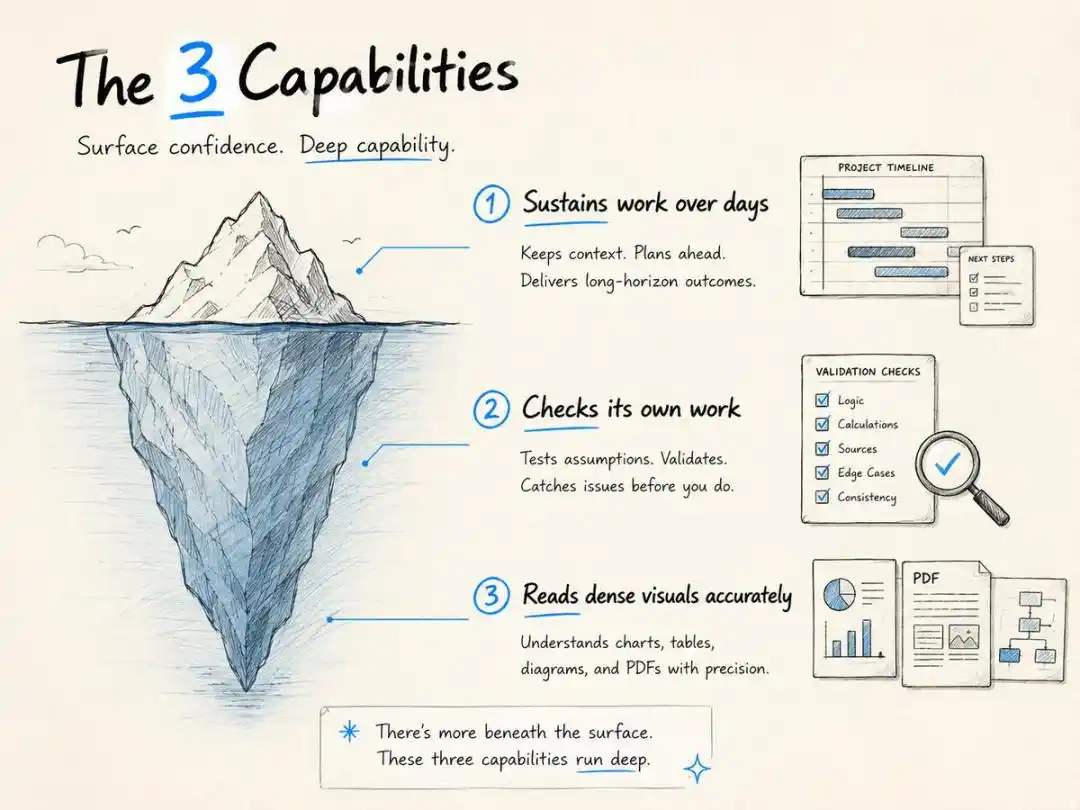
The three major capabilities of Fable 5 summarized in the tutorial: Long-term autonomous work, self-verification, understanding dense charts.

First, it can work continuously for days, not minutes.

Previous models were sprinters; Fable 5 is the first model built for "long-term autonomous work."

In Claude Code, you can give it an entire multi-day project; it plans in phases itself, dispatches sub-agents, and keeps working until the goal is met.

Second, it checks its own work. After finishing a task, it doesn't rush to deliver; it first writes tests, runs them, catches errors, fixes them, and only then says "done."

Third, the ability to understand dense charts.

According to the author's tests, for tables in financial reports, charts embedded in PDFs, architecture diagrams, dashboard screenshots—areas where Opus 4.8 occasionally misidentified columns or confused axes—Fable 5 can read them accurately and consistently.

And to truly utilize these capabilities, it relies on two commands: /goal and /loop.

Without them, you're paying double the price for a chatbot; with them, you're buying an autonomous working employee.
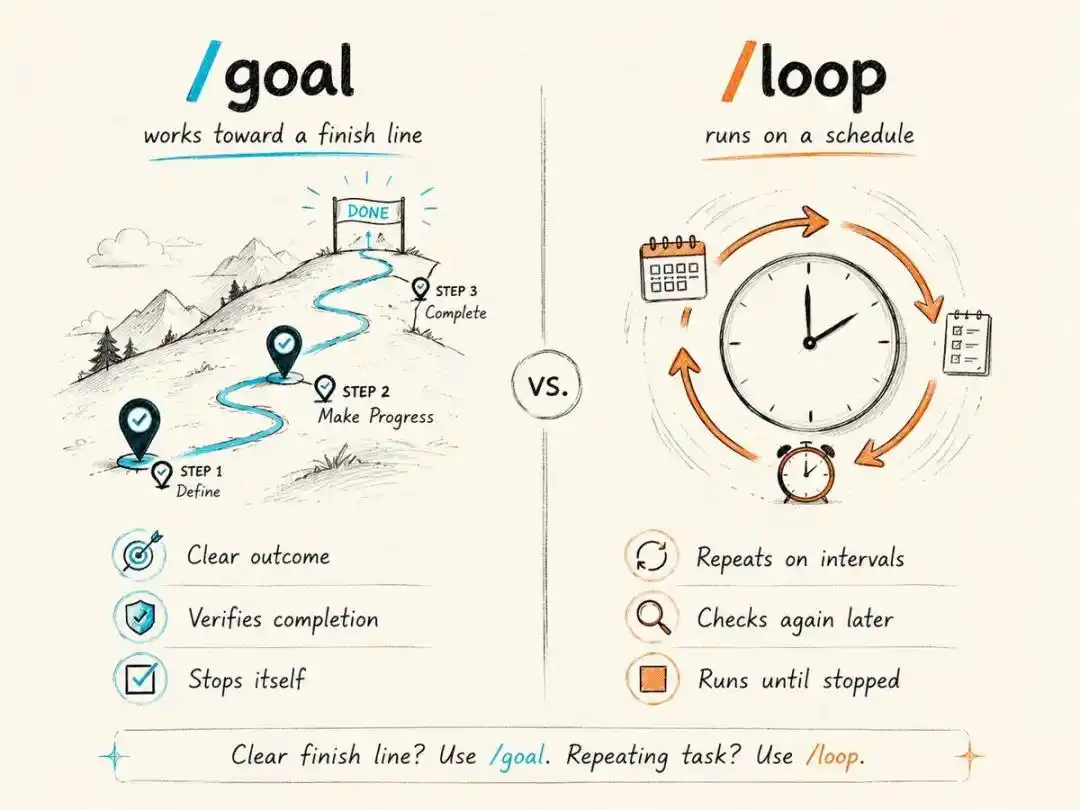
/goal runs towards the finish line and stops itself when reached; /loop runs repeatedly on schedule until you tell it to stop.

The mechanism of /goal is: you define the result, it's responsible for iteration. Whether it runs well follows an ironclad rule: write the "completion criteria" concretely, and must include an exit strategy for failure.

For example, "Improve this piece of code" is a bad goal because it's unverifiable; "All tests under /tests/ pass, only files in /src are allowed to be modified, stop and report if still failing after 3 fixes" is a good goal because each point can be verified.

/loop doesn't target a specific endpoint; it runs repeatedly on schedule until you stop it.

For example, check error logs every 30 minutes, pick out severity-level ones and report them in plain language; or scan the inbox every hour, summarize new emails, and draft replies for those needing responses.

The division of labor mantra is three sentences: For a clear endpoint, use /goal; for periodic repetition, use /loop; to keep running until a condition is met, combine both.

Before letting go, there's one more piece of very practical advice: set the spending limit first. An uncapped /goal hitting a difficult problem can burn through tokens frighteningly fast.

Making It Remember You: 20 Minutes of Local Configuration

The tutorial also mentions a step most guides skip, which is precisely the most crucial.

Fable 5 won't remember you. Every new session, it knows nothing about your business, writing style, clients, or preferences, starting from zero each time.

The solution is to set up a local context system on your own machine, which takes only 20 minutes.
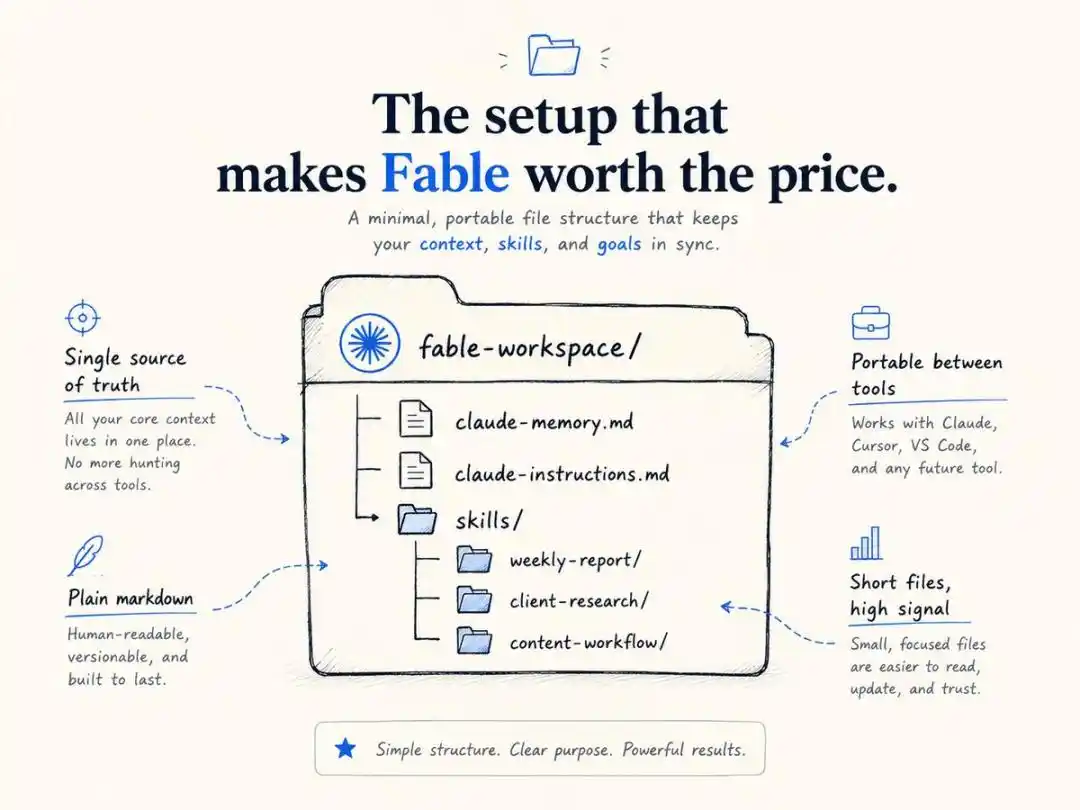
One folder, two markdown files, and a set of skills—that's all the configuration needed for Fable 5 to "know you."

It's done in four steps.

Step one, create a context folder, e.g., named `fable-workspace`, serving as the "single source of truth" it must read before starting any work.

The folder can contain items like: a one-page summary of business and priorities, standard operating procedures for frequent tasks, key information for ongoing projects, often-referenced strategic documents, plus a decision log.

Keep each file to one page; too much content eats up the context window.

Step two, create a memory file `claude-memory.md`, and leave an instruction: Whenever I mention important information about business, preferences, or situation, update the key points into it, keep it brief, and date it.

From then on, it updates itself. Mention a new client once, and it already knows in the next session.

Step three, create an instruction file `claude-instructions.md`, clearly stating behavioral rules for each session: read the memory file before starting work, check past decisions before giving advice, ask if unsure—don't guess, proactively report after finishing work and mark areas needing human review.

Step four, in Claude Code, use `/add` to point to this folder, or write into CLAUDE.md. Once connected, at the start of every session, it already comes loaded with your full context.

This configuration has another benefit: if you switch to another AI tool someday, you can directly package and take your context with you.

Regarding saving money, there's an 80/20 approach: only use Fable 5 for that 20% of tasks that truly leverage its strengths.

In Claude Code, Fable can also dispatch cheaper sub-agents to do rough work: it comes up with the plan, Sonnet, Haiku, etc., execute it, and finally, it returns to validate.

At this point, you'll realize Boris's "Night Shift AI Army" breaks down to just three things:

A model that works autonomously, a set of standards defining "done," and a cycle that runs on schedule.

The model and the cycle are already in place.

What's truly scarce is the person who can clearly explain to the model "what a finished task looks like."

References:

https://safe.ai/blog/significant-increase-in-digital-labor-automation

https://x.com/free_ai_guides/status/2073050543027638443

https://youtu.be/SlGRN8jh2RI

https://x.com/bcherny/status/2007179861115511237

This article is from WeChat public account "Xinzhiyuan", edited by: Yuanyu

Trending Cryptos

Related Questions

QWhat is the core concept that allows Claude Code's creator to manage thousands of AI agents simultaneously without chaos?

AThe core concept is the 'Loop'. It involves setting up timed, automated tasks (like code fixes, CI health checks, or user feedback collection) that run periodically (e.g., every minute, 5 minutes, or daily) with minimal human oversight. This enables continuous, self-directed work by AI agents.

QAccording to the article, how is the role of an 'engineer' being redefined in Boris's workflow?

AThe role is shifting from being a hands-on coder to a designer and manager of automated systems. The engineer sets up the systems (like Loops), defines goals, and acts as a reviewer/approver for the code (PRs) generated by AI agents, rather than writing the code line-by-line themselves.

QWhat is the critical component that prevents an autonomous AI loop from becoming a machine that generates bugs?

AThe critical component is a 'verification' or 'acceptance' mechanism, specifically the '/goal' command in Claude Code. A separate 'supervisor' model independently checks if the AI's work meets the predefined, concrete completion criteria after each step, creating a feedback loop that ensures quality and stops the process when the goal is achieved.

QWhat are the two key commands in Fable 5 that users must utilize to unlock its potential for autonomous work?

AThe two key commands are '/goal' and '/loop'. '/goal' is for tasks with a clear end state, where the AI iterates until the goal is met. '/loop' is for recurring, periodic tasks that run until manually stopped. Using them transforms Fable 5 from a chatbot into an autonomous worker.

QWhat practical setup does the article suggest to make Fable 5 'remember' a user's context across different sessions?

AIt suggests creating a local context system with a dedicated folder (e.g., 'fable-workspace'). This folder should contain concise Markdown files summarizing the business, priorities, operating procedures, and active projects. A 'claude-memory.md' file is used for the AI to self-update with important user information, and a 'claude-instructions.md' file defines session behavior rules. This folder is then linked to Claude Code via the '/add' command or a CLAUDE.md file.

Related Reads

After Three Consecutive Quarters of Decline, Can the Crypto Market Find a Window for Stabilization in Q3?

The cryptocurrency market has just concluded its worst-performing quarter since 2022, with total capitalization dropping 12.6% to $2.1 trillion. All core metrics indicate capital is leaving the sector, not just rotating within it. Bitcoin fell 14.2% and Ethereum dropped 25.4% in Q2, breaking their previous correlation with US tech stocks. A key driver is the reversal in US spot Bitcoin ETF flows, which saw a net outflow of approximately $4.67 billion in Q2, including a record monthly outflow near $4.5 billion in June. While recent data suggests long-term holders are accumulating again, sustained ETF outflows mean continued selling pressure. Market focus is now singularly on the Federal Reserve. The upcoming July FOMC meeting is seen as the most critical event for Q3. A dovish signal could support Bitcoin reclaiming a $68,000-$84,000 range, while a hawkish stance might establish a new trading band around $50,000-$56,000. Additionally, regulatory uncertainty persists, with the progress of the crucial *CLARITY Act* stalling in the Senate, reducing its perceived 2026 passage probability to 40-45%. Despite the broad downturn, a few sectors showed growth. Prediction markets saw nominal volume surge 48.7% year-over-year to $113.8 billion, and tokenized collectibles transaction volume rose 143% quarterly to $1.4 billion. The Real-World Asset (RWA) tokenization sector also continued steady growth, now representing ~$28.1 billion in on-chain value. The market's foundation for an extreme crash appears limited, with Bitcoin price hovering near its 200-week moving average. However, the trading paradigm has shifted from narrative-driven speculation to decisions based on price action, policy developments, and interest rate expectations, making a broad sentiment-driven rally unlikely in the near term.

marsbit6h ago

After Three Consecutive Quarters of Decline, Can the Crypto Market Find a Window for Stabilization in Q3?

marsbit6h ago

BIT Trading Moment: BTC Still Suppressed by Weekly 200 EMA, Rejection May Restart Decline; Storage and Semiconductors that Surged Last Night Begin Falling in Evening Trading

**Crypto & Stock Market Wrap: Bitcoin Tests Resistance, Stocks Retreat After AI Surge** Bitcoin consolidates around $66,000, facing key resistance near $68,000—an area seen as a major psychological and technical hurdle where previous rallies have failed. Analysts note the cryptocurrency is caught between its 200-week moving average (~$63,333) and 200-week EMA (~$68,328). A clear break above $68k is needed to signal a stronger bullish trend, while a rejection could lead to a retest of $63k support. Market sentiment remains cautious, with low futures open interest pointing to a low-liquidity rebound rather than a full bull market. Bitcoin spot ETFs saw another $203 million inflow. US stock futures pointed lower after a strong Tuesday session led by a massive rebound in semiconductors and memory stocks. The rally was fueled by renewed optimism about AI-driven hardware demand, with Micron, SanDisk, and SK Hynix surging. However, those gains reversed in pre-market trading. Super Micro Computer (SMCI) soared over 20% after hours on strong guidance and a record backlog. Other standouts included Rocket Lab and nuclear energy plays Oklo and X-Energy. Rising oil prices (Brent above $91) and climbing Treasury yields (10-year near 4.64%), however, are reigniting inflation concerns and acting as a headwind for equities. In Asia, markets were mixed. South Korea's KOSPI pared early gains to close slightly higher as semiconductor stocks like SK Hynix gave back initial surges. Japan's Nikkei edged lower as the yen hit a fresh 38-year low against the dollar, raising fears of potential market intervention. Key events to watch include the Samsung Galaxy launch, AMD's AI event, and a slew of major tech earnings from Alphabet, Tesla, and IBM after the close on Wednesday, followed by the ECB meeting and Intel's earnings on Thursday.

marsbit7h ago

BIT Trading Moment: BTC Still Suppressed by Weekly 200 EMA, Rejection May Restart Decline; Storage and Semiconductors that Surged Last Night Begin Falling in Evening Trading

marsbit7h ago

Former CFTC Chairman, Circle President Tarbert: Preaching Long-Termism While Cashing Out $30 Million Himself

Former CFTC Chairman and Circle President Heath Tarbert has consistently advocated for a long-term vision in public, urging patience from investors as Circle’s stock price has fallen significantly from its peak. However, it has been revealed that since Circle’s IPO, Tarbert has continuously sold his CRCL shares through pre-arranged trading plans, cashing out approximately $30 million, without making any public market purchases. This contrast between his public messaging and personal actions has drawn criticism. Tarbert joined Circle in July 2023 as Chief Legal Officer, leveraging his regulatory experience to help guide the company through its IPO and expansion. Despite promoting stablecoins as long-term infrastructure, he established a 10b5-1 trading plan just before Circle went public, leading to substantial stock sales over the following year. In March 2026, he initiated another plan to sell more shares. His career trajectory highlights a pattern of moving between high-level regulatory roles and influential positions in the financial sector. After resigning as CFTC Chairman in early 2021, he joined Citadel Securities as Chief Legal Officer just 27 days later, during a period of intense regulatory scrutiny for the firm. He later joined Circle, aiding its efforts to navigate regulatory challenges for its public listing. While Tarbert's expertise in policy and compliance is valuable to companies like Circle, his actions—advocating long-term confidence while personally divesting—raise questions about the alignment between his public statements and his private financial decisions, leaving investors who followed his advice to bear the market risks.

marsbit7h ago

Former CFTC Chairman, Circle President Tarbert: Preaching Long-Termism While Cashing Out $30 Million Himself

marsbit7h ago

Gate Research Institute: The 'Wall Street-ization' Wave of Crypto Financial Products – Competition or Integration?

The article titled "Gate Research Institute: Are Crypto Financial Products Sparking a 'Wall Street' Wave—Competition or Convergence?" explores the evolving relationship between the crypto ecosystem and traditional finance (TradFi). The piece begins by reflecting on Bitcoin's original 2009 vision of decentralization, disintermediation, and moving away from banks. It then contrasts this with the 2024 landscape, where key crypto assets like Bitcoin are increasingly held through Wall Street products like ETFs issued by giants like BlackRock. The article questions whether this signifies that TradFi is systematically taking over the rights to issue, price, custody, and distribute crypto financial assets. The core argument is that this is not a zero-sum takeover but rather a bidirectional convergence where each side addresses the other's weaknesses. Crypto offers 24/7 global markets, programmable settlement, and open access but lacks compliant channels, institutional-grade custody, deep fiat liquidity, and mainstream distribution. TradFi possesses these but is constrained by legacy systems, limited operating hours, and slow settlement. Two primary convergence paths are highlighted: * **Path A (CEX to TradFi):** Exemplified by Gate, which has progressed from offering tokenized stocks and CFDs to providing direct, real stock trading (US, Hong Kong, South Korea) within its platform, using USDT. * **Path B (TradFi to Crypto):** Exemplified by Robinhood, which has integrated crypto trading, acquired exchanges like Bitstamp, and is moving traditional assets like stocks onto the blockchain via tokenization and its own Layer 2. Both paths are ultimately competing to become the next-generation, unified financial account—a "super account" where users can seamlessly trade cryptocurrencies, stocks, ETFs, RWA (Real World Assets), and tokenized treasury products in one interface. The growth of RWA and tokenized treasuries (e.g., BlackRock's BUIDL) is presented as the asset-layer fusion, providing stable, yield-bearing assets on-chain and acting as a bridge between the two worlds. In conclusion, the "Wall Street-ization" of crypto is framed as a mutual transformation. Decentralized ideals persist in the protocol layer, while at the application layer, a more efficient, global, and accessible unified capital market is emerging from this convergence. The future competition lies not between crypto exchanges and stockbrokers, but between platforms vying to offer the most comprehensive asset coverage, liquidity, and user experience within a single account.

marsbit7h ago

Gate Research Institute: The 'Wall Street-ization' Wave of Crypto Financial Products – Competition or Integration?

marsbit7h ago

Trading

Spot

Hot Articles

Discussions

Welcome to the HTX Community. Here, you can stay informed about the latest platform developments and gain access to professional market insights. Users' opinions on the price of S (S) are presented below.

活动图片















