INJ price prediction – Can Injective’s SEC filing trigger a breakout above $5.20?

ambcryptoPublished on 2026-07-17Last updated on 2026-07-17

Abstract

Injective (INJ) has recovered above $5, but faces key resistance at $5.20 to break out from its July consolidation range. This price movement follows the project's filing for transfer agent registration with the U.S. SEC, aiming to bring regulated, on-chain record-keeping for tokenized real-world assets and securities. The filing initiates the process and does not imply SEC approval. Injective also published a MiCAR whitepaper to support expansion in the EU, highlighting a broader regulatory push. While the RSI indicates strengthening buying momentum, a decisive move above $5.20 is needed to signal an extended recovery. Failure could see a retest of lower support levels.

Injective [INJ] traded back above $5 as the token attempted to extend its recovery from June lows, with buyers now facing resistance around the $5.20 region.

The latest price move comes as Injective filed its transfer agent registration with the U.S. Securities and Exchange Commission [SEC]. This is part of the blockchain network’s push to bring on-chain regulated real-world assets [RWAs] and securities infrastructure.

Injective files for SEC transfer-agent registration

Injective announced on July 16 that it had officially filed its transfer agent registration with the SEC.

Transfer agents maintain official ownership records for securities and process changes when those assets change hands. Injective wants to bring this function on-chain, allowing the ownership record to exist on the same blockchain as the tokenized security rather than relying on a separate off-chain database.

According to Injective, moving the transfer-agent function on-chain could allow market participants to record and transfer ownership of tokenized securities within seconds while reducing the need for multiple intermediaries to reconcile transactions.

The filing begins the registration process and should not be interpreted as SEC approval or confirmation that Injective is already operating as a registered transfer agent.

Regulatory push extends beyond the U.S.

The SEC filing forms part of Injective’s broader push to expand its regulated financial infrastructure.

Injective said the announcement came hours after it published its MiCAR whitepaper, which the project says will support its expansion across European Union member states within the region’s regulatory framework.

Together, the developments highlight Injective’s efforts to position its blockchain infrastructure for institutional and regulated markets across the U.S. and Europe.

However, the developments have yet to trigger a decisive breakout for INJ.

Can INJ break above $5.20?

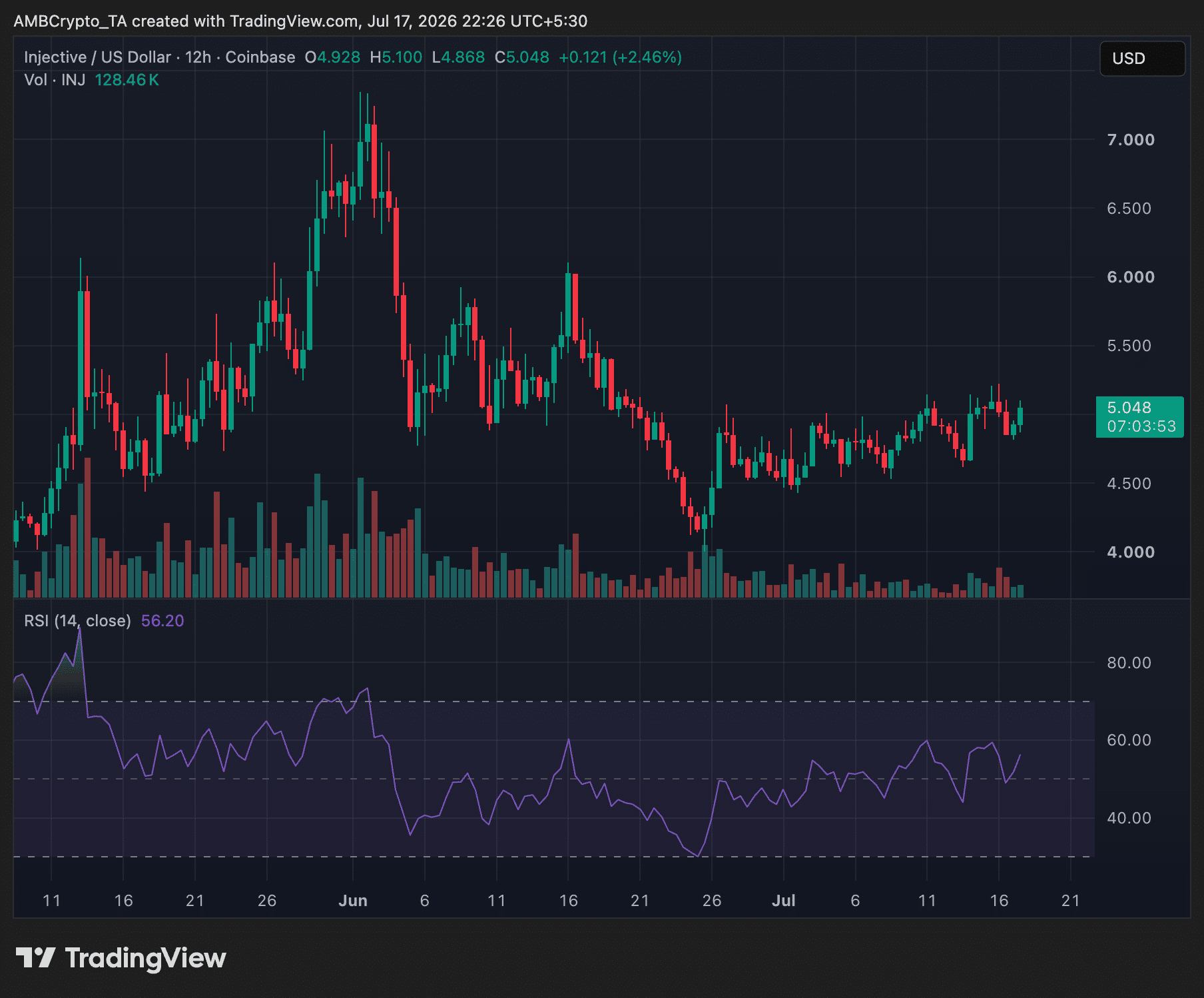
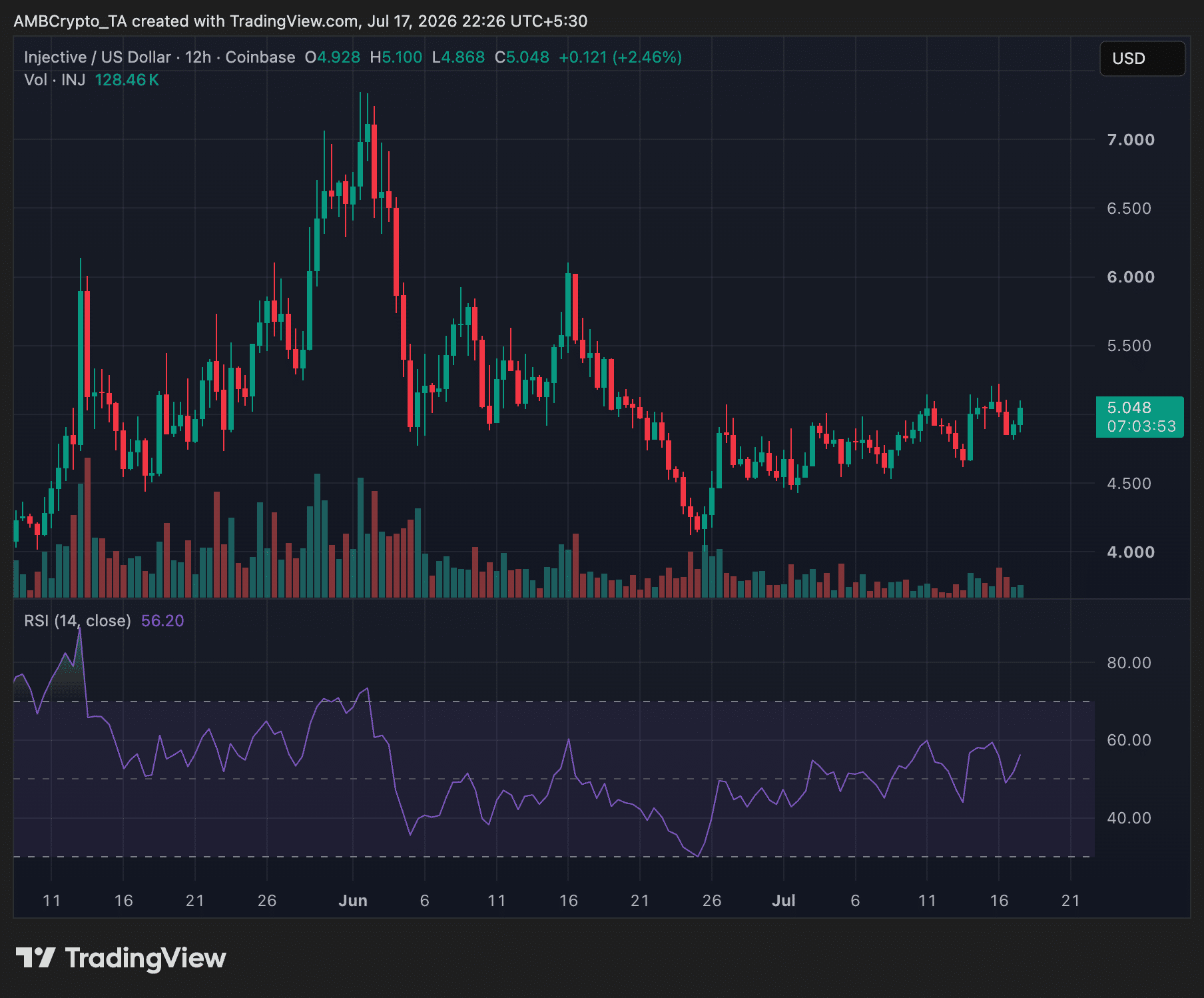
At press time, INJ was trading at approximately $5.05, with the latest 12-hour candle gaining around 2.5%.

The token has recovered considerably since falling towards $4.10 in late June. However, its price action throughout July has largely remained within a consolidation range between approximately $4.50 and $5.20.
Source: TradingView

The Relative Strength Index [RSI] stood at 56.20, above the neutral 50 level, suggesting that buying momentum had strengthened. However, the indicator remained well below overbought territory, leaving room for further upside if demand increases.

The immediate challenge is the $5.20 region, which has repeatedly limited INJ’s recovery attempts during July. A decisive move above this area could signal a breakout from the recent consolidation range and strengthen the case for an extended recovery.

Failure to overcome the resistance, however, could leave INJ range-bound and expose the token to another test of support around the lower end of its recent trading range.


Final Summary

  • Injective has filed for SEC transfer-agent registration to bring official ownership records for tokenized securities on-chain.
  • INJ has recovered above $5 with its RSI rising to 56.20. Still, the token must overcome resistance around $5.20 to confirm a breakout from its July consolidation range.


Trending Cryptos

Related Questions

QWhat is the significance of Injective filing its transfer agent registration with the SEC?

AIt is part of Injective's push to bring regulated real-world assets and securities infrastructure on-chain. A transfer agent maintains ownership records, and moving this function on-chain would allow faster recording/transfer of tokenized securities and reduce intermediaries.

QWhat is the key price level that INJ must overcome to signal a breakout according to the article?

AThe key resistance level is around $5.20. A decisive move above this area is needed to break out of its recent consolidation range and signal an extended recovery.

QBesides the SEC filing, what other regulatory effort did Injective announce recently?

AInjective published its MiCAR whitepaper, which is intended to support its expansion across European Union member states within the region's regulatory framework.

QWhat does the Relative Strength Index (RSI) reading of 56.20 for INJ suggest about its momentum?

AAn RSI of 56.20, above the neutral 50 level, suggests that buying momentum has strengthened. However, it is still well below overbought territory, indicating potential for further upside if demand increases.

QWhat is the current trading range for INJ mentioned in the article?

AThroughout July, INJ's price action has largely remained within a consolidation range between approximately $4.50 and $5.20.

Related Reads

USDT Supply Shrinks by $5.5 Billion While Stablecoin Turnover Hits Record High

The supply of stablecoins has contracted for the first time in years, with total market capitalization falling 4.3% from its May peak to $308.5 billion. Despite this decline, June saw a record $1.83 trillion in adjusted transaction volume for stablecoins, a 60% increase from May. This divergence suggests a shift in usage patterns: less capital is sitting idle, while the remaining supply circulates more rapidly through payment and trading systems. Specifically, the supply of Tether's USDT decreased from approximately $189.54 billion to $184 billion between May 1 and July 29, while Circle's USDC supply fell from $77.27 billion to $72.41 billion. Part of this capital appears to have moved into tokenized Treasury products, a sector whose value has grown to over $16 billion, partly driven by regulations like the 2025 GENIUS Act that prohibit interest payments on payment-focused stablecoins. Transaction velocity is emerging as a key metric, with stablecoins now turning over about six times per month—double the rate from two years ago. USDC, despite having a smaller supply than USDT, processed about $1.21 trillion in adjusted volume in June, leading in settlement activity. While a significant portion of on-chain volume may not represent genuine economic payments, identifiable real-world payments have grown sharply, reaching an estimated $390 billion in 2025. The data indicates stablecoins are evolving from static collateral into active financial infrastructure.

cryptonews.ru2m ago

USDT Supply Shrinks by $5.5 Billion While Stablecoin Turnover Hits Record High

cryptonews.ru2m ago

A7 to Provide Unique Expertise on Stablecoin Settlement to the Market

Beginning September 1, 2026, Russia's "On Digital Currencies and Digital Rights" law will establish rules for cryptocurrency circulation, significantly expanding tools for importers and exporters. Company A7, a user of the largest ruble-pegged stablecoin A7A5, has announced its readiness to share its unique expertise in digital asset operations with foreign trade participants. According to Oleg Ogienko, Director of Government Relations and International Ties for the A7A5 project, the company's specialists have developed significant expertise in legally formalizing such transactions, compliance, currency control, and interacting with infrastructure participants. Following the law's enactment, A7 will continue applying this expertise for client operations and plans to adapt its business processes as the Bank of Russia issues related regulatory acts. The Bank of Russia clarified that exporters and importers will be able to conduct cross-border settlements in digital currency either through intermediaries or directly, though domestic use of such assets will remain restricted. All requirements for operators and settlement participants will be detailed in the regulator's subordinate acts. A7 had previously highlighted the high degree of transaction freedom in foreign trade as a key advantage of Russia's developing crypto-asset regulation model, while noting limitations for individuals and a banking-centric system that could hinder market growth.

cryptonews.ru7m ago

A7 to Provide Unique Expertise on Stablecoin Settlement to the Market

cryptonews.ru7m ago

Trading

Spot

Hot Articles

Discussions

Welcome to the HTX Community. Here, you can stay informed about the latest platform developments and gain access to professional market insights. Users' opinions on the price of S (S) are presented below.

活动图片