AVAX’s short-term relief rally is a hidden sell signal – Here’s why

ambcryptoPublished on 2026-06-27Last updated on 2026-06-27

Abstract

Avalanche (AVAX) has seen a 5.95% price rally in the past 24 hours, standing out among major cryptocurrencies. However, analysis suggests this short-term relief may be a hidden sell signal. Key concerns include a nearly 8% drop in daily trading volume and only a modest 3.3% increase in Open Interest, indicating weak spot buying and speculative interest. Technically, AVAX broke a key support level from February, reaching a low of $5.68 in early June. The current bounce is approaching the 23.6% Fibonacci retracement level at $6.83, a local resistance zone. The overall structure on higher timeframes remains bearish. The article advises traders to wait, as the current bounce lacks conviction and presents a poor risk-to-reward ratio. Swing traders are recommended to watch for a larger potential bounce toward resistance levels at $8.11, $8.69, or $9.51 to consider selling. The $6.8-$7.0 area is identified as a local supply zone and a potential sell area, though sellers should be prepared to cut losses if the price moves higher than expected. The conclusion is that AVAX's short-term strength appears fragile and may not last.

Avalanche [AVAX] has rallied by 5.95% in the past 24 hours. It was one of the few tokens in the top 50 crypto assets by market capitalization that have made noticeable gains in recent trading sessions.

However, the altcoin’s daily trading volume was down by nearly 8%. This was a sign that Spot buying was not as strong as the bulls would want it to be. The fragile bounce was accompanied by only a 3.3% increase in Open Interest.

Speculative traders’ reluctance to chase the move was another indication of AVAX’s fragility. Here’s a deeper dive into the token’s long-term price trends.

AVAX bounces from oversold conditions made earlier in June
Source: AVAX/USDT on TradingView

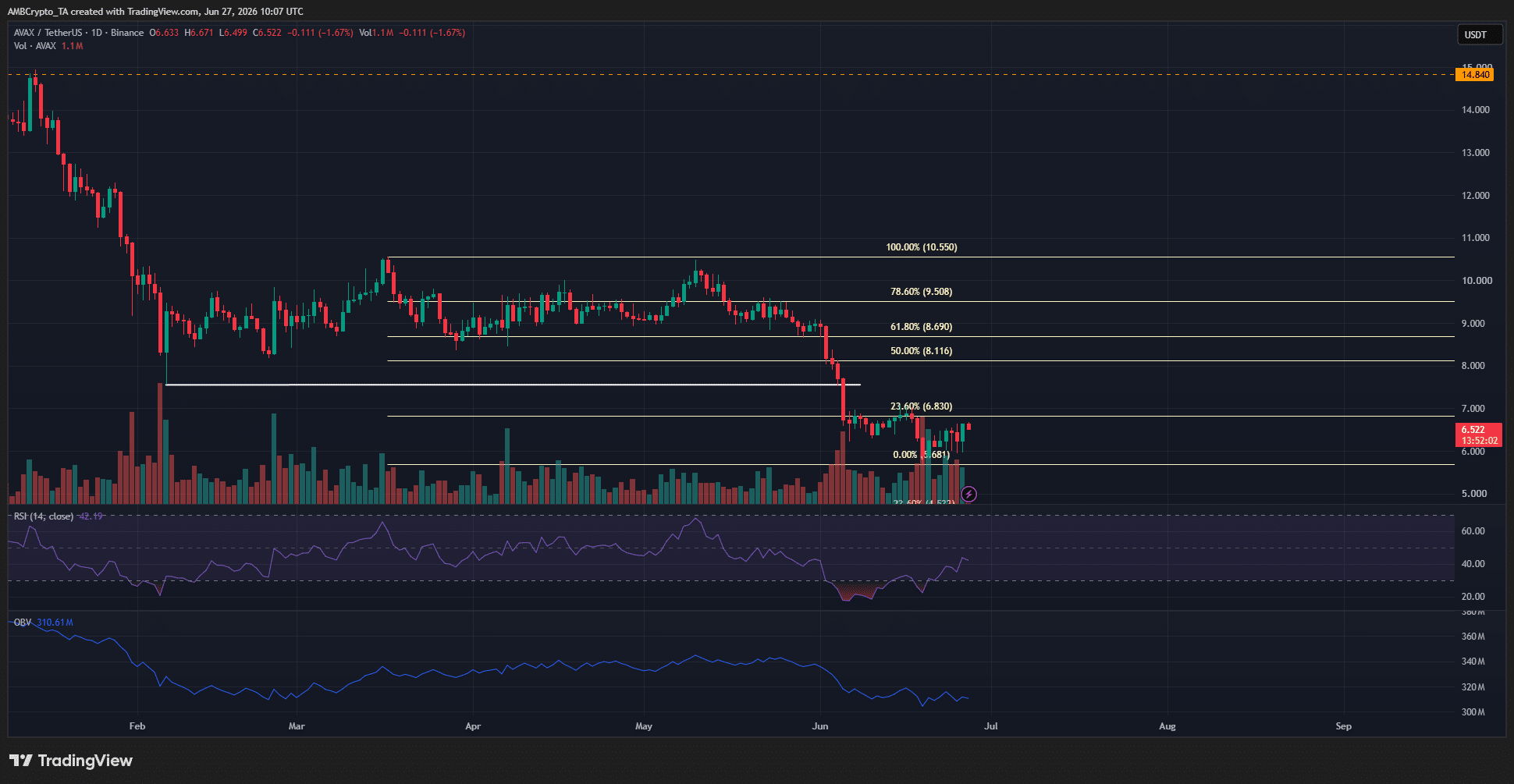
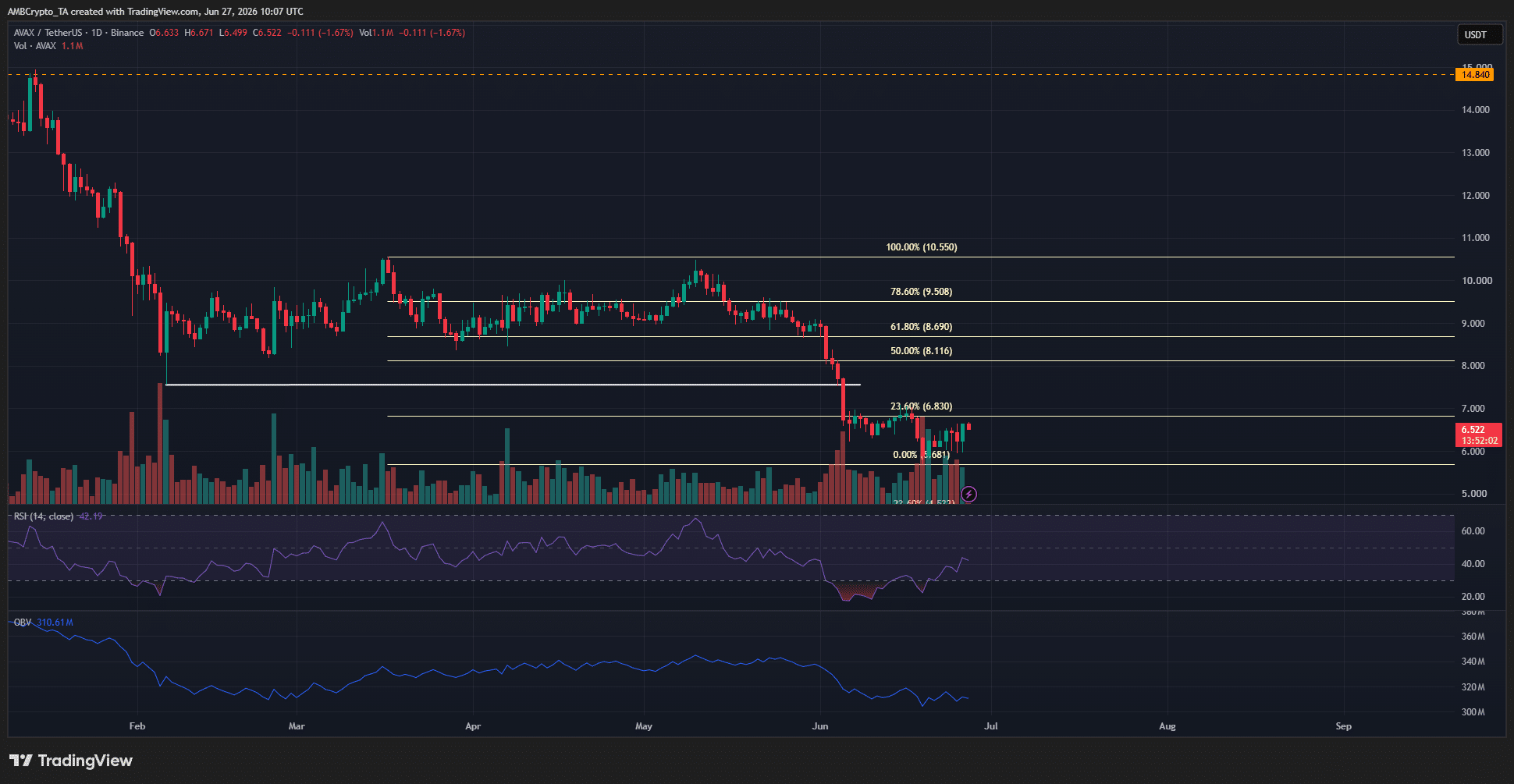
In February, AVAX set a swing low at $7.55, which it breached in the first week of June. This bearish structural break originated at the $10.55 high made in March, and the move reached a low of $5.68.

Hence, these two levels were used as the anchor points for a set of Fibonacci retracement levels. At the time of writing, AVAX was approaching $6.83, the 23.6% retracement level.

The $6.8 area has served as a local resistance zone over the past three weeks. Until it is surpassed, short-term bulls will want to stay away from entering long positions.

Swing traders will want to wait for a much bigger bounce to sell into. Key retracement levels at $8.11, $8.69, and $9.51 will be the targets to watch out for.

Traders’ call to action – Wait
Source: AVAX/USDT on TradingView

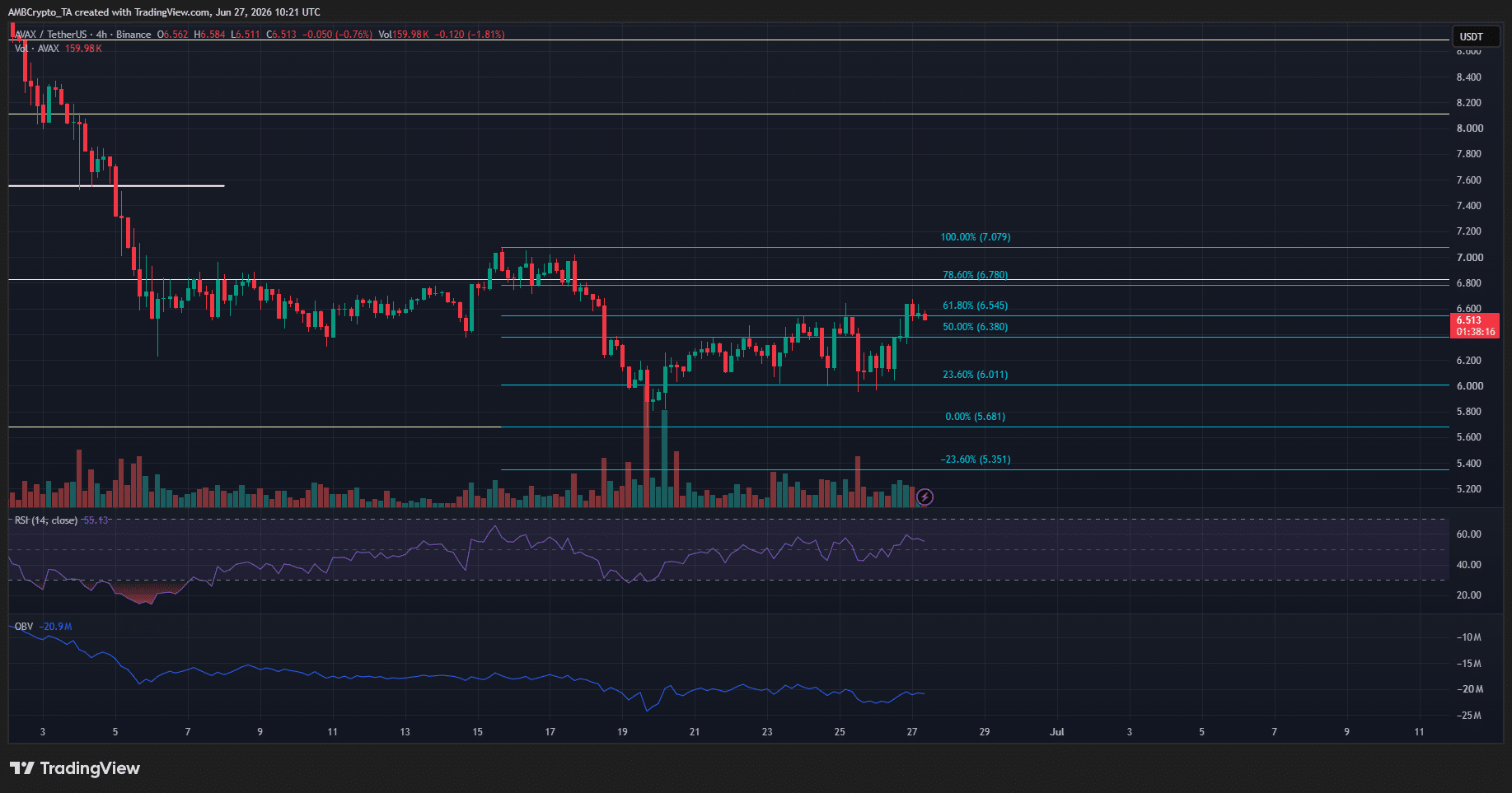
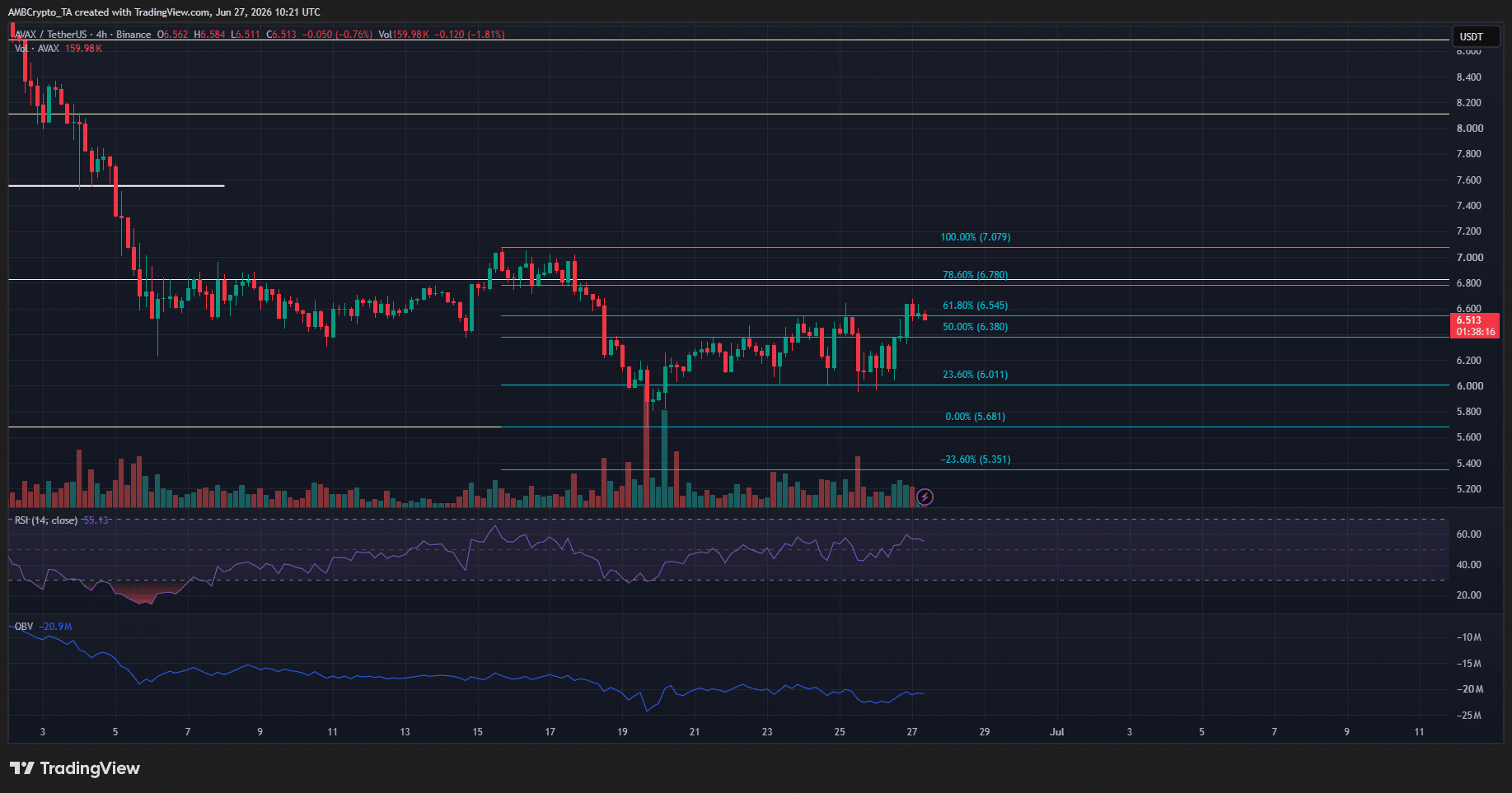
The 4-hour structure was firmly bearish, and AVAX’s bounce has strayed into the golden pocket between the 61.8% and 78.6% retracement levels plotted based on this timeframe’s swing move.

It was a clear sell signal. Additionally, the $6.8-$7.0 area has been a local supply zone. At the same time, traders should remember that Avalanche token prices could bounce toward $8 before the next higher timeframe bearish move.

Sellers at the $6.8 area should be ready to cut their losses in case the bounce goes higher than expected.


Final Summary

  • The relative bullish strength of Avalanche in the short term might not last much longer, given the weak volume and price structure.
  • Swing traders can wait for a bigger bounce before entering positions with conviction. Presently, the risk-to-reward was too little to take action.


Trending Cryptos

Related Questions

QWhat is the main argument presented in the title regarding AVAX's recent price movement?

AThe title argues that AVAX's short-term relief rally is a hidden sell signal, suggesting the bounce is not a strong bullish reversal but rather an opportunity to sell.

QWhat two market indicators are cited as signs of weakness behind AVAX's price rally?

AThe two indicators are a nearly 8% decrease in daily trading volume, suggesting weak spot buying, and only a 3.3% increase in Open Interest, indicating speculative traders' reluctance to chase the move.

QAccording to the Fibonacci analysis, what key retracement level is AVAX approaching, and what is its significance?

AAVAX is approaching the 23.6% Fibonacci retracement level at $6.83. This area has served as a local resistance zone for the past three weeks, and surpassing it is a key hurdle for short-term bulls.

QWhat specific price area on the 4-hour chart does the article identify as a clear sell signal?

AThe article identifies the golden pocket between the 61.8% and 78.6% Fibonacci retracement levels on the 4-hour chart as a clear sell signal, coinciding with the local supply zone of $6.8-$7.0.

QWhat is the overall recommended action for traders based on the article's conclusion?

AThe overall recommended action is to wait. The article advises swing traders to wait for a bigger bounce (towards key levels like $8.11) before selling with conviction, as the current risk-to-reward ratio is unfavorable.

Related Reads

Pacific 'Fever': How Extreme Weather Becomes Wall Street's ATM?

"Pacific 'Fever': How Extreme Weather Becomes Wall Street's Piggy Bank" The article examines how the 2026-2027 El Niño, potentially the strongest since 1950, is not only disrupting global weather but also creating major financial opportunities. It links recent extreme events in China and worldwide to this climate phenomenon, which alters atmospheric patterns, increasing risks of floods, droughts, and heatwaves. The core narrative explores how financial markets capitalize on these disruptions. A hedge fund is raising $500 million specifically to bet on El Niño-affected crops like South African corn and Malaysian palm oil. Historically, such strategies have yielded massive profits. Examples include Richard Dennis ("Turtle Trader") making his first fortune in the 1970s soy boom triggered by El Niño's impact on Peruvian anchovies (a key fishmeal source), and Anthony Ward's cocoa empire built on superior weather intelligence. The 2024 cocoa price surge, driven by West African drought, enriched quantitative trend-following funds. Currently, markets are preemptively bidding up palm oil, rubber, and sugar futures based on anticipated future supply shocks, despite high current inventories. The article details El Niño's asymmetric global impacts: causing drought in Southeast Asia (hurting palm oil/rubber) and India (affecting sugar/cotton), but bringing beneficial rains to South American soy and sugarcane. Key metrics to watch include the Niño3.4 index, Indian monsoon data, and Malaysian palm oil stocks. The true price effects often materialize *after* the El Niño peaks, suggesting 2027 may see the real volatility. The conclusion warns that beyond trading gains, the convergence of El Niño, energy shortages, and fertilizer scarcity poses a systemic risk, potentially raising the cost of living for everyone, turning a climate event into a global economic story.

链捕手8m ago

Pacific 'Fever': How Extreme Weather Becomes Wall Street's ATM?

链捕手8m ago

Just Now, OpenAI's Chief Futurist Departed, Once Called a Jackass by Musk

Just now, OpenAI's Chief Futurist, Joshua Achiam, announced his departure from the company via X. Having joined as a 25-year-old intern in 2017, he spent nine years at OpenAI, evolving from an AI safety research scientist to leading the Mission Alignment team. Earlier this year, that team was dissolved, and Achiam transitioned to the newly created role of Chief Futurist, positioned at the intersection of AI safety and policy to study AGI's long-term risks and opportunities. In his departure statement, Achiam called his time a "graduation," reflecting on the immense progress from AI that couldn't converse to systems solving scientific problems. He expressed optimism about a future of peace, prosperity, and possibility, closing with "To safe AGI." His tenure was notably marked by a 2018 incident where he publicly challenged Elon Musk—then still with OpenAI—on safety compromises if Musk pursued AGI at Tesla, leading Musk to call him a "jackass." This became an internal legend, with colleagues later giving him a trophy inscribed, "To safety, never stop being that jackass." Achiam's exit follows a pattern of prominent safety and alignment experts leaving OpenAI, including Jan Leike and others who joined rivals like Anthropic or started non-profits. His departure coincides with OpenAI's internal efforts to more tightly integrate its research and policy teams, and the recent hiring of former White House AI advisor Dean Ball. Achiam did not cite a specific reason for leaving but indicated it was a long-considered decision, stating the mission to ensure AGI benefits humanity can now be advanced beyond the "frontier lab's" walls.

marsbit10m ago

Just Now, OpenAI's Chief Futurist Departed, Once Called a Jackass by Musk

marsbit10m ago

Anthropic Drops $19 Billion to 'Sponsor' a Bitcoin Miner

On July 6, 2026, Bitcoin mining company TeraWulf (NASDAQ: WULF) saw its stock surge 15% pre-market following the announcement of a landmark 20-year agreement with AI giant Anthropic. The deal grants Anthropic 401 MW of IT load capacity at TeraWulf's "Justified Data" campus in Kentucky and is projected to generate approximately $19 billion in contracted revenue for the miner over its duration. On the same day, TeraWulf also sold its 50.1% stake in a Texas joint venture for about $530 million. This dual move signals a strategic pivot: divesting non-core assets to fund its fully-owned Kentucky project and shifting focus from cryptocurrency mining to becoming a specialized infrastructure provider for AI. The agreement highlights a key advantage for Bitcoin miners transitioning to AI: their pre-existing access to land and critical power grid capacity, which is becoming a major bottleneck for data center expansion. Unlike peers who operate AI clouds, TeraWulf is adopting a "landlord" model, leasing only the physical space and power for clients' own servers. However, a significant gap exists between the deal's announcement and revenue generation, with the first phase of the Kentucky site not operational until late 2027. The $19 billion figure represents a long-term bet on both TeraWulf's execution and Anthropic's financial durability in the capital-intensive AI race. The market's positive reaction reflects the growing value of fundamental infrastructure—secured land and reliable electricity—in the era of AI compute scarcity.

marsbit14m ago

Anthropic Drops $19 Billion to 'Sponsor' a Bitcoin Miner

marsbit14m ago

Securitize Drops 40% in First Week of Trading as Tokenization Industry Enters Patent Wars

The article discusses the recent stock performance of Securitize (NYSE: SECZ) and a looming patent war in the tokenization industry. Securitize, a leading tokenization platform and transfer agent for BlackRock's BUIDL fund, debuted on the NYSE via a SPAC merger on July 2. After an initial rise, its stock plummeted nearly 40% within a week, closing at $8.06 on July 7. Analysts attribute the sharp decline largely to typical post-SPAC investor turnover and broader pressure on crypto-related stocks, rather than fundamental business deterioration. Concurrently, Securitize faces significant legal challenges. On June 15, infrastructure rival tZERO accused Securitize of patent infringement concerning its core DS Protocol and Vault Registrar products. Securitize preemptively filed a lawsuit on June 22 seeking a declaratory judgment of non-infringement. tZERO, holding 105 patents, has indicated it has identified at least six other market participants for potential infringement actions, signaling a broader industry-wide patent conflict. A separate lawsuit was also filed by Liquid Rarity Exchange. The article concludes that while Securitize's stock drop may be a temporary SPAC-related correction, the patent disputes initiated by tZERO represent a more profound, long-term risk for the entire tokenization sector, potentially shifting competitive dynamics from business execution to intellectual property litigation.

Foresight News43m ago

Securitize Drops 40% in First Week of Trading as Tokenization Industry Enters Patent Wars

Foresight News43m ago

Trading

Spot

Hot Articles

Discussions

Welcome to the HTX Community. Here, you can stay informed about the latest platform developments and gain access to professional market insights. Users' opinions on the price of S (S) are presented below.

活动图片